


Credit card minimum payments are designed to ensure that individuals pay down their debt over time, and scheduling minimum automatic repayments helps people avoid forgetting to repay. Yet minimum payments have additional, unintended psychological default effects by drawing attention away from the card balance due. First, once individuals set the minimum automatic repayment as the default, they then neglect to make the occasional larger repayments they made previously. As a result, individuals incur considerably more credit card interest than late payment fees avoided. Using detailed transaction data, the authors show that approximately 8% of all of the interest ever paid is due to this effect. Second, manual credit card payments are lower when individuals are prompted with minimum payment information. In an experiment, the authors test two new interventions to mitigate this effect—a prompt for full repayment and a prompt asking those repaying little to pay more—yielding large counter effects. Thus, shrouding the minimum payment option for automatic and manual payments and directing attention to the full balance may remedy the unintended effects of default minimum payments.
Minimum Required Payment and Supplemental Information Disclosure Effects on Consumer Debt Repayment Decisions
Repayment decisions—how much of the loan to repay and when to make the payments—directly influence consumer debt levels. The authors examine how minimum required payment policy and loan information disclosed to consumers influence repayment decisions. They find that while presenting minimum required payment information has a negative impact on repayment decisions, increasing the minimum required level has a positive effect on repayment for most consumers. Experimental evidence from U.S. consumers shows that consumers’ propensity to pay the minimum required each month moderates these effects; U.K. credit card field data indicate that borrowers’ credit limit and balance due also moderate these effects. However, increasing the minimum level is unlikely to completely eliminate the negative effect of presenting minimum payment information. In addition, disclosing supplemental information, such as future interest cost and time needed to repay the loan, does not reduce the negative effects of including minimum payment information and has no substantial positive effect on repayments. This research offers new insights into the debt repayment process and has implications for consumers, lenders, and public policy.
Do Nudges Reduce Borrowing and Consumer Confusion in the Credit Card Market?
We study nudges that turn out to have precise null effects in reducing long‐run credit card debt. We test nudges across two field experiments covering 183,441 UK cardholders. Our first experiment studies nudges added to monthly credit card statements. Our second experiment studies letters and email nudges (separate from monthly statements) sent to cardholders who signed up to automatically pay the minimum required payment. In a follow‐up survey to our second experiment, we find that 96% of respondents underestimate the time it would take to fully repay a debt if the cardholder made only the minimum required payment. The nudges reduce this confusion, but underestimation remains overwhelmingly common.

How Do Consumers Avoid Penalty Fees? Evidence from Credit Cards
Using data from multiple card issuers, we show that the most common penalty fee type incurred by credit card holders, late payment fees, declines sharply over the first few months of card life. This phenomenon is wholly due to some consumers adopting automatic payments after a late payment event, thereby insuring themselves against future late payment fees. Nonadopters, who remain on manual-only payments, experience an unchanged high likelihood of future fees, despite exhibiting ample levels of available liquidity. Our results show that heterogeneity in adopting account management features of financial products, such as automatic payments, is important for understanding who avoids financial mistakes. This paper was accepted by Gustavo Manso, finance.

Timing to the Statement: Understanding Fluctuations in Consumer Credit Use
We show that consumers spend 15% more per day in the first week following the receipt of a credit card statement than in the days just prior to the statement. This increase in spending includes both an increase in the likelihood that they use the credit card in the first weeks following their statement and an increase in transaction amount on days they use the credit card. In contrast to the effect on credit card spending, debit card spending is unaffected by credit card statement issuance, suggesting that consumers are not simply switching among modes of payment. Our estimates are based on exogenous variation from bank-assigned statement dates. We propose and test several alternative explanations to this spending puzzle: optimization of the free float, salience effect of the credit card statement, mental accounting, liquidity constraints, and automatic payments. We find that the consumers most apt to spend early in the credit card cycle tend to be those who do not revolve balances and are not close to their credit limit. Thus, this paper documents a puzzle with mixed support for several alternative explanations. This paper was accepted by David Simchi-Levi, finance.
Payment Rewards and Credit Card Debt: Experimental Evidence
We report on a controlled laboratory experiment in which participants make consumption, saving, and credit card repayment decisions when credit card purchases e

“Repayment-by-Purchase” Increases Consumer Debt Repayment
This article tests the effect of a novel credit card payment format—repayment-by-purchase—on consumers’ payments toward credit card debt. In contrast to typical balance repayment, where consumers make repayments relative to a total amount owed, repayment-by-purchase prompts consumers to select items (e.g., a Starbucks coffee) or categories of purchase (e.g., restaurant and café purchases) and to make payments toward their related debt. A field experiment first suggests that customers who opted into repayment-by-purchase paid 12.18% more toward their statement balance than a control group. Subsequently, five lab experiments show that consumers repaying-by-purchase increase repayment by an average of 22.47% over typical balance repayment. Process evidence suggests that these differences may be driven by repayment-by-purchase's power to increase purchase salience, which in turns increases perceptions of progress toward reducing debt. Consistent with this theory, the effect of repayment-by-purchase on bill repayment emerges regardless of whether consumers repay durable versus nondurable goods, and for specific items or categories of purchases, as long as the bill uses labels that are concrete enough to raise past purchase salience.
The Hedonics of Debt
Psychologists and economists often discuss the “pain” of paying for our purchases. Four experiments examine how people evaluate prospective debt payments, analyzing how different features of a loan (down payment, final payment, duration, monthly payments) affect willingness to accept the loan. Akin to previous findings on physical pain, participants exhibited duration neglect and over-weighted final moments. However, participants also focused heavily on the monthly or average payment (unlike in retrospective studies of physical pain where only peak-end moments seem to count). In Experiment 2, participants’ willingness to accept the loan was not significantly diminished by making it more expensive through keeping the same monthly payment but extending the length of the loan by 40 percent (evincing duration neglect). Further, in Experiments 3 and 4, we show that participants increased their willingness to buy if loans were made longer and more expensive by adding smaller, less “painful” payments to the end.

Minimum Payments Alter Debt Repayment Strategies Across Multiple Cards
U.S. households currently hold $770 billion in credit card debt, often managing repayments across multiple accounts. The authors investigate how minimum payment requirements (i.e., the requirement to allocate at least some money to each account with a balance) alter consumers’ allocation strategies across multiple accounts. Across four experiments, they find that minimum payment requirements cause consumers to increase dispersion (i.e., spread their repayments more evenly) across accounts. The authors term this change in strategy “the dispersion effect of minimum payments” and provide evidence that it can be costly for consumers. They find that the effect is partially driven by the tendency for consumers to interpret minimum payment requirements as recommendations to pay more than the minimum amount. While the presence of the minimum payment requirement is unlikely to change, the authors propose that marketers and policy makers can influence the effects of minimum payments on dispersion by altering the way that information is displayed to consumers. Specifically, they investigate five distinct information displays and find that choice of display can either exaggerate or minimize dispersion and corresponding costs. They discuss implications for consumers, policy makers, and firms, with a particular focus on ways to improve consumer financial well-being.
When Motivation is against Debtors' Best Interest: The Illusion of Goal Progress in Credit Card Debt Repayment
The authors explore the illusion of goal progress by consumers who own multiple credit cards and pay off their debt balances to facilitate the achievement of their subgoal rather than the superordinate goal of being debt-free. The first experiment shows that debtors use their savings toward the credit card debt they can pay off entirely or substantially, even if it is associated with the smallest balance and the lowest annual percentage rate rather than toward the debt with the highest annual percentage rate. The second experiment reveals that when the income available to pay down the debt is in the form of effortless money (i.e., windfall or reward money) as opposed to hard-earned savings, the tendency to allocate money toward the smallest credit card debt is exacerbated. However, people tend to pay their debt more rationally when the number of debt accounts increases. Finally, the third experiment shows that credit card debt repayment decisions depend on the nature of the debt (hedonic vs. utilitarian) and the timing of consumption benefits (past vs. future). The article concludes with a discussion of managerial and public policy implications.
The Hidden Role of Contract Terms: The Case of Credit Card Minimum Payments in Mexico
This paper argues that thresholds in financial contracts act as implicit nudges in consumers’ decisions. Exploiting a regulatory change to credit card minimum payments in Mexico, we find that a 1-percentage point change in minimum payments leads to a 0.87-percentage point change in actual payments, both expressed as a percentage of total balances. We decompose the effect of minimum payments into a constraining effect and a reference effect. The former captures the effect of minimum payments as a binding constraint and accounts for 59% of its total effect. The latter captures any remaining impact of changes in minimum payments beyond their constraining effect and represents 41% of the total. In turn, 67% of the reference effect is explained by the multiple heuristic: the tendency of consumers to pay whole-number multiples of the minimum payment. This paper was accepted by Kay Giesecke, finance.
Managing Mental Accounts: Payment Cards and Consumption Expenditures
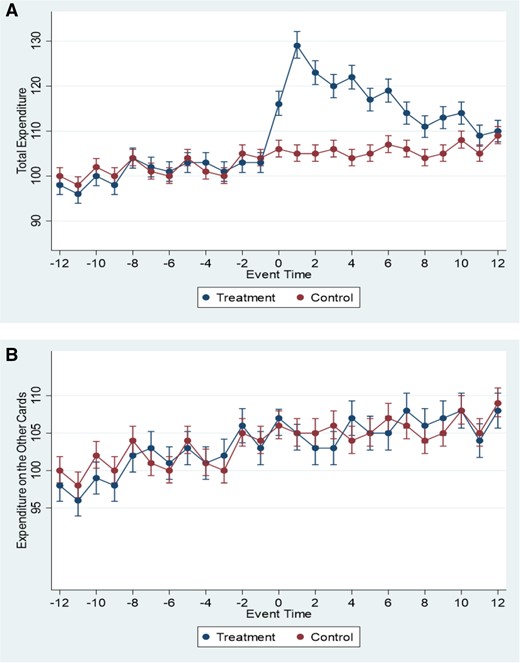
Does mental accounting matter for total consumption expenditures? We exploit a unique setting in which individuals exogenously received a new credit card, without requesting one. Using random variation in the time of receipt we show that individuals temporarily increase total consumption expenditure by making purchases with the new card without reducing spending on the others. We do not observe a corresponding increase in indebtedness. Total consumption expenditure rises even for the least liquidity-constrained individuals. The evidence is consistent with consumers treating methods of payment as nonfungible budget categories, as suggested by models of mental accounting and narrow bracketing.

Consumer Misunderstanding of Credit Card Use, Payments, and Debt: Causes and Solutions
The authors identify several judgmental biases related to paying off credit card debt. Participants with stronger numerical skills made fewer errors, as did those who used the new statement format mandated by Congress in the CARD Act of 2009. Study 1 shows that people underestimate how long it takes to eliminate a debt when payments barely cover interest owed. Study 2 shows that less numerate people tend to underestimate the monthly payment required to pay off a debt in three years, whereas more numerate people tend to overestimate the payment. The newly revised statement required by the CARD Act substantially reduced these biases. However, even with the new statement, many people still underestimate required payments when still using the credit card. Study 3 identifies ambiguities in the revised statement that can lead to misjudgments about how much to pay on monthly bills. The authors recommend additional public policy actions to help cardholders understand the relationship between payments and debt elimination.
Managing Mental Accounts: Payment Cards and Consumption Expenditures
Abstract Does mental accounting matter for total consumption expenditures? We exploit a unique setting in which individuals exogenously receive a new payment card, without requesting one. Using random variation in the time of receipt, we show that individuals temporarily increase total consumption expenditure by making purchases with the new card without reducing spending on the others. We do not observe a corresponding increase in indebtedness. Total consumption expenditure rises even for the least liquidity-constrained individuals. The evidence is consistent with consumers treating methods of payment as nonfungible budget categories, as suggested by models of mental accounting and narrow bracketing.
On shifting consumers from high‐interest to low‐interest debt
Abstract In the United States, many consumers are increasingly accumulating debt, much of which is harmful and expensive. Prior research has devoted a great deal of attention to understanding why consumers generally get into debt and the strategies they can use to repay existing debts. While this work has furthered the agenda of helping consumers reduce or eliminate their overall debt balances, it has failed to emphasize the fact that for many consumers, debt may be unavoidable. This article aims to promote research that addresses not only overall debt reduction but also the need for consumers to shift from more to less costly types of debt. By shedding light on the psychological reasons why consumers may naturally gravitate toward more costly forms of debt when less costly ones may be available, we offer a novel perspective on why consumers get into and stay in debt longer than they should. This new angle has the potential to spur on further research into the ways consumers can use debt more effectively and less expensively in service of the overarching goal of debt reduction.

Credit Cards as Spending Facilitating Stimuli: A Conditioning Interpretation
Abstract. Four experiments and one study were conducted to test the hypothesis that stimuli associated with spending can elicit spending responses. In all
Purchase Justifiability Drives Payment Choice: Consumers Pay with Card to Remember and Cash to Forget
AbstractAlthough consumers often have multiple payment methods at their fingertips, such as cash and credit/debit cards, prior research is silent on how consumers choose between them. We home in on a key element of purchase—purchase justifiability—that affects how consumers choose to pay. Analysis of 118,042 real-world purchases and six experiments reveals that when consumers are motivated to forget (vs. remember) a purchase because they see it as difficult (vs. easy) to justify, they have an increased preference to pay with cash (vs. card) because cards create a “paper/electronic trail” that aids memory retrieval. These payment preferences are strongest among consumers most likely to recall/track their card spending, and manifest only when card expenses are trackable. We reconcile our results with the classic effect of payment method on pain of paying and discuss implications for merchants and for financial institutions designing payment methods of the future.
