


This article tests the effect of a novel credit card payment format—repayment-by-purchase—on consumers’ payments toward credit card debt. In contrast to typical balance repayment, where consumers make repayments relative to a total amount owed, repayment-by-purchase prompts consumers to select items (e.g., a Starbucks coffee) or categories of purchase (e.g., restaurant and café purchases) and to make payments toward their related debt. A field experiment first suggests that customers who opted into repayment-by-purchase paid 12.18% more toward their statement balance than a control group. Subsequently, five lab experiments show that consumers repaying-by-purchase increase repayment by an average of 22.47% over typical balance repayment. Process evidence suggests that these differences may be driven by repayment-by-purchase's power to increase purchase salience, which in turns increases perceptions of progress toward reducing debt. Consistent with this theory, the effect of repayment-by-purchase on bill repayment emerges regardless of whether consumers repay durable versus nondurable goods, and for specific items or categories of purchases, as long as the bill uses labels that are concrete enough to raise past purchase salience.
Payment Rewards and Credit Card Debt: Experimental Evidence
We report on a controlled laboratory experiment in which participants make consumption, saving, and credit card repayment decisions when credit card purchases e

Do Payment Mechanisms Change the Way Consumers Perceive Products?
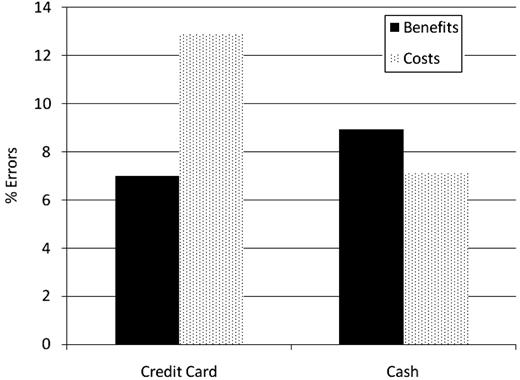
Abstract. Do payment mechanisms change the way consumers perceive products? We argue that consumers for whom credit cards (cash) have been primed focus mor
Differences in Consumer Purchase Behavior by Credit Card Payment System
Abstract. A conceptualization of the relationships between alternative payment systems and various environmental and behavioral variables, which may serve
Context-Dependent Drivers of Discretionary Debt Decisions: Explaining Willingness to Borrow for Experiential Purchases
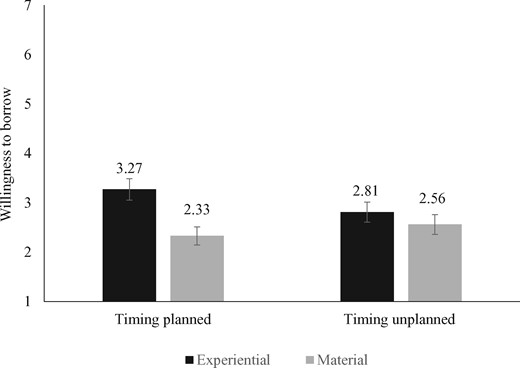
Abstract Mental accounting research suggests that consumers prefer borrowing for longer-lasting purchases in order to receive benefits from the purchases as they pay for them. In contrast, two sets of archival data and five lab studies show that consumers are more willing to borrow for experiential versus material purchases, even though experiential purchases tend to have a shorter physical duration. Further, framing the same purchase as more experiential than material increases willingness to borrow. This effect occurs because purchase timing is more important for experiential purchases—a function of consumers’ aversion to missing out on planned consumption. Thus, we moderate the proposed effect by varying whether the borrowing decision impacts planned consumption. Other differences between material and experiential purchases, such as scarcity or expected happiness, cannot similarly explain our results. Moreover, our conceptualization allows us to reconcile the apparent contradiction between the previous and current research by examining the relative impact of purchase-timing importance and payment-benefit duration matching in different contexts (i.e., “purchasing” and “source-of-funding” decisions).
The Red, the Black, and the Plastic: Paying Down Credit Card Debt for Hotels, Not Sofas
Using transaction data from a sample of 1.8 million credit card accounts, we provide the first field test of a major prediction of Prelec and Loewenstein’s theory of mental accounting: that consumers will pay off expenditure on transient forms of consumption more quickly than expenditure on durables. According to the theory, this is because the pain of paying can be offset by the future anticipated pleasure of consumption only when money is spent on consumption that endures over time. Consistent with this prediction, we found that repayment of debt incurred for nondurable goods is an absolute 10% more likely than repayment of debt incurred for durable goods. The strength of this relationship is comparable to an increment in 15 percentage points in the credit card annualized percentage rate. Our results have not only managerial implications for the structuring of financial transactions (e.g., that credit card customers should be given the option of paying off specific purchases) but also more general implications for exploiting variations in the pain of paying in incentive schemes aimed at customers and employees. This paper was accepted by Yan Chen, behavioral economics.

Minimum Required Payment and Supplemental Information Disclosure Effects on Consumer Debt Repayment Decisions
Repayment decisions—how much of the loan to repay and when to make the payments—directly influence consumer debt levels. The authors examine how minimum required payment policy and loan information disclosed to consumers influence repayment decisions. They find that while presenting minimum required payment information has a negative impact on repayment decisions, increasing the minimum required level has a positive effect on repayment for most consumers. Experimental evidence from U.S. consumers shows that consumers’ propensity to pay the minimum required each month moderates these effects; U.K. credit card field data indicate that borrowers’ credit limit and balance due also moderate these effects. However, increasing the minimum level is unlikely to completely eliminate the negative effect of presenting minimum payment information. In addition, disclosing supplemental information, such as future interest cost and time needed to repay the loan, does not reduce the negative effects of including minimum payment information and has no substantial positive effect on repayments. This research offers new insights into the debt repayment process and has implications for consumers, lenders, and public policy.
The Hedonics of Debt
Psychologists and economists often discuss the “pain” of paying for our purchases. Four experiments examine how people evaluate prospective debt payments, analyzing how different features of a loan (down payment, final payment, duration, monthly payments) affect willingness to accept the loan. Akin to previous findings on physical pain, participants exhibited duration neglect and over-weighted final moments. However, participants also focused heavily on the monthly or average payment (unlike in retrospective studies of physical pain where only peak-end moments seem to count). In Experiment 2, participants’ willingness to accept the loan was not significantly diminished by making it more expensive through keeping the same monthly payment but extending the length of the loan by 40 percent (evincing duration neglect). Further, in Experiments 3 and 4, we show that participants increased their willingness to buy if loans were made longer and more expensive by adding smaller, less “painful” payments to the end.

When Motivation is against Debtors' Best Interest: The Illusion of Goal Progress in Credit Card Debt Repayment
The authors explore the illusion of goal progress by consumers who own multiple credit cards and pay off their debt balances to facilitate the achievement of their subgoal rather than the superordinate goal of being debt-free. The first experiment shows that debtors use their savings toward the credit card debt they can pay off entirely or substantially, even if it is associated with the smallest balance and the lowest annual percentage rate rather than toward the debt with the highest annual percentage rate. The second experiment reveals that when the income available to pay down the debt is in the form of effortless money (i.e., windfall or reward money) as opposed to hard-earned savings, the tendency to allocate money toward the smallest credit card debt is exacerbated. However, people tend to pay their debt more rationally when the number of debt accounts increases. Finally, the third experiment shows that credit card debt repayment decisions depend on the nature of the debt (hedonic vs. utilitarian) and the timing of consumption benefits (past vs. future). The article concludes with a discussion of managerial and public policy implications.
On shifting consumers from high‐interest to low‐interest debt
Abstract In the United States, many consumers are increasingly accumulating debt, much of which is harmful and expensive. Prior research has devoted a great deal of attention to understanding why consumers generally get into debt and the strategies they can use to repay existing debts. While this work has furthered the agenda of helping consumers reduce or eliminate their overall debt balances, it has failed to emphasize the fact that for many consumers, debt may be unavoidable. This article aims to promote research that addresses not only overall debt reduction but also the need for consumers to shift from more to less costly types of debt. By shedding light on the psychological reasons why consumers may naturally gravitate toward more costly forms of debt when less costly ones may be available, we offer a novel perspective on why consumers get into and stay in debt longer than they should. This new angle has the potential to spur on further research into the ways consumers can use debt more effectively and less expensively in service of the overarching goal of debt reduction.

Credit Cards as Spending Facilitating Stimuli: A Conditioning Interpretation
Abstract. Four experiments and one study were conducted to test the hypothesis that stimuli associated with spending can elicit spending responses. In all
Purchase Justifiability Drives Payment Choice: Consumers Pay with Card to Remember and Cash to Forget
AbstractAlthough consumers often have multiple payment methods at their fingertips, such as cash and credit/debit cards, prior research is silent on how consumers choose between them. We home in on a key element of purchase—purchase justifiability—that affects how consumers choose to pay. Analysis of 118,042 real-world purchases and six experiments reveals that when consumers are motivated to forget (vs. remember) a purchase because they see it as difficult (vs. easy) to justify, they have an increased preference to pay with cash (vs. card) because cards create a “paper/electronic trail” that aids memory retrieval. These payment preferences are strongest among consumers most likely to recall/track their card spending, and manifest only when card expenses are trackable. We reconcile our results with the classic effect of payment method on pain of paying and discuss implications for merchants and for financial institutions designing payment methods of the future.

Minimum Payments Alter Debt Repayment Strategies Across Multiple Cards
U.S. households currently hold $770 billion in credit card debt, often managing repayments across multiple accounts. The authors investigate how minimum payment requirements (i.e., the requirement to allocate at least some money to each account with a balance) alter consumers’ allocation strategies across multiple accounts. Across four experiments, they find that minimum payment requirements cause consumers to increase dispersion (i.e., spread their repayments more evenly) across accounts. The authors term this change in strategy “the dispersion effect of minimum payments” and provide evidence that it can be costly for consumers. They find that the effect is partially driven by the tendency for consumers to interpret minimum payment requirements as recommendations to pay more than the minimum amount. While the presence of the minimum payment requirement is unlikely to change, the authors propose that marketers and policy makers can influence the effects of minimum payments on dispersion by altering the way that information is displayed to consumers. Specifically, they investigate five distinct information displays and find that choice of display can either exaggerate or minimize dispersion and corresponding costs. They discuss implications for consumers, policy makers, and firms, with a particular focus on ways to improve consumer financial well-being.
Default Effects of Credit Card Minimum Payments
Credit card minimum payments are designed to ensure that individuals pay down their debt over time, and scheduling minimum automatic repayments helps people avoid forgetting to repay. Yet minimum payments have additional, unintended psychological default effects by drawing attention away from the card balance due. First, once individuals set the minimum automatic repayment as the default, they then neglect to make the occasional larger repayments they made previously. As a result, individuals incur considerably more credit card interest than late payment fees avoided. Using detailed transaction data, the authors show that approximately 8% of all of the interest ever paid is due to this effect. Second, manual credit card payments are lower when individuals are prompted with minimum payment information. In an experiment, the authors test two new interventions to mitigate this effect—a prompt for full repayment and a prompt asking those repaying little to pay more—yielding large counter effects. Thus, shrouding the minimum payment option for automatic and manual payments and directing attention to the full balance may remedy the unintended effects of default minimum payments.
A Mega-Replication of the Effect of Cash Versus Card Payment on Pain of Paying: Magnitude, Behavioral Outcomes, and Moderators
Abstract We revisit the widely accepted finding that paying with cash is more painful than paying with card by conducting the first systematic mega-replication (including 13 large-scale preregistered replications; a total of 32,371 participants, 65 products, and 57 price points ranging from $1.09 to $400). The aggregate evidence reveals four insights: (1) leveraging a broad set of established paradigms, we replicate the finding that paying with cash is more psychologically painful than paying with card, even among today’s consumers who own multiple cards, digital wallets, and virtual currencies; (2) comparing two outcome variables—amount spent and willingness-to-pay (WTP), we find a more reliable and larger overall direct effect of payment method on amount spent than on WTP; (3) these direct effects of payment method on outcome variables are mediated by pain of paying; (4) the mode-of-payment effect on pain of paying (and thereby on outcome variables) is moderated by individual differences, particularly the relative frequency of using cash versus card. We outline actionable guidance and future directions for researchers and practitioners interested in examining mode-of-payment effects, and discuss the value of and suitable approaches for future theory-driven large-scale replications.

Leave Home without it? The Effects of Credit Card Debt and Available Credit on Spending
This research examines how credit card debt affects consumer spending. In five experimental and field studies, the authors demonstrate that outstanding credit card debt increases spending for consumers with high self-control. They also show that this effect can be eliminated by increasing the available credit on the credit card. Thus, when the available credit is low, consumers with greater self-control increase spending, but when the available credit is high, they reduce spending. The results extend the literature on goal violation and self-control and offer insights into consumer decision making and consumption patterns under conditions of debt.
Payment method and perceptions of ownership
How consumers pay influences how they feel about a transaction. In particular, paying by card has been argued to have an effect on the perception of cost, making it less salient and painful. We propose and show that payment method also influences how consumers feel about the acquired good. Specifically, we focus on effects of the payment method on psychological ownership, i.e., the perception of an object as “mine.” We propose that cash payment results in stronger psychological ownership because it influences the extent of perceived investment in an object. We provide evidence for the proposed effect from field and laboratory settings. Results of a longitudinal exit survey and an experiment show that cash payers report higher levels of immediate psychological ownership than card payers. However, this effect seems to depend on the meanings associated with a payment method. Asian students (who associate credit card payment with investment and debt) do not exhibit this effect. Moreover, the initial boost in psychological ownership seems to be comparably short-lived. While those paying in cash experience no further increase in psychological ownership over time, those paying by card do.
