


Modern marketing increasingly requires managers to deploy new content at scale, often with limited opportunity for prior testing. As a result, decisions about what to launch become strategic managerial choices under uncertainty rather than purely creative exercises. While generative AI makes the creation of new content fast and highly scalable, it simultaneously expands the set of options managers must evaluate, making reliable content selection increasingly difficult. We develop a framework for causal prediction that enables managers to evaluate and deploy novel marketing content generated by AI. The framework uses pretrained large language models to represent previously deployed content and learn how its features causally relate to outcomes. Using a rejection-sampling procedure, the framework screens new content proposed by generative AI to avoid extrapolation beyond what historical data can reliably support. In a large-scale email marketing application (3.3 million observations across 34 campaigns), the framework improves out-of-sample prediction and real-world deployment performance relative to standard approaches, enabling outcome-guided generation of higher-performing AI-generated content. The framework establishes a threshold based on how closely new content resembles past campaigns, separating cases where causal prediction is reliable from cases where direct experimentation is warranted. The framework has important implications for marketing decision making in a rapidly evolving environment where generative AI is transforming content creation and deployment.
SalesRLAgent: A Reinforcement Learning Approach for Real-Time Sales Conversion Prediction and Optimization
Current approaches to sales conversation analysis and conversion prediction typically rely on Large Language Models (LLMs) combined with basic retrieval augmented generation (RAG). These systems, while capable of answering questions, fail to accurately predict conversion probability or provide strategic guidance in real time. In this paper, we present SalesRLAgent, a novel framework leveraging specialized reinforcement learning to predict conversion probability throughout sales conversations. Unlike systems from Kapa.ai, Mendable, Inkeep, and others that primarily use off-the-shelf LLMs for content generation, our approach treats conversion prediction as a sequential decision problem, training on synthetic data generated using GPT-4O to develop a specialized probability estimation model. Our system incorporates Azure OpenAI embeddings (3072 dimensions), turn-by-turn state tracking, and meta-learning capabilities to understand its own knowledge boundaries. Evaluations demonstrate that SalesRLAgent achieves 96.7% accuracy in conversion prediction, outperforming LLM-only approaches by 34.7% while offering significantly faster inference (85ms vs 3450ms for GPT-4). Furthermore, integration with existing sales platforms shows a 43.2% increase in conversion rates when representatives utilize our system's real-time guidance. SalesRLAgent represents a fundamental shift from content generation to strategic sales intelligence, providing moment-by-moment conversion probability estimation with actionable insights for sales professionals.

The potential of generative AI for personalized persuasion at scale
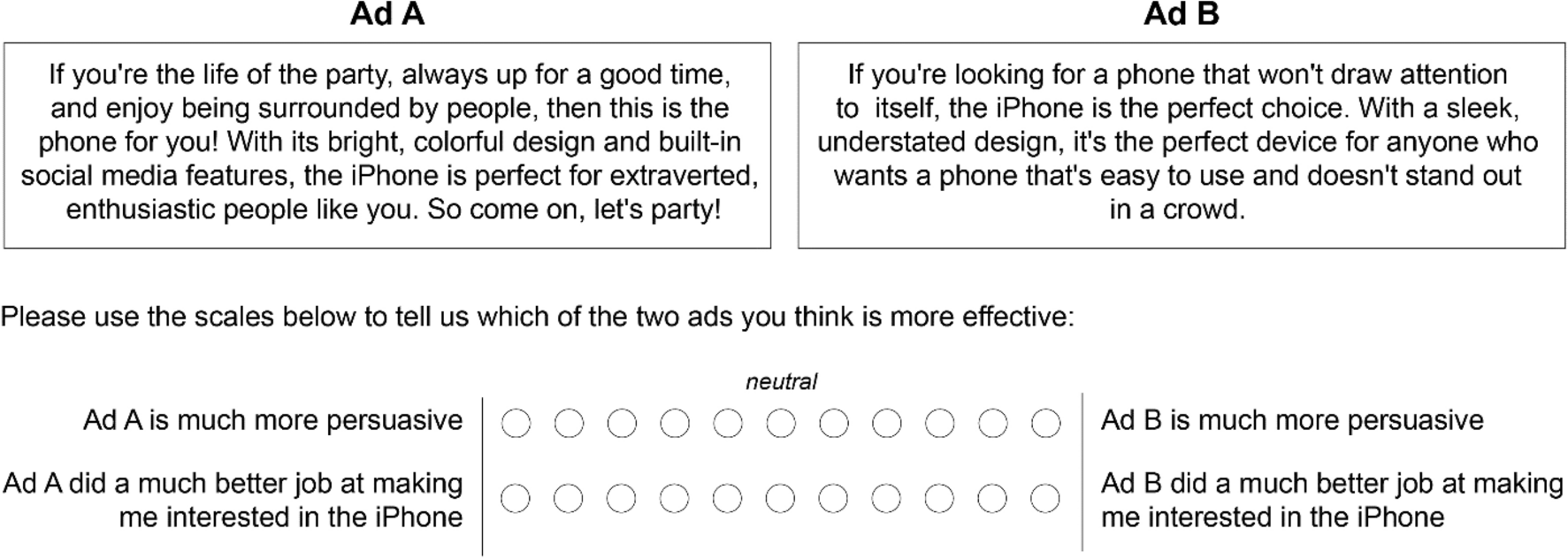
Matching the language or content of a message to the psychological profile of its recipient (known as “personalized persuasion”) is widely considered to be one of the most effective messaging strategies. We demonstrate that the rapid advances in large language models (LLMs), like ChatGPT, could accelerate this influence by making personalized persuasion scalable. Across four studies (consisting of seven sub-studies; total N = 1788), we show that personalized messages crafted by ChatGPT exhibit significantly more influence than non-personalized messages. This was true across different domains of persuasion (e.g., marketing of consumer products, political appeals for climate action), psychological profiles (e.g., personality traits, political ideology, moral foundations), and when only providing the LLM with a single, short prompt naming or describing the targeted psychological dimension. Thus, our findings are among the first to demonstrate the potential for LLMs to automate, and thereby scale, the use of personalized persuasion in ways that enhance its effectiveness and efficiency. We discuss the implications for researchers, practitioners, and the general public.
Reasoning Under Uncertainty: Exploring Probabilistic Reasoning Capabilities of LLMs
Despite widespread success in language understanding and generation, large language models (LLMs) exhibit unclear and often inconsistent behavior when faced with tasks that require probabilistic reasoning. In this work, we present the first comprehensive study of the reasoning capabilities of LLMs over explicit discrete probability distributions. Given observations from a probability distribution, we evaluate models on three carefully designed tasks, mode identification, maximum likelihood estimation, and sample generation, by prompting them to provide responses to queries about either the joint distribution or its conditionals. These tasks thus probe a range of probabilistic skills, including frequency analysis, marginalization, and generative behavior. Through comprehensive empirical evaluations, we demonstrate that there exists a clear performance gap between smaller and larger models, with the latter demonstrating stronger inference and surprising capabilities in sample generation. Furthermore, our investigations reveal notable limitations, including sensitivity to variations in the notation utilized to represent probabilistic outcomes and performance degradation of over 60% as context length increases. Together, our results provide a detailed understanding of the probabilistic reasoning abilities of LLMs and identify key directions for future improvement.
Reasoning Under Uncertainty: Exploring Probabilistic Reasoning Capabilities of LLMs
Despite widespread success in language understanding and generation, large language models (LLMs) exhibit unclear and often inconsistent behavior when faced with tasks that require probabilistic reasoning. In this work, we present the first comprehensive study of the reasoning capabilities of LLMs over explicit discrete probability distributions. Given observations from a probability distribution, we evaluate models on three carefully designed tasks, mode identification, maximum likelihood estimation, and sample generation, by prompting them to provide responses to queries about either the joint distribution or its conditionals. These tasks thus probe a range of probabilistic skills, including frequency analysis, marginalization, and generative behavior. Through comprehensive empirical evaluations, we demonstrate that there exists a clear performance gap between smaller and larger models, with the latter demonstrating stronger inference and surprising capabilities in sample generation. Furthermore, our investigations reveal notable limitations, including sensitivity to variations in the notation utilized to represent probabilistic outcomes and performance degradation of over 60% as context length increases. Together, our results provide a detailed understanding of the probabilistic reasoning abilities of LLMs and identify key directions for future improvement.
The GenAI Future of Consumer Research
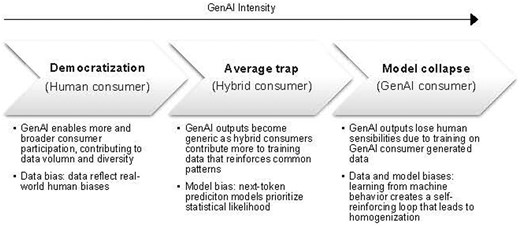
Abstract We develop a novel generative AI (GenAI) trajectory, “democratization-average trap-model collapse,” to identify data and model challenges posed by GenAI, from which we project the GenAI future of consumer research. This trajectory consists of three key phenomena: democratization broadens consumer participation, the average trap produces generic responses, and model collapse occurs when GenAI outputs lose human sensibilities. Data and model challenges arise as democratization enhances data representation while also embedding real-world biases. The average trap, caused by next-token prediction models, leads to generic outputs that lack individuality. Additionally, model collapse occurs when GenAI increasingly learns from its own outputs, amplifying machine bias and diverging from human behavior. To address these challenges, researchers can leverage democratization to study marginalized consumers and prioritize human-centered research over purely data-driven methods. The average trap can be mitigated by fine-tuning models with task-specific and marginalized consumption data while engineering responses for uniqueness. Preventing model collapse requires integrating human–machine hybrid data and applying theories of mind to realign AI with human-centric consumption. Finally, we outline three future research directions: preserving data distribution tails to support consumption democratization, countering the average trap in next-token prediction, and reversing the trajectory from democratization to model collapse.

Literature Meets Data: A Synergistic Approach to Hypothesis Generation
AI holds promise for transforming scientific processes, including hypothesis generation. Prior work on hypothesis generation can be broadly categorized into theory-driven and data-driven approaches. While both have proven effective in generating novel and plausible hypotheses, it remains an open question whether they can complement each other. To address this, we develop the first method that combines literature-based insights with data to perform LLM-powered hypothesis generation. We apply our method on five different datasets and demonstrate that integrating literature and data outperforms other baselines (8.97\% over few-shot, 15.75\% over literature-based alone, and 3.37\% over data-driven alone). Additionally, we conduct the first human evaluation to assess the utility of LLM-generated hypotheses in assisting human decision-making on two challenging tasks: deception detection and AI generated content detection. Our results show that human accuracy improves significantly by 7.44\% and 14.19\% on these tasks, respectively. These findings suggest that integrating literature-based and data-driven approaches provides a comprehensive and nuanced framework for hypothesis generation and could open new avenues for scientific inquiry.
Generative Search: Evidence from a Large-Scale Field Experiment
Generative search is an emerging search paradigm that integrates Generative AI (GenAI) into traditional search engines by presenting users with AI-generated responses before conventional search results. Whereas keyword-based search requires consumers to translate their underlying needs into effective keyword queries, generative search lets users express those intentions directly in natural language, a shift made possible by GenAI’s new mode of information presentation. This shift moves the consumer-search engine interaction upstream to the stage of problem formulation, rendering empirically observable a previously hidden phase of search behavior: the mapping from problem formulation to keyword articulation. Yet, it remains empirically unknown whether generative search increases consumer purchases and how search behavior changes when it can begin from expressed intent rather than keywords. Using a large-scale field experiment conducted on Meituan, a leading Chinese technology platform, this paper provides empirical evidence on the effectiveness of generative search. We find that generative search significantly increases consumer purchases. Further analysis reveals that generative search facilitates more effective and diverse keyword queries and reduces exploratory browsing and clicking, while concentrating evaluation within relevant categories and merchants. The empirical evidence is most consistent with a mechanism in which AI-generated answers provide information about consumers’ underlying needs, while also expanding awareness of relevant attributes and shifting attention toward more relevant categories. These findings provide empirical insights for future consumer search models that allow search to originate at the intention-expressing stage. This paper was accepted by Raphael Thomadsen, marketing. Funding: Financial support from the Ministry of Education – Singapore [Grant A-8001730-00-00] is gratefully acknowledged. Supplemental Material: The online appendix and data files are available at https://doi.org/10.1287/mnsc.2025.02458 .

Sparse Autoencoders for Hypothesis Generation
We describe HypotheSAEs, a general method to hypothesize interpretable relationships between text data (e.g., headlines) and a target variable (e.g., clicks). HypotheSAEs has three steps: (1) train a sparse autoencoder on text embeddings to produce interpretable features describing the data distribution, (2) select features that predict the target variable, and (3) generate a natural language interpretation of each feature (e.g., "mentions being surprised or shocked") using an LLM. Each interpretation serves as a hypothesis about what predicts the target variable. Compared to baselines, our method better identifies reference hypotheses on synthetic datasets (at least +0.06 in F1) and produces more predictive hypotheses on real datasets (~twice as many significant findings), despite requiring 1-2 orders of magnitude less compute than recent LLM-based methods. HypotheSAEs also produces novel discoveries on two well-studied tasks: explaining partisan differences in Congressional speeches and identifying drivers of engagement with online headlines.
Generative AI enhances individual creativity but reduces the collective diversity of novel content
Creativity is core to being human. Generative artificial intelligence (AI)—including powerful large language models (LLMs)—holds promise for humans to be more creative by offering new ideas, or less creative by anchoring on generative AI ideas. We study the causal impact of generative AI ideas on the production of short stories in an online experiment where some writers obtained story ideas from an LLM. We find that access to generative AI ideas causes stories to be evaluated as more creative, better written, and more enjoyable, especially among less creative writers. However, generative AI–enabled stories are more similar to each other than stories by humans alone. These results point to an increase in individual creativity at the risk of losing collective novelty. This dynamic resembles a social dilemma: With generative AI, writers are individually better off, but collectively a narrower scope of novel content is produced. Our results have implications for researchers, policy-makers, and practitioners interested in bolstering creativity. , Generative AI can enhance the creativity of short stories but may limit the variation in diverse outputs.

AI models collapse when trained on recursively generated data
Stable diffusion revolutionized image creation from descriptive text. GPT-2 (ref. 1), GPT-3(.5) (ref. 2) and GPT-4 (ref. 3) demonstrated high performance across a variety of language tasks. ChatGPT introduced such language models to the public. It is now clear that generative artificial intelligence (AI) such as large language models (LLMs) is here to stay and will substantially change the ecosystem of online text and images. Here we consider what may happen to GPT-{n} once LLMs contribute much of the text found online. We find that indiscriminate use of model-generated content in training causes irreversible defects in the resulting models, in which tails of the original content distribution disappear. We refer to this effect as ‘model collapse’ and show that it can occur in LLMs as well as in variational autoencoders (VAEs) and Gaussian mixture models (GMMs). We build theoretical intuition behind the phenomenon and portray its ubiquity among all learned generative models. We demonstrate that it must be taken seriously if we are to sustain the benefits of training from large-scale data scraped from the web. Indeed, the value of data collected about genuine human interactions with systems will be increasingly valuable in the presence of LLM-generated content in data crawled from the Internet.
AI models collapse when trained on recursively generated data
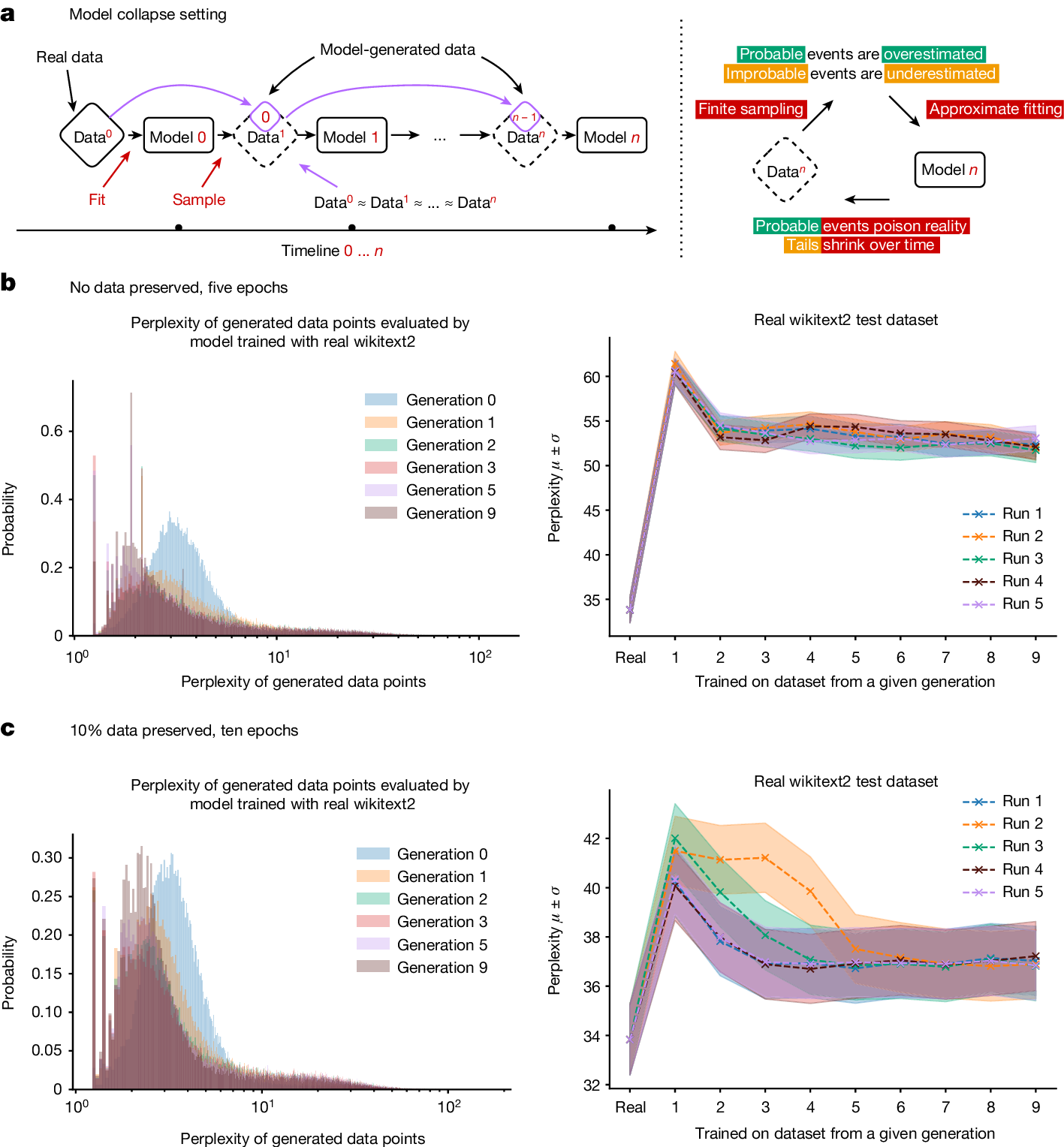
Stable diffusion revolutionized image creation from descriptive text. GPT-2 (ref. 1), GPT-3(.5) (ref. 2) and GPT-4 (ref. 3) demonstrated high performance across a variety of language tasks. ChatGPT introduced such language models to the public. It is now clear that generative artificial intelligence (AI) such as large language models (LLMs) is here to stay and will substantially change the ecosystem of online text and images. Here we consider what may happen to GPT-{n} once LLMs contribute much of the text found online. We find that indiscriminate use of model-generated content in training causes irreversible defects in the resulting models, in which tails of the original content distribution disappear. We refer to this effect as ‘model collapse’ and show that it can occur in LLMs as well as in variational autoencoders (VAEs) and Gaussian mixture models (GMMs). We build theoretical intuition behind the phenomenon and portray its ubiquity among all learned generative models. We demonstrate that it must be taken seriously if we are to sustain the benefits of training from large-scale data scraped from the web. Indeed, the value of data collected about genuine human interactions with systems will be increasingly valuable in the presence of LLM-generated content in data crawled from the Internet.
The levers of political persuasion with conversational artificial intelligence
There are widespread fears that conversational artificial intelligence (AI) could soon exert unprecedented influence over human beliefs. In this work, in three large-scale experiments ( N = 76,977 participants), we deployed 19 large language models (LLMs)—including some post-trained explicitly for persuasion—to evaluate their persuasiveness on 707 political issues. We then checked the factual accuracy of 466,769 resulting LLM claims. We show that the persuasive power of current and near-future AI is likely to stem more from post-training and prompting methods—which boosted persuasiveness by as much as 51 and 27%, respectively—than from personalization or increasing model scale, which had smaller effects. We further show that these methods increased persuasion by exploiting LLMs’ ability to rapidly access and strategically deploy information and that, notably, where they increased AI persuasiveness, they also systematically decreased factual accuracy. , Editor’s summary Many fear that we are on the precipice of unprecedented manipulation by large language models (LLMs), but techniques driving their persuasiveness are poorly understood. In the initial “pretrained” phase, LLMs may exhibit flawed reasoning. Their power unlocks during vital “posttraining,” when developers refine pretrained LLMs to sharpen their reasoning and align with users’ needs. Posttraining also enables LLMs to maintain logical, sophisticated conversations. Hackenburg et al . examined which techniques made diverse, conversational LLMs most persuasive across 707 British political issues (see the Perspective by Argyle). LLMs were most persuasive after posttraining, especially when prompted to use facts and evidence (information) to argue. However, information-dense LLMs produced the most inaccurate claims, raising concerns about the spread of misinformation during rollouts of future models. —Ekeoma Uzogara , INTRODUCTION Rapid advances in artificial intelligence (AI) have sparked widespread concerns about its potential to influence human beliefs. One possibility is that conversational AI could be used to manipulate public opinion on political issues through interactive dialogue. Despite extensive speculation, however, fundamental questions about the actual mechanisms, or “levers,” responsible for driving advances in AI persuasiveness—e.g., computational power or sophisticated training techniques—remain largely unanswered. In this work, we systematically investigate these levers and chart the horizon of persuasiveness with conversational AI. RATIONALE We considered multiple factors that could enhance the persuasiveness of conversational AI: raw computational power (model scale), specialized post-training methods for persuasion, personalization to individual users, and instructed rhetorical strategies. Across three large-scale experiments with 76,977 total UK participants, we deployed 19 large language models (LLMs) to persuade on 707 political issues while varying these factors independently. We also analyzed more than 466,000 AI-generated claims, examining the relationship between persuasiveness and truthfulness. RESULTS We found that the most powerful levers of AI persuasion were methods for post-training and rhetorical strategy (prompting), which increased persuasiveness by as much as 51 and 27%, respectively. These gains were often larger than those obtained from substantially increasing model scale. Personalizing arguments on the basis of user data had a comparatively small effect on persuasion. We observe that a primary mechanism driving AI persuasiveness was information density: Models were most persuasive when they packed their arguments with a high volume of factual claims. Notably, however, we documented a concerning trade-off between persuasion and accuracy: The same levers that made AI more persuasive—including persuasion post-training and information-focused prompting—also systematically caused the AI to produce information that was less factually accurate. CONCLUSION Our findings suggest that the persuasive power of current and near-future AI is likely to stem less from model scale or personalization and more from post-training and prompting techniques that mobilize an LLM’s ability to rapidly generate information during conversation. Further, we reveal a troubling trade-off: When AI systems are optimized for persuasion, they may increasingly deploy misleading or false information. This research provides an empirical foundation for policy-makers and technologists to anticipate and address the challenges of AI-driven persuasion, and it highlights the need for safeguards that balance AI’s legitimate uses in political discourse with protections against manipulation and misinformation. Persuasiveness of conversational AI increases with model scale. The persuasive impact in percentage points on the y axis is plotted against effective pretraining compute [floating-point operations (FLOPs)] on the x axis. Point estimates are persuasive effects of different AI models. Colored lines show trends for models that we uniformly chat-tuned for open-ended conversation (purple) versus those that were post-trained using heterogeneous, opaque methods by AI developers (green). pp, percentage points; CI, confidence interval.

DataInf: Efficiently Estimating Data Influence in LoRA-tuned LLMs and Diffusion Models
Quantifying the impact of training data points is crucial for understanding the outputs of machine learning models and for improving the transparency of the AI pipeline. The influence function is a principled and popular data attribution method, but its computational cost often makes it challenging to use. This issue becomes more pronounced in the setting of large language models and text-to-image models. In this work, we propose DataInf, an efficient influence approximation method that is practical for large-scale generative AI models. Leveraging an easy-to-compute closed-form expression, DataInf outperforms existing influence computation algorithms in terms of computational and memory efficiency. Our theoretical analysis shows that DataInf is particularly well-suited for parameter-efficient fine-tuning techniques such as LoRA. Through systematic empirical evaluations, we show that DataInf accurately approximates influence scores and is orders of magnitude faster than existing methods. In applications to RoBERTa-large, Llama-2-13B-chat, and stable-diffusion-v1.5 models, DataInf effectively identifies the most influential fine-tuning examples better than other approximate influence scores. Moreover, it can help to identify which data points are mislabeled.
Commercial Persuasion in AI-Mediated Conversations
As Large Language Models (LLMs) become a primary interface between users and the web, companies face growing economic incentives to embed commercial influence into AI-mediated conversations. We present two preregistered experiments (N = 2,012) in which participants selected a book to receive from a large eBook catalog using either a traditional search engine or a conversational LLM agent powered by one of five frontier models. Unbeknownst to participants, a fifth of all products were randomly designated as sponsored and promoted in different ways. We find that LLM-driven persuasion nearly triples the rate at which users select sponsored products compared to traditional search placement (61.2% vs. 22.4%), while the vast majority of participants fail to detect any promotional steering. Explicit "Sponsored" labels do not significantly reduce persuasion, and instructing the model to conceal its intent makes its influence nearly invisible (detection accuracy < 10%). Altogether, our results indicate that conversational AI can covertly redirect consumer choices at scale, and that existing transparency mechanisms may be insufficient to protect users.
Large Language Models: An Applied Econometric Framework
Large language models (LLMs) enable researchers to analyze text at unprecedented scale and minimal cost. Researchers can now revisit old questions and tackle novel ones with rich data. We provide an econometric framework for realizing this potential in two empirical uses. For prediction problems—forecasting outcomes from text—valid conclusions require “no training leakage” between the LLM's training data and the researcher's sample, which can be enforced through careful model choice and research design. For estimation problems—automating the measurement of economic concepts for downstream analysis—valid downstream inference requires combining LLM outputs with a small validation sample to deliver consistent and precise estimates. Absent a validation sample, researchers cannot assess possible errors in LLM outputs, and consequently seemingly innocuous choices (which model, which prompt) can produce dramatically different parameter estimates. When used appropriately, LLMs are powerful tools that can expand the frontier of empirical economics.
