In this article, we summarize the developments in the mathematical modeling of the mechanics of bone and related biological phenomena. We will devote special attention to the results of the last 10–15 years, although we will cover some relevant classical work to better frame the more recent researches. We will propose a division of the literature based on the main aim of the model (mechanical/biomathematical) and the type of biological phenomena considered (stimulus, growth, cell population dynamics). Finally, we will suggest some possible directions for future investigations.
A review of mathematical modeling of bone remodeling from a systems biology perspective
Bone remodeling is an essential, delicately balanced physiological process of coordinated activity of bone cells that remove and deposit new bone tissue in the adult skeleton. Due to the complex nature of this process, many mathematical models of bone remodeling have been developed. Each of these models has unique features, but they have underlying patterns. In this review, the authors highlight the important aspects frequently found in mathematical models for bone remodeling and discuss how and why these aspects are included when considering the physiology of the bone basic multicellular unit, which is the term used for the collection of cells responsible for bone remodeling. The review also emphasizes the view of bone remodeling from a systems biology perspective. Understanding the systemic mechanisms involved in remodeling will help provide information on bone pathology associated with aging, endocrine disorders, cancers, and inflammatory conditions and enhance systems pharmacology. Furthermore, some features of the bone remodeling cycle and interactions with other organ systems that have not yet been modeled mathematically are discussed as promising future directions in the field.

A review of mathematical modeling of bone remodeling from a systems biology perspective
Bone remodeling is an essential physiological process in the adult skeleton. Due to the complex nature of this process, many mathematical models of bone remodeling have been developed. Each of these models has unique features, but they have underlying patterns. In this review, the authors highlight the important aspects frequently found in mathematical models for bone remodeling and discuss how and why these aspects are included when considering the physiology of the bone basic multicellular unit, which is the term used for the collection of cells responsible for bone remodeling. The review also emphasizes the view of bone remodeling from a systems biology perspective. Understanding the systemic mechanisms involved in remodeling will help provide information on bone pathology associated with aging, endocrine disorders, cancers, and inflammatory conditions and enhance systems pharmacology. Furthermore, some features of the bone remodeling cycle and interactions with other organ systems that have not yet been modeled mathematically are discussed as promising future directions in the field.
Towards a new spatial representation of bone remodeling
Irregular bone remodeling is associated with a number of bone diseases such as osteoporosis and multiple myeloma. Computational and mathematical modeling can aid in therapy and treatment as well as understanding fundamental biology. Different approaches to modeling give insight into different aspects of a phenomena so it is useful to have an arsenal of various computational and mathematical models. Here we develop a mathematical representation of bone remodeling that can effectively describe many aspects of the complicated geometries and spatial behavior observed. There is a sharp interface between bone and marrow regions. Also the surface of bone moves in and out, i.e. in the normal direction, due to remodeling. Based on these observations we employ the use of a level-set function to represent the spatial behavior of remodeling. We elaborate on a temporal model for osteoclast and osteoblast population dynamics to determine the change in bone mass which influences how the interface between bone and marrow changes. We exhibit simulations based on our computational model that show the motion of the interface between bone and marrow as a consequence of bone remodeling. The simulations show that it is possible to capture spatial behavior of bone remodeling in complicated geometries as they occur in vitro and in vivo. By employing the level set approach it is possible to develop computational and mathematical representations of the spatialbehavior of bone remodeling. By including in this formalism further details, such as more complex cytokine interactions and accurate parameter values, it is possible to obtain simulations of phenomena related to bone remodeling with spatial behavior much as in vitro and in vivo. This makes it possible to perform in silica experiments more closely resembling experimental observations.
A mechano-chemo-biological model for bone remodeling with a new mechano-chemo-transduction approach
Bone remodeling is a fundamental biological process that develops in bone tissue along its whole lifetime. It refers to a continuous bone transformation with new bone formation and old bone resorption that changes the internal microstructure and composition of the tissue. The main objectives of bone remodeling are: repair of the internal microcracks; adaptation of the macroscopic stiffness and strength to the actual changing mechanical demands; and control of the calcium homeostasis. Understanding this process and predicting its evolution is critical to reduce the effects of long-term disuse as happens during periods of reduced mobility. It is also important in the design of bone implants to avoid long-term stress shielding. Many mathematical models have been proposed from the earliest purely phenomenological to the latest that include biological knowledge. However, there still exists a lack of connection between the mechanical driving force and the biochemical and cell processes it triggers. Here, and following previous works that model independently the mechanobiological and biochemical processes in bone remodeling, we present a more complete model, useful for both cortical and trabecular bone, that uses a new mechanotransduction approach based on the effect of strains onto the bonding–unbonding rate of RANK/RANKL/OPG receptor–ligand reactions. We compare the results of this model with previous ones, showing a good agreement in similar conditions. We also apply it to realistic situations such as a femoral bone after implantation of a hip prosthesis, getting similar results to the clinical ones in the final bone density distribution. Finally, we extend this approach to the anisotropic case, getting not only the mean density, but also the directional homogenization of the microstructure. This biochemical approach permits, not only to predict the bone evolution under changes in the mechanical loads, but also, to consider anabolic and catabolic drugs to control bone density, such as those used in osteoporosis.

A novel mathematical model of bone remodelling cycles for trabecular bone at the cellular level
After an initial phase of growth and development, bone undergoes a continuous cycle of repair, renewal and optimisation by a process called remodelling. This paper describes a novel mathematical model of the trabecular bone remodelling cycle. It is essentially formulated to simulate a remodelling event at a fixed position in the bone, integrating bone removal by osteoclasts and formation by osteoblasts. The model is developed to construct the variation in bone thickness at a particular point during the remodelling event, derived from standard bone histomorphometric analyses. The novelties of the approach are the adoption of a predator–prey model to describe the dynamic interaction between osteoclasts and osteoblasts, using a genetic algorithm–based solution; quantitative reconstruction of the bone remodelling cycle; and the introduction of a feedback mechanism in the bone formation activity to co-regulate bone thickness. The application of the model is first demonstrated by using experimental data recorded for normal (healthy) bone remodelling to predict the temporal variation in the number of osteoblasts and osteoclasts. The simulated histomorphometric data and remodelling cycle characteristics compare well with the specified input data. Sensitivity studies then reveal how variations in the model’s parameters affect its output; it is hoped that these parameters can be linked to specific biochemical factors in the future. Two sample pathological conditions, hypothyroidism and primary hyperparathyroidism, are examined to demonstrate how the model could be applied more broadly, and, for the first time, the osteoblast and osteoclast populations are predicted for these conditions. Further data are required to fully validate the model’s predictive capacity, but this work shows it has potential, especially in the modelling of pathological conditions and the optimisation of the treatment of those conditions.
Spatial extension of a bone remodeling dynamics model and its finite element analysis
Abstract There are many works dealing with the dynamics of bone remodeling, proposing increasingly complex and complete models. In the recent years, the efforts started to focus on developing models that not only reproduce the temporal evolution, but also include the spatial aspects of this phenomenon. In this work, we propose the spatial extension of an existing model that includes the dynamics of osteocytes. The spatial dependence is modeled in terms of a linear diffusion, as proposed in previous works dealing with related problems. The resulting model is then written in its variational form, and fully discretized using the well‐known finite element method and a combination of the implicit and explicit Euler schemes. The numerical algorithm is then analyzed, proving some a priori error estimates and its linear convergence. Finally, we extend the examples already published for the temporal model to one and two dimensions, showing the dynamics of the solution in the spatial domain.

Toward a Mathematical Modeling of Diseases’ Impact on Bone Remodeling: Technical Review
A wide variety of bone diseases have hitherto been discovered, such as osteoporosis, Patget’s disease, osteopetrosis, and metastatic bone disease, which is not well defined. Some of these diseases are secondary to other pathologies, including cancer, or to some clinical treatments. To better understand bone behavior and prevent its deterioration, bone biomechanics have been the subject of mathematical modeling that exponentially increased over the last years. These models are more and more involving the impact of bone diseases on its quality. The current paper provides a meaningful and critical analysis of previously developed bone remodeling mathematical models, particularly those addressing bone diseases. Besides, mechanistic pharmacokinetic/pharmacodynamic (PK/PD) models, which englobe either bone disease and its treatments’ effect on bone health. Therefore, the review starts by presenting bone remodeling cycle and mathematical models describing this process, followed by introducing some bone diseases and discussing models of pathological mechanisms affecting bone, and ends by exhibiting the available bone treatment procedures and the PK/PD models considering these lasts.

<i>In silico</i> models of bone remodeling from macro to nano—from organ to cell
Abstract Computational modeling is a tool through which researchers can achieve a greater understanding of the mechanisms governing biological systems. In the field of bone biology, a plethora of models exist which attempt to replicate and investigate bone's dynamic behavior at different scales. At organ level, models are continuum based and describe the variation of bone's apparent density as a function of both biological and external mechanical stimuli. At tissue level, models include bone microarchitecture and more descriptive parameters such as trabecular thickness, osteoclast resorption depth, and activation frequency. Finally, at cell level, models employ partial differential equations to describe complex cellular interactions in the temporal domain. Although informative, these models exist in isolation. Consequently, their interpretation is limited. In this review, we present an overview of the organ‐, tissue‐, and cell‐level models and assess their ability to reflect bone's metabolic processes reliably. Existing interscale synergies are then presented along with a computational framework which could be exploited to achieve a fully integrated, multiscale modeling approach. WIREs Syst Biol Med 2011 3 241–251 DOI: 10.1002/wsbm.115 This article is categorized under: Analytical and Computational Methods > Computational Methods Models of Systems Properties and Processes > Organ, Tissue, and Physiological Models

A new biological bone remodeling in silico model combined with advanced discretization methods
Abstract Bone remodeling remains a highly researched topic investigated by many strands of science. The main purpose of this work is formulating a new computational framework for biological simulation, extending the version of the bone remodeling model previously proposed by Komarova. Thus, considering only the biological aspect of the remodeling process, the action of osteoclasts and osteoblasts is taken into account as well as its impact on bone mass. It is conducted a spatiotemporal analysis of a remodeling cycle obtaining a dynamic behavior of bone cells very similar to the biological process already described in the literature. The numerical example used is based on bone images obtained with scanning electron microscopy. During simulation, it is possible to observe the variation of bone's architecture through isomaps. These maps are obtained through the combination of biological bone remodeling models with three distinct numerical techniques—finite element method (FEM), radial point interpolation method (RPIM), and natural neighbor radial point interpolation method (NNRPIM). A study combining these numerical techniques allows to compare their performance. Ultimately, this work supports the inclusion of meshless methods due to their smoother results and its easiness to be combined with medical images from CT scans and MRI.

A multiscale mechanobiological model of bone remodelling predicts site-specific bone loss in the femur during osteoporosis and mechanical disuse
We propose a multiscale mechanobiological model of bone remodelling to investigate the site-specific evolution of bone volume fraction across the midshaft of a femur. The model includes hormonal regulation and biochemical coupling of bone cell populations, the influence of the microstructure on bone turnover rate, and mechanical adaptation of the tissue. Both microscopic and tissue-scale stress/strain states of the tissue are calculated from macroscopic loads by a combination of beam theory and micromechanical homogenisation. This model is applied to simulate the spatio-temporal evolution of a human midshaft femur scan subjected to two deregulating circumstances: (i) osteoporosis and (ii) mechanical disuse. Both simulated deregulations led to endocortical bone loss, cortical wall thinning and expansion of the medullary cavity, in accordance with experimental findings. Our model suggests that these observations are attributable to a large extent to the influence of the microstructure on bone turnover rate. Mechanical adaptation is found to help preserve intracortical bone matrix near the periosteum. Moreover, it leads to non-uniform cortical wall thickness due to the asymmetry of macroscopic loads introduced by the bending moment. The effect of mechanical adaptation near the endosteum can be greatly affected by whether the mechanical stimulus includes stress concentration effects or not.

Dynamic Biochemical and Cellular Models of Bone Physiology: Integrating Remodeling Processes, Tumor Growth, and Therapy
Bone is an activeCoelho, Rui M. Neto, Joana P. connective tissue composed of different types of cells. The dynamic behavior of bone remodeling processes is typically represented throughValério, Duarte differential equations, which represent the physiological phenomena occurring in this organ. These models takeVinga, Susana into account the tight biochemical regulation between osteoclasts and osteoblasts and have also been enriched with variables and parameters related to bone pathologies and treatment. This chapter reviews some of the more recent models describing bone physiology, focusing on those that include the main cellular processes, along the biochemical control, and also the pharmacokinetic/pharmacodynamic (PK/PD) of the most common treatments for diseases such as cancer. These models are then compared in terms of the simulations obtained and, finally, some highlights on integrating them with the biomechanical component of the system which will be given. These models are expected to provide a valuable insight into this complex system and to support the development of clinical decision systems for bone pathologies.

The Cellular Dynamics of Bone Remodeling: A Mathematical Model
The mechanical properties of vertebrate bone are largely determined by a process which involves the complex interplay of three different cell types. This process is called bone remodeling and occurs asynchronously at multiple sites in the mature skeleton. The cells involved are bone resorbing osteoclasts, bone matrix producing osteoblasts, and mechanosensing osteocytes. These cells communicate with each other by means of autocrine and paracrine signaling factors and operate in complex entities, the so-called bone multicellular units (BMUs). To investigate the BMU dynamics in silico, we develop a novel mathematical model resulting in a system of nonlinear partial differential equations (PDEs) with time delays. The model describes the osteoblast and osteoclast populations together with the dynamics of the key messenger molecule RANKL and its decoy receptor OPG. Scaling theory is used to address parameter sensitivity and predict the emergence of pathological remodeling regimes. The model is studied numerically in one and two space dimensions using finite difference schemes in space and explicit delay equation solvers in time. The computational results are in agreement with in vivo observations and provide new insights into the role of the RANKL/OPG pathway in the spatial regulation of bone remodeling.

Analytic approach to explore dynamical osteoporotic bone turnover
The dynamics of the osteoporotic bone turnover is studied in this paper with the aid of stability analysis of the associated mathematical model. Osteoporosis, which is a common bone disorder, is studied in this papper in detail with an emphasis on the relative threshold values. We examine the expository signaling among the bone cells named osteoclast and osteoblast. Main functioning of osteoblasts is bone formation, whereas osteoclasts are bone removal cells.

<i>In silico</i> biology of bone modelling and remodelling: adaptation
Modelling and remodelling are the processes by which bone adapts its shape and internal structure to external influences. However, the cellular mechanisms triggering osteoclastic resorption and osteoblastic formation are still unknown. In order to investigate current biological theories, in silico models can be applied. In the past, most of these models were based on the continuum assumption, but some questions related to bone adaptation can be addressed better by models incorporating the trabecular microstructure. In this paper, existing simulation models are reviewed and one of the microstructural models is extended to test the hypothesis that bone adaptation can be simulated without particular knowledge of the local strain distribution in the bone. Validation using an experimental murine loading model showed that this is possible. Furthermore, the experimental model revealed that bone formation cannot be attributed only to an increase in trabecular thickness but also to structural reorganization including the growth of new trabeculae. How these new trabeculae arise is still an unresolved issue and might be better addressed by incorporating other levels of hierarchy, especially the cellular level. The cellular level sheds light on the activity and interplay between the different cell types, leading to the effective change in the whole bone. For this reason, hierarchical multi-scale simulations might help in the future to better understand the biomathematical laws behind bone adaptation.

<i>In silico</i> biology of bone modelling and remodelling: regeneration
Bone regeneration is the process whereby bone is able to (scarlessly) repair itself from trauma, such as fractures or implant placement. Despite extensive experimental research, many of the mechanisms involved still remain to be elucidated. Over the last decade, many mathematical models have been established to investigate the regeneration process in silico . The first models considered only the influence of the mechanical environment as a regulator of the healing process. These models were followed by the development of bioregulatory models where mechanics was neglected and regeneration was regulated only by biological stimuli such as growth factors. The most recent mathematical models couple the influences of both biological and mechanical stimuli. Examples are given to illustrate the added value of mathematical regeneration research, specifically in the in silico design of treatment strategies for non-unions. Drawbacks of the current continuum-type models, together with possible solutions in extending the models towards other time and length scales are discussed. Finally, the demands for dedicated and more quantitative experimental research are presented.

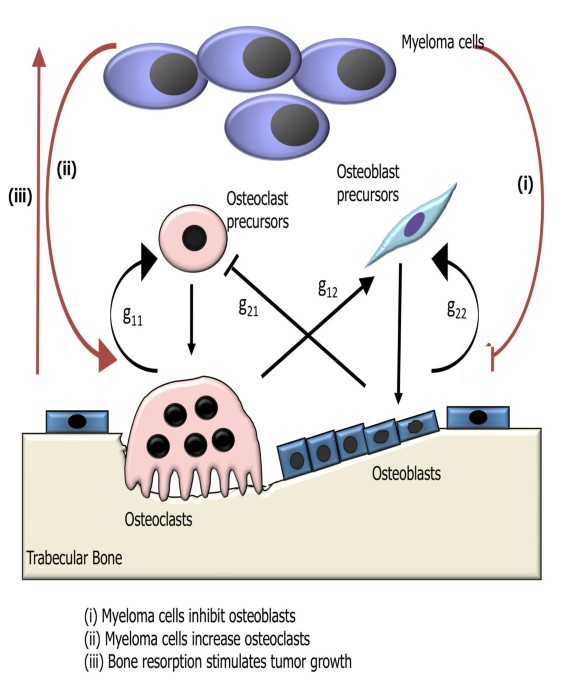
A mathematical model of bone remodeling dynamics for normal bone cell populations and myeloma bone disease
Multiple myeloma is a hematologic malignancy associated with the development of a destructive osteolytic bone disease.