


How people assess their social environments plays a central role in how they evaluate their life circumstances. Using a large probabilistic national sample, we investigated how accurately people estimate characteristics of the general population. For most characteristics, people seemed to underestimate the quality of others’ lives and showed apparent self-enhancement, but for some characteristics, they seemed to overestimate the quality of others’ lives and showed apparent self-depreciation. In addition, people who were worse off appeared to enhance their social position more than those who were better off. We demonstrated that these effects can be explained by a simple social-sampling model. According to the model, people infer how others are doing by sampling from their own immediate social environments. Interplay of these sampling processes and the specific structure of social environments leads to the apparent biases. The model predicts the empirical results better than alternative accounts and highlights the importance of considering environmental structure when studying human cognition.
A sampling model of social judgment.
Beware of samples! A cognitive-ecological sampling approach to judgment biases.
Misperceptions About Others
Perceptions about others play an important role in shaping people's attitudes and behaviors, as well as social norms more broadly. This review presents a meta-analysis of the recent empirical literature that examines perceptions about others in the field, covering over a million observations for a total of 434 elicited perceptions. We document a number of stylized facts. Misperceptions about others are widespread, asymmetric, much larger when about out-group members, and positively associated with one's own attitudes. Experimental treatments to recalibrate misperceptions generally work as intended; they sometimes lead to meaningful changes in behaviors, though this often occurs only immediately after the treatments. We discuss different conceptual frameworks that could explain the origin, persistence, and rigidity of misperceptions about others. We point to several directions for future research.

The Majority Illusion in Social Networks
Social behaviors are often contagious, spreading through a population as individuals imitate the decisions and choices of others. A variety of global phenomena, from innovation adoption to the emergence of social norms and political movements, arise as a result of people following a simple local rule, such as copy what others are doing. However, individuals often lack global knowledge of the behaviors of others and must estimate them from the observations of their friends' behaviors. In some cases, the structure of the underlying social network can dramatically skew an individual's local observations, making a behavior appear far more common locally than it is globally. We trace the origins of this phenomenon, which we call "the majority illusion," to the friendship paradox in social networks. As a result of this paradox, a behavior that is globally rare may be systematically overrepresented in the local neighborhoods of many people, i.e., among their friends. Thus, the "majority illusion" may facilitate the spread of social contagions in networks and also explain why systematic biases in social perceptions, for example, of risky behavior, arise. Using synthetic and real-world networks, we explore how the "majority illusion" depends on network structure and develop a statistical model to calculate its magnitude in a network.

Resampling reduces bias amplification in experimental social networks
Large-scale social networks are thought to contribute to polarization by amplifying people’s biases. However, the complexity of these technologies makes it difficult to identify the mechanisms responsible and evaluate mitigation strategies. Here we show under controlled laboratory conditions that transmission through social networks amplifies motivational biases on a simple artificial decision-making task. Participants in a large behavioural experiment showed increased rates of biased decision-making when part of a social network relative to asocial participants in 40 independently evolving populations. Drawing on ideas from Bayesian statistics, we identify a simple adjustment to content-selection algorithms that is predicted to mitigate bias amplification by generating samples of perspectives from within an individual’s network that are more representative of the wider population. In two large experiments, this strategy was effective at reducing bias amplification while maintaining the benefits of information sharing. Simulations show that this algorithm can also be effective in more complex networks.

The "Majority Illusion" in Social Networks
Individual’s decisions, from what product to buy to whether to engage in risky behavior, often depend on the choices, behaviors, or states of other people. People, however, rarely have global knowledge of the states of others, but must estimate them from the local observations of their social contacts. Network structure can significantly distort individual’s local observations. Under some conditions, a state that is globally rare in a network may be dramatically over-represented in the local neighborhoods of many individuals. This effect, which we call the “majority illusion,” leads individuals to systematically overestimate the prevalence of that state, which may accelerate the spread of social contagions. We develop a statistical model that quantifies this effect and validate it with measurements in synthetic and real-world networks. We show that the illusion is exacerbated in networks with a heterogeneous degree distribution and disassortative structure.
The "Majority Illusion" in Social Networks
Individual’s decisions, from what product to buy to whether to engage in risky behavior, often depend on the choices, behaviors, or states of other people. People, however, rarely have global knowledge of the states of others, but must estimate them from the local observations of their social contacts. Network structure can significantly distort individual’s local observations. Under some conditions, a state that is globally rare in a network may be dramatically over-represented in the local neighborhoods of many individuals. This effect, which we call the “majority illusion,” leads individuals to systematically overestimate the prevalence of that state, which may accelerate the spread of social contagions. We develop a statistical model that quantifies this effect and validate it with measurements in synthetic and real-world networks. We show that the illusion is exacerbated in networks with a heterogeneous degree distribution and disassortative structure.
Mechanisms of social cognition
Social animals including humans share a range of social mechanisms that are automatic and implicit and enable learning by observation. Learning from others includes imitation of actions and mirroring of emotions. Learning about others, such as their group membership and reputation, is crucial for social interactions that depend on trust. For accurate prediction of others' changeable dispositions, mentalizing is required, i.e., tracking of intentions, desires, and beliefs. Implicit mentalizing is present in infants less than one year old as well as in some nonhuman species. Explicit mentalizing is a meta-cognitive process and enhances the ability to learn about the world through self-monitoring and reflection, and may be uniquely human. Meta-cognitive processes can also exert control over automatic behavior, for instance, when short-term gains oppose long-term aims or when selfish and prosocial interests collide. We suggest that they also underlie the ability to explicitly share experiences with other agents, as in reflective discussion and teaching. These are key in increasing the accuracy of the models of the world that we construct.
Reflective and Impulsive Determinants of Social Behavior - Fritz Strack, Roland Deutsch, 2004
This article describes a 2-systems model that explains social behavior as a joint function of reflective and impulsive processes. In particular, it is assumed t...
Do LLMs Exhibit Human-like Response Biases? A Case Study in Survey Design
Abstract One widely cited barrier to the adoption of LLMs as proxies for humans in subjective tasks is their sensitivity to prompt wording—but interestingly, humans also display sensitivities to instruction changes in the form of response biases. We investigate the extent to which LLMs reflect human response biases, if at all. We look to survey design, where human response biases caused by changes in the wordings of “prompts” have been extensively explored in social psychology literature. Drawing from these works, we design a dataset and framework to evaluate whether LLMs exhibit human-like response biases in survey questionnaires. Our comprehensive evaluation of nine models shows that popular open and commercial LLMs generally fail to reflect human-like behavior, particularly in models that have undergone RLHF. Furthermore, even if a model shows a significant change in the same direction as humans, we find that they are sensitive to perturbations that do not elicit significant changes in humans. These results highlight the pitfalls of using LLMs as human proxies, and underscore the need for finer-grained characterizations of model behavior.1

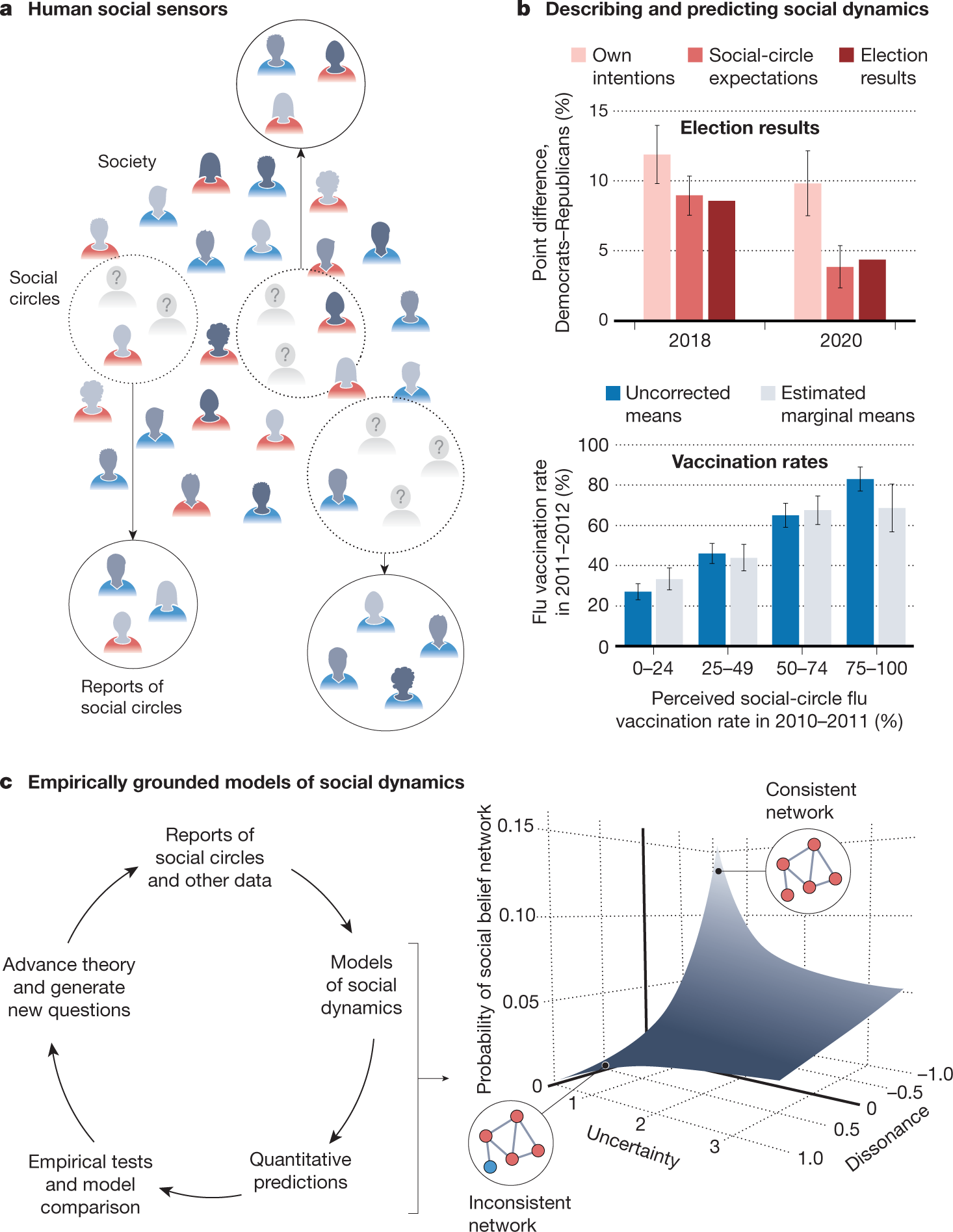
Human social sensing is an untapped resource for computational social science
The ability to ‘sense’ the social environment and thereby to understand the thoughts and actions of others allows humans to fit into their social worlds, communicate and cooperate, and learn from others’ experiences. Here we argue that, through the lens of computational social science, this ability can be used to advance research into human sociality. When strategically selected to represent a specific population of interest, human social sensors can help to describe and predict societal trends. In addition, their reports of how they experience their social worlds can help to build models of social dynamics that are constrained by the empirical reality of human social systems.
Bayesian Inference of Social Norms as Shared Constraints on Behavior
People act upon their desires, but often, also act in adherence to implicit social norms. How do people infer these unstated social norms from others' behavior, especially in novel social contexts? We propose that laypeople have intuitive theories of social norms as behavioral constraints shared across different agents in the same social context. We formalize inference of norms using a Bayesian Theory of Mind approach, and show that this computational approach provides excellent predictions of how people infer norms in two scenarios. Our results suggest that people separate the influence of norms and individual desires on others' actions, and have implications for modelling generalizations of hidden causes of behavior.
Elegant theories and the problems of social psychology
This perspective article provides a commentary on the current state of theories used in social psychology, with a particular emphasis on the importance of distinguishing between theoretical models ...
Talking with strangers is surprisingly informative
A meaningful amount of people’s knowledge comes from their conversations with others. The amount people expect to learn predicts their interest in having a conversation (pretests 1 and 2), suggesting that the presumed information value of conversations guides decisions of whom to talk with. The results of seven experiments, however, suggest that people may systematically underestimate the informational benefit of conversation, creating a barrier to talking with—and hence learning from—others in daily life. Participants who were asked to talk with another person expected to learn significantly less from the conversation than they actually reported learning afterward, regardless of whether they had conversation prompts and whether they had the goal to learn (experiments 1 and 2). Undervaluing conversation does not stem from having systematically poor opinions of how much others know (experiment 3) but is instead related to the inherent uncertainty involved in conversation itself. Consequently, people underestimate learning to a lesser extent when uncertainty is reduced, as in a nonsocial context (surfing the web, experiment 4); when talking to an acquainted conversation partner (experiment 5); and after knowing the content of the conversation (experiment 6). Underestimating learning in conversation is distinct from underestimating other positive qualities in conversation, such as enjoyment (experiment 7). Misunderstanding how much can be learned in conversation could keep people from learning from others in daily life.

A Theory of Response Sampling in LLMs: Part Descriptive and Part Prescriptive
Large Language Models (LLMs) are increasingly utilized in autonomous decision-making, where they sample options from vast action spaces. However, the heuristics that guide this sampling process remain under-explored. We study this sampling behavior and show that this underlying heuristics resembles that of human decision-making: comprising a descriptive component (reflecting statistical norm) and a prescriptive component (implicit ideal encoded in the LLM) of a concept. We show that this deviation of a sample from the statistical norm towards a prescriptive component consistently appears in concepts across diverse real-world domains like public health, and economic trends. To further illustrate the theory, we demonstrate that concept prototypes in LLMs are affected by prescriptive norms, similar to the concept of normality in humans. Through case studies and comparison with human studies, we illustrate that in real-world applications, the shift of samples toward an ideal value in LLMs' outputs can result in significantly biased decision-making, raising ethical concerns.
AI Models Exceed Individual Human Accuracy in Predicting Everyday Social Norms
A fundamental question in cognitive science concerns how social norms are acquired and represented. While humans typically learn norms through embodied social experience, we investigated whether large language models can achieve sophisticated norm understanding through statistical learning alone. Across two studies, we systematically evaluated multiple AI systems' ability to predict human social appropriateness judgments for 555 everyday scenarios by examining how closely they predicted the average judgment compared to each human participant. In Study 1, GPT-4.5's accuracy in predicting the collective judgment on a continuous scale exceeded that of every human participant (100th percentile). Study 2 replicated this, with Gemini 2.5 Pro outperforming 98.7% of humans, GPT-5 97.8%, and Claude Sonnet 4 96.0%. Despite this predictive power, all models showed systematic, correlated errors. These findings demonstrate that sophisticated models of social cognition can emerge from statistical learning over linguistic data alone, challenging strong versions of theories emphasizing the exclusive necessity of embodied experience for cultural competence. The systematic nature of AI limitations across different architectures indicates potential boundaries of pattern-based social understanding, while the models' ability to outperform nearly all individual humans in this predictive task suggests that language serves as a remarkably rich repository for cultural knowledge transmission.