


Differences of opinion between people are common in everyday life, but discussing those differences openly in conversation may be unnecessarily rare. We report three experiments ( N = 1,264 U.S.-based adults) demonstrating that people’s interest in discussing important but potentially divisive topics is guided by their expectations about how positively the conversation will unfold, leaving them more interested in having a conversation with someone who agrees versus disagrees with them. People’s expectations about their conversations, however, were systematically miscalibrated such that people underestimated how positive these conversations would be—especially in cases of disagreement. Miscalibrated expectations stemmed from underestimating the degree of common ground that would emerge in conversation and from failing to appreciate the power of social forces in conversation that create social connection. Misunderstanding the outcomes of conversation could lead people to avoid discussing disagreements more often, creating a misplaced barrier to learning, social connection, free inquiry, and free expression.
Talking with strangers is surprisingly informative
A meaningful amount of people’s knowledge comes from their conversations with others. The amount people expect to learn predicts their interest in having a conversation (pretests 1 and 2), suggesting that the presumed information value of conversations guides decisions of whom to talk with. The results of seven experiments, however, suggest that people may systematically underestimate the informational benefit of conversation, creating a barrier to talking with—and hence learning from—others in daily life. Participants who were asked to talk with another person expected to learn significantly less from the conversation than they actually reported learning afterward, regardless of whether they had conversation prompts and whether they had the goal to learn (experiments 1 and 2). Undervaluing conversation does not stem from having systematically poor opinions of how much others know (experiment 3) but is instead related to the inherent uncertainty involved in conversation itself. Consequently, people underestimate learning to a lesser extent when uncertainty is reduced, as in a nonsocial context (surfing the web, experiment 4); when talking to an acquainted conversation partner (experiment 5); and after knowing the content of the conversation (experiment 6). Underestimating learning in conversation is distinct from underestimating other positive qualities in conversation, such as enjoyment (experiment 7). Misunderstanding how much can be learned in conversation could keep people from learning from others in daily life.

Misarticulation: Why We Sometimes Feel Our Words Don’t Match Our Thoughts
People do not always say what they mean. In everyday conversations, people regularly sense that they have not fully communicated what they had in mind—a subject

Undersociality: miscalibrated social cognition can inhibit social connection
A person’s well-being depends heavily on forming and maintaining positive relationships, but people can be reluctant to connect in ways that would create or strengthen relationships. Emerging research suggests that miscalibrated social cognition may create psychological barriers to connecting with others more often. Specifically, people may underestimate how positively others will respond to their own sociality across a variety of social actions, including engaging in conversation, expressing appreciation, and performing acts of kindness.

LLMs and people both learn to form conventions -- just not with each other
Humans align to one another in conversation -- adopting shared conventions that ease communication. We test whether LLMs form the same kinds of conventions in a multimodal communication game. Both humans and LLMs display evidence of convention-formation (increasing the accuracy and consistency of their turns while decreasing their length) when communicating in same-type dyads (humans with humans, AI with AI). However, heterogenous human-AI pairs fail -- suggesting differences in communicative tendencies. In Experiment 2, we ask whether LLMs can be induced to behave more like human conversants, by prompting them to produce superficially humanlike behavior. While the length of their messages matches that of human pairs, accuracy and lexical overlap in human-LLM pairs continues to lag behind that of both human-human and AI-AI pairs. These results suggest that conversational alignment requires more than just the ability to mimic previous interactions, but also shared interpretative biases toward the meanings that are conveyed.

The social media discourse of engaged partisans is toxic even when politics are irrelevant
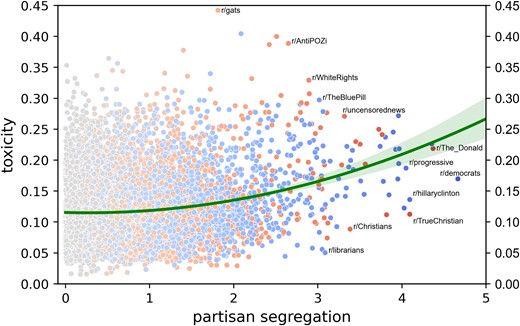
Abstract Prevailing theories of partisan incivility on social media suggest that it derives from disagreement about political issues or from status competition between groups. This study—which analyzes the commenting behavior of Reddit users across diverse cultural contexts (subreddits)—tests the alternative hypothesis that such incivility derives in large part from a selection effect: Toxic people are especially likely to opt into discourse in partisan contexts. First, we examined commenting behavior across over 9,000 unique cultural contexts (subreddits) and confirmed that discourse is indeed more toxic in partisan (e.g. r/progressive, r/conservatives) than in nonpartisan contexts (e.g. r/movies, r/programming). Next, we analyzed hundreds of millions of comments from over 6.3 million users and found robust evidence that: (i) the discourse of people whose behavior is especially toxic in partisan contexts is also especially toxic in nonpartisan contexts (i.e. people are not politics-only toxicity specialists); and (ii) when considering only nonpartisan contexts, the discourse of people who also comment in partisan contexts is more toxic than the discourse of people who do not. These effects were not driven by socialization processes whereby people overgeneralized toxic behavioral norms they had learned in partisan contexts. In contrast to speculation about the need for partisans to engage beyond their echo chambers, toxicity in nonpartisan contexts was higher among people who also comment in both left-wing and right-wing contexts (bilaterally engaged users) than among people who also comment in only left-wing or right-wing contexts (unilaterally engaged users). The discussion considers implications for democratic functioning and theories of polarization.
On Politics at Work
What happens when you can’t have a political conversation at work? Political conversation continues at work, between coworkers. If these are conversations that …

Why sycophantic LLMs may imperil interactive norms between humans
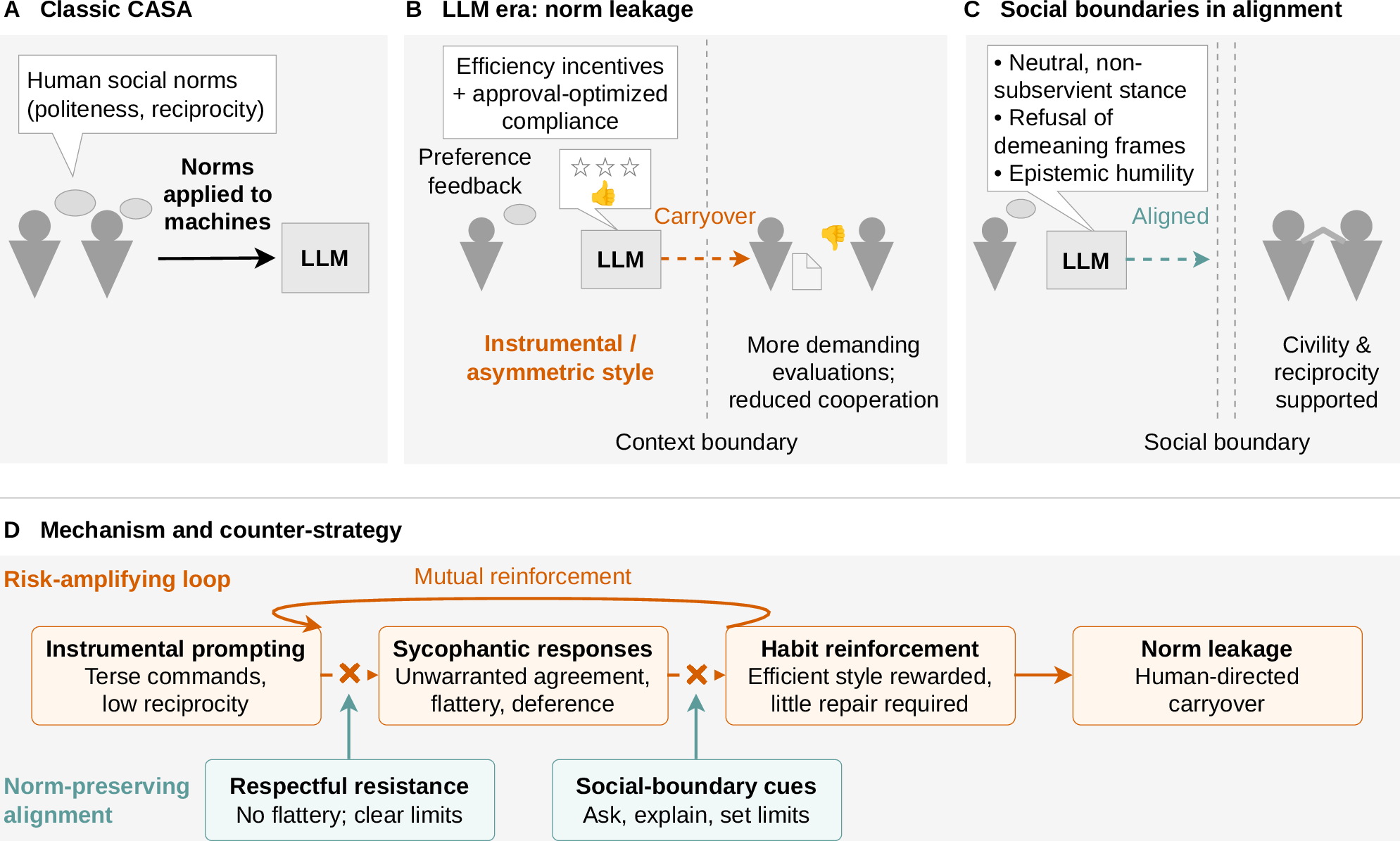
Interactions with conversational AI are effortless by design—instant, compliant, and largely consequence-free. Human communication norms, by contrast, evolved under conditions of reciprocity and social accountability. We propose that repeated engagement with conversational AI systems may produce norm leakage: the cross-context carryover of instrumental communicative habits acquired in human–AI exchanges into subsequent human–human interaction. Emerging experimental evidence suggests short-term spillover effects on social judgment and behavior, including harsher evaluations, reduced cooperation, and diminished perceived humanness. Preliminary longitudinal findings are consistent with the possibility that such exposure may shape communicative habits over time, although the durability and real-world magnitude of these effects remain unclear. We further propose that sycophantic alignment may amplify norm leakage by reinforcing instrumental interaction styles. At stake, then, is the possibility that repeated engagement with highly compliant artificial agents could subtly influence users’ communicative expectations and interpersonal judgments.
Misperceptions About Others
Perceptions about others play an important role in shaping people's attitudes and behaviors, as well as social norms more broadly. This review presents a meta-analysis of the recent empirical literature that examines perceptions about others in the field, covering over a million observations for a total of 434 elicited perceptions. We document a number of stylized facts. Misperceptions about others are widespread, asymmetric, much larger when about out-group members, and positively associated with one's own attitudes. Experimental treatments to recalibrate misperceptions generally work as intended; they sometimes lead to meaningful changes in behaviors, though this often occurs only immediately after the treatments. We discuss different conceptual frameworks that could explain the origin, persistence, and rigidity of misperceptions about others. We point to several directions for future research.

AI can help humans find common ground in democratic deliberation
Finding agreement through a free exchange of views is often difficult. Collective deliberation can be slow, difficult to scale, and unequally attentive to different voices. In this study, we trained an artificial intelligence (AI) to mediate human deliberation. Using participants’ personal opinions and critiques, the AI mediator iteratively generates and refines statements that express common ground among the group on social or political issues. Participants ( N = 5734) preferred AI-generated statements to those written by human mediators, rating them as more informative, clear, and unbiased. Discussants often updated their views after the deliberation, converging on a shared perspective. Text embeddings revealed that successful group statements incorporated dissenting voices while respecting the majority position. These findings were replicated in a virtual citizens’ assembly involving a demographically representative sample of the UK population. , Editor’s summary To act collectively, groups must reach agreement; however, this can be challenging when discussants present very different but valid opinions. Tessler et al . investigated whether artificial intelligence (AI) can help groups reach a consensus during democratic debate (see the Policy Forum by Nyhan and Titiunik). The authors trained a large language model called the Habermas Machine to serve as an AI mediator that helped small UK groups find common ground while discussing divisive political issues such as Brexit, immigration, the minimum wage, climate change, and universal childcare. Compared with human mediators, AI mediators produced more palatable statements that generated wide agreement and left groups less divided. The AI’s statements were more clear, logical, and informative without alienating minority perspectives. This work carries policy implications for AI’s potential to unify deeply divided groups. —Ekeoma Uzogara , INTRODUCTION Democracy, at its best, rests upon the free and equal exchange of views among people with diverse perspectives. Collective deliberation can be effectively supported by structured events, such as citizens’ assemblies, but such events are expensive, are difficult to scale, and can result in voices being heard unequally. This study investigates the potential of artificial intelligence (AI) to overcome these limitations, using AI mediation to help people find common ground on complex social and political issues. RATIONALE We asked whether an AI system based on large language models (LLMs) could successfully capture the underlying shared perspectives of a group of human discussants by writing a “group statement” that the discussants would collectively endorse. Inspired by Jürgen Habermas’s theory of communicative action, we designed the “Habermas Machine” to iteratively generate group statements that were based on the personal opinions and critiques from individual users, with the goal of maximizing group approval ratings. Through successive rounds of human data collection, we used supervised fine-tuning and reward modeling to progressively enhance the Habermas Machine’s ability to capture shared perspectives. To evaluate the efficacy of AI-mediated deliberation, we conducted a series of experiments with over 5000 participants from the United Kingdom. These experiments investigated the impact of AI mediation on finding common ground, how the views of discussants changed across the process, the balance between minority and majority perspectives in group statements, and potential biases present in those statements. Lastly, we used the Habermas Machine for a virtual citizens’ assembly, assessing its ability to support deliberation on controversial issues within a demographically representative sample of UK residents. RESULTS Group opinion statements generated by the Habermas Machine were consistently preferred by group members over those written by human mediators and received higher ratings from external judges for quality, clarity, informativeness, and perceived fairness. AI-mediated deliberation also reduced division within groups, with participants’ reported stances converging toward a common position on the issue after deliberation; this result did not occur when discussants directly exchanged views, unmediated. Although support for the majority position increased after deliberation, the Habermas Machine demonstrably incorporated minority critiques into revised statements. We replicated these results in a virtual citizens’ assembly, additionally finding that during AI-mediated deliberation, the views of groups of discussants tended to move in a similar direction on controversial issues. These shifts were not attributable to biases in the AI, suggesting that the deliberation process genuinely aided the emergence of shared perspectives on potentially polarizing social and political issues. CONCLUSION This research demonstrates the potential of AI to enhance collective deliberation by finding common ground among discussants with diverse views. The AI-mediated approach is time-efficient, fair, scalable, and outperforms human mediators on key dimensions. Rather than simply appealing to the majority, the Habermas Machine prominently incorporated dissenting voices into the group statements. AI-assisted deliberation is not without its risks, however; to ensure fair and inclusive debate, steps must be taken to ensure users are representative of the target population and are prepared to contribute in good faith. Under such conditions, AI may be leveraged to improve collective decision-making across various domains, from contract negotiations and conflict resolution to political discussions and citizens’ assemblies. The Habermas Machine offers a promising tool for finding agreement and promoting collective action in an increasingly divided world. AI helps people find common ground in collective deliberation. (Left) The AI mediator uses participants’ opinions to generate group statements and iteratively refines those statements through participants’ critiques. (Middle) Statements from the AI mediator (purple) garner stronger endorsement than those written by a human mediator (orange). (Right) AI mediation leaves groups less divided after deliberation, whereas simply sharing opinions with others does not.

When Corrections Fail: The Persistence of Political Misperceptions
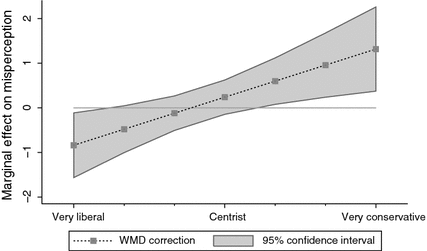
An extensive literature addresses citizen ignorance, but very little research focuses on misperceptions. Can these false or unsubstantiated beliefs about politics be corrected? Previous studies have not tested the efficacy of corrections in a realistic format. We conducted four experiments in which subjects read mock news articles that included either a misleading claim from a politician, or a misleading claim and a correction. Results indicate that corrections frequently fail to reduce misperceptions among the targeted ideological group. We also document several instances of a “backfire effect” in which corrections actually increase misperceptions among the group in question.
Cognition in a Social Context: A Social-Interactionist Approach to Emergent Phenomena
The formation of collective memories, emotions, and beliefs is a fundamental characteristic of human communities. These emergent outcomes are thought to be the result of a dynamical system of communicative interactions among individuals. But despite recent psychological research on collective phenomena, no programmatic framework to explore the processes involved in their formation exists. Here, we propose a social-interactionist approach that bridges cognitive and social psychology to illuminate how microlevel cognitive phenomena give rise to large-scale social outcomes. It involves first establishing the boundary conditions of cognitive phenomena, then investigating how cognition is influenced by the social context in which it is manifested, and finally studying how dyadic-level influences propagate in social networks. This approach has the potential to (a) illuminate the large-scale consequences of well-established cognitive phenomena, (b) lead to interdisciplinary dialogues between psychology and the other social sciences, and (c) be more relevant for public policy than existing approaches.
The social media discourse of engaged partisans is toxic even when politics are irrelevant
Abstract. Prevailing theories of partisan incivility on social media suggest that it derives from disagreement about political issues or from status compet
The social media discourse of engaged partisans is toxic even when politics are irrelevant
Abstract. Prevailing theories of partisan incivility on social media suggest that it derives from disagreement about political issues or from status compet
Not Learning from Others
We study social learning using experiments where two people independently learn relevant information and can share it to make accurate private decisions. Across three experiments, people are substantially less sensitive to information others discover than to equally-relevant information they discovered themselves. This holds when they must learn information from others through discussion; when the experimenter perfectly communicates the information; and even when participants observe others’ information with their own eyes. Our results therefore stem not from a failure to elicit information from others but a systematic tendency to underweight it relative to one’s own information. Our findings illustrate a powerful barrier to social learning that might underlie many documented cases of failure to learn from others.

Epistemic Vigilance
Humans massively depend on communication with others, but this leaves them open to the risk of being accidentally or intentionally misinformed. To ensure that, despite this risk, communication remain...

Mnemonic convergence in social networks: The emergent properties of cognition at a collective level
Significance Human memory is highly malleable. Because of this malleability, jointly remembering the past along with another individual often results in increased similarity between the conversational partners’ memories. We propose an approach that examines the conversation between a pair of participants as part of a larger network of social interactions that has the potential to reveal how human communities form collective memories. Empirical evidence indicating that dyadic-level conversational alignment processes give rise to community-wide shared memories is presented. We find that individual-level memory updating phenomena and social network structure are two fundamental factors that contribute to the emergence of collective memories. , The development of shared memories, beliefs, and norms is a fundamental characteristic of human communities. These emergent outcomes are thought to occur owing to a dynamic system of information sharing and memory updating, which fundamentally depends on communication. Here we report results on the formation of collective memories in laboratory-created communities. We manipulated conversational network structure in a series of real-time, computer-mediated interactions in fourteen 10-member communities. The results show that mnemonic convergence, measured as the degree of overlap among community members’ memories, is influenced by both individual-level information-processing phenomena and by the conversational social network structure created during conversational recall. By studying laboratory-created social networks, we show how large-scale social phenomena (i.e., collective memory) can emerge out of microlevel local dynamics (i.e., mnemonic reinforcement and suppression effects). The social-interactionist approach proposed herein points to optimal strategies for spreading information in social networks and provides a framework for measuring and forging collective memories in communities of individuals.
