The high level of inequality of income and wealth across individuals, groups, and nations is widely regarded as among the most fundamental problems facing humanity. Yet democracies often elect and reelect politicians who deliver policies that exacerbate rather than reduce inequality. We argue that this disconnect arises from three basic features of human social cognition that evolved for interpersonal interactions in small groups rather than for navigating the vast political, economic, and technological systems that shape contemporary life: a focus on local notions of equality and equity between socially connected individuals rather than across society at large; group identification, which directs attention to inequality between groups rather than “pure” inequality across the broader population; and what we call the “i-frame bias”—a tendency to explain social outcomes, including inequality, as the product of individual behaviors, taking the system within which those individuals operate as a given. We extend our analysis to examine how economic elites exploit these features of social cognition to shape the political and policy landscape and examine the role psychology can play in reducing inequality.
The persistence of cognitive biases in financial decisions across economic groups
While economic inequality continues to rise within countries, efforts to address it have been largely ineffective, particularly those involving behavioral approaches. It is often implied but not tested that choice patterns among low-income individuals may be a factor impeding behavioral interventions aimed at improving upward economic mobility. To test this, we assessed rates of ten cognitive biases across nearly 5000 participants from 27 countries. Our analyses were primarily focused on 1458 individuals that were either low-income adults or individuals who grew up in disadvantaged households but had above-average financial well-being as adults, known as positive deviants. Using discrete and complex models, we find evidence of no differences within or between groups or countries. We therefore conclude that choices impeded by cognitive biases alone cannot explain why some individuals do not experience upward economic mobility. Policies must combine both behavioral and structural interventions to improve financial well-being across populations.

If you rise, I fall: Equality is prevented by the misperception that it harms advantaged groups
Nine preregistered studies ( n = 4197) demonstrate that advantaged group members misperceive equality as necessarily harming their access to resources and inequality as necessarily benefitting them. Only when equality is increased within their ingroup, instead of between groups, do advantaged group members accurately perceive it as unharmful. Misperceptions persist when equality-enhancing policies offer broad benefits to society or when resources, and resource access, are unlimited. A longitudinal survey of the 2020 U.S. voters reveals that harm perceptions predict voting against actual equality-enhancing policies, more so than voters’ political and egalitarian beliefs. Finally two novel-groups experiments reveal that advantaged participants’ harm misperceptions predict voting for inequality-enhancing policies that financially hurt them and against equality-enhancing policies that financially benefit them. Misperceptions persist even after an intervention to improve decision-making. This misperception that equality is necessarily zero-sum may explain why inequality prevails even as it incurs societal costs that harm everyone. , Advantaged groups misperceive equality as harming their resource access, which predicts voting against equality policies.

Analytical Democratic Theory: A Microfoundational Approach
A prominent and publicly influential literature challenges the quality of democratic decision making, drawing on political science findings with specific claims about the ubiquity of cognitive bias to lament citizens’ incompetence. A competing literature in democratic theory defends the wisdom of crowds, drawing on a cluster of models in support of the capacity of ordinary citizens to produce correct outcomes. In this Letter, we draw on recent findings in psychology to demonstrate that the former literature is based on outdated and erroneous claims and that the latter is overly sanguine about the circumstances that yield reliable collective decision making. By contrast, “interactionist” scholarship shows how individual-level biases are not devastating for group problem solving, given appropriate conditions. This provides possible microfoundations for a broader research agenda similar to that implemented by Elinor Ostrom and her colleagues on common-good provision, investigating how different group structures are associated with both success and failure in democratic decision making. This agenda would have implications for both democratic theory and democratic practice.
Do the disadvantaged legitimize the social system? A large-scale test of the status–legitimacy hypothesis.
Affluence and Influence
Why policymaking in the United States privileges the rich over the poor

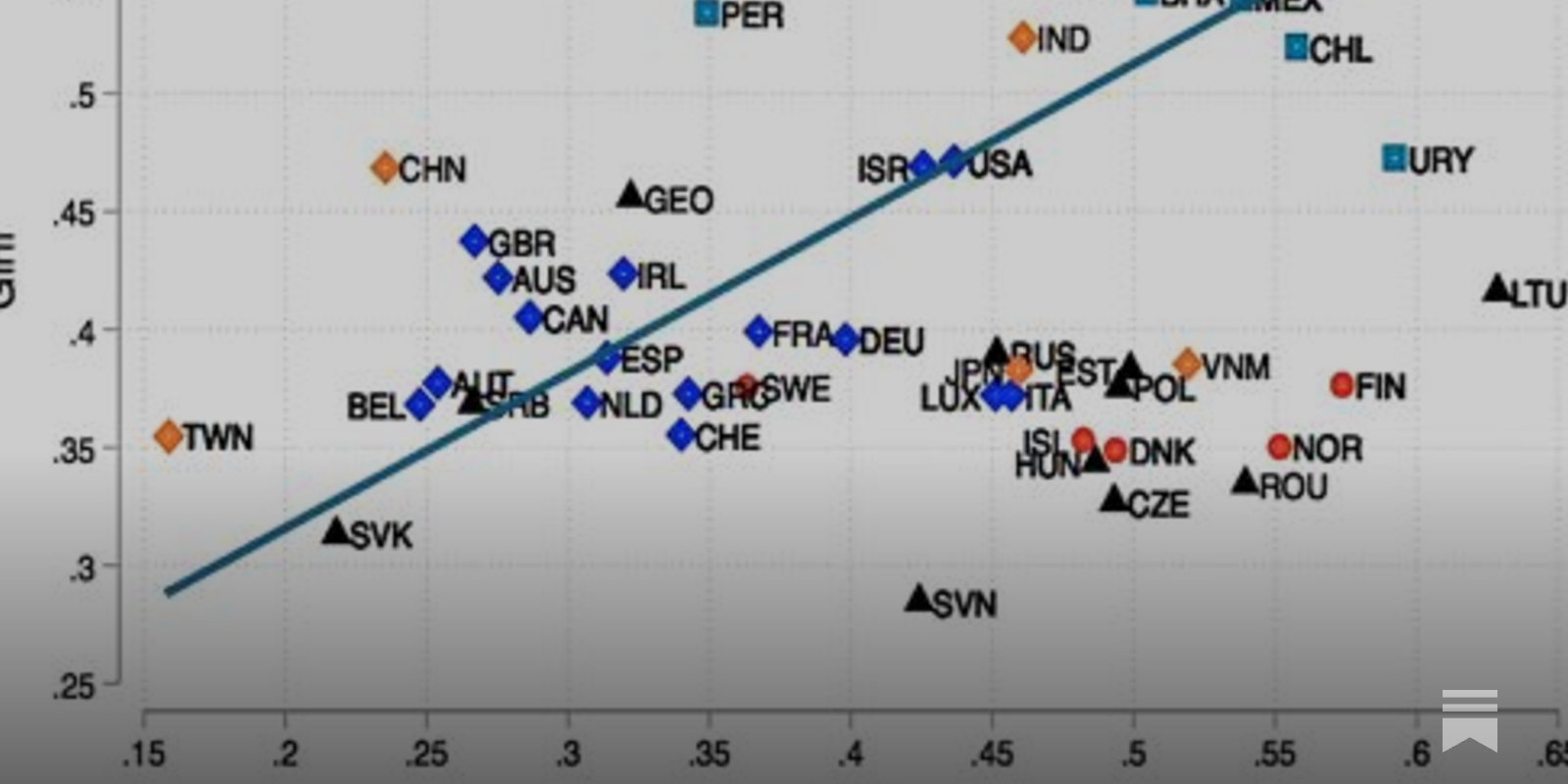
New Capitalism II: Compositional vs income inequality
Are all class-based societies unequal?
The Psychology of Inequality
Researchers find that much of the damage done by being poor comes from feeling poor.

The marketplace of rationalizations
Recent work in economics has rediscovered the importance of belief-based utility for understanding human behaviour. Belief ‘choice’ is subject to an important constraint, however: people can only bring themselves to believe things for which they can find rationalizations. When preferences for similar beliefs are widespread, this constraint generates rationalization markets, social structures in which agents compete to produce rationalizations in exchange for money and social rewards. I explore the nature of such markets, I draw on political media to illustrate their characteristics and behaviour, and I highlight their implications for understanding motivated cognition and misinformation.
A 26-year-old MIT graduate is turning heads over his theory that income inequality is actually…
Wealthy tech founders and the automation of middle-class jobs are often blamed for increasingly concentrations of wealth in the 1%. But, a…

Why The Rich Think The Poor Are Lazy
Echo Chambers and Their Effects on Economic and Political Outcomes
In this review, we survey the economics literature on echo chambers. We identify echo chambers as arising from a combination of two phenomena: ( a) the choice of individuals to segregate with like-minded ones, i.e., the creation of chambers, and ( b) behavioral biases that induce polarization when individuals exchange beliefs in these chambers, i.e., the echo. We summarize the literatures on these two phenomena and suggest how to combine the two literatures to gain insights about the effects of echo chambers on economic and political outcomes. We end by suggesting pathways for future research and discussing policy interventions to alleviate echo chambers.

Inequality can double the energy required to secure universal decent living
Ecological breakdown and economic inequality are among the largest contemporary global challenges, and the issues are thoroughly entangled – as they have been throughout the history of civilisations. Yet, the global economy continues toward ecological crises, and inequalities remain far higher than citizens believe to be fair. Here, we explore the role of inequality, alongside traditional drivers of ecological impacts, in determining global energy requirements for providing universal decent living. We consider scenarios from fair inequality – where inequalities mirror public ideals – through a fairly unequal world, to one with a super-rich global elite. The energy-costs of inequality appear far more significant than population: even fair levels increase the energy required to provide universal decent living by 40%, and a super-rich global 1% could consume as much energy as would providing decent living to 1.7 billion. We finish by arguing that total population remains important nonetheless, but for reasons beyond ecological impacts.

The Origin and Future of Economic Inequality
Norms: An Integrated Framework
Norms are a foundational concept in sociology. Following a period of skepticism about norms as overly deterministic and as paying too little attention to social conflict, inequalities, and agency, the past 20 years have seen a proliferation of norms research across the social sciences. Here we focus on the burgeoning research in sociology to answer questions about where norms come from, why people enforce them, and how they are applied. To do so, we rely on three key theoretical approaches in the literature—consequentialist, relational, and agentic. As we apply these approaches, we explore their implications for what are arguably the two most fundamental issues in sociology—social order and inequality. We conclude by synthesizing and building on existing norms research to produce an integrated theoretical framework that can shed light on aspects of norms that are currently not well understood—in particular, their change and erosion.

The Dispersion of Power: A Critical Realist Theory of Democracy
Abstract The Dispersion of Power is an urgent call to rethink centuries of conventional wisdom about what democracy is, why it matters, and how to make it better. Drawing from history, social science, psychology, and critical theory, it explains why elections do not and cannot realize the classic ideal of popular rule, and why prevailing strategies of democratic reform often make things worse. Instead, Bagg argues, we should see democracy as a way of protecting public power from capture—an alternative vision that is at once more realistic and more inspiring. Despite their many shortcomings, real-world elections do prevent the most extreme forms of tyranny, and are therefore indispensable. In dealing with the vast inequalities that remain, however, we cannot rely on standard solutions such as electoral reform, direct democracy, deliberation, and participatory governance. Instead, Bagg shows, protecting and enriching democracy requires addressing underlying inequalities of power directly. In part, this entails substantive policies attacking the advantages of wealthy elites. Even more crucially, deepening democracy requires the organization of oppositional, countervailing power among ordinary people. Neither task is easy, but historical precedents exist in both cases—and if democracy is to survive contemporary crises, leaders and citizens alike must find ways to revive and reinvent these essential democratic practices for the twenty-first century.

Meritocracy: the great delusion that ingrains inequality | Jo Littler
From Theresa May to Donald Trump, our leaders sell it as a utopian system of fairness – but ‘merit’ has been manipulated to privilege the wealthy