Previous research (Lane, Napier, Peres, & Sándor, in press) has shown that despite the fact that it typically takes half as much time to issue a command to a computer application using that command's keyboard shortcut, most people issue a particular command by clicking an icon on a toolbar or by selecting the command from a pull-down menu. This study examined reasons why that might be the case with a web survey that focused on demographic characteristics of people who do and do not use keyboard shortcuts, as well as social factors of computer use that might influence use of keyboard shortcuts. Participants' shortcut usage was influenced by social factors, such as working in an environment with other shortcut users and experiential factors, primarily the hours spent using a computer per week.
Satisficing and the Use of Keyboard Shortcuts: Being Good Enough Is Enough?
Keyboard shortcuts are generally accepted as the most efficient method for issuing commands, but previous research has suggested that many people do not use them. In this study we investigate the use of keyboard shortcuts further and explore reasons why they are underutilized by users. In Experiment 1, we establish two baseline findings: (1) people infrequently use keyboard shortcuts and (2) lack of knowledge of keyboard shortcuts cannot fully account for the low frequency of use. In Experiments 2 and 3, we furthermore establish that (3) even when put under time pressure users often fail to select those methods they themselves believe to be fastest and (4) the frequency of use of keyboard shortcuts can be increased by a tool that assists users learning keyboard shortcuts. We discuss how the theoretical notion of ‘satisficing’, adopted from economic and cognitive theory, can explain our results.
Demand characteristics in human–computer experiments
Demand characteristics refer to cues that can inform participants in experiments about the hypothesis and influence their behavior. They lead researchers to erroneously infer non-existing effects, undermining the experimental integrity of empirical studies. Despite a widespread acknowledgment of their confounding influence in experimental psychology, experiments involving humans and computers to a lesser extent consider effects of demand characteristics, as computerized protocols are thought to be immune to some experimenter biases. Furthermore, demand characteristics are considered to mainly effect subjective measures. As a result, demand characteristics often remain uncontrolled in studies involving computers, and in particular for objective measures such as performance. In this paper, we present two experiments that underline the importance of demand characteristics in human–computer interaction experiments. In a text-entry study, we made participants believe they were evaluating a research-based keyboard. This belief led to increased performance and self-reported user experience. In a second study, we conducted a thought experiment on the illusion of body ownership in virtual reality, where the experimental design indicated the study hypothesis. We found hypothesis-compliant responses from participants, even when they did not experience the illusion. We conclude that demand characteristics pose a significant challenge to the interpretation and validity of human–computer experiments, even when they are fully automated. We discuss the implications and offer guidelines to mitigate effects of demand characteristics.
Hidden Costs of Graphical User Interfaces: Failure to Make the Transition from Menus and Icon Toolbars to Keyboard Shortcuts
Graphical interfaces allow users to issue commands using pull-down menus, icon toolbars, and keyboard shortcuts. Menus and icon toolbars are easier to learn, whereas keyboard shortcuts are more ef...
The Distribution of Users’ Computer Skills: Worse Than You Think
Across 33 rich countries, only 5% of the population has high computer-related abilities, and only a third of people can complete medium-complexity tasks.
Self disclosure on computer forms: meta-analysis and implications
Computer attitude affects a user's choice and/or behaviour towards working with a computer. Computer attitude consists of computer anxiety, computer liking and computer confidence. Literature indicates that computer experience has either a positive ...

Modeling the Engagement-Disengagement Cycle of Compulsive Phone Use | Proceedings of the 2019 CHI Conference on Human Factors in Computing Systems
As part of the Digital Library's transition to Open Access, new features for researchers are available in the Premium Edition. Click here to learn more.

Typing without having to type
25+ years into my career as a programmer I think I may finally be coming around to preferring type hints or even strong typing. I resisted those in the past …
How an accessibility designer adds keyboard shortcuts to a web app
Keyboard shortcuts occupy a strange area for web design.

The Decline of Usability: Revisited | datagubbe.se
What Managers Need to Know About Social Tools
To identify the value that social tools can bring to companies, the authors split employees at a large financial services firm into two groups, only one of which used an internal social platform, and observed them for six months. Those who had used the tool became 31% more likely to find coworkers with relevant expertise and 88% more likely to discover who had useful connections. Internal social tools can help employees make faster decisions, develop more innovative ideas for products and services, and become more engaged in their work and their companies. But companies that try to “go social” often fall into four traps: They (1) assume that Millennials will embrace social tools at work; (2) struggle to foster personal interaction that builds trust and promotes knowledge sharing; (3) fail to recognize how learning occurs on social tools; and (4) focus on the wrong data. The authors offer advice on how to avoid these traps.

The Psychology of a Billion-Dollar Enterprise App: Why Is Slack So Habit-Forming?
Slack isn’t just another office collaboration app. The company has been called, “the fastest-growing workplace software ever.” Recent press…

Smartphones and Cognition: A Review of Research Exploring the Links between Mobile Technology Habits and Cognitive Functioning
While smartphones and related mobile technologies are recognized as flexible and powerful tools that, when used prudently, can augment human cognition, there is also a growing perception that habitual involvement with these devices may have a negative and lasting impact on users’ ability to think, remember, pay attention, and regulate emotion. The present review considers an intensifying, though still limited, area of research exploring the potential cognitive impacts of smartphone-related habits, and seeks to determine in which domains of functioning there is accruing evidence of a significant relationship between smartphone technology and cognitive performance, and in which domains the scientific literature is not yet mature enough to endorse any firm conclusions. We focus our review primarily on three facets of cognition that are clearly implicated in public discourse regarding the impacts of mobile technology – attention, memory, and delay of gratification – and then consider evidence regarding the broader relationships between smartphone habits and everyday cognitive functioning. Along the way, we highlight compelling findings, discuss limitations with respect to empirical methodology and interpretation, and offer suggestions for how the field might progress toward a more coherent and robust area of scientific inquiry.

Thinking outside the box means thinking outside the search engine
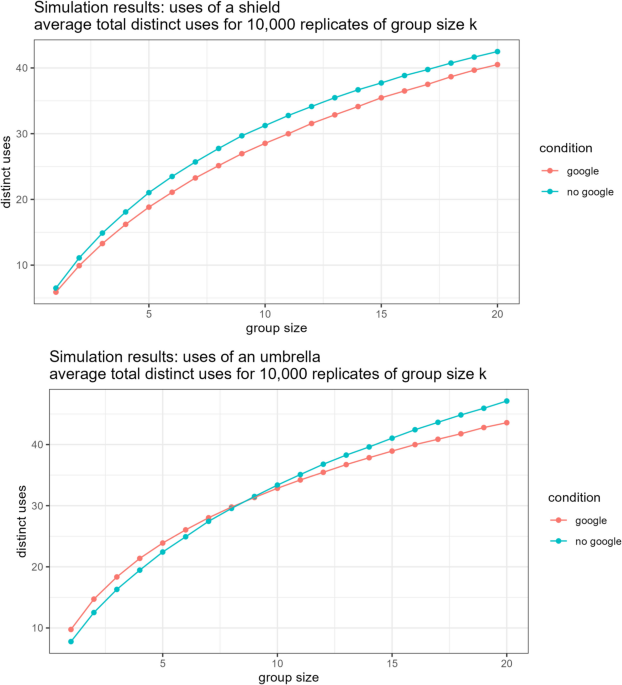
This study investigates the impact of internet access on creativity and identifies potential hidden costs of internet use for groups. Using the alternative uses task, we randomized participants (N = 244) into separate conditions to generate ideas for nonstandard uses for one of two common objects—a shield or an umbrella—either with or without internet access. Nominal group analysis reveals that while individual creativity may be enhanced by internet access, groups articulate fewer novel solutions when provided internet access, suggesting that internet access may constrain collective creative fluency. We also ran a reanalysis of previous data sets on creativity and internet use and found robust converging evidence across different paradigms, coders, and contexts. We further explore robustness by examining alternative operationalizations of fluency: quality of responses, as measured by coders’ evaluations of effectiveness, novelty, and subjective evaluations of creativity. While overall trends suggest an advantage for subjects who do not have internet access, this patterning depends to some degree on variation among coders. Implications for the way digital tools influence creative processes are discussed.
How People Use ChatGPT
Despite the rapid adoption of LLM chatbots, little is known about how they are used. We document the growth of ChatGPT’s consumer product from its launch in November 2022 through July 2025, when it had been adopted by around 10% of the world’s adult population. Early adopters were disproportionately male but the gender gap has narrowed dramatically, and we find higher growth rates in lower-income countries. Using a privacy-preserving automated pipeline, we classify usage patterns within a representative sample of ChatGPT conversations. We find steady growth in work-related messages but even faster growth in non-work-related messages, which have grown from 53% to more than 70% of all usage. Work usage is more common for educated users in highly-paid professional occupations. We classify messages by conversation topic and find that “Practical Guidance,” “Seeking Information,” and “Writing” are the three most common topics and collectively account for nearly 80% of all conversations. Writing dominates work-related tasks, highlighting chatbots’ unique ability to generate digital outputs compared to traditional search engines. Computer programming and self-expression both represent relatively small shares of use. Overall, we find that ChatGPT provides economic value through decision support, which is especially important in knowledge-intensive jobs.

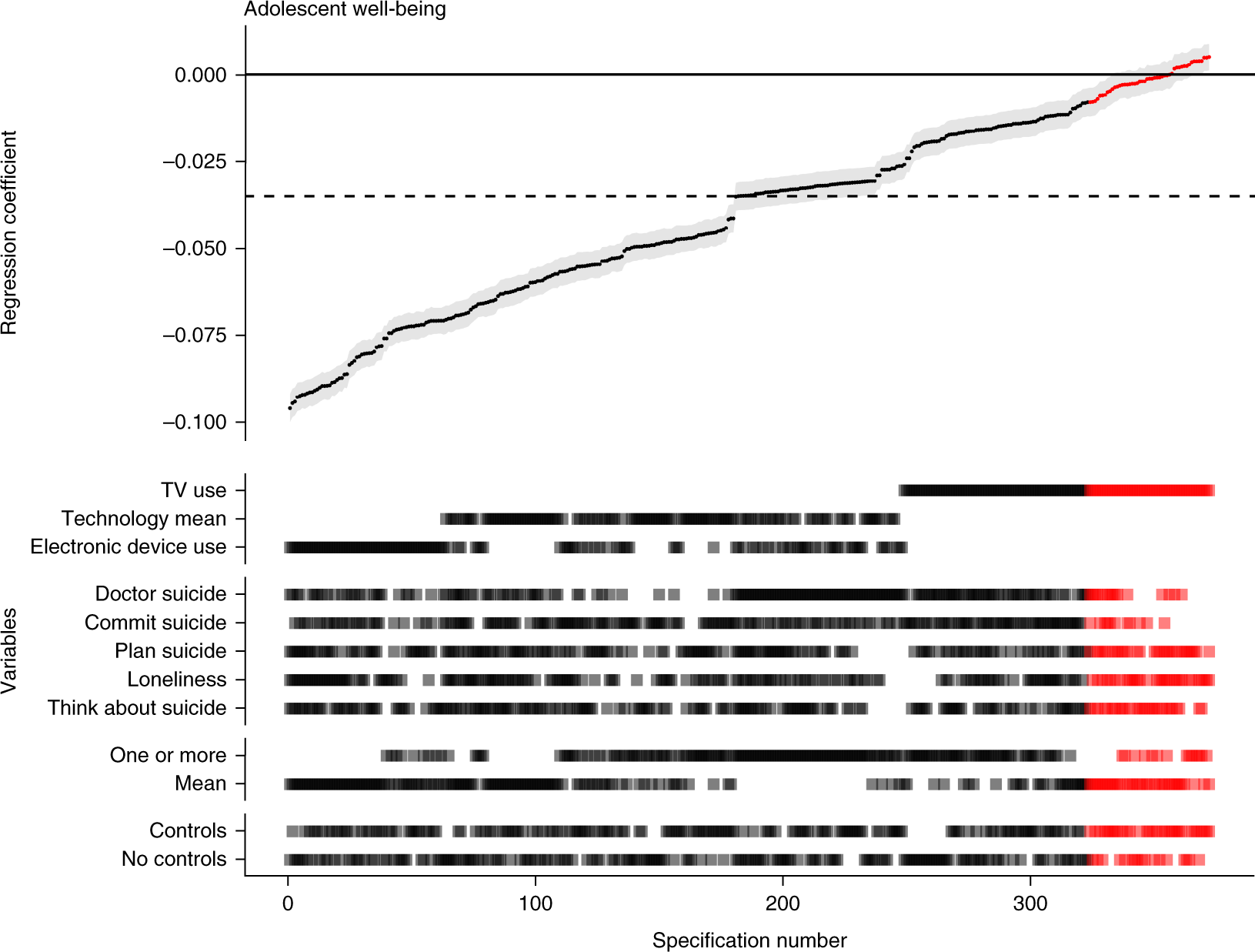
The association between adolescent well-being and digital technology use
The widespread use of digital technologies by young people has spurred speculation that their regular use negatively impacts psychological well-being. Current empirical evidence supporting this idea is largely based on secondary analyses of large-scale social datasets. Though these datasets provide a valuable resource for highly powered investigations, their many variables and observations are often explored with an analytical flexibility that marks small effects as statistically significant, thereby leading to potential false positives and conflicting results. Here we address these methodological challenges by applying specification curve analysis (SCA) across three large-scale social datasets (total n = 355,358) to rigorously examine correlational evidence for the effects of digital technology on adolescents. The association we find between digital technology use and adolescent well-being is negative but small, explaining at most 0.4% of the variation in well-being. Taking the broader context of the data into account suggests that these effects are too small to warrant policy change.