This paper uses a unique panel dataset of consumer financial transactions to study how consumers respond to an exogenous unanticipated income shock. Consumption rose significantly after the fiscal policy announcement: during the ten subsequent months, for each $1 received, consumers on average spent $0.80. We find a strong announcement effect—19 percent of the response occurs during the first two-month announcement period via credit cards. Subsequently, consumers switched to debit cards after disbursement before finally increasing spending on credit cards in the later months. Consumers with low liquid assets or with low credit card limit experienced stronger consumption responses. (JEL D12, D14, E21)
Consumption Response to Credit Expansions: Evidence from Experimental Assignment of 45,307 Credit Lines
In a field experiment that constructs a randomized credit limit shock, participants borrow to spend 11 cents on the dollar in the first quarter and 28 cents by the third year. Effects extend to those far from the limit, those who had the new limits as available credit, and those with a liquid asset buffer. In the short-run, flexible and installment contracts are used in tandem, with unconstrained using installments more. Long-run borrowing is predominantly using installments. Near limits, participants borrow when credit expands but save out of constraints when limits are tight. Findings support a buffer-stock interpretation emphasizing precautionary saving.
Asymmetric Consumption Smoothing
Analyzing account-level data from an account aggregator, we find that households increase consumption when they receive expected tax refunds, as if they face liquidity constraints. However, these same households smooth consumption when making payments in other years, primarily by transferring funds among liquid accounts. Even households carrying credit card debt smooth consumption when making payments, and even highly liquid households spend out of refunds. This behavior is inconsistent with pure liquidity constraints or hand-to-mouth behavior and is most consistent with a mental accounting life-cycle model.
Timing to the Statement: Understanding Fluctuations in Consumer Credit Use
We show that consumers spend 15% more per day in the first week following the receipt of a credit card statement than in the days just prior to the statement. This increase in spending includes both an increase in the likelihood that they use the credit card in the first weeks following their statement and an increase in transaction amount on days they use the credit card. In contrast to the effect on credit card spending, debit card spending is unaffected by credit card statement issuance, suggesting that consumers are not simply switching among modes of payment. Our estimates are based on exogenous variation from bank-assigned statement dates. We propose and test several alternative explanations to this spending puzzle: optimization of the free float, salience effect of the credit card statement, mental accounting, liquidity constraints, and automatic payments. We find that the consumers most apt to spend early in the credit card cycle tend to be those who do not revolve balances and are not close to their credit limit. Thus, this paper documents a puzzle with mixed support for several alternative explanations. This paper was accepted by David Simchi-Levi, finance.

Cash versus Debit Card: The Role of Budget Control
Due to the financial crisis, an increasing number of households face financial problems. This may lead to an increasing need for monitoring spending and budgets. We demonstrate that both cash and the debit card are perceived as helpful in this respect. We show that, on average, consumers responsible for financial decision making within a household find cash and the debit card equally helpful for monitoring their household finances. Individuals differ in major respects, however. In particular, low earners and the liquidity‐constrained prefer cash as a budgeting tool. Finally, we present evidence that at an aggregated level, such preferences strongly affect consumer payment behavior. These findings suggest that the substitution of cash by cards may slow down because of the financial crisis.

Debt and the Response to Household Income Shocks: Validation and Application of Linked Financial Account Data
The increasing availability of data derived from linked consumer financial accounts has the potential to dramatically expand the potential for research. Examining the most comprehensive existing set of linked-account data, consisting of transaction and balance sheet data for millions of Americans, I demonstrate the power and versatility of such sources. I discuss advantages and concerns arising from this type of data and match a range of distributional moments to external sources. As one application, I test consumption elasticities across households with varying levels, and types, of debt. I find that heterogeneity in consumption elasticity can be explained entirely by credit and liquidity.

On shifting consumers from high‐interest to low‐interest debt
Abstract In the United States, many consumers are increasingly accumulating debt, much of which is harmful and expensive. Prior research has devoted a great deal of attention to understanding why consumers generally get into debt and the strategies they can use to repay existing debts. While this work has furthered the agenda of helping consumers reduce or eliminate their overall debt balances, it has failed to emphasize the fact that for many consumers, debt may be unavoidable. This article aims to promote research that addresses not only overall debt reduction but also the need for consumers to shift from more to less costly types of debt. By shedding light on the psychological reasons why consumers may naturally gravitate toward more costly forms of debt when less costly ones may be available, we offer a novel perspective on why consumers get into and stay in debt longer than they should. This new angle has the potential to spur on further research into the ways consumers can use debt more effectively and less expensively in service of the overarching goal of debt reduction.

Demand for emergency savings is higher for low-income households, but so is the cost of shocks
This paper examines how the precautionary motive varies with income. I first develop a theoretical benchmark of how we would expect precaution to vary with income starting from a basic version of the buffer-stock model. Emergency savings provide a way for households to smooth over shocks and so give insight into the precautionary motive. Using data from the Survey of Consumer Finances in the USA, I show that as income declines, the desired emergency savings relative to income increase, suggesting that low-income households are more precautionary. Observable differences, such as income uncertainty, do not explain the rise. Instead, I propose and estimate a model with a minimum subsistence level and unexpected expenses. The model implies that low-income households are increasingly exposed to shocks, explaining the increase in precaution. Supporting the approach, I show that expenses on repairs are a larger fraction of the spending of low-income households.
Credit Crises, Precautionary Savings, and the Liquidity Trap*
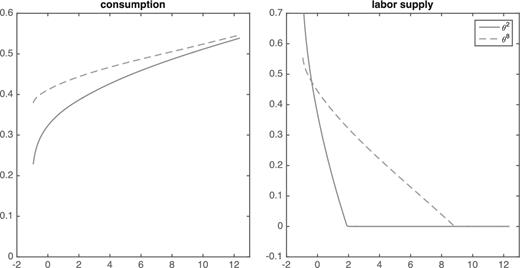
Abstract We study the effects of a credit crunch on consumer spending in a heterogeneous-agent incomplete-market model. After an unexpected permanent tightening in consumers’ borrowing capacity, constrained consumers are forced to repay their debt, and unconstrained consumers increase their precautionary savings. This depresses interest rates, especially in the short run, and generates an output drop, even with flexible prices. The output drop is larger with sticky prices, if the zero lower bound prevents the interest rate from adjusting downward. Adding durable goods to the model, households take larger debt positions and the output response can be larger.
Windfall Income and the Permanent Income Hypothesis: New Evidence
This paper examines consumer response to windfall income. By using data from the 1972–73 Consumer Expenditure Surveys, an attempt was made to test Friedman's permanent income hypothesis. The results revealed that the marginal propensity to consume regular income was greater than the marginal propensity to consume windfall income for windfalls that were large relative to regular income. However, when windfall income was less than ten percent of regular income, the relationship reversed. Implications are drawn for short and long‐run fiscal policies affecting consumers

Consumer Spending during Unemployment: Positive and Normative Implications
Using de-identified bank account data, we show that spending drops sharply at the large and predictable decrease in income arising from the exhaustion of unemployment insurance (UI) benefits. We use the high-frequency response to a predictable income decline as a new test to distinguish between alternative consumption models. The sensitivity of spending to income we document is inconsistent with rational models of liquidity-constrained households, but is consistent with behavioral models with present-biased or myopic households. Depressed spending after exhaustion also implies that the consumption-smoothing gains from extending UI benefits are four times larger than from raising UI benefit levels. (JEL D14, D91, E21, E24, E70, J65)
Household Debt: Facts, Puzzles, Theories, and Policies
Borrowing decisions affect most households, with large stakes and implications for research subfields as varied as macroeconomics and industrial organization. I review theoretical and empirical work on household debt: its prevalence, level, growth, and composition, as well as various measures of consumer choice and market (in)efficiency, elasticities, and prices, including new evidence on how borrowing heterogeneity affects the distribution of the opportunity cost of consumption. I also discuss opportunities and challenges in policy evaluation. A key takeaway is that puzzles abound, and I highlight numerous avenues for further research.

What Would You Do with $500? Spending Responses to Gains, Losses, News, and Loans
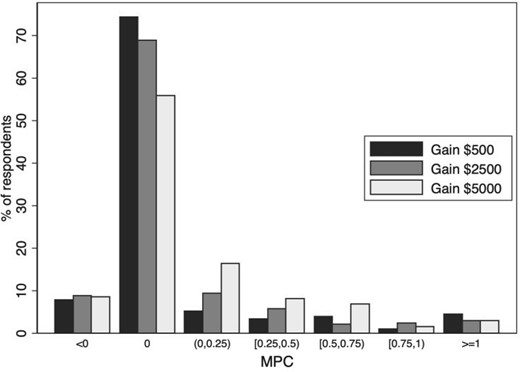
Abstract We use survey questions about spending in hypothetical scenarios to investigate features of propensities to consume that are useful for distinguishing between consumption theories. We find that (1) responses to unanticipated gains are vastly heterogeneous (either zero or substantially positive); (2) responses increase in the size of the gain, driven by the extensive margin of spending adjustments; (3) responses to losses are much larger and more widespread than responses to gains; and (4) even those with large responses to gains do not respond to news about future gains. These four findings suggest that limited access to disposable resources, and frictions in adjusting consumption, are important determinants of consumption behaviour. We also find that (5) households do not respond to the offer of a one-year interest-free loan, suggesting that this is not a consequence of short-term credit constraints; and (6) people do cut spending in response to news about future losses, suggesting that neither is this a consequence of myopia. A calibrated precautionary savings model with utility costs of changing consumption, and a sufficient fraction of low-wealth households, can account for these features of propensities to consume on both the extensive and intensive margins.
When Motivation is against Debtors' Best Interest: The Illusion of Goal Progress in Credit Card Debt Repayment
The authors explore the illusion of goal progress by consumers who own multiple credit cards and pay off their debt balances to facilitate the achievement of their subgoal rather than the superordinate goal of being debt-free. The first experiment shows that debtors use their savings toward the credit card debt they can pay off entirely or substantially, even if it is associated with the smallest balance and the lowest annual percentage rate rather than toward the debt with the highest annual percentage rate. The second experiment reveals that when the income available to pay down the debt is in the form of effortless money (i.e., windfall or reward money) as opposed to hard-earned savings, the tendency to allocate money toward the smallest credit card debt is exacerbated. However, people tend to pay their debt more rationally when the number of debt accounts increases. Finally, the third experiment shows that credit card debt repayment decisions depend on the nature of the debt (hedonic vs. utilitarian) and the timing of consumption benefits (past vs. future). The article concludes with a discussion of managerial and public policy implications.

Managing Mental Accounts: Payment Cards and Consumption Expenditures
Does mental accounting matter for total consumption expenditures? We exploit a unique setting in which individuals exogenously received a new credit card, without requesting one. Using random variation in the time of receipt we show that individuals temporarily increase total consumption expenditure by making purchases with the new card without reducing spending on the others. We do not observe a corresponding increase in indebtedness. Total consumption expenditure rises even for the least liquidity-constrained individuals. The evidence is consistent with consumers treating methods of payment as nonfungible budget categories, as suggested by models of mental accounting and narrow bracketing.

Reducing debt improves psychological functioning and changes decision-making in the poor
Significance The impact of chronic debt on the poor is psychological, not just financial. We hypothesize that chronic debt impairs psychological functioning and decision-making, contributing to the poverty trap. This is because debt is not considered fungible and is viewed as costly mental accounts that consume cognitive bandwidth. We test this using quasiexperimental evidence from a one-off, unanticipated debt-relief program worth several months’ household income. Comparing the poor before and after debt relief, those with more debt accounts paid off experienced greater improvements in cognitive functioning, reported less anxiety, and became less present-biased. These findings provide actionable evidence for poverty-alleviation policy. , We examine how chronic debt affects behavior by studying how a large, unanticipated debt-relief program affected psychological functioning and economic decision-making in beneficiaries. A charity granted low-income households debt relief worth up to Singapore dollars 5,000 (∼3 month’s household income). We exploited quasiexperimental variation in the structure of debt relief: For the same dollar amount of relief, some beneficiaries had more debt accounts eliminated, while others had fewer paid off. Comparing 196 beneficiaries before and after debt relief, and controlling for debt-relief amount, having an additional debt account paid off improves cognitive functioning by about one-quarter of a SD and reduces the likelihood of exhibiting anxiety by 11% and of present bias by 10%. To achieve the same effect on cognitive functioning of eliminating one debt account, a beneficiary must receive debt relief worth ∼1 month’s household income. There is no effect of debt-relief magnitude on anxiety and decision-making. We exclude training and calendar effects, debt-causing behaviors, and liquidity constraints as explanations. Instead, these results support the hypothesis that chronic debt impairs behavior because the mental-accounting costs of owing distinct debt accounts consume mental bandwidth. Poverty-alleviation policies aimed at the indebted poor should consider addressing mental accounting and bandwidth taxes.

Do Liquidity Constraints and Interest Rates Matter for Consumer Behavior? Evidence from Credit Card Data
Abstract. This paper utilizes a unique data set of credit card accounts to analyze how people respond to credit supply. Increases in credit limits generate