

We survey the recent literature in economics using open-ended survey data to uncover mechanisms behind economic beliefs and behaviors. We first provide an overview of different applications, including the measurement of motives, mental models, narratives, attention, information transmission, and recall. We next describe different ways of eliciting open-ended responses, including single-item open-ended questions, speech recordings, and artificial intelligence–powered qualitative interviews. Subsequently, we discuss methods to annotate and analyze such data with a focus on recent advances in large language models. Our review concludes with a discussion of promising avenues for future research. (JEL C83, C90, D83, D91)
Understanding Economic Behavior Using Open-Ended Survey Data
We survey the recent literature in economics using open-ended survey data to uncover mechanisms behind economic beliefs and behaviors. We first provide an overview of different applications, including the measurement of motives, mental models, narratives, attention, information transmission, and recall. We next describe different ways of eliciting open-ended responses, including single-item open-ended questions, speech recordings, and artificial intelligence–powered qualitative interviews. Subsequently, we discuss methods to annotate and analyze such data with a focus on recent advances in large language models. Our review concludes with a discussion of promising avenues for future research.
Interpretable Discovery from Unstructured Data: A High-Dimensional Approach
We propose an automatic, general-purpose framework for making discoveries from unstructured data (e.g., text data from open-ended surveys of economic beliefs). The framework leverages recent methods from the literature on AI interpretability to transform unstructured datasets into high-dimensional, structured datasets of interpretable concept measurements; specifies concept-level parameters and null hypotheses based on this transformed dataset; tests these hypotheses using algorithms validated by new results in high-dimensional multiple testing, producing a selected set ("discoveries"); and both generates and evaluates human-interpretable natural language descriptions of these discoveries. The proposed framework has few researcher degrees of freedom, is robust to data snooping, mitigates under-exploration, and facilitates fast and inexpensive sensitivity analysis and replication. We revisit applications to recent descriptive and causal analyses of unstructured data in empirical economics, and find this framework is able to automatically replicate existing discoveries, add nuance to others, and make entirely new discoveries as well.

Generative AI Meets Open-Ended Survey Responses: Research Participant Use of AI and Homogenization
The growing popularity of generative artificial intelligence (AI) tools presents new challenges for data quality in online surveys and experiments. This study examines participants’ use of large language models to answer open-ended survey questions and describes empirical tendencies in human versus large language model (LLM)-generated text responses. In an original survey of research participants recruited from a popular online platform for sourcing social science research subjects, 34 percent reported using LLMs to help them answer open-ended survey questions. Simulations comparing human-written responses from three pre-ChatGPT studies with LLM-generated text reveal that LLM responses are more homogeneous and positive, particularly when they describe social groups in sensitive questions. These homogenization patterns may mask important underlying social variation in attitudes and beliefs among human subjects, raising concerns about data validity. Our findings shed light on the scope and potential consequences of participants’ LLM use in online research.

Exploring Psychology in the Field: Steps and Examples From the Used‐Car Market
Abstract The growing availability of large datasets in a variety of domains presents an opportunity for researchers to use field data to better understand psychological concepts. I discuss, from an empirical economics point of view, steps for how to study cognition in large datasets. I use two recent papers that explore psychology in the used‐car market as motivating examples. These examples help illustrate the potential importance of big data as a way to explore human psychology and cognition. , The growing availability of large datasets in a variety of domains presents an opportunity for researchers to use field data to better understand psychological concepts. I discuss from an empirical economics point of view, steps for how to study cognition in large datasets and illustrate these steps with recent empirical papers.

Narratives about the Macroeconomy
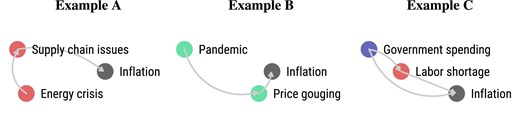
Abstract We study narratives about the macroeconomy—the stories people tell to explain macroeconomic phenomena—in the context of a historic surge in inflation. In our empirical analysis, we field surveys with more than 10,000 U.S. households and 100 academic experts, measure economic narratives in open-ended questions, and represent them as directed acyclic graphs. Households’ narratives are strongly heterogeneous, coarser than experts’ narratives, focus more on the supply than the demand side, and often feature politically charged explanations. Moreover, narratives shape how households form inflation expectations and interpret new information, which we demonstrate in a series of experiments. Informed by these findings, our theoretical analysis incorporates narratives into an otherwise conventional New Keynesian model and demonstrates their importance for aggregate outcomes through their effect on agents’ expectations.
Take caution in using LLMs as human surrogates
Recent studies suggest large language models (LLMs) can generate human-like responses, aligning with human behavior in economic experiments, surveys, and political discourse. This has led many to propose that LLMs can be used as surrogates or simulations for humans in social science research. However, LLMs differ fundamentally from humans, relying on probabilistic patterns, absent the embodied experiences or survival objectives that shape human cognition. We assess the reasoning depth of LLMs using the 11-20 money request game. Nearly all advanced approaches fail to replicate human behavior distributions across many models. The causes of failure are diverse and unpredictable, relating to input language, roles, safeguarding, and more. These results warrant caution in using LLMs as surrogates or for simulating human behavior in research.

Large Language Models for Market Research: A Data-Augmentation Approach
This paper proposes a statistical data augmentation approach that efficiently integrates LLM-generated data with real data in conjoint analysis. , Large language models (LLMs) have transformed artificial intelligence by excelling in complex natural language processing tasks. Their ability to generate human-like text has opened new possibilities for market research, particularly in conjoint analysis, where understanding consumer preferences is essential but often resource intensive. Traditional survey-based methods face limitations in scalability and cost, making LLM-generated data a promising alternative. However, although LLMs have the potential to simulate real consumer behavior, recent studies highlight a significant gap between LLM-generated and human data, with biases introduced when substituting between the two. In this paper, we address this gap by proposing a novel statistical data augmentation approach that efficiently integrates LLM-generated data with real data in conjoint analysis. This results in statistically robust estimators with consistent and asymptotically normal properties, in contrast to naïve approaches that simply substitute human data with LLM-generated data, which can exacerbate bias. We further present a finite-sample performance bound on the estimation error. We validate our framework through an empirical study on COVID-19 vaccine preferences, demonstrating its superior ability to reduce estimation error and save data and costs by 24.9%–79.8%. In contrast, naïve approaches fail to save data due to the inherent biases in LLM-generated data compared with human data. Another empirical study on sports car choices validates the robustness of our results. Our findings suggest that, although LLM-generated data are not a direct substitute for human responses, they can serve as a valuable complement when used within a robust statistical framework. History: Hema Yoganarasimhan served as the senior editor. Funding: This work was supported by OpenAI Research funding. Supplemental Material: The online appendices and data files are available at https://doi.org/10.1287/mksc.2025.0009 .

Large Language Models: An Applied Econometric Framework
Large language models (LLMs) enable researchers to analyze text at unprecedented scale and minimal cost. Researchers can now revisit old questions and tackle novel ones with rich data. We provide an econometric framework for realizing this potential in two empirical uses. For prediction problems—forecasting outcomes from text—valid conclusions require “no training leakage” between the LLM's training data and the researcher's sample, which can be enforced through careful model choice and research design. For estimation problems—automating the measurement of economic concepts for downstream analysis—valid downstream inference requires combining LLM outputs with a small validation sample to deliver consistent and precise estimates. Absent a validation sample, researchers cannot assess possible errors in LLM outputs, and consequently seemingly innocuous choices (which model, which prompt) can produce dramatically different parameter estimates. When used appropriately, LLMs are powerful tools that can expand the frontier of empirical economics.

Reason-Mediated Behavioral Models for Auditing LLM Social Simulators
Large language models are increasingly used as social simulators, including as synthetic survey respondents. Most evaluations ask whether simulated outcomes resemble human outcomes. We argue that this is necessary but too weak: a simulator can match the final answer while using the wrong behavioral mechanism. We study this problem through a 94-person sunscreen concept test in which each respondent evaluated three product concepts and wrote open-ended rationales. We map those rationales into signed reason states $Z$, where positive signs support adoption and negative signs block it. This gives a practical audit: holding respondent descriptors $D$, category context $K$, and concept treatment $X$ fixed, do human-stated reasons help predict behavior $Y$, and can an LLM simulate the same reason state without seeing the human rationale or outcome? Human-stated reasons substantially improve held-out prediction of purchase intent. LLM-simulated reasons are more brittle: they often sound plausible, but frequently echo the concept board rather than recover the respondent's acceptance or rejection path. The paper contributes an evaluation framework for social simulators. Reason states do not identify natural causal effects by themselves, but they provide an interpretable test of whether a simulator's stated reasons align with human evidence.
The GenAI Future of Consumer Research
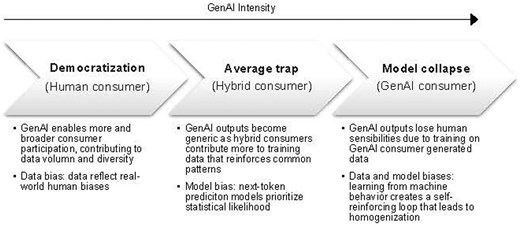
Abstract We develop a novel generative AI (GenAI) trajectory, “democratization-average trap-model collapse,” to identify data and model challenges posed by GenAI, from which we project the GenAI future of consumer research. This trajectory consists of three key phenomena: democratization broadens consumer participation, the average trap produces generic responses, and model collapse occurs when GenAI outputs lose human sensibilities. Data and model challenges arise as democratization enhances data representation while also embedding real-world biases. The average trap, caused by next-token prediction models, leads to generic outputs that lack individuality. Additionally, model collapse occurs when GenAI increasingly learns from its own outputs, amplifying machine bias and diverging from human behavior. To address these challenges, researchers can leverage democratization to study marginalized consumers and prioritize human-centered research over purely data-driven methods. The average trap can be mitigated by fine-tuning models with task-specific and marginalized consumption data while engineering responses for uniqueness. Preventing model collapse requires integrating human–machine hybrid data and applying theories of mind to realign AI with human-centric consumption. Finally, we outline three future research directions: preserving data distribution tails to support consumption democratization, countering the average trap in next-token prediction, and reversing the trajectory from democratization to model collapse.
Are Large Language Models Sensitive to the Motives Behind Communication?
Human communication is $\textit{motivated}$: people speak, write, and create content with a particular communicative intent in mind. As a result, information that large language models (LLMs) and AI agents process is inherently framed by humans' intentions and incentives. People are adept at navigating such nuanced information: we routinely identify benevolent or self-serving motives in order to decide what statements to trust. For LLMs to be effective in the real world, they too must critically evaluate content by factoring in the motivations of the source---for instance, weighing the credibility of claims made in a sales pitch. In this paper, we undertake a comprehensive study of whether LLMs have this capacity for $\textit{motivational vigilance}$. We first employ controlled experiments from cognitive science to verify that LLMs' behavior is consistent with rational models of learning from motivated testimony, and find they successfully discount information from biased sources in a human-like manner. We then extend our evaluation to sponsored online adverts, a more naturalistic reflection of LLM agents' information ecosystems. In these settings, we find that LLMs' inferences do not track the rational models' predictions nearly as closely---partly due to additional information that distracts them from vigilance-relevant considerations. However, a simple steering intervention that boosts the salience of intentions and incentives substantially increases the correspondence between LLMs and the rational model. These results suggest that LLMs possess a basic sensitivity to the motivations of others, but generalizing to novel real-world settings will require further improvements to these models.
The marketplace of rationalizations
Recent work in economics has rediscovered the importance of belief-based utility for understanding human behaviour. Belief ‘choice’ is subject to an important constraint, however: people can only bring themselves to believe things for which they can find rationalizations. When preferences for similar beliefs are widespread, this constraint generates rationalization markets, social structures in which agents compete to produce rationalizations in exchange for money and social rewards. I explore the nature of such markets, I draw on political media to illustrate their characteristics and behaviour, and I highlight their implications for understanding motivated cognition and misinformation.

AI Behavioral Science
We outline a foundation for a new field of ``AI Behavioral Science,'' covering three perspectives. First, as AI becomes ubiquitous and is increasingly proprietary and opaque, it becomes vital to develop techniques for assessing AI behavior. We outline how tools developed to assess people's behaviors by social scientists can be used to assess and infer AI's behaviors biases, tendencies, and heuristics. Second, we also discuss how AI can change the ways in which we learn about human behavior. Beyond its computational power, AI offers new techniques for simulating, inferring, and predicting human behaviors that we outline and discuss. Third, as humans and AI are interacting in increasingly complex and intertwined systems, we need to understand the implications for the resulting economic and political outcomes. We outline issues that are increasingly pressing concerning the future of human-AI interactions and potential changes and disruptions that can ensue.
LLM-generated messages can persuade humans on policy issues
The emergence of large language models (LLMs) has made it possible for generative artificial intelligence (AI) to tackle many higher-order cognitive tasks, with critical implications for industry, government, and labor markets. Here, we investigate whether existing, openly-available LLMs can be used to create messages capable of influencing humans’ political attitudes. Across three pre-registered experiments (total N = 4829), participants who read persuasive messages generated by LLMs showed significantly more attitude change across a range of policies - including polarized policies, like an assault weapons ban, a carbon tax, and a paid parental-leave program - relative to control condition participants who read a neutral message. Overall, LLM-generated messages were similarly effective in influencing policy attitudes as messages crafted by lay humans. Participants’ reported perceptions of the authors of the persuasive messages suggest these effects occurred through somewhat distinct causal pathways. While the persuasiveness of LLM-generated messages was associated with perceptions that the author used more facts, evidence, logical reasoning, and a dispassionate voice, the persuasiveness of human-generated messages was associated with perceptions of the author as unique and original. These results demonstrate that recent developments in AI make it possible to create politically persuasive messages quickly, cheaply, and at massive scale.

Do LLMs Exhibit Human-like Response Biases? A Case Study in Survey Design
Abstract One widely cited barrier to the adoption of LLMs as proxies for humans in subjective tasks is their sensitivity to prompt wording—but interestingly, humans also display sensitivities to instruction changes in the form of response biases. We investigate the extent to which LLMs reflect human response biases, if at all. We look to survey design, where human response biases caused by changes in the wordings of “prompts” have been extensively explored in social psychology literature. Drawing from these works, we design a dataset and framework to evaluate whether LLMs exhibit human-like response biases in survey questionnaires. Our comprehensive evaluation of nine models shows that popular open and commercial LLMs generally fail to reflect human-like behavior, particularly in models that have undergone RLHF. Furthermore, even if a model shows a significant change in the same direction as humans, we find that they are sensitive to perturbations that do not elicit significant changes in humans. These results highlight the pitfalls of using LLMs as human proxies, and underscore the need for finer-grained characterizations of model behavior.1

A Framework for Studying AI Agent Behavior: Evidence from Consumer Choice Experiments
Environments built for people are increasingly operated by a new class of economic actors: LLM-powered software agents making decisions on our behalf. These decisions range from our purchases to travel plans to medical treatment selection. Current evaluations of these agents largely focus on task competence, but we argue for a deeper assessment: how these agents choose when faced with realistic decisions. We introduce ABxLab, a framework for systematically probing agentic choice through controlled manipulations of option attributes and persuasive cues. We apply this to a realistic web-based shopping environment, where we vary prices, ratings, and psychological nudges, all of which are factors long known to shape human choice. We find that agent decisions shift predictably and substantially in response, revealing that agents are strongly biased choosers even without being subject to the cognitive constraints that shape human biases. This susceptibility reveals both risk and opportunity: risk, because agentic consumers may inherit and amplify human biases; opportunity, because consumer choice provides a powerful testbed for a behavioral science of AI agents, just as it has for the study of human behavior. We release our framework as an open benchmark for rigorous, scalable evaluation of agent decision-making.