


This paper proposes a statistical data augmentation approach that efficiently integrates LLM-generated data with real data in conjoint analysis. , Large language models (LLMs) have transformed artificial intelligence by excelling in complex natural language processing tasks. Their ability to generate human-like text has opened new possibilities for market research, particularly in conjoint analysis, where understanding consumer preferences is essential but often resource intensive. Traditional survey-based methods face limitations in scalability and cost, making LLM-generated data a promising alternative. However, although LLMs have the potential to simulate real consumer behavior, recent studies highlight a significant gap between LLM-generated and human data, with biases introduced when substituting between the two. In this paper, we address this gap by proposing a novel statistical data augmentation approach that efficiently integrates LLM-generated data with real data in conjoint analysis. This results in statistically robust estimators with consistent and asymptotically normal properties, in contrast to naïve approaches that simply substitute human data with LLM-generated data, which can exacerbate bias. We further present a finite-sample performance bound on the estimation error. We validate our framework through an empirical study on COVID-19 vaccine preferences, demonstrating its superior ability to reduce estimation error and save data and costs by 24.9%–79.8%. In contrast, naïve approaches fail to save data due to the inherent biases in LLM-generated data compared with human data. Another empirical study on sports car choices validates the robustness of our results. Our findings suggest that, although LLM-generated data are not a direct substitute for human responses, they can serve as a valuable complement when used within a robust statistical framework. History: Hema Yoganarasimhan served as the senior editor. Funding: This work was supported by OpenAI Research funding. Supplemental Material: The online appendices and data files are available at https://doi.org/10.1287/mksc.2025.0009 .
On the Way to LLM Personalization: Learning to Remember User Conversations
Large Language Models (LLMs) have quickly become an invaluable assistant for a variety of tasks. However, their effectiveness is constrained by their ability to tailor responses to human preferences and behaviors via personalization. Prior work in LLM personalization has largely focused on style transfer or incorporating small factoids about the user, as knowledge injection remains an open challenge. In this paper, we explore injecting knowledge of prior conversations into LLMs to enable future work on less redundant, personalized conversations. We identify two real-world constraints: (1) conversations are sequential in time and must be treated as such during training, and (2) per-user personalization is only viable in parameter-efficient settings. To this aim, we propose PLUM, a pipeline performing data augmentation for up-sampling conversations as question-answer pairs, that are then used to finetune a low-rank adaptation adapter with a weighted cross entropy loss. Even in this first exploration of the problem, we perform competitively with baselines such as RAG, attaining an accuracy of 81.5% across 100 conversations.

Large Language Models: An Applied Econometric Framework
Large language models (LLMs) enable researchers to analyze text at unprecedented scale and minimal cost. Researchers can now revisit old questions and tackle novel ones with rich data. We provide an econometric framework for realizing this potential in two empirical uses. For prediction problems—forecasting outcomes from text—valid conclusions require “no training leakage” between the LLM's training data and the researcher's sample, which can be enforced through careful model choice and research design. For estimation problems—automating the measurement of economic concepts for downstream analysis—valid downstream inference requires combining LLM outputs with a small validation sample to deliver consistent and precise estimates. Absent a validation sample, researchers cannot assess possible errors in LLM outputs, and consequently seemingly innocuous choices (which model, which prompt) can produce dramatically different parameter estimates. When used appropriately, LLMs are powerful tools that can expand the frontier of empirical economics.

Generative AI Meets Open-Ended Survey Responses: Research Participant Use of AI and Homogenization
The growing popularity of generative artificial intelligence (AI) tools presents new challenges for data quality in online surveys and experiments. This study examines participants’ use of large language models to answer open-ended survey questions and describes empirical tendencies in human versus large language model (LLM)-generated text responses. In an original survey of research participants recruited from a popular online platform for sourcing social science research subjects, 34 percent reported using LLMs to help them answer open-ended survey questions. Simulations comparing human-written responses from three pre-ChatGPT studies with LLM-generated text reveal that LLM responses are more homogeneous and positive, particularly when they describe social groups in sensitive questions. These homogenization patterns may mask important underlying social variation in attitudes and beliefs among human subjects, raising concerns about data validity. Our findings shed light on the scope and potential consequences of participants’ LLM use in online research.

The GenAI Future of Consumer Research
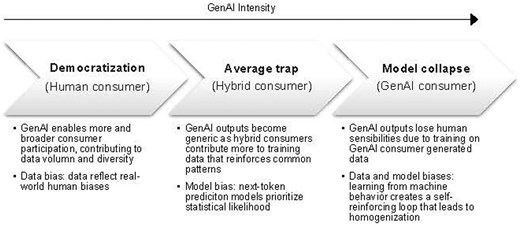
Abstract We develop a novel generative AI (GenAI) trajectory, “democratization-average trap-model collapse,” to identify data and model challenges posed by GenAI, from which we project the GenAI future of consumer research. This trajectory consists of three key phenomena: democratization broadens consumer participation, the average trap produces generic responses, and model collapse occurs when GenAI outputs lose human sensibilities. Data and model challenges arise as democratization enhances data representation while also embedding real-world biases. The average trap, caused by next-token prediction models, leads to generic outputs that lack individuality. Additionally, model collapse occurs when GenAI increasingly learns from its own outputs, amplifying machine bias and diverging from human behavior. To address these challenges, researchers can leverage democratization to study marginalized consumers and prioritize human-centered research over purely data-driven methods. The average trap can be mitigated by fine-tuning models with task-specific and marginalized consumption data while engineering responses for uniqueness. Preventing model collapse requires integrating human–machine hybrid data and applying theories of mind to realign AI with human-centric consumption. Finally, we outline three future research directions: preserving data distribution tails to support consumption democratization, countering the average trap in next-token prediction, and reversing the trajectory from democratization to model collapse.
EXPRESS: Evaluating Novel Unstructured Treatments with Generative AI: A Causal Prediction Framework
Modern marketing increasingly requires managers to deploy new content at scale, often with limited opportunity for prior testing. As a result, decisions about what to launch become strategic managerial choices under uncertainty rather than purely creative exercises. While generative AI makes the creation of new content fast and highly scalable, it simultaneously expands the set of options managers must evaluate, making reliable content selection increasingly difficult. We develop a framework for causal prediction that enables managers to evaluate and deploy novel marketing content generated by AI. The framework uses pretrained large language models to represent previously deployed content and learn how its features causally relate to outcomes. Using a rejection-sampling procedure, the framework screens new content proposed by generative AI to avoid extrapolation beyond what historical data can reliably support. In a large-scale email marketing application (3.3 million observations across 34 campaigns), the framework improves out-of-sample prediction and real-world deployment performance relative to standard approaches, enabling outcome-guided generation of higher-performing AI-generated content. The framework establishes a threshold based on how closely new content resembles past campaigns, separating cases where causal prediction is reliable from cases where direct experimentation is warranted. The framework has important implications for marketing decision making in a rapidly evolving environment where generative AI is transforming content creation and deployment.
Quantifying the Persona Effect in LLM Simulations
Large language models (LLMs) have shown remarkable promise in simulating human language and behavior. This study investigates how integrating persona variables—demographic, social, and behavioral factors—impacts LLMs' ability to simulate diverse perspectives. We find that persona variables account for \ensuremath<10% variance in annotations in existing subjective NLP datasets. Nonetheless, incorporating persona variables via prompting in LLMs provides modest but statistically significant improvements. Persona prompting is most effective in samples where many annotators disagree, but their disagreements are relatively minor. Notably, we find a linear relationship in our setting: the stronger the correlation between persona variables and human annotations, the more accurate the LLM predictions are using persona prompting. In a zero-shot setting, a powerful 70b model with persona prompting captures 81% of the annotation variance achievable by linear regression trained on ground truth annotations. However, for most subjective NLP datasets, where persona variables have limited explanatory power, the benefits of persona prompting are limited.
Beyond Model Collapse: Scaling Up with Synthesized Data Requires Verification
Large Language Models (LLM) are increasingly trained on data generated by other LLM, either because generated text and images become part of the pre-training corpus, or because synthetized data is used as a replacement for expensive human-annotation. This raises concerns about \emph{model collapse}, a drop in model performance when their training sets include generated data. Considering that it is easier for both humans and machines to tell between good and bad examples than to generate high-quality samples, we investigate the use of verification on synthesized data to prevent model collapse. We provide a theoretical characterization using Gaussian mixtures, linear classifiers, and linear verifiers to derive conditions with measurable proxies to assess whether the verifier can effectively select synthesized data that leads to optimal performance. We experiment with two practical tasks -- computing matrix eigenvalues with transformers and news summarization with LLMs -- which both exhibit model collapse when trained on generated data, and show that verifiers, even imperfect ones, can indeed be harnessed to prevent model collapse and that our proposed proxy measure strongly correlates with performance.
Artificial Artificial Artificial Intelligence: Crowd Workers Widely Use Large Language Models for Text Production Tasks
Large language models (LLMs) are remarkable data annotators. They can be used to generate high-fidelity supervised training data, as well as survey and experimental data. With the widespread adoption of LLMs, human gold--standard annotations are key to understanding the capabilities of LLMs and the validity of their results. However, crowdsourcing, an important, inexpensive way to obtain human annotations, may itself be impacted by LLMs, as crowd workers have financial incentives to use LLMs to increase their productivity and income. To investigate this concern, we conducted a case study on the prevalence of LLM usage by crowd workers. We reran an abstract summarization task from the literature on Amazon Mechanical Turk and, through a combination of keystroke detection and synthetic text classification, estimate that 33-46% of crowd workers used LLMs when completing the task. Although generalization to other, less LLM-friendly tasks is unclear, our results call for platforms, researchers, and crowd workers to find new ways to ensure that human data remain human, perhaps using the methodology proposed here as a stepping stone. Code/data: https://github.com/epfl-dlab/GPTurk
Words that Work: Using Large Language Models to Generate and Refine Hypotheses from Text
In this paper, we introduce a data-driven framework for generating and refining hypotheses from text. Our three-step approach–Hypothesize, Intervene, and Predic

SalesRLAgent: A Reinforcement Learning Approach for Real-Time Sales Conversion Prediction and Optimization
Current approaches to sales conversation analysis and conversion prediction typically rely on Large Language Models (LLMs) combined with basic retrieval augmented generation (RAG). These systems, while capable of answering questions, fail to accurately predict conversion probability or provide strategic guidance in real time. In this paper, we present SalesRLAgent, a novel framework leveraging specialized reinforcement learning to predict conversion probability throughout sales conversations. Unlike systems from Kapa.ai, Mendable, Inkeep, and others that primarily use off-the-shelf LLMs for content generation, our approach treats conversion prediction as a sequential decision problem, training on synthetic data generated using GPT-4O to develop a specialized probability estimation model. Our system incorporates Azure OpenAI embeddings (3072 dimensions), turn-by-turn state tracking, and meta-learning capabilities to understand its own knowledge boundaries. Evaluations demonstrate that SalesRLAgent achieves 96.7% accuracy in conversion prediction, outperforming LLM-only approaches by 34.7% while offering significantly faster inference (85ms vs 3450ms for GPT-4). Furthermore, integration with existing sales platforms shows a 43.2% increase in conversion rates when representatives utilize our system's real-time guidance. SalesRLAgent represents a fundamental shift from content generation to strategic sales intelligence, providing moment-by-moment conversion probability estimation with actionable insights for sales professionals.
Augmenting Research Ideation with Data: An Empirical Investigation...
Recent advancements in large language models (LLMs) demonstrate strong potential for generating novel research ideas, yet such ideas often struggle with feasibility and effectiveness. In this...
Large language models outperform humans at estimating society's everyday norms—but hybrids are even better
As AI assistants and social robots enter human environments, their ability to navigate context-dependent social norms is essential to avoid harm and ensure successful collaboration. We evaluate six large language models (LLMs) on their ability to estimate American social norms across 555 everyday scenarios (measured in prior work) and compare these to estimates from 320 humans. LLMs achieve remarkably high accuracy, clearly outperforming the average human. However, the errors LLMs make are systematic; they are similar across runs of the same LLM and even across different LLMs. As a consequence of this homogeneity, aggregating estimates of LLMs produces little improvement. Individual humans make much worse estimates, often defaulting to extreme right-or-wrong judgments even when asked to estimate population averages, but their errors are idiosyncratic and, consequently, aggregating their estimates yields dramatic improvement through wisdom-of-crowds effects. As humans make different errors than LLMs, hybrid ensembles combining both substantially outperform either alone.
How memory augmentation can improve large language models
Generative AI models struggle to handle long context, but memory augmentation can reduce their memory footprint, making them more accurate and lightweight

Greedy or not, here I come: Language production under vocabulary constraints in humans and resource-rational models
Communicating using only a limited vocabulary is a common but challenging cognitive phenomenon, requiring an ideal communicator to plan carefully to optimize for intelligibility while circumventing a constrained lexicon. In this work, we investigate how humans respond to a broad array of questions under variable vocabulary limitations, consisting of only 250 highly frequent words at the most restrictive. We provide theoretically motivated comparisons to greedy and globally optimal sampling algorithms using Sequential Monte Carlo inference with large language models. Humans generally resemble greedy sampling more than globally optimal sampling, though more skilled humans are more likely to backtrack and revise -- a non-greedy behavior. An observed human pattern of leaning on semantically light words in high-constraint settings falls out of both greedy and globally optimal sampling. We discuss the results and their broader implications for resource-rational cognition, psycholinguistics, L2 communication, and language impairments.
The potential of generative AI for personalized persuasion at scale
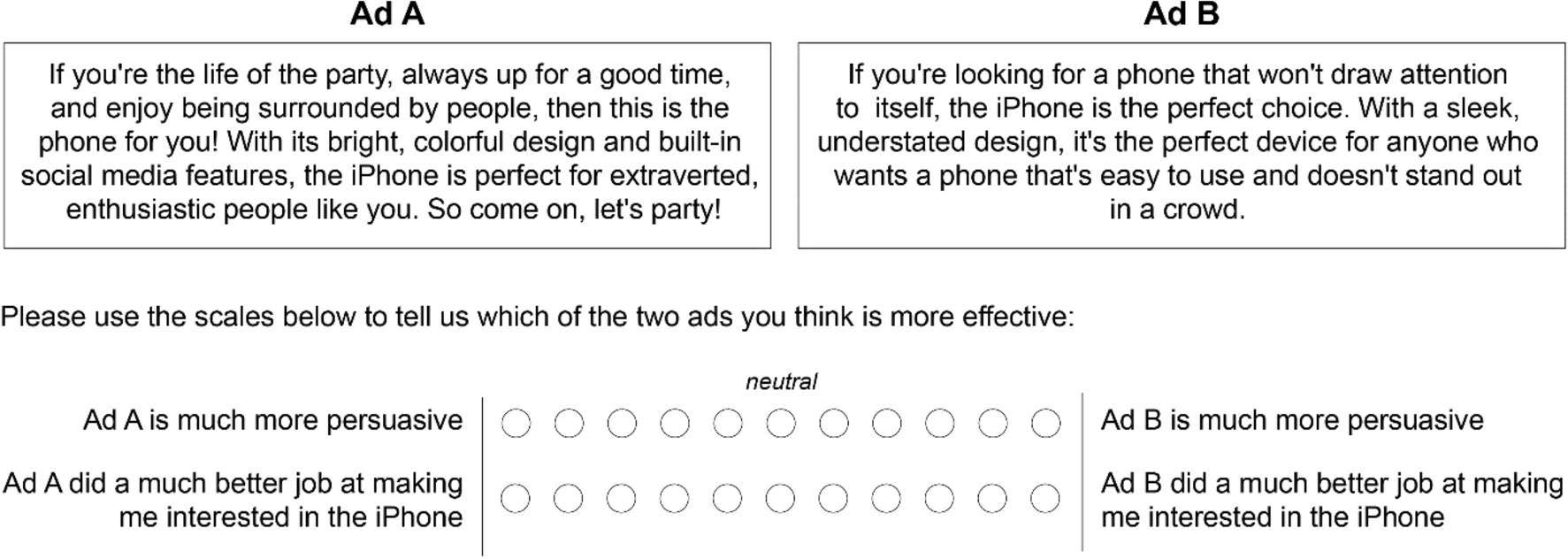
Matching the language or content of a message to the psychological profile of its recipient (known as “personalized persuasion”) is widely considered to be one of the most effective messaging strategies. We demonstrate that the rapid advances in large language models (LLMs), like ChatGPT, could accelerate this influence by making personalized persuasion scalable. Across four studies (consisting of seven sub-studies; total N = 1788), we show that personalized messages crafted by ChatGPT exhibit significantly more influence than non-personalized messages. This was true across different domains of persuasion (e.g., marketing of consumer products, political appeals for climate action), psychological profiles (e.g., personality traits, political ideology, moral foundations), and when only providing the LLM with a single, short prompt naming or describing the targeted psychological dimension. Thus, our findings are among the first to demonstrate the potential for LLMs to automate, and thereby scale, the use of personalized persuasion in ways that enhance its effectiveness and efficiency. We discuss the implications for researchers, practitioners, and the general public.
Reasoning Under Uncertainty: Exploring Probabilistic Reasoning Capabilities of LLMs
Despite widespread success in language understanding and generation, large language models (LLMs) exhibit unclear and often inconsistent behavior when faced with tasks that require probabilistic reasoning. In this work, we present the first comprehensive study of the reasoning capabilities of LLMs over explicit discrete probability distributions. Given observations from a probability distribution, we evaluate models on three carefully designed tasks, mode identification, maximum likelihood estimation, and sample generation, by prompting them to provide responses to queries about either the joint distribution or its conditionals. These tasks thus probe a range of probabilistic skills, including frequency analysis, marginalization, and generative behavior. Through comprehensive empirical evaluations, we demonstrate that there exists a clear performance gap between smaller and larger models, with the latter demonstrating stronger inference and surprising capabilities in sample generation. Furthermore, our investigations reveal notable limitations, including sensitivity to variations in the notation utilized to represent probabilistic outcomes and performance degradation of over 60% as context length increases. Together, our results provide a detailed understanding of the probabilistic reasoning abilities of LLMs and identify key directions for future improvement.