


This is a descriptive study reporting financial and engagement metrics for 973 e-commerce websites, comparing organic large language model traffic (oLLM) with traditional digital channels. , We investigate organic large language model traffic (oLLM) versus traditional digital channels in e-commerce. Analyzing 12 months of first-party data from 973 websites with $20 billion combined revenue, we examine more than 50,000 transactions from ChatGPT referrals alongside 164 million transactions from traditional channels. Using regression models that account for data sparsity, we assess financial metrics (conversion rate, average order value, revenue per session) and engagement metrics (bounce rate, session duration, page views). Results are consistent across extensive robustness checks. One year after launch, oLLM exhibits conversion rates and revenue per session above paid social but below all other traditional channels. Product complexity moderates the effects: oLLM’s financial outcomes and traffic shares are stronger in complex product categories. Engagement metrics show favorable bounce rates but lower session duration and page views. Temporal analysis shows increasing conversion rates but declining average order values, yielding only moderate revenue-per-session gains over time. Cross-website analyses support growing consumer LLM proficiency as the underlying mechanism. The descriptive study positions oLLM as a new and developing channel. With low volumes and modest revenue per session, oLLM currently serves niche informational needs of proficient consumers and does not yet function as a broad conversion channel. History: Puneet Manchanda served as the senior editor. This paper was accepted through the Marketing Science: Frontiers review process. Supplemental Material: The online appendices and data files are available at https://doi.org/10.1287/mksc.2025.0489 .
Do Self-Promotional “Best” Lists Boost ChatGPT Visibility? Study of 26,283 Source URLs
Just last month, OpenAI CEO Sam Altman revealed that more than 800 million people use the platform each week. But what does it take to get mentioned and
Commercial Persuasion in AI-Mediated Conversations
As Large Language Models (LLMs) become a primary interface between users and the web, companies face growing economic incentives to embed commercial influence into AI-mediated conversations. We present two preregistered experiments (N = 2,012) in which participants selected a book to receive from a large eBook catalog using either a traditional search engine or a conversational LLM agent powered by one of five frontier models. Unbeknownst to participants, a fifth of all products were randomly designated as sponsored and promoted in different ways. We find that LLM-driven persuasion nearly triples the rate at which users select sponsored products compared to traditional search placement (61.2% vs. 22.4%), while the vast majority of participants fail to detect any promotional steering. Explicit "Sponsored" labels do not significantly reduce persuasion, and instructing the model to conceal its intent makes its influence nearly invisible (detection accuracy < 10%). Altogether, our results indicate that conversational AI can covertly redirect consumer choices at scale, and that existing transparency mechanisms may be insufficient to protect users.

Grok in the Wild: Characterizing the Roles and Uses of Large Language Models on Social Media
xAI's large language model, Grok, is called by millions of people each week on the social media platform X. Prior work characterizing how large language models are used has focused on private, one-on-one interactions. Grok's deployment on X represents a major departure from this setting, with interactions occurring in a public social space. In this paper, we systematically sample three months of interaction data to investigate how, when, and to what effect Grok is used on X. At the platform level, we find that Grok responds to 62% of requests, that the majority (51%) are in English, and that engagement is low, with half of Grok's responses receiving 20 or fewer views after 48 hours. We also inductively build a taxonomy of 10 roles that LLMs play in mediating social interactions and use these roles to analyze 41,735 interactions with Grok on X. We find that Grok most often serves as an information provider but, in contrast to LLM use in private one-on-one settings, also takes on roles related to dispute management, such as truth arbiter, advocate, and adversary. Finally, we characterize the population of X users who prompted Grok and find that their self-expressed interests are closely related to the roles the model assumes in the corresponding interactions. Our findings provide an initial quantitative description of human-AI interactions on X, and a broader understanding of the diverse roles that large language models might play in our online social spaces.
Grok in the Wild: Characterizing the Roles and Uses of Large Language Models on Social Media
xAI's large language model, Grok, is called by millions of people each week on the social media platform X. Prior work characterizing how large language models are used has focused on private, one-on-one interactions. Grok's deployment on X represents a major departure from this setting, with interactions occurring in a public social space. In this paper, we systematically sample three months of interaction data to investigate how, when, and to what effect Grok is used on X. At the platform level, we find that Grok responds to 62% of requests, that the majority (51%) are in English, and that engagement is low, with half of Grok's responses receiving 20 or fewer views after 48 hours. We also inductively build a taxonomy of 10 roles that LLMs play in mediating social interactions and use these roles to analyze 41,735 interactions with Grok on X. We find that Grok most often serves as an information provider but, in contrast to LLM use in private one-on-one settings, also takes on roles related to dispute management, such as truth arbiter, advocate, and adversary. Finally, we characterize the population of X users who prompted Grok and find that their self-expressed interests are closely related to the roles the model assumes in the corresponding interactions. Our findings provide an initial quantitative description of human-AI interactions on X, and a broader understanding of the diverse roles that large language models might play in our online social spaces.
ChatGPT ads are becoming a real business - Sensemaker
OpenAI says its ad business reached a $1 billion annualized run rate in under 200 days. The bigger shift is what conversation context is becoming.
OpenAI’s ChatGPT ads business hits $1 billion run rate as Europe gets self-serve access
That figure comes from multiplying current monthly ad revenue by 12, so it's a snapshot of where things stand today.

How People Use ChatGPT
Despite the rapid adoption of LLM chatbots, little is known about how they are used. We document the growth of ChatGPT’s consumer product from its launch in November 2022 through July 2025, when it had been adopted by around 10% of the world’s adult population. Early adopters were disproportionately male but the gender gap has narrowed dramatically, and we find higher growth rates in lower-income countries. Using a privacy-preserving automated pipeline, we classify usage patterns within a representative sample of ChatGPT conversations. We find steady growth in work-related messages but even faster growth in non-work-related messages, which have grown from 53% to more than 70% of all usage. Work usage is more common for educated users in highly-paid professional occupations. We classify messages by conversation topic and find that “Practical Guidance,” “Seeking Information,” and “Writing” are the three most common topics and collectively account for nearly 80% of all conversations. Writing dominates work-related tasks, highlighting chatbots’ unique ability to generate digital outputs compared to traditional search engines. Computer programming and self-expression both represent relatively small shares of use. Overall, we find that ChatGPT provides economic value through decision support, which is especially important in knowledge-intensive jobs.

Is Google Getting Worse? A Longitudinal Investigation of SEO Spam in Search Engines
Many users of web search engines have been complaining in recent years about the supposedly decreasing quality of search results. This is often attributed to an increasing amount of search-engine-optimized but low-quality content. Evidence for this has always been anecdotal, yet it’s not unreasonable to think that popular online marketing strategies such as affiliate marketing incentivize the mass production of such content to maximize clicks. Since neither this complaint nor affiliate marketing as such have received much attention from the IR community, we hereby lay the groundwork by conducting an in-depth exploratory study of how affiliate content affects today’s search engines. We monitored Google, Bing and DuckDuckGo for a year on 7,392 product review queries. Our findings suggest that all search engines have significant problems with highly optimized (affiliate) content—more than is representative for the entire web according to a baseline retrieval system on the ClueWeb22. Focussing on the product review genre, we find that only a small portion of product reviews on the web uses affiliate marketing, but the majority of all search results do. Of all affiliate networks, Amazon Associates is by far the most popular. We further observe an inverse relationship between affiliate marketing use and content complexity, and that all search engines fall victim to large-scale affiliate link spam campaigns. However, we also notice that the line between benign content and spam in the form of content and link farms becomes increasingly blurry—a situation that will surely worsen in the wake of generative AI. We conclude that dynamic adversarial spam in the form of low-quality, mass-produced commercial content deserves more attention. (Code and data: https://github.com/webis-de/ECIR-24).

Is Google Getting Worse? A Longitudinal Investigation of SEO Spam in Search Engines
Many users of web search engines have been complaining in recent years about the supposedly decreasing quality of search results. This is often attributed to an increasing amount of search-engine-optimized but low-quality content. Evidence for this has always been anecdotal, yet it’s not unreasonable to think that popular online marketing strategies such as affiliate marketing incentivize the mass production of such content to maximize clicks. Since neither this complaint nor affiliate marketing as such have received much attention from the IR community, we hereby lay the groundwork by conducting an in-depth exploratory study of how affiliate content affects today’s search engines. We monitored Google, Bing and DuckDuckGo for a year on 7,392 product review queries. Our findings suggest that all search engines have significant problems with highly optimized (affiliate) content—more than is representative for the entire web according to a baseline retrieval system on the ClueWeb22. Focussing on the product review genre, we find that only a small portion of product reviews on the web uses affiliate marketing, but the majority of all search results do. Of all affiliate networks, Amazon Associates is by far the most popular. We further observe an inverse relationship between affiliate marketing use and content complexity, and that all search engines fall victim to large-scale affiliate link spam campaigns. However, we also notice that the line between benign content and spam in the form of content and link farms becomes increasingly blurry—a situation that will surely worsen in the wake of generative AI. We conclude that dynamic adversarial spam in the form of low-quality, mass-produced commercial content deserves more attention. (Code and data: https://github.com/webis-de/ECIR-24).
How to get ChatGPT to recommend your product | Ethan Smith
🎙️ Graphite's CEO on why ChatGPT is driving more qualified leads than Google, how to optimize for Reddit without spamming, and why early-stage startups can win at AEO when they couldn't at SEO

Are Self‐Service Customers Satisfied or Stuck?
This paper investigates the impact of self‐service technology (SST) usage on customer satisfaction and retention. Specifically, we disentangle the distinct effects of satisfaction and switching costs as drivers of retention among self‐service customers. Our empirical analysis examines 26,924 multi‐channel customers of a nationwide retail bank. We track each customer's channel usage, overall satisfaction, and retention over a 1‐year period. We find that, relative to face‐to‐face service, customers who use self‐service channels for a greater proportion of their transactions are either no more satisfied, or less satisfied with the service they receive, depending on the channel. However, we also find that these same customers are predictably less likely to defect to a competitor if they are heavily reliant on self‐service channels characterized by high switching costs. Through a mediation model, we demonstrate that, when self‐service usage promotes retention, it does so in a way that is consistent with switching costs. As a robustness check, we examine the behavior of channel enthusiasts, who concentrate transactions among specific channels. Relative to more diversified customers, we find that self‐service enthusiasts in low switching cost channels defect with greater frequency, while self‐service enthusiasts in high switching cost channels are retained with greater frequency.

Advertising as a Reminder: Evidence from the Dutch State Lottery
We show that advertising can act as a reminder for consumers who intend to buy a product. , Consumers who intend to buy a product may forget to do so because they suffer from limited attention. Therefore, they may value being reminded by an advertisement. This reminder effect of advertising could be important in many markets but is usually difficult to document. We study it in the context of buying a product that has existed for almost 300 years: a ticket for the Dutch State Lottery. This context is particularly suitable for our analysis because the product is simple, it is very well known, and there are multiple fixed and known purchase cycles per year. Moreover, radio and TV advertisements are designed explicitly to remind consumers to buy a lottery ticket before the draw. This can conveniently be done online. We develop an approach to distinguish reminder effects of advertising from other effects, such as conveying information about the size of the jackpot. The key idea is that reminder effects are short lived. We use minute-level advertising and online sales data and find that the reminder effect of advertising is strong. Reaching 1% of the population by a radio advertisement leads to an increase in online sales of 1.55% in the four hours after the advertisement is aired. For TV advertisements, the increase is 0.78%. We show that the effects generally last longer for radio advertisements. We also provide direct evidence that reminding consumers not only affects the timing of purchases but also leads to market expansion. Finally, we estimate a model of consumer behavior under limited attention to quantify the effect on total sales. We find that total sales would be 16.7% lower without the reminder effect of advertising and that shifting advertising to the week of the draw would lead to a 9.2% increase in sales. History: Puneet Manchanda served as the senior editor and Günter Hitsch served as associate editor for this article. Supplemental Material: A replication package with code and log files and an Online Appendix are available at https://doi.org/10.1287/mksc.2022.1405 .
The moderating role of income on consumers’ preferences and usage for online and offline payment methods
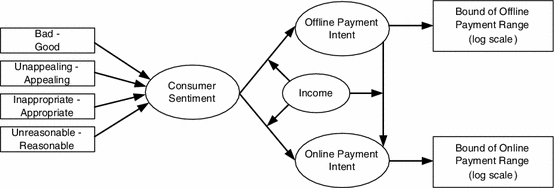
In this paper we examine consumer attitudes towards a payment method, which is a key factor affecting the probability of completing a transaction offline and online. More specifically, we constructed a model that surveyed the offline and online usage of prepaid e-cash, debit cards, credit cards and cash. User perceptions of the attractiveness of e-cash and various traditional payment means were also empirically assessed. Consumer attitudes towards a payment technology were found to be influential on users’ perceptions in both online and offline environments. User perceptions of offline purchases with a payment technology had significant and positive effects on the corresponding online usage perceptions. The effects of our research model are contingent on the income level of users. Our findings have significant implications, as they could help shed light on why consumers abandon their shopping carts and do not complete their transactions, which could potentially play a significant role when it comes to designing applications targeting sspecific consumer segments.
Improving Customer Compatibility with Tradeoff Transparency
Through a large-scale field experiment with 393,036 customers considering opening a credit card account with a nationwide retail bank, we investigate how providing transparency into an offering’s tradeoffs affects subsequent rates of customer acquisition and long-run engagement. Although we find tradeoff transparency to have an insignificant effect on acquisition rates, customers who were shown each offering’s tradeoffs selected different products than those who were not. Moreover, prospective customers who experienced transparency and subsequently chose to open an account went on to exhibit higher-quality service relationships over time. Monthly spending was 9.9% higher and cancellation rates were 20.5% lower among those who experienced transparency into each offering’s tradeoffs. Increased product use and retention accrued disproportionately to customers with prior category experience: more-experienced customers who were provided transparency spent 19.2% more on a monthly basis and were 33.7% less likely to defect after nine months. Importantly, we find that these gains in engagement and retention do not come at the expense of customers’ financial well-being: the probability of making late payments was reduced among customers who experienced transparency. We further find that the positive effects of tradeoff transparency on engagement and retention were attenuated in the presence of a promotion that provided financial incentives to choose particular offerings. Taken together, these results suggest that providing transparency into an offering’s tradeoffs may be an effective strategy for informing customer choices, leading to better outcomes for customers and firms alike. This paper was accepted by Vishal Gaur, operations management. Funding: Funding for this research, apart from the costs Commonwealth Bank of Australia internally incurred to support the experiment, was provided by Harvard Business School. R. W. Buell has received compensation from Commonwealth Bank of Australia in the past for executive education teaching. Supplemental Material: The online appendix and data files are available at https://doi.org/10.1287/mnsc.2024.4985 .

From asking to doing: How the world is putting ChatGPT to work
New OpenAI Signals data shows how people use ChatGPT worldwide, with country-level insights on adoption, usage trends, and evolving behavior.

Money as Message | Andreessen Horowitz
Network effects — where a product or service becomes more valuable to its users as more people use it — are one of the key ways software businesses maintain a better product and more defensible market position. This is especially true of messaging apps like WeChat — which, as I’ve argued before, is not just...
