We provide evidence from field experiments with three different banks that reminder messages increase commitment attainment for clients who recently opened commitment savings accounts. Messages that mention both savings goals and financial incentives are particularly effective, whereas other content variations such as gain versus loss framing do not have significantly different effects. Nor do we find evidence that receiving additional late reminders has an additive effect. These empirical results do not map neatly into existing models, so we provide a simple model where limited attention to exceptional expenses can generate undersaving that is in turn mitigated by reminders. Data, as supplemental material, are available at http://dx.doi.org/10.1287/mnsc.2015.2296 . This paper was accepted by Teck-Hua Ho, behavioral economics.
Temporal Reframing and Participation in a Savings Program: A Field Experiment
This study explores whether framing savings in more or less granular formats can increase sign-ups for a recurring deposit program in a FinTech environment. , A growing number of American workers are now freelancers and thus, responsible for their own retirement savings, yet they face psychological hurdles that hamper them from saving enough money for the long term. Although prior theory-derived interventions have been successful in addressing some of these obstacles, encouraging participation in saving programs is a challenging endeavor for policy makers and consumers alike. In a field setting, we test whether framing savings in more or less granular formats (for example, saving daily versus monthly) can encourage continued saving behavior through increasing the take up of a recurring deposit program. Among thousands of new users of a financial technology app, we find that framing deposits in daily amounts as opposed to monthly amounts quadruples the number of consumers who enroll. Furthermore, framing deposits in more granular terms reduced the participation gap between lower- and higher-income consumers: three times as many consumers in the highest rather than lowest income bracket participated in the program when it was framed as a $150 monthly deposit, but this difference in participation was eliminated when deposits were framed as $5 per day.

Knowing When to Spend: Unintended Financial Consequences of Earmarking to Encourage Savings
Maintaining savings is an important financial goal. Yet there are times when savings should be spent, such as when people face unavoidable costs, and spending their savings allows them to avoid high interest rate debt. Existing behavioral research has focused on consumer decisions between savings and discretionary spending and has proposed interventions to promote savings in these contexts. However, when spending is not discretionary, such interventions could risk exacerbating a pattern found in economic research in which people borrow high interest rate debt while maintaining savings that earn low levels of interest. To examine how mental accounting interacts with considerations of personal responsibility and guilt to contribute to this pattern, this article explores whether people spend their savings when they need money most: during emergencies. Six studies reveal that people's tendency to preserve savings by borrowing from a high interest rate credit option varies as a function of the savings’ intended use. Paradoxically, people are most likely to turn to high interest rate credit with the belief that doing so is the responsible option.

Save More Today or Tomorrow: The Role of Urgency in Precommitment Design
To encourage farsighted behaviors, previous research suggests that marketers should invite consumers to precommit to adopting these behaviors “later.” However, the authors propose that people will draw different inferences from different types of precommitment offers, and that these inferences can help explain when precommitment is (and is not) effective at increasing adoption of farsighted behaviors. Specifically, the authors theorize that simultaneously offering consumers the opportunity to adopt a farsighted behavior now or later (i.e., offering “simultaneous precommitment”) may signal that the behavior is not urgently recommended; however, offering consumers the opportunity to adopt that behavior immediately and then, only if they decline, inviting them to adopt it later (i.e., offering “sequential precommitment”) may signal just the opposite. In a multisite field experiment (N = 5,196), the authors find that simultaneously giving consumers the chance to increase their savings now or later reduced retirement savings. Two preregistered lab studies (N = 5,080) show that simultaneous precommitment leads people to infer that taking action is not urgently recommended, and such inferences predict less adoption of recommended behaviors. Importantly, offering sequential precommitment increases inferred urgency, predicting greater adoption. Together, this research advances knowledge about the limits and potential of precommitment.
Earmarking and Partitioning: Increasing Saving by Low-Income Households
This research examines the effects of earmarking money on savings by low-income consumers. In particular, the authors test two interventions that are designed to enhance the effects of earmarking: (1) using a visual reminder of the savings goal and (2) dividing the earmarked money into two parts. Consistent with prior research suggesting that partitioning increases self-control, people save more when earmarked money is partitioned into two accounts than when it is pooled into one account. In addition, the presence of the visual reminder increases the savings rate. The authors conclude with implications for consumer welfare and directions for further research.
Sending Out an SMS: Automatic Enrollment Experiments for Overdraft Alerts
ABSTRACT At‐scale field experiments at major U.K. banks show that automatic enrollment into “just‐in‐time” text alerts reduces unarranged overdraft and unpaid item charges 17% to 19% and arranged overdraft charges 4% to 8%, implying annual market‐wide savings of £170 million to £240 million. Incremental benefits from “early‐warning” alerts are statistically insignificant, although economically significant effects are not ruled out. Prior to the experiments, over half of overdrafts could have been avoided by using lower‐cost liquidity available in savings and credit card accounts. Alerts help consumers achieve less than half of these potential savings.

What Would You Do with $500? Spending Responses to Gains, Losses, News, and Loans
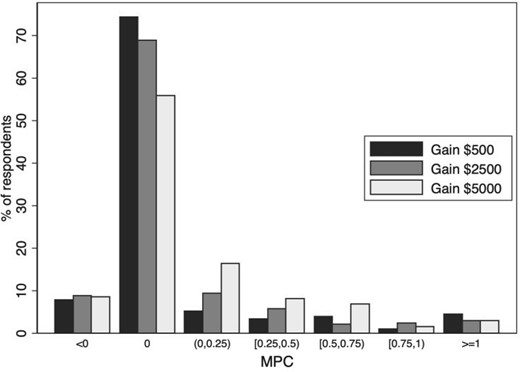
Abstract We use survey questions about spending in hypothetical scenarios to investigate features of propensities to consume that are useful for distinguishing between consumption theories. We find that (1) responses to unanticipated gains are vastly heterogeneous (either zero or substantially positive); (2) responses increase in the size of the gain, driven by the extensive margin of spending adjustments; (3) responses to losses are much larger and more widespread than responses to gains; and (4) even those with large responses to gains do not respond to news about future gains. These four findings suggest that limited access to disposable resources, and frictions in adjusting consumption, are important determinants of consumption behaviour. We also find that (5) households do not respond to the offer of a one-year interest-free loan, suggesting that this is not a consequence of short-term credit constraints; and (6) people do cut spending in response to news about future losses, suggesting that neither is this a consequence of myopia. A calibrated precautionary savings model with utility costs of changing consumption, and a sufficient fraction of low-wealth households, can account for these features of propensities to consume on both the extensive and intensive margins.
The Effects of Financial Incentives in Experiments: A Review and Capital-Labor-Production Framework
We review 74 experiments with no, low, or high performance-based financial incentives. The modal result has no effect on mean performance (though variance is usually reduced by higher payment). Higher incentive does improve performance often, typically judgment tasks that are responsive to better effort. Incentives also reduce “presentation” effects (e.g., generosity and risk-seeking). Incentive effects are comparable to effects of other variables, particularly “cognitive capital” and task “production” demands, and interact with those variables, so a narrow-minded focus on incentives alone is misguided. We also note that no replicated study has made rationality violations disappear purely by raising incentives.
Do people like financial nudges?
Do people like financial nudges? To answer that question we conducted a pre-registered survey presenting people with 36 hypothetical scenarios describing financial interventions. We varied levels of transparency (i.e., explaining how the interventions worked), framing (interventions framed in terms of spending, or saving), and ‘System’ (interventions could target either System 1 or System 2). Participants were a random sample of 2,100 people drawn from a representative Australian population. All financial interventions were tested across six dependent variables: approval, benefit, ethics, manipulation, the likelihood of use, as well as the likelihood of use if the intervention were to be proposed by a bank. Results indicate that people generally approve of financial interventions, rating them as neutral to positive across all dependent variables (except for manipulation, which was reverse coded). We find effects of framing and System. People have strong and significant preferences for System 2 interventions, and interventions framed in terms of savings. Transparency was not found to have a significant impact on how people rate financial interventions. Financial interventions continue to be rated positive, regardless of the messenger. Looking at demographics, we find that participants who were female, younger, living in metro areas and earning higher incomes were most likely to favor financial interventions, and this effect is especially strong for those aged under 45. We discuss the implications for these results as applied to the financial sector.

The Benefits of Emergency Reserves: Greater Preference and Persistence for Goals that Have Slack with a Cost
Marketers of programs that are designed to help consumers reach goals face dual challenges of making the program attractive enough to encourage consumer signup while still motivating consumers to reach desirable goals and thus stay satisfied with the program. The authors offer a possible solution to this challenge: the emergency reserve, or slack with a cost. They demonstrate how an explicitly defined emergency reserve not only is preferred over other options for goal-related programs but can also lead to increased persistence. Study 1 demonstrates that consumers prefer programs with emergency reserves to programs that do not have them, and Study 2 further clarifies that consumers' preference for an emergency reserve depends on the presence of a superordinate goal. Study 3 reveals that consumers prefer goals with emergency reserves because they perceive them to have both higher attainability and value than other goals. Study 4 demonstrates that reserves can lead to increased goal persistence in a realistic task that involves persistence over time. Finally, Studies 5 and 6 reveal that consumers persist more with reserve goals because they want to avoid using the “emergency” reserve.
The Ostrich in Us: Selective Attention to Personal Finances
Abstract We analyze attention to personal finances using a high-frequency panel of bank data, including information on logins. We document a number of robust patterns. Relative to their personal histories, individuals pay more attention when holding more cash and liquidity and when receiving income. In contrast, attention decreases discretely as bank account balances go from positive to negative and then decreases further as overdraft debt increases. We conclude that Ostrich effects in a personal finance context, i.e., the avoidance of obtaining information on everyday personal finances, is a widespread phenomenon and explore a number of explanations for our findings.

Misunderstanding Savings Growth: Implications for Retirement Savings Behavior
People systematically underestimate exponential growth. This article illustrates this phenomenon, its implications, and some potential interventions in the context of saving for retirement, where savings grow exponentially over long periods of time. Experiment 1 shows that a majority of participants expect savings over 40 years to grow linearly rather than exponentially, leading them to grossly underestimate their account balance at retirement. Experiment 2 demonstrates that this misunderstanding leads to underestimates of the cost of waiting to save, which makes putting off saving more attractive than it should be. Finally, Experiments 3–5 show that highlighting the exponential growth of savings motivates both college students and employees to save more for retirement. Making clear to employees the exponential growth of savings before they make crucial decisions about how much to save may be a simple and effective means of increasing retirement savings.
Does Saving Cause Borrowing? Implications for the Co-Holding Puzzle
Using an experiment in which 3.1 million bank customers were encouraged to save, we explore the mechanisms behind co-holding liquid savings and credit card debt. Theoretically, we first show that the joint responses of spending, saving, and borrowing to the nudge differ for different economic models of co-holding. Using machine learning techniques, we then find that the most responsive individuals reduce spending and increase their savings by 4.9% (206 USD PPP per month) while their credit card debt remains unchanged. For them, the marginal responses to the nudge are consistent with our model of co-holding for the purpose of self- or partner control.

Does Saving Cause Borrowing? Implications for the Coholding Puzzle
ABSTRACT Using an experiment in which 3.1 million bank customers were encouraged to save, we explore the mechanisms behind coholding liquid savings and credit card debt. Theoretically, we show that the joint responses of spending, saving, and borrowing to the nudge differ across economic models of coholding. Using machine learning techniques, we find that the most responsive individuals reduce spending and increase savings by 4.9% (206 USD PPP per month) while their credit card debt remains unchanged. These individuals' marginal responses to the nudge are consistent with our model of coholding for the purpose of self‐ or partner‐control.

Information Disclosure, Cognitive Biases, and Payday Borrowing
ABSTRACT Can psychology‐guided information disclosure induce borrowers to lower their use of high‐cost debt? In a field experiment at payday stores, we find that information that makes people think less narrowly (over time) about finance costs results in less borrowing. In particular, reinforcing the adding‐up dollar fees incurred when rolling over loans reduces the take‐up of future payday loans by 11% in the subsequent 4 months. Although we remain agnostic as to the overall sufficiency of better disclosure policy to “remedy” payday borrowing, we cast the 11% reduction in borrowing in light of the relative low cost of this policy.

Credit Cards as Spending Facilitating Stimuli: A Conditioning Interpretation
Abstract. Four experiments and one study were conducted to test the hypothesis that stimuli associated with spending can elicit spending responses. In all
Context-Dependent Drivers of Discretionary Debt Decisions: Explaining Willingness to Borrow for Experiential Purchases
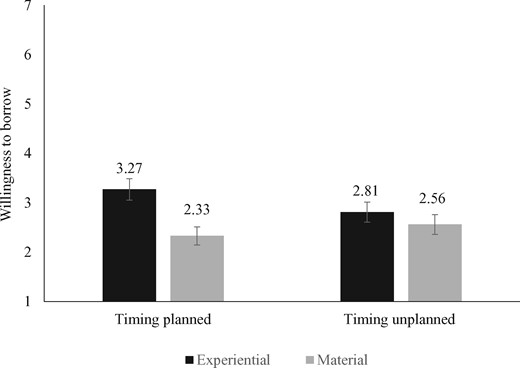
Abstract Mental accounting research suggests that consumers prefer borrowing for longer-lasting purchases in order to receive benefits from the purchases as they pay for them. In contrast, two sets of archival data and five lab studies show that consumers are more willing to borrow for experiential versus material purchases, even though experiential purchases tend to have a shorter physical duration. Further, framing the same purchase as more experiential than material increases willingness to borrow. This effect occurs because purchase timing is more important for experiential purchases—a function of consumers’ aversion to missing out on planned consumption. Thus, we moderate the proposed effect by varying whether the borrowing decision impacts planned consumption. Other differences between material and experiential purchases, such as scarcity or expected happiness, cannot similarly explain our results. Moreover, our conceptualization allows us to reconcile the apparent contradiction between the previous and current research by examining the relative impact of purchase-timing importance and payment-benefit duration matching in different contexts (i.e., “purchasing” and “source-of-funding” decisions).