This paper uses detailed data from an online peer-to-peer lending intermediary to test whether local access to finance affects consumers’ willingness to pay for loans. After controlling for local economic conditions and borrower credit quality, we find that borrowers who reside in areas with good access to bank finance request loans with lower interest rates. This effect is stronger for borrowers with poor credit and those seeking small loans, suggesting that local access to finance is more important for marginal borrowers. Overall, our findings shed light on how consumers substitute between alternative sources of finance. This paper was accepted by Wei Jiang, finance.
Credit Card Debt and Consumer Payment Choice: What Can We Learn from Credit Bureau Data?
We estimate a two-stage Heckman selection model of credit card adoption and use with a unique dataset that combines administrative data from the Equifax credit bureau and self-reported data from a representative survey of consumers. Higher-income consumers carry higher credit card balances, but they tend to repay those balances each month. Credit card revolvers have lower income and are less educated. Revolvers are twice as likely to use debit cards as credit cards for payments, but they carry much higher balances on their credit cards. The high cost of paying off credit card debt likely exacerbates existing inequalities in disposable income. Unlike the mortgage market, we find no evidence for lenders’ cutoff between subprime and prime consumers in the credit card market.
Prosocial Compliance in P2P Lending: A Natural Field Experiment
We implement behavioral mechanisms in a natural field experiment to increase loan repayment rates on a peer-to-peer (P2P) lending website. The results show that text message reminders that convey lenders’ positive expectations considerably increase the likelihood that borrowers will repay their loans, whereas reminders emphasizing the adverse consequences of failure to repay loans do not have enduring effects. Our experiment results in an increase in loan repayments in the sample period. In addition, our reminders are cost-free to implement, showing the potential importance of such interventions in enhancing prosocial compliance in P2P lending. This paper was accepted by John List, behavioral economics.
Information Salience and Mispricing in Housing
Making the purchase price fully salient to consumers has been shown to affect demand and equilibrium prices in various markets. Using a setting where part of the home acquisition price is in the form of nonsalient debt, we show this can happen in housing—a market where a typical household makes its largest acquisition. A regulation that made the debt and the total price salient for homebuyers eliminated a large mispricing caused by consumers’ inattention to the debt before the regulation. An average homebuyer would lose about $13,300 by acquiring a dwelling with one-standard deviation ($51,000)-higher debt, but this is nearly eliminated after the regulation. To shed light on the underlying channels, we use administrative data and show that young, financially inexperienced, and first-time homebuyers used to overpay the most. The results are not driven by rational channels based on liquidity constraints and adverse selection. Our findings imply that making all-inclusive house price and mortgage features salient at the time of advertising the sale can help avoid unintentional borrowing. This paper was accepted by David Simchi-Levi, finance. Supplemental Material: The online appendix is available at https://doi.org/10.1287/mnsc.2021.4253 .
Consumer Rationality and Credit Cards
Borrowing on credit cards at high interest rates might appear irrational. However, even low transactions costs can make credit cards attractive relative to bank loans. Credit cards also provide liquidity services by allowing consumers to avoid some of the opportunity costs of holding money. The effect of alternative interest rates on the demand for card debits can explain why credit card interest rates only partially reflect changes in the cost of funds. Credit card interest rates that are inflexible relative to the cost of funds are not inconsistent with a competitive equilibrium that yields zero profits for the marginal entrant.
Do Liquidity Constraints and Interest Rates Matter for Consumer Behavior? Evidence from Credit Card Data
Abstract. This paper utilizes a unique data set of credit card accounts to analyze how people respond to credit supply. Increases in credit limits generate
Why Do Borrowers Make Mortgage Refinancing Mistakes?
Refinancing a mortgage is often one of the most important financial decisions people make. Borrowers choose the interest rate differential at which to refinance, and when that differential is reached, they need to take the steps to refinance before rates change again. Using a simple closed-form solution approximation of the optimal refinancing rule and a unique panel data set including information from a large secondary market participant on refinancing, we find that approximately 57% of borrowers refinance suboptimally—50% choose the wrong rate, 17% wait too long to refinance, and 10% do both. Financially sophisticated borrowers make smaller mistakes, refinancing at rates closer to optimal and waiting less after mortgage rates reach their trigger rates. Evidence suggests borrowers learn from their refinancing experiences. This paper was accepted by Amit Seru, finance.
Present-Biased Preferences and Credit Card Borrowing
Some individuals borrow extensively on their credit cards. This paper tests whether present-biased time preferences correlate with credit card borrowing. In a field study, we elicit individual time preferences with incentivized choice experiments, and match resulting time preference measures to individual credit reports and annual tax returns. The results indicate that present-biased individuals are more likely to have credit card debt, and to have significantly higher amounts of credit card debt, controlling for disposable income, other socio-demographics, and credit constraints. (JEL D12, D14, D91)
Can Self-Control Explain Avoiding Free Money? Evidence from Interest-Free Student Loans
Abstract This paper uses insights from behavioral economics to explain a particularly surprising borrowing phenomenon: one in six undergraduate students offered interest-free loans turns them down. Models of impulse control predict that students may optimally reject subsidized loans to avoid excessive consumption during school. Using the National Postsecondary Student Aid Study, we investigate students' take-up decisions and identify a group of students for whom the loans create an especially tempting liquidity increase. Students who would receive the loan in cash are significantly more likely to turn it down, suggesting that consumers choose to limit their liquidity in economically meaningful situations.
Borrowing on the Wrong Credit Card? Evidence from Mexico
We establish new facts about the way consumers allocate debt among their credit cards using data for a representative sample of cardholders in Mexico. We find that relative prices are weak predictors of the allocation of debt, purchases, and payments. Consumers allocate a large fraction of their debt to high-interest cards, incurring a cost of 31 percent above the minimum. Using an experiment, we find that consumers do not substitute in the price margin, although they respond to salient temporary low-interest offers. We conclude that limited attention and mental accounting best rationalize our results and discuss implications for the market.
Debt Traps? Market Vendors and Moneylender Debt in India and the Philippines
A debt trap occurs when someone takes on a high-interest-rate loan and is barely able to pay back the interest, and thus perpetually finds themselves in debt (often by refinancing). Studying such practices is important for understanding financial decision-making of households in dire circumstances, and also for setting appropriate consumer protection policies. We conduct a simple experiment in three sites in which we paid off high-interest moneylender debt of individuals. Most borrowers returned to debt within six weeks. One to two years after intervention, treatment individuals were borrowing at the same rate as control households.
The Credit Card Debt Puzzle: The Role of Preferences, Credit Access Risk, and Financial Literacy
Abstract. We use the 1979 National Longitudinal Survey of Youth to revisit what is termed the credit card debt puzzle: why consumers simultaneously co-hold high-interest credit card debt and low-interest assets that could be used to pay down this debt. Relative to individuals with no credit card debt but positive liquid assets, borrower-savers have very different perceptions of future credit access risk and use credit cards for precautionary motives. Moreover, changing perceptions about credit access risk are essential for predicting transitions among the two groups. Preferences and the composition of financial portfolios also play a role in these transitions.
Minimum Required Payment and Supplemental Information Disclosure Effects on Consumer Debt Repayment Decisions
Repayment decisions—how much of the loan to repay and when to make the payments—directly influence consumer debt levels. The authors examine how minimum required payment policy and loan information disclosed to consumers influence repayment decisions. They find that while presenting minimum required payment information has a negative impact on repayment decisions, increasing the minimum required level has a positive effect on repayment for most consumers. Experimental evidence from U.S. consumers shows that consumers’ propensity to pay the minimum required each month moderates these effects; U.K. credit card field data indicate that borrowers’ credit limit and balance due also moderate these effects. However, increasing the minimum level is unlikely to completely eliminate the negative effect of presenting minimum payment information. In addition, disclosing supplemental information, such as future interest cost and time needed to repay the loan, does not reduce the negative effects of including minimum payment information and has no substantial positive effect on repayments. This research offers new insights into the debt repayment process and has implications for consumers, lenders, and public policy.

Household Debt: Facts, Puzzles, Theories, and Policies
Borrowing decisions affect most households, with large stakes and implications for research subfields as varied as macroeconomics and industrial organization. I review theoretical and empirical work on household debt: its prevalence, level, growth, and composition, as well as various measures of consumer choice and market (in)efficiency, elasticities, and prices, including new evidence on how borrowing heterogeneity affects the distribution of the opportunity cost of consumption. I also discuss opportunities and challenges in policy evaluation. A key takeaway is that puzzles abound, and I highlight numerous avenues for further research.

Always Leave Home Without It: A Further Investigation of the Credit-Card Effect on Willingness to Pay
In studies involving genuine transactions of potentially high value we show that willingness-to-pay can be increased when customers are instructed to use a credit card rather than cash. The effect may be large (up to 100%) and it appears unlikely that it arises due solely to liquidity constraints. In addition to demonstrating the effect, we provide a methodology for detecting it, and our findings suggest a source of variance to test alternative explanations.
Is Digital Credit Filling a Hole or Digging a Hole? Evidence from Malawi
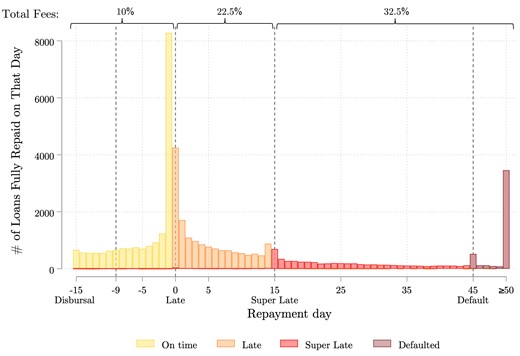
Abstract Digital credit has expanded rapidly in Africa, with opaque loan terms amidst low consumer financial literacy. Rich data from Malawi shows substantial demand for a digital loan with a base interest rate of 10% over 15 days, yet most borrowers are not aware of loan terms, repay late and incur substantial late fees. Regression discontinuity analyses show no evidence that access to small digital loans harms consumers’ perceived well-being. A short, randomised, phone-based financial literacy intervention improved knowledge, but did not increase timely loan repayment and modestly increased loan demand, ultimately increasing the likelihood of ever defaulting.
Context-Dependent Drivers of Discretionary Debt Decisions: Explaining Willingness to Borrow for Experiential Purchases
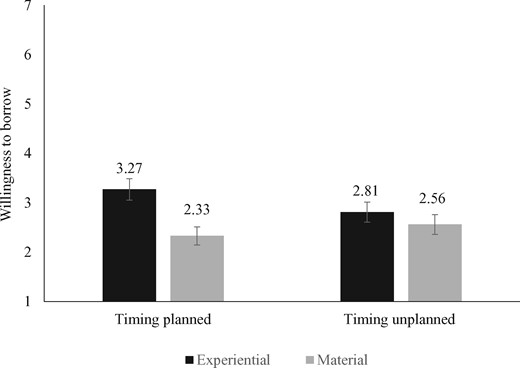
Abstract Mental accounting research suggests that consumers prefer borrowing for longer-lasting purchases in order to receive benefits from the purchases as they pay for them. In contrast, two sets of archival data and five lab studies show that consumers are more willing to borrow for experiential versus material purchases, even though experiential purchases tend to have a shorter physical duration. Further, framing the same purchase as more experiential than material increases willingness to borrow. This effect occurs because purchase timing is more important for experiential purchases—a function of consumers’ aversion to missing out on planned consumption. Thus, we moderate the proposed effect by varying whether the borrowing decision impacts planned consumption. Other differences between material and experiential purchases, such as scarcity or expected happiness, cannot similarly explain our results. Moreover, our conceptualization allows us to reconcile the apparent contradiction between the previous and current research by examining the relative impact of purchase-timing importance and payment-benefit duration matching in different contexts (i.e., “purchasing” and “source-of-funding” decisions).