


We implement behavioral mechanisms in a natural field experiment to increase loan repayment rates on a peer-to-peer (P2P) lending website. The results show that text message reminders that convey lenders’ positive expectations considerably increase the likelihood that borrowers will repay their loans, whereas reminders emphasizing the adverse consequences of failure to repay loans do not have enduring effects. Our experiment results in an increase in loan repayments in the sample period. In addition, our reminders are cost-free to implement, showing the potential importance of such interventions in enhancing prosocial compliance in P2P lending. This paper was accepted by John List, behavioral economics.
Moral Incentives in Credit Card Debt Repayment: Evidence from a Field Experiment
We study the role of morality in debt repayment, using an experiment with the credit card customers of a large Islamic bank in Indonesia. In our main treatment, clients receive a text message stating that “non-repayment of debts by someone who is able to repay is an injustice.” This moral appeal decreases delinquency by 4.4 percentage points from a baseline of 66 percent and reduces default among customers with the highest ex ante credit risk. Additional treatments help benchmark the effects against direct financial incentives and rule out competing explanations, such as reminder effects, priming religion, and provision of new information.

The Hedonics of Debt
Psychologists and economists often discuss the “pain” of paying for our purchases. Four experiments examine how people evaluate prospective debt payments, analyzing how different features of a loan (down payment, final payment, duration, monthly payments) affect willingness to accept the loan. Akin to previous findings on physical pain, participants exhibited duration neglect and over-weighted final moments. However, participants also focused heavily on the monthly or average payment (unlike in retrospective studies of physical pain where only peak-end moments seem to count). In Experiment 2, participants’ willingness to accept the loan was not significantly diminished by making it more expensive through keeping the same monthly payment but extending the length of the loan by 40 percent (evincing duration neglect). Further, in Experiments 3 and 4, we show that participants increased their willingness to buy if loans were made longer and more expensive by adding smaller, less “painful” payments to the end.

Do Local Capital Market Conditions Affect Consumers’ Borrowing Decisions?
This paper uses detailed data from an online peer-to-peer lending intermediary to test whether local access to finance affects consumers’ willingness to pay for loans. After controlling for local economic conditions and borrower credit quality, we find that borrowers who reside in areas with good access to bank finance request loans with lower interest rates. This effect is stronger for borrowers with poor credit and those seeking small loans, suggesting that local access to finance is more important for marginal borrowers. Overall, our findings shed light on how consumers substitute between alternative sources of finance. This paper was accepted by Wei Jiang, finance.
“Repayment-by-Purchase” Increases Consumer Debt Repayment
This article tests the effect of a novel credit card payment format—repayment-by-purchase—on consumers’ payments toward credit card debt. In contrast to typical balance repayment, where consumers make repayments relative to a total amount owed, repayment-by-purchase prompts consumers to select items (e.g., a Starbucks coffee) or categories of purchase (e.g., restaurant and café purchases) and to make payments toward their related debt. A field experiment first suggests that customers who opted into repayment-by-purchase paid 12.18% more toward their statement balance than a control group. Subsequently, five lab experiments show that consumers repaying-by-purchase increase repayment by an average of 22.47% over typical balance repayment. Process evidence suggests that these differences may be driven by repayment-by-purchase's power to increase purchase salience, which in turns increases perceptions of progress toward reducing debt. Consistent with this theory, the effect of repayment-by-purchase on bill repayment emerges regardless of whether consumers repay durable versus nondurable goods, and for specific items or categories of purchases, as long as the bill uses labels that are concrete enough to raise past purchase salience.

The Effects of Financial Incentives in Experiments: A Review and Capital-Labor-Production Framework
We review 74 experiments with no, low, or high performance-based financial incentives. The modal result has no effect on mean performance (though variance is usually reduced by higher payment). Higher incentive does improve performance often, typically judgment tasks that are responsive to better effort. Incentives also reduce “presentation” effects (e.g., generosity and risk-seeking). Incentive effects are comparable to effects of other variables, particularly “cognitive capital” and task “production” demands, and interact with those variables, so a narrow-minded focus on incentives alone is misguided. We also note that no replicated study has made rationality violations disappear purely by raising incentives.
Payment Rewards and Credit Card Debt: Experimental Evidence
We report on a controlled laboratory experiment in which participants make consumption, saving, and credit card repayment decisions when credit card purchases e

Cut me some slack! How perceptions of financial slack influence pain of payment
Abstract Consumers often experience pain of payment, a tug of negative affect that holds back their spending. While the literature has long viewed pain of payment as self‐regulatory in nature, it has left the dynamics of self‐regulation that lead to the pain of paying largely unaddressed. In self‐regulation, affect arises when people move away from a goal they hold. Thus, understanding the specific goals that people consider when making a payment can help us better predict when pain of payment will arise. We propose that people have a goal to maintain financial slack, and that violating this goal contributes to pain of payment. Thus, people experience more pain of payment when the goal to maintain financial slack is stronger or when it is particularly salient that a purchase entails losing financial slack. Critically, subjective changes in financial slack are not equivalent to objective changes in wealth, altering pain of payment for economically equivalent trades. This research contributes to the existing literature by identifying a novel antecedent to the pain of payment. It additionally expands our understanding of people's preferences between payment systems. Finally, it offers guidance to practitioners who wish to minimize pain of payment among their consumers.

Getting to the Top of Mind: How Reminders Increase Saving
We provide evidence from field experiments with three different banks that reminder messages increase commitment attainment for clients who recently opened commitment savings accounts. Messages that mention both savings goals and financial incentives are particularly effective, whereas other content variations such as gain versus loss framing do not have significantly different effects. Nor do we find evidence that receiving additional late reminders has an additive effect. These empirical results do not map neatly into existing models, so we provide a simple model where limited attention to exceptional expenses can generate undersaving that is in turn mitigated by reminders. Data, as supplemental material, are available at http://dx.doi.org/10.1287/mnsc.2015.2296 . This paper was accepted by Teck-Hua Ho, behavioral economics.
Context-Dependent Drivers of Discretionary Debt Decisions: Explaining Willingness to Borrow for Experiential Purchases
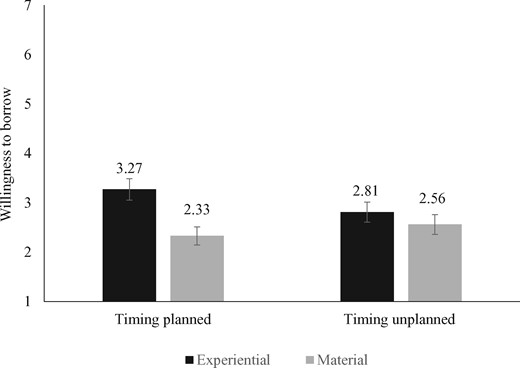
Abstract Mental accounting research suggests that consumers prefer borrowing for longer-lasting purchases in order to receive benefits from the purchases as they pay for them. In contrast, two sets of archival data and five lab studies show that consumers are more willing to borrow for experiential versus material purchases, even though experiential purchases tend to have a shorter physical duration. Further, framing the same purchase as more experiential than material increases willingness to borrow. This effect occurs because purchase timing is more important for experiential purchases—a function of consumers’ aversion to missing out on planned consumption. Thus, we moderate the proposed effect by varying whether the borrowing decision impacts planned consumption. Other differences between material and experiential purchases, such as scarcity or expected happiness, cannot similarly explain our results. Moreover, our conceptualization allows us to reconcile the apparent contradiction between the previous and current research by examining the relative impact of purchase-timing importance and payment-benefit duration matching in different contexts (i.e., “purchasing” and “source-of-funding” decisions).
Minimum Required Payment and Supplemental Information Disclosure Effects on Consumer Debt Repayment Decisions
Repayment decisions—how much of the loan to repay and when to make the payments—directly influence consumer debt levels. The authors examine how minimum required payment policy and loan information disclosed to consumers influence repayment decisions. They find that while presenting minimum required payment information has a negative impact on repayment decisions, increasing the minimum required level has a positive effect on repayment for most consumers. Experimental evidence from U.S. consumers shows that consumers’ propensity to pay the minimum required each month moderates these effects; U.K. credit card field data indicate that borrowers’ credit limit and balance due also moderate these effects. However, increasing the minimum level is unlikely to completely eliminate the negative effect of presenting minimum payment information. In addition, disclosing supplemental information, such as future interest cost and time needed to repay the loan, does not reduce the negative effects of including minimum payment information and has no substantial positive effect on repayments. This research offers new insights into the debt repayment process and has implications for consumers, lenders, and public policy.
Can Self-Control Explain Avoiding Free Money? Evidence from Interest-Free Student Loans
Abstract This paper uses insights from behavioral economics to explain a particularly surprising borrowing phenomenon: one in six undergraduate students offered interest-free loans turns them down. Models of impulse control predict that students may optimally reject subsidized loans to avoid excessive consumption during school. Using the National Postsecondary Student Aid Study, we investigate students' take-up decisions and identify a group of students for whom the loans create an especially tempting liquidity increase. Students who would receive the loan in cash are significantly more likely to turn it down, suggesting that consumers choose to limit their liquidity in economically meaningful situations.
The Debt Payment Puzzle: An Experimental Investigation
Why do borrowing individuals fail to repay their debt optimally? We design a diagnostic laboratory experiment where we rule out selection into debt and other co
Small Probabilistic Discounts Stimulate Spending: Pain of Paying in Price Promotions
AbstractWe find that small probabilistic price promotions effectively stimulate demand, even more so than comparable fixed price promotions (e.g., “1% chance it’s free” vs. “1% off,” respectively), because they more effectively reduce the pain of paying. In three field experiments at a grocer, we exogenously and endogenously manipulated the salience of pain of paying via elicitation timing (e.g., at entrance or checkout) and payment method (i.e., cash/debit cards or credit cards). This modulated the attractiveness of probabilistic discounts and their ability to stimulate spending. Shoppers paying with cash or debit cards, for example, spent 54% more if they received a 1% probabilistic discount than a 1% fixed discount (experiment 2). A fourth experiment showed that consumers’ sensitivity to pain of paying modulates the greater comparative efficacy of small probabilistic than fixed discounts. More broadly, the results elucidate a novel affective route through which price promotions stimulate demand––pain of paying.

Information Disclosure, Cognitive Biases, and Payday Borrowing
ABSTRACT Can psychology‐guided information disclosure induce borrowers to lower their use of high‐cost debt? In a field experiment at payday stores, we find that information that makes people think less narrowly (over time) about finance costs results in less borrowing. In particular, reinforcing the adding‐up dollar fees incurred when rolling over loans reduces the take‐up of future payday loans by 11% in the subsequent 4 months. Although we remain agnostic as to the overall sufficiency of better disclosure policy to “remedy” payday borrowing, we cast the 11% reduction in borrowing in light of the relative low cost of this policy.

Monetary incentives, what are they good for?
This paper is a critical reflection on the use of monetary incentives in economic experiments. The argument is that incentives have their effect through their influence on one or more of three fact...

Default Effects of Credit Card Minimum Payments
Credit card minimum payments are designed to ensure that individuals pay down their debt over time, and scheduling minimum automatic repayments helps people avoid forgetting to repay. Yet minimum payments have additional, unintended psychological default effects by drawing attention away from the card balance due. First, once individuals set the minimum automatic repayment as the default, they then neglect to make the occasional larger repayments they made previously. As a result, individuals incur considerably more credit card interest than late payment fees avoided. Using detailed transaction data, the authors show that approximately 8% of all of the interest ever paid is due to this effect. Second, manual credit card payments are lower when individuals are prompted with minimum payment information. In an experiment, the authors test two new interventions to mitigate this effect—a prompt for full repayment and a prompt asking those repaying little to pay more—yielding large counter effects. Thus, shrouding the minimum payment option for automatic and manual payments and directing attention to the full balance may remedy the unintended effects of default minimum payments.