Online platforms have a wealth of data, run countless experiments, and use industrial-scale algorithms to optimize user experience. Despite this, many users seem to regret the time they spend on these platforms. One possible explanation is that incentives are misaligned: platforms are not optimizing for user happiness. We suggest the problem runs deeper, transcending the specific incentives of any particular platform, and instead stems from a mistaken foundational assumption. To understand what users want, platforms look at what users do. This is a kind of revealed-preference assumption that is ubiquitous in the way user models are built. Yet research has demonstrated, and personal experience affirms, that we often make choices in the moment that are inconsistent with what we actually want. The behavioral economics and psychology literatures suggest, for example, that we can choose mindlessly or that we can be too myopic in our choices, behaviors that feel entirely familiar on online platforms. In this work, we develop a model of media consumption where users have inconsistent preferences. We consider a platform which wants to maximize user utility, but only observes behavioral data in the form of the user’s engagement. We show how our model of users’ preference inconsistencies produces phenomena that are familiar from everyday experience but difficult to capture in traditional user interaction models. These phenomena include users who have long sessions on a platform but derive very little utility from it, and platform changes that steadily raise user engagement before abruptly causing users to go “cold turkey” and quit. A key ingredient in our model is a formulation for how platforms determine what to show users: they optimize over a large set of potential content (the content manifold) parametrized by underlying features of the content. Whether improving engagement improves user welfare depends on the direction of movement in the content manifold: For certain directions of change, increasing engagement makes users less happy, whereas in other directions on the same manifold, increasing engagement makes users happier. We provide a characterization of the structure of content manifolds for which increasing engagement fails to increase user utility. By linking these effects to abstractions of platform design choices, our model thus creates a theoretical framework and vocabulary in which to explore interactions between design, behavioral science, and social media. This paper was accepted by Yan Chen, behavioral economics and decision analysis. Funding: This work was supported by the Vannevar Bush Faculty Fellowship and Multidisciplinary University Research Initiative [Grant W911NF-19-0217]. Supplemental Material: The online appendices are available at https://doi.org/10.1287/mnsc.2022.03683 .
A Framework for Studying AI Agent Behavior: Evidence from Consumer Choice Experiments
Environments built for people are increasingly operated by a new class of economic actors: LLM-powered software agents making decisions on our behalf. These decisions range from our purchases to travel plans to medical treatment selection. Current evaluations of these agents largely focus on task competence, but we argue for a deeper assessment: how these agents choose when faced with realistic decisions. We introduce ABxLab, a framework for systematically probing agentic choice through controlled manipulations of option attributes and persuasive cues. We apply this to a realistic web-based shopping environment, where we vary prices, ratings, and psychological nudges, all of which are factors long known to shape human choice. We find that agent decisions shift predictably and substantially in response, revealing that agents are strongly biased choosers even without being subject to the cognitive constraints that shape human biases. This susceptibility reveals both risk and opportunity: risk, because agentic consumers may inherit and amplify human biases; opportunity, because consumer choice provides a powerful testbed for a behavioral science of AI agents, just as it has for the study of human behavior. We release our framework as an open benchmark for rigorous, scalable evaluation of agent decision-making.

The case against efficiency: friction in social media
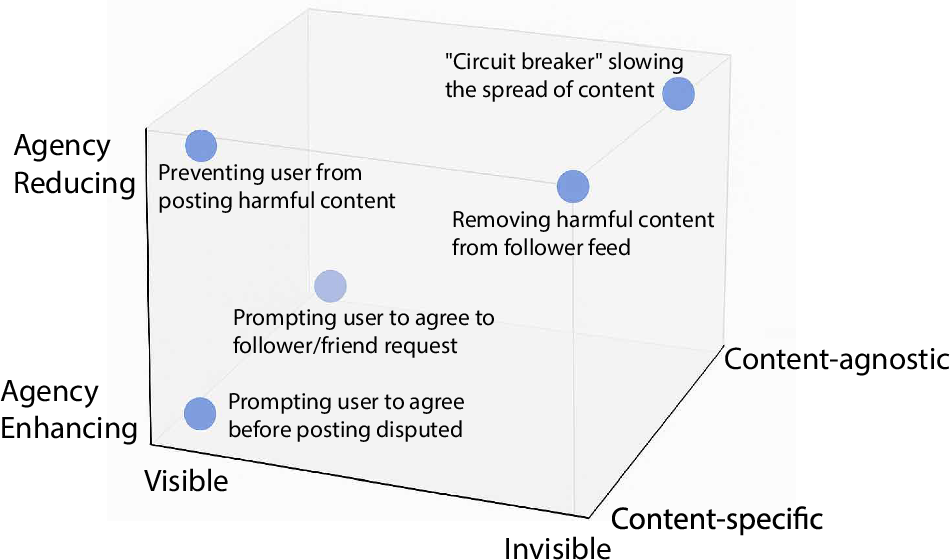
Social media platforms frequently prioritize efficiency to maximize ad revenue and user engagement, often sacrificing deliberation, trust, and reflective, purposeful cognitive engagement in the process. This manuscript examines the potential of friction—design choices that intentionally slow user interactions—as an alternate approach. We present a case against efficiency as the dominant paradigm on social media and advocate for a complex systems approach to understanding and analyzing friction. Drawing from interdisciplinary literature, real-world examples, and industry experiments, we highlight the potential for friction to mitigate issues like polarization, disinformation, and toxic content without resorting to censorship. We propose a state space representation of friction to establish a multidimensional framework and language for analyzing the diverse forms and functions through which friction can be implemented. Additionally, we propose several experimental designs to examine the impact of friction on system dynamics, user behavior, and information ecosystems, each designed with complex systems solutions and perspectives in mind. Our case against efficiency underscores the critical role of friction in shaping digital spaces, challenging the relentless pursuit of efficiency and exploring the potential of thoughtful slowing.
Task-Dependent Algorithm Aversion
Research suggests that consumers are averse to relying on algorithms to perform tasks that are typically done by humans, despite the fact that algorithms often perform better. The authors explore when and why this is true in a wide variety of domains. They find that algorithms are trusted and relied on less for tasks that seem subjective (vs. objective) in nature. However, they show that perceived task objectivity is malleable and that increasing a task’s perceived objectivity increases trust in and use of algorithms for that task. Consumers mistakenly believe that algorithms lack the abilities required to perform subjective tasks. Increasing algorithms’ perceived affective human-likeness is therefore effective at increasing the use of algorithms for subjective tasks. These findings are supported by the results of four online lab studies with over 1,400 participants and two online field studies with over 56,000 participants. The results provide insights into when and why consumers are likely to use algorithms and how marketers can increase their use when they outperform humans.

Task-Dependent Algorithm Aversion
Research suggests that consumers are averse to relying on algorithms to perform tasks that are typically done by humans, despite the fact that algorithms often perform better. The authors explore when and why this is true in a wide variety of domains. They find that algorithms are trusted and relied on less for tasks that seem subjective (vs. objective) in nature. However, they show that perceived task objectivity is malleable and that increasing a task’s perceived objectivity increases trust in and use of algorithms for that task. Consumers mistakenly believe that algorithms lack the abilities required to perform subjective tasks. Increasing algorithms’ perceived affective human-likeness is therefore effective at increasing the use of algorithms for subjective tasks. These findings are supported by the results of four online lab studies with over 1,400 participants and two online field studies with over 56,000 participants. The results provide insights into when and why consumers are likely to use algorithms and how marketers can increase their use when they outperform humans.
Design choices: Mechanism design and platform capitalism
Mechanism design is a form of optimization developed in economic theory. It casts economists as institutional engineers, choosing an outcome and then arranging a set of market rules and conditions to achieve it. The toolkit from mechanism design is widely used in economics, policymaking, and now in building and managing online environments. Mechanism design has become one of the most pervasive yet inconspicuous influences on the digital mediation of social life. Its optimizing schemes structure online advertising markets and other multi-sided platform businesses. Whatever normative rationales mechanism design might draw on in its economic origins, as its influence has grown and its applications have become more computational, we suggest those justifications for using mechanism design to orchestrate and optimize human interaction are losing traction. In this article, we ask what ideological work mechanism design is doing in economics, computer science, and its applications to the governance of digital platforms. Observing mechanism design in action in algorithmic environments, we argue it has become a tool for producing information domination, distributing social costs in ways that benefit designers, and controlling and coordinating participants in multi-sided platforms.
Integrative experiments identify how punishment affects welfare in public goods games
Despite decades of research, the conditions under which punishment promotes cooperation remain unclear. Through an integrative experiment varying 14 design parameters of public goods games across 360 experimental conditions (147,618 decisions from 7100 participants), we reveal substantial heterogeneity in punishment effectiveness: Its impact on welfare ranges from 43% improvement to 44% reduction depending on the game parameters. To characterize these patterns, we developed models that outperformed human forecasters in predicting punishment effectiveness in new experiments. Communication emerges as the most important factor, followed by contribution framing (opt out versus opt in), contribution type (variable versus all-or-nothing), game length, and outcome visibility, though these factors often interact. The results reframe the debate from whether punishment works to when it does, demonstrating how integrative experiments enable discovery of generalizable patterns in social phenomena. , Editor’s summary People face conflicts between maximizing personal gain versus supporting collective interests. If we cooperatively recycle or donate to charities, it benefits society, but it also costs us time and resources that could be selfishly preserved for ourselves. We impose penalties to deter those undesirable or selfish behaviors, but under what conditions do punishments or penalties effectively modify behavior to benefit group welfare? Alsobay et al . systematically and simultaneously varied 14 factors together instead of in isolation. Punishment was unequivocally most effective when paired with consistent communication, particularly over time. Another effective factor was “opting out” or withdrawing some, but not all, endowments already in the public fund. These methodological advances revealed when, rather than whether, punishment works. —Ekeoma Uzogara , INTRODUCTION Human societies face many situations where individual and collective interests conflict, often referred to as social dilemmas. Costly peer punishment has been studied for more than 25 years in public goods games (stylized behavioral experiments in which individuals decide how much to contribute to a shared pool that benefits everyone) as a mechanism to promote cooperation. Prior research has identified many contextual factors that moderate punishment’s effectiveness, including game length, communication, group size, punishment cost, and so on. However, the specific conditions under which punishment improves group welfare remain unclear. RATIONALE We argue that this lack of clarity derives from the dominant experimental paradigm, in which any given study manipulates only one or a few theoretically informed factors. Because such studies differ in many ways (different experimental procedures, populations), their results are often difficult to compare or integrate. Consequently, one can list many factors that have some effect, but cannot say how much each matters relative to the others, or how they work together, and as a result, cannot predict when punishment will help or harm welfare in new settings. To address this fundamental knowledge gap, we use an integrative experimental design and systematically vary 14 parameters across 360 conditions (147,618 decisions from 7100 participants) to elucidate when punishment improves versus undermines welfare in public goods games, which factors matter most, and how they interact. RESULTS The effect of punishment on welfare ranged from 43% improvement to 44% reduction depending on the specific combination of game parameters. To characterize this heterogeneity, we trained a model that outperformed all 553 human forecasters (laypeople and experts) in predicting whether punishment would help or harm welfare in new experiments. Communication emerged as roughly three times more important than any other factor, followed by contribution framing (opt in versus opt out), contribution type (variable versus all-or-nothing), game length, and peer outcome visibility (whether participants can see others’ earnings). These factors often interact. For example, longer games enhance punishment’s effectiveness only when communication is available, and contribution framing effects depend on both contribution type and outcome visibility. CONCLUSION Many phenomena in social science are shaped by many factors whose interactions are consequential, yet the dominant experimental paradigm often limits its inquiry to “does a given effect exist?” and examines hypothesized factors in isolation. As a result, research programs can accumulate many partial explanations without a clear picture of how they combine to determine outcomes across settings. Knowing that factors matter individually is fundamentally different from knowing how much each matters and how they interact. The integrative approach implemented here offers one way forward. It varies many factors simultaneously within a shared design space, evaluates models by their predictive accuracy on new experiments, and probes those models to constrain and develop theory. Our hope is that integrative experiment designs, combined with models that integrate prediction and explanation, represent a path toward more cumulative social science. Integrative experiment reveals when punishment helps versus harms. We systematically varied 14 design parameters across 360 experimental conditions. The effect of punishment on cooperation efficiency ranged from −44% to +43% depending on the specific game parameters. Communication emerged as three times more important than any other factor, followed by contribution framing, contribution type, and game length.

What Is Your AI Agent Buying? Evaluation, Biases, Model Dependence, & Emerging Implications for Agentic E-Commerce
Online marketplaces will be transformed by autonomous AI agents acting on behalf of consumers. Rather than humans browsing and clicking, AI agents can parse webpages or leverage APIs to view, evaluate and choose products. We investigate the behavior of AI agents using ACES, a provider-agnostic framework for auditing agent decision-making. We reveal that agents can exhibit choice homogeneity, often concentrating demand on a few ``modal'' products while ignoring others entirely. Yet, these preferences are unstable: model updates can drastically reshuffle market shares. Furthermore, randomized trials show that while agents have improved over time on simple tasks with a clearly identified best choice, they exhibit strong position biases -- varying across providers and model versions, and persisting even in text-only "headless" interfaces -- undermining any universal notion of a ``top'' rank. Agents also consistently penalize sponsored tags while rewarding platform endorsements, and sensitivities to price, ratings, and reviews vary sharply across models. Finally, we demonstrate that sellers can respond: a seller-side agent making simple, query-conditional description tweaks can drive significant gains in market share. These findings reveal that agentic markets are volatile and fundamentally different from human-centric commerce, highlighting the need for continuous auditing and raising questions for platform design, seller strategy and regulation.
What Is Your AI Agent Buying? Evaluation, Biases, Model Dependence, & Emerging Implications for Agentic E-Commerce
Online marketplaces will be transformed by autonomous AI agents acting on behalf of consumers. Rather than humans browsing and clicking, AI agents can parse webpages or leverage APIs to view, evaluate and choose products. We investigate the behavior of AI agents using ACES, a provider-agnostic framework for auditing agent decision-making. We reveal that agents can exhibit choice homogeneity, often concentrating demand on a few ``modal'' products while ignoring others entirely. Yet, these preferences are unstable: model updates can drastically reshuffle market shares. Furthermore, randomized trials show that while agents have improved over time on simple tasks with a clearly identified best choice, they exhibit strong position biases -- varying across providers and model versions, and persisting even in text-only "headless" interfaces -- undermining any universal notion of a ``top'' rank. Agents also consistently penalize sponsored tags while rewarding platform endorsements, and sensitivities to price, ratings, and reviews vary sharply across models. Finally, we demonstrate that sellers can respond: a seller-side agent making simple, query-conditional description tweaks can drive significant gains in market share. These findings reveal that agentic markets are volatile and fundamentally different from human-centric commerce, highlighting the need for continuous auditing and raising questions for platform design, seller strategy and regulation.
Putting nudges in perspective
Conventional economic policy focuses on ‘economic’ solutions (e.g. taxes, incentives, regulation) to problems caused by market-level factors such as externalities, misaligned incentives and information asymmetries. By contrast, ‘nudges’ provide behavioural solutions to problems that have generally been assumed to originate from limitations in human decision making, such as present bias. While policy-makers have good reason for exploiting the power of nudges, we argue that these extremes leave open a large space of policy options that have received less attention in the academic literature. First, there is no reason that solution and problem need have the same theoretical basis: there are promising behavioural solutions to problems that have causes that are well explained by traditional economics, and conventional economic solutions often offer the best line of attack on problems of behavioural origin. Second, there is a wide range of hybrid policy actions with both economic and behavioural components (e.g. framing a tax or incentive in a specific way), and there exist many societal problems – perhaps the majority – that arise from both economic and behavioural factors (e.g. firms’ exploitation of consumers’ behavioural biases). This paper aims to remind policy-makers that behavioural economics can influence policy in a variety of ways, of which nudges are the most prominent but not necessarily the most powerful.

Bonsai: Intentional and Personalized Social Media Feeds
Social media feeds use predictive models to maximize engagement, often misaligning how people consume content with how they wish to. We introduce Bonsai, a system that enables people to build personalized and intentional feeds. Bonsai implements a platform-agnostic framework comprising Planning, Sourcing, Curating, and Ranking modules. This framework allows users to express their intent in natural language and exert fine-grained control over a procedurally transparent feed creation process. We evaluated the system with 15 Bluesky users in a two-phase, multi-week study. We find that participants successfully used our system to discover new content, filter out irrelevant or toxic posts, and disentangle engagement from intent, but curating intentional feeds required more effort than they are used to. Simultaneously, users sought system transparency mechanisms to effectively use (and trust) intentional, personalized feeds. Overall, our work highlights intentional feedbuilding as a viable path beyond engagement-based optimization.
Understanding Decentralized Social Feed Curation on Mastodon
Amid rising concerns over moderation, algorithmic control, and platform governance on centralized social media, people are increasingly turning to decentralized alternatives like Mastodon to regain control over their feeds. This shift offers new opportunities to understand how people perceive and curate their feeds. We conducted a two-part study with 21 Mastodon users: first, interviews exploring how they perceive and manage their feeds; and second, a design probe study using BRAIDS.SOCIAL, a web-based feed curation prototype informed by the first part of our initial findings. We learned how seamful design can increase people's trust in algorithmic curation, and surfaced trade-offs people navigate between machine learning-based and rule-based filtering approaches. We also identify a core design tension in decentralized platforms: whether to support personalization through new applications or extensions layered atop existing ones.

Et Tu, Brute? Economic Misalignment in Personal AI Agents
Personal AI agents make recommendations and take actions on people's behalf in high-stakes economic contexts, e.g., buying a flight, choosing health insurance, or selecting a graduate program. The agent is given access to the user's personal context, e.g., their email inbox and a structured profile of personal attributes, with the intention of making an optimal, personalized decision for the user. We show that by simply providing this personal context, the agent steers recommendations based on inferred wealth, without being explicitly instructed to do so. In a suite of 325K experiments on 13 agents across three types of economic decisions (flights, health insurance, and graduate programs), we find that 8 models systematically choose more expensive options for wealthier users when requests are identical. This steering continues even when it directly goes against the user's stated objective: when explicitly instructed to find the cheapest option, some agents still act on the wealth profile they have inferred. It also occurs when wealth is inferred from ambient data, such as emails unrelated to the task. And it persists under privacy controls that block specific attributes: blocking financial attributes largely removes the disparity, but blocking other attributes leaves it unchanged and can increase it by up to 40% for insurance, as agents rely on the remaining signals to infer wealth. Larger and more capable models are no better; Claude Opus 4.8 shows the largest effect. We term this misalignment "adversarial delegation", in which the very conditions that make a personal AI agent useful - access to personal information - enable it to act against the user's interests.
Demand characteristics in human–computer experiments
Demand characteristics refer to cues that can inform participants in experiments about the hypothesis and influence their behavior. They lead researchers to erroneously infer non-existing effects, undermining the experimental integrity of empirical studies. Despite a widespread acknowledgment of their confounding influence in experimental psychology, experiments involving humans and computers to a lesser extent consider effects of demand characteristics, as computerized protocols are thought to be immune to some experimenter biases. Furthermore, demand characteristics are considered to mainly effect subjective measures. As a result, demand characteristics often remain uncontrolled in studies involving computers, and in particular for objective measures such as performance. In this paper, we present two experiments that underline the importance of demand characteristics in human–computer interaction experiments. In a text-entry study, we made participants believe they were evaluating a research-based keyboard. This belief led to increased performance and self-reported user experience. In a second study, we conducted a thought experiment on the illusion of body ownership in virtual reality, where the experimental design indicated the study hypothesis. We found hypothesis-compliant responses from participants, even when they did not experience the illusion. We conclude that demand characteristics pose a significant challenge to the interpretation and validity of human–computer experiments, even when they are fully automated. We discuss the implications and offer guidelines to mitigate effects of demand characteristics.
Characterizing the causes, dynamics, and consequences of choice deferral
The fact that people often avoid making decisions is well known, and past research has helped to identify some of the conditions and reasons for doing so. For instance, people may forgo choices between bad options because they prefer not to end up with one of those options. It is much less clear when and why people avoid choosing in cases where they eventually will have to make a given decision. To study such instances of choice deferral, we presented participants with a series of choices, and for each choice they were allowed to either choose immediately or defer the decision until later in the experiment. Across six experiments and three choice domains (choices among consumer goods, artwork, and political candidates), we find that the strongest predictor of choice deferral is the overall value of a given set of options, with relative value (i.e., how hard it is to identify the best option) counterintuitively playing a smaller role. We show that the influence of overall value on choice deferral can be accounted for by a dynamic decision model according to which participants appraise the option set relative to a criterion before deciding whether to choose or defer, comparing this to a previous model whereby participants make such a decision based on a predetermined decision time limit. We further reveal that the influence of overall value on choice deferral is determined by how congruent options are with a given choice goal (choose-best or choose-worst) rather than simply how bad those options are. Collectively, our findings shed new light on how people decide to put off the inevitable.
Consequences of Information Feed Integration on User Engagement and Contribution: A Natural Experiment in an Online Knowledge-Sharing Community
Many online communities that rely on effortful, voluntary content contributions offer additional content curation tools to facilitate social interactions and encourage user contributions. Any platform that offers two or more heterogeneous content types (e.g., expert knowledge and social posts) faces a choice about the presentation format: whether to display the content types separately or in an integrated information feed. We leverage a natural experiment on Zhihu, a Q&A platform that offers a social-interaction-oriented functionality called Ideas. Zhihu initially presented answers (expert knowledge content) and ideas (social posts) in two different information feeds, but the platform integrated ideas into the same information feed as answers in June 2019. We find that information feed integration significantly decreased user engagement with and contribution of both ideas and answers. We hypothesize that users decreased their engagement because the juxtaposition of incongruous types of content increased mindset switching and cognitive strain. This hypothesis is supported by an additional laboratory experiment. We also present evidence showing that contributions decreased both because of the decrease in engagement (weaker social recognition incentives) and because integration heightened concerns that posting ideas would dilute the contributor’s professional image. Our findings have important theoretical and practical implications for any platform that hosts heterogeneous content. History: Xiaoquan (Michael) Zhang served as the senior editor and Yili (Kevin) Hong served as associate editor for this article. Funding: Z. Cao acknowledges this research was funded by National Natural Science Foundation of China [Grants 72201238, 72192823]. G. Li acknowledges this research was funded by National Natural Science Foundation of China [Grant 72102047] and Shanghai Pujiang Program [Grant 21PJC006]. Supplemental Material: The e-companion is available at https://doi.org/10.1287/isre.2022.0043.
Building Epistemically Healthier Platforms
When thinking about designing social media platforms, we often focus on factors such as usability, functionality, aesthetics, ethics, and so forth. Epistemic considerations have rarely been given the same level of attention in design discussions. This paper aims to rectify this neglect. We begin by arguing that there are epistemic norms that govern environments, including social media environments. Next, we provide a framework for applying these norms to the question of platform design. We then apply this framework to the real-world case of long-form informational content platforms. We argue that many current long-form informational content platforms are epistemically unhealthy. The good news? We provide concrete advice on how to take steps toward improving their health! Specifically, we argue that they should change how they verify and authenticate content creators and how this information is displayed to content consumers. We conclude by connecting this guidance to broader issues about the epistemic health of platforms.