


Even if algorithms make better predictions than humans on average, humans may sometimes have private information that an algorithm does not have access to that can improve performance. How can we help humans effectively use and adjust recommendations made by algorithms in such situations? When deciding whether and how to override an algorithm’s recommendations, we hypothesize that people are biased toward following naïve advice-weighting (NAW) behavior; they take a weighted average between their own prediction and the algorithm’s prediction, with a constant weight across prediction instances regardless of whether they have valuable private information. This leads to humans overadhering to the algorithm’s predictions when their private information is valuable and underadhering when it is not. In an online experiment where participants were tasked with making demand predictions for 20 products while having access to an algorithm’s predictions, we confirm this bias toward NAW and find that it leads to a 20%–61% increase in prediction error. In a second experiment, we find that feature transparency—even when the underlying algorithm is a black box—helps users more effectively discriminate how to deviate from algorithms, resulting in a 25% reduction in prediction error. We make further improvements in a third experiment via an intervention designed to move users away from advice weighting and instead, use only their private information to inform deviations, leading to a 34% reduction in prediction error. This paper was accepted by Elena Katok, Special Issue on the Human-Algorithm Connection. Supplemental Material: The online appendix and data files are available at https://doi.org/10.1287/mnsc.2022.03850 .
Algorithm appreciation: People prefer algorithmic to human judgment
Even though computational algorithms often outperform human judgment, received wisdom suggests that people may be skeptical of relying on them (Dawes, 1979). Counter to this notion, results from six experiments show that lay people adhere more to advice when they think it comes from an algorithm than from a person. People showed this effect, what we call algorithm appreciation, when making numeric estimates about a visual stimulus (Experiment 1A) and forecasts about the popularity of songs and romantic attraction (Experiments 1B and 1C). Yet, researchers predicted the opposite result (Experiment 1D). Algorithm appreciation persisted when advice appeared jointly or separately (Experiment 2). However, algorithm appreciation waned when: people chose between an algorithm’s estimate and their own (versus an external advisor’s; Experiment 3) and they had expertise in forecasting (Experiment 4). Paradoxically, experienced professionals, who make forecasts on a regular basis, relied less on algorithmic advice than lay people did, which hurt their accuracy. These results shed light on the important question of when people rely on algorithmic advice over advice from people and have implications for the use of “big data” and algorithmic advice it generates.
Et Tu, Brute? Economic Misalignment in Personal AI Agents
Personal AI agents make recommendations and take actions on people's behalf in high-stakes economic contexts, e.g., buying a flight, choosing health insurance, or selecting a graduate program. The agent is given access to the user's personal context, e.g., their email inbox and a structured profile of personal attributes, with the intention of making an optimal, personalized decision for the user. We show that by simply providing this personal context, the agent steers recommendations based on inferred wealth, without being explicitly instructed to do so. In a suite of 325K experiments on 13 agents across three types of economic decisions (flights, health insurance, and graduate programs), we find that 8 models systematically choose more expensive options for wealthier users when requests are identical. This steering continues even when it directly goes against the user's stated objective: when explicitly instructed to find the cheapest option, some agents still act on the wealth profile they have inferred. It also occurs when wealth is inferred from ambient data, such as emails unrelated to the task. And it persists under privacy controls that block specific attributes: blocking financial attributes largely removes the disparity, but blocking other attributes leaves it unchanged and can increase it by up to 40% for insurance, as agents rely on the remaining signals to infer wealth. Larger and more capable models are no better; Claude Opus 4.8 shows the largest effect. We term this misalignment "adversarial delegation", in which the very conditions that make a personal AI agent useful - access to personal information - enable it to act against the user's interests.

Privacy Risk in Machine Learning: Analyzing the Connection to Overfitting
Machine learning algorithms, when applied to sensitive data, pose a distinct threat to privacy. A growing body of prior work demonstrates that models produced by these algorithms may leak specific private information in the training data to an attacker, either through the models' structure or their observable behavior. However, the underlying cause of this privacy risk is not well understood beyond a handful of anecdotal accounts that suggest overfitting and influence might play a role. This paper examines the effect that overfitting and influence have on the ability of an attacker to learn information about the training data from machine learning models, either through training set membership inference or attribute inference attacks. Using both formal and empirical analyses, we illustrate a clear relationship between these factors and the privacy risk that arises in several popular machine learning algorithms. We find that overfitting is sufficient to allow an attacker to perform membership inference and, when the target attribute meets certain conditions about its influence, attribute inference attacks. Interestingly, our formal analysis also shows that overfitting is not necessary for these attacks and begins to shed light on what other factors may be in play. Finally, we explore the connection between membership inference and attribute inference, showing that there are deep connections between the two that lead to effective new attacks.
Trust and reliance on AI — An experimental study on the extent and costs of overreliance on AI
Decision-making is undergoing rapid changes due to the introduction of artificial intelligence (AI), as AI recommender systems can help mitigate human flaws and increase decision accuracy and efficiency. However, AI can also commit errors or suffer from algorithmic bias. Hence, blind trust in technologies carries risks, as users may follow detrimental advice resulting in undesired consequences. Building upon research on algorithm appreciation and trust in AI, the current study investigates whether users who receive AI advice in an uncertain situation overrely on this advice — to their own detriment and that of other parties. In a domain-independent, incentivized, and interactive behavioral experiment, we find that the mere knowledge of advice being generated by an AI causes people to overrely on it, that is, to follow AI advice even when it contradicts available contextual information as well as their own assessment. Frequently, this overreliance leads not only to inefficient outcomes for the advisee, but also to undesired effects regarding third parties. The results call into question how AI is being used in assisted decision making, emphasizing the importance of AI literacy and effective trust calibration for productive deployment of such systems.
The governance & behavioral challenges of generative artificial intelligence’s hypercustomization capabilities
Generative artificial intelligence (GenAI) is changing human–machine interactions and the broader information ecosystem. Much as social media algorithms personalize online experiences, GenAI applications can align with user preferences to customize the way individuals interact with information. However, through training, fine-tuning, and prompting, GenAI applications can introduce a new level of customization: hypercustomization. By dynamically tailoring responses to an individual’s explicit and implicit preferences, hypercustomization can reinforce biases, false beliefs, or misconceptions. As a result, it can heighten significant societal challenges, such as the spread of misinformation and political and social polarization. In this article, we explore the risks associated with hypercustomization and the governance and behavioral challenges that might impede effective risk mitigation. These challenges include a lack of transparency in GenAI applications, opacity of the nature of their interactions with users, users’ overreliance on these systems, and the inefficacy of warning messages. We also provide recommendations for overcoming these challenges.

PrivacySIM: Evaluating LLM Simulation of User Privacy Behavior
Large language models (LLMs) are increasingly used to simulate human behavior, but their ability to simulate individual privacy decisions is not well understood. In this paper, we address the problem of evaluating whether a core set of user persona attributes can drive LLMs to simulate individual-level privacy behavior. We introduce PrivacySIM, an evaluation suite that benchmarks LLM simulation of user privacy behavior against the ground-truth responses of $1{,}000$ users. These users are drawn from five published user studies on privacy spanning LLM healthcare consultations, conversational agents, and chatbots. Drawing on these user studies, we hypothesize three persona facets as plausible predictors of privacy decision-making: demographics, previous experiences, and stated privacy attitudes. We condition nine frontier LLMs on subsets of these three facets and measure how often each model's response to a data-sharing scenario matches the user's actual response. Our findings show that (1) privacy persona conditioning consistently improves simulation quality over no-persona conditioning, but even the strongest model (40.4% accuracy) remains far from faithfully simulating individual privacy decisions. (2) A user's stated privacy attitudes alone may not be the best predictor because they often diverge from the user's actual privacy behavior. (3) Users with high AI/chatbot experience but low stated privacy attitudes are the most challenging to simulate. PrivacySIM is a first step toward understanding and improving the capabilities of LLMs to simulate user privacy decisions. We release PrivacySIM to enable further evaluation of LLM privacy simulation.
Task-Dependent Algorithm Aversion
Research suggests that consumers are averse to relying on algorithms to perform tasks that are typically done by humans, despite the fact that algorithms often perform better. The authors explore when and why this is true in a wide variety of domains. They find that algorithms are trusted and relied on less for tasks that seem subjective (vs. objective) in nature. However, they show that perceived task objectivity is malleable and that increasing a task’s perceived objectivity increases trust in and use of algorithms for that task. Consumers mistakenly believe that algorithms lack the abilities required to perform subjective tasks. Increasing algorithms’ perceived affective human-likeness is therefore effective at increasing the use of algorithms for subjective tasks. These findings are supported by the results of four online lab studies with over 1,400 participants and two online field studies with over 56,000 participants. The results provide insights into when and why consumers are likely to use algorithms and how marketers can increase their use when they outperform humans.
Machine Unlearning
Once users have shared their data online, it is generally difficult for them to revoke access and ask for the data to be deleted. Machine learning (ML) exacerbates this problem because any model trained with said data may have memorized it, putting users at risk of a successful privacy attack exposing their information. Yet, having models unlearn is notoriously difficult. We introduce SISA training, a framework that expedites the unlearning process by strategically limiting the influence of a data point in the training procedure. While our framework is applicable to any learning algorithm, it is designed to achieve the largest improvements for stateful algorithms like stochastic gradient descent for deep neural networks. SISA training reduces the computational overhead associated with unlearning, even in the worst-case setting where unlearning requests are made uniformly across the training set. In some cases, the service provider may have a prior on the distribution of unlearning requests that will be issued by users. We may take this prior into account to partition and order data accordingly, and further decrease overhead from unlearning. Our evaluation spans several datasets from different domains, with corresponding motivations for unlearning. Under no distributional assumptions, for simple learning tasks, we observe that SISA training improves time to unlearn points from the Purchase dataset by 4.63x, and 2.45x for the SVHN dataset, over retraining from scratch. SISA training also provides a speed-up of 1.36x in retraining for complex learning tasks such as ImageNet classification; aided by transfer learning, this results in a small degradation in accuracy. Our work contributes to practical data governance in machine unlearning.
Underspecified Human Decision Experiments Considered Harmful
Decision-making with information displays is a key focus of research in areas like human-AI collaboration and data visualization. However, what constitutes a decision problem, and what is required for an experiment to conclude that decisions are flawed, remain imprecise. We present a widely applicable definition of a decision problem synthesized from statistical decision theory and information economics. We claim that to attribute loss in human performance to bias, an experiment must provide the information that a rational agent would need to identify the normative decision. We evaluate whether recent empirical research on AI-assisted decisions achieves this standard. We find that only 10 (26%) of 39 studies that claim to identify biased behavior presented participants with sufficient information to make this claim in at least one treatment condition. We motivate the value of studying well-defined decision problems by describing a characterization of performance losses they allow to be conceived.

Artificial intelligence in communication impacts language and social relationships
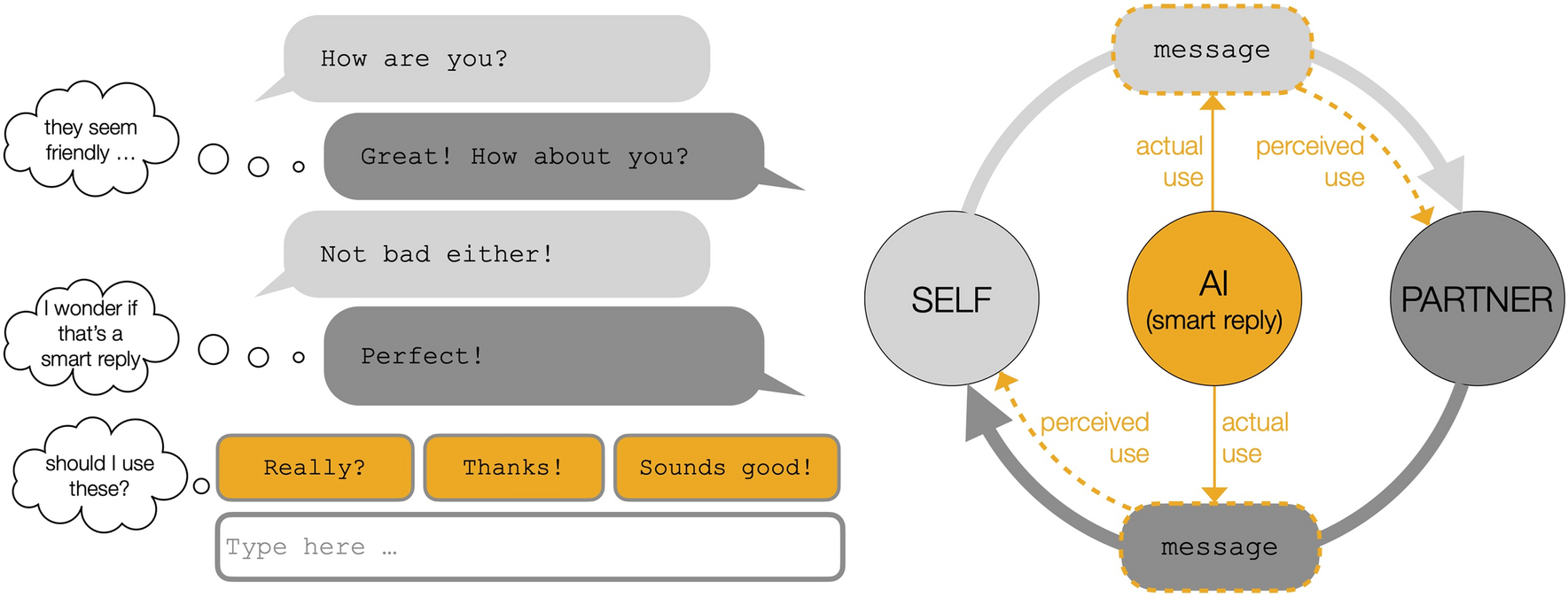
Artificial intelligence (AI) is already widely used in daily communication, but despite concerns about AI’s negative effects on society the social consequences of using it to communicate remain largely unexplored. We investigate the social consequences of one of the most pervasive AI applications, algorithmic response suggestions (“smart replies”), which are used to send billions of messages each day. Two randomized experiments provide evidence that these types of algorithmic recommender systems change how people interact with and perceive one another in both pro-social and anti-social ways. We find that using algorithmic responses changes language and social relationships. More specifically, it increases communication speed, use of positive emotional language, and conversation partners evaluate each other as closer and more cooperative. However, consistent with common assumptions about the adverse effects of AI, people are evaluated more negatively if they are suspected to be using algorithmic responses. Thus, even though AI can increase the speed of communication and improve interpersonal perceptions, the prevailing anti-social connotations of AI undermine these potential benefits if used overtly.
Eternal Sunshine of the Spotless Net: Selective Forgetting in Deep Networks
We explore the problem of selectively forgetting a particular subset of the data used for training a deep neural network. While the effects of the data to be forgotten can be hidden from the output of the network, insights may still be gleaned by probing deep into its weights. We propose a method for "scrubbing" the weights clean of information about a particular set of training data. The method does not require retraining from scratch, nor access to the data originally used for training. Instead, the weights are modified so that any probing function of the weights is indistinguishable from the same function applied to the weights of a network trained without the data to be forgotten. This condition is a generalized and weaker form of Differential Privacy. Exploiting ideas related to the stability of stochastic gradient descent, we introduce an upper-bound on the amount of information remaining in the weights, which can be estimated efficiently even for deep neural networks.
User Privacy and Large Language Models: An Analysis of Frontier Developers' Privacy Policies
Hundreds of millions of people now regularly interact with large language models via chatbots. Model developers are eager to acquire new sources of high-quality training data as they race to improve model capabilities and win market share. This paper analyzes the privacy policies of six U.S. frontier AI developers to understand how they use their users' chats to train models. Drawing primarily on the California Consumer Privacy Act, we develop a novel qualitative coding schema that we apply to each developer's relevant privacy policies to compare data collection and use practices across the six companies. We find that all six developers appear to employ their users' chat data to train and improve their models by default, and that some retain this data indefinitely. Developers may collect and train on personal information disclosed in chats, including sensitive information such as biometric and health data, as well as files uploaded by users. Four of the six companies we examined appear to include children's chat data for model training, as well as customer data from other products. On the whole, developers' privacy policies often lack essential information about their practices, highlighting the need for greater transparency and accountability. We address the implications of users' lack of consent for the use of their chat data for model training, data security issues arising from indefinite chat data retention, and training on children's chat data. We conclude by providing recommendations to policymakers and developers to address the data privacy challenges posed by LLM-powered chatbots.
Data Minimization at Inference Time
In high-stakes domains such as legal, banking, hiring, and healthcare, learning models frequently rely on sensitive user information for inference, necessitating the complete set of features. This not only poses significant privacy risks for individuals but also demands substantial human effort from organizations to verify information accuracy. This study asks whether it is necessary to use all input features for accurate predictions at inference time. The paper demonstrates that, in a personalized setting, individuals may only need to disclose a small subset of features without compromising decision-making accuracy. The paper also provides an efficient sequential algorithm to determine the appropriate attributes for each individual to provide. Evaluations across various learning tasks show that individuals can potentially report as little as 10\% of their information while maintaining the same accuracy level as a model that employs the full set of user information.
Clio: Privacy-Preserving Insights into Real-World AI Use
How are AI assistants being used in the real world? While model providers in theory have a window into this impact via their users' data, both privacy concerns and practical challenges have made analyzing this data difficult. To address these issues, we present Clio (Claude insights and observations), a privacy-preserving platform that uses AI assistants themselves to analyze and surface aggregated usage patterns across millions of conversations, without the need for human reviewers to read raw conversations. We validate this can be done with a high degree of accuracy and privacy by conducting extensive evaluations. We demonstrate Clio's usefulness in two broad ways. First, we share insights about how models are being used in the real world from one million Claude.ai Free and Pro conversations, ranging from providing advice on hairstyles to providing guidance on Git operations and concepts. We also identify the most common high-level use cases on Claude.ai (coding, writing, and research tasks) as well as patterns that differ across languages (e.g., conversations in Japanese discuss elder care and aging populations at higher-than-typical rates). Second, we use Clio to make our systems safer by identifying coordinated attempts to abuse our systems, monitoring for unknown unknowns during critical periods like launches of new capabilities or major world events, and improving our existing monitoring systems. We also discuss the limitations of our approach, as well as risks and ethical concerns. By enabling analysis of real-world AI usage, Clio provides a scalable platform for empirically grounded AI safety and governance.