


Behavioral interventions often focus on reducing friction to encourage behavior change. In contrast, we provide evidence that adding initial friction to a sign-up process can increase follow-through behavior. In a field experiment with a state department of transportation ([Formula: see text]), we test whether adding modest friction during sign-up for a carpool platform increases usage. Although a more effortful sign-up process leads to 25% fewer sign-ups, overall usage increases. Importantly, these results were only partly explained by selection: Using an intent-to-treat analysis, participants with a more effortful sign-up process took 1.6 times more carpool trips per week over four months, leading to more overall trips despite fewer users. In a second experiment with online task work, participants with more effortful sign-up were 37% more likely to return the next day and completed more work overall. These results suggest that adding friction may be an overlooked strategy when follow-through, rather than initial uptake, is the primary goal. This paper was accepted by George Wu, behavioral economics and decision analysis. Funding: The authors acknowledge funding from the University of Konstanz for Study 2, Harvard University Pershing Square Foundation for Human Research, and Harvard Business School. The funders had no role in data collection and analysis, the decision to publish, or preparation of this manuscript. Supplemental Material: The online appendices and data files are available at https://doi.org/10.1287/mnsc.2023.03600 .
The efficiency-gain illusion: People underestimate the rate of AI use and overestimate its benefits on simple tasks
People are increasingly turning to AI assistance for simple tasks, e.g., arithmetic, spell-check, and answering simple questions. But does AI assistance actually save users time and effort? We investigate people's propensity to use AI for cognitively simple tasks and assess whether their reliance is well-calibrated. Across three pre-registered user studies (N = 2691), we find that people frequently choose to use AI even when doing so is inefficient (i.e. provides no meaningful time or effort savings). We identify systematic miscalibration at two levels: (1) a self-estimate miscalibration where people on average believe that they are using AI less than they actually are, and (2) efficiency-gain illusions where people overestimate how much time and effort savings AI use affords. We also identify a session-level carryover effect where a participant's prior AI use leads to further AI adoption and entrenches their miscalibration about time savings. Our results shed light on the mechanisms and biases underlying people's choice of whether to use AI as well as the risk of an overreliance feedback loop.

It’s the Effort That Counts: The Effect of Self-Control on Goal Progress Perceptions
Does the amount of self-control consumers must exert to choose a goal-consistent action influence their perceptions of goal progress? For example, if you choose to go to the gym when one of your favorite TV shows is on (vs. when nothing interesting is on TV), do you perceive that you have made a differential amount of progress toward your goal, despite completing the exact same workout? In eight studies (N = 7,515), the authors demonstrate that consumers perceive that they have made more progress on their goals when more (vs. less) self-control is required to choose to complete an identical goal-consistent task. This is because when consumers exert more (vs. less) self-control to choose a goal-consistent task over the goal-inconsistent alternatives, they infer higher commitment to the goal. The higher inferred commitment, in turn, leads consumers to perceive that future goal pursuit will be easier. The authors demonstrate this effect across a variety of tasks and means of exerting self-control, as well as with both hypothetical scenarios and real-behavior studies.

Variety Effects in Mobile Advertising
Mobile app users are often exposed to a sequence of short-lived marketing interventions (e.g., ads) within each usage session. This study examines how an increase in the variety of ads shown in a session affects a user's response to the next ad. The authors leverage the quasi-experimental variation in ad assignment in their data and propose an empirical framework that accounts for different types of confounding to isolate the effects of a unit increase in variety. Across a series of models, the authors consistently show that an increase in ad variety in a session results in a higher response rate to the next ad: holding all else fixed, a unit increase in variety of the prior sequence of ads can increase the click-through rate on the next ad by approximately 13%. The authors then explore the underlying mechanism and document empirical evidence for an attention-based account. The article offers important managerial implications by identifying a source of interdependence across ad exposures that is often ignored in the design of advertising auctions. Furthermore, the attention-based mechanism suggests that platforms can incorporate real-time attention measures to help advertisers with targeting dynamics.
In-Store Spending Dynamics: How Budgets Invert Relative-Spending Patterns
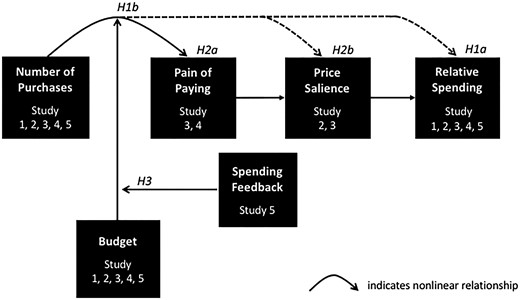
Abstract The authors conduct four controlled lab experiments and one field study in a brick-and-mortar grocery store to demonstrate that relative spending—the price of the purchased item relative to the mean price of the product category—evolves nonlinearly and distinctly for budget and nonbudget shoppers. While the relative spending of budget shoppers evolves in a concave manner, the relative spending of nonbudget shoppers evolves inversely in a convex manner. Thus, budget (nonbudget) shoppers spend relatively more (less) in the middle than at the beginning and toward the end of their shopping trip. Mediation analyses confirm that the pain of paying experienced while shopping drives price salience, which then drives relative spending. Moreover, manipulating shoppers’ pain of paying, by altering the opportunity costs associated with their spending or drawing shoppers’ attention to their spending via real-time spending feedback, is shown to influence these spending patterns. The research offers theoretical contributions to the in-store decision-making, budgeting, and pain-of-paying literature and has important implications for marketing and promotion strategies in retail and mobile technology environments, as it suggests when a shopper may be more sensitive to price-related factors.
Small Probabilistic Discounts Stimulate Spending: Pain of Paying in Price Promotions
AbstractWe find that small probabilistic price promotions effectively stimulate demand, even more so than comparable fixed price promotions (e.g., “1% chance it’s free” vs. “1% off,” respectively), because they more effectively reduce the pain of paying. In three field experiments at a grocer, we exogenously and endogenously manipulated the salience of pain of paying via elicitation timing (e.g., at entrance or checkout) and payment method (i.e., cash/debit cards or credit cards). This modulated the attractiveness of probabilistic discounts and their ability to stimulate spending. Shoppers paying with cash or debit cards, for example, spent 54% more if they received a 1% probabilistic discount than a 1% fixed discount (experiment 2). A fourth experiment showed that consumers’ sensitivity to pain of paying modulates the greater comparative efficacy of small probabilistic than fixed discounts. More broadly, the results elucidate a novel affective route through which price promotions stimulate demand––pain of paying.

Anticipation and Choice Heuristics in the Dynamic Consumption of Pain Relief
Humans frequently need to allocate resources across multiple time-steps. Economic theory proposes that subjects do so according to a stable set of intertemporal preferences, but the computational demands of such decisions encourage the use of formally less competent heuristics. Few empirical studies have examined dynamic resource allocation decisions systematically. Here we conducted an experiment involving the dynamic consumption over approximately 15 minutes of a limited budget of relief from moderately painful stimuli. We had previously elicited the participants’ time preferences for the same painful stimuli in one-off choices, allowing us to assess self-consistency. Participants exhibited three characteristic behaviors: saving relief until the end, spreading relief across time, and early spending, of which the last was markedly less prominent. The likelihood that behavior was heuristic rather than normative is suggested by the weak correspondence between one-off and dynamic choices. We show that the consumption choices are consistent with a combination of simple heuristics involving early-spending, spreading or saving of relief until the end, with subjects predominantly exhibiting the last two.
Temporal Reframing and Participation in a Savings Program: A Field Experiment
This study explores whether framing savings in more or less granular formats can increase sign-ups for a recurring deposit program in a FinTech environment. , A growing number of American workers are now freelancers and thus, responsible for their own retirement savings, yet they face psychological hurdles that hamper them from saving enough money for the long term. Although prior theory-derived interventions have been successful in addressing some of these obstacles, encouraging participation in saving programs is a challenging endeavor for policy makers and consumers alike. In a field setting, we test whether framing savings in more or less granular formats (for example, saving daily versus monthly) can encourage continued saving behavior through increasing the take up of a recurring deposit program. Among thousands of new users of a financial technology app, we find that framing deposits in daily amounts as opposed to monthly amounts quadruples the number of consumers who enroll. Furthermore, framing deposits in more granular terms reduced the participation gap between lower- and higher-income consumers: three times as many consumers in the highest rather than lowest income bracket participated in the program when it was framed as a $150 monthly deposit, but this difference in participation was eliminated when deposits were framed as $5 per day.

The Benefits of Emergency Reserves: Greater Preference and Persistence for Goals that Have Slack with a Cost
Marketers of programs that are designed to help consumers reach goals face dual challenges of making the program attractive enough to encourage consumer signup while still motivating consumers to reach desirable goals and thus stay satisfied with the program. The authors offer a possible solution to this challenge: the emergency reserve, or slack with a cost. They demonstrate how an explicitly defined emergency reserve not only is preferred over other options for goal-related programs but can also lead to increased persistence. Study 1 demonstrates that consumers prefer programs with emergency reserves to programs that do not have them, and Study 2 further clarifies that consumers' preference for an emergency reserve depends on the presence of a superordinate goal. Study 3 reveals that consumers prefer goals with emergency reserves because they perceive them to have both higher attainability and value than other goals. Study 4 demonstrates that reserves can lead to increased goal persistence in a realistic task that involves persistence over time. Finally, Studies 5 and 6 reveal that consumers persist more with reserve goals because they want to avoid using the “emergency” reserve.
A Generalizable Scale of Propensity to Plan: The Long and the Short of Planning for Time and for Money
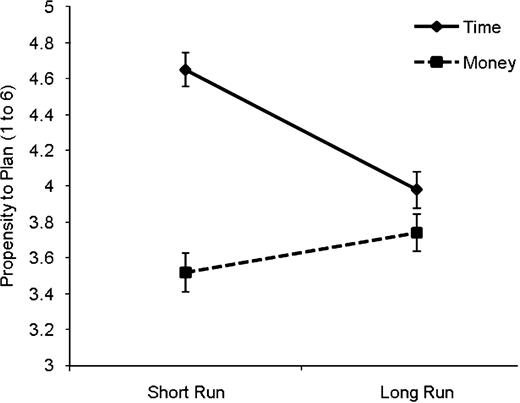
Abstract. Planning has pronounced effects on consumer behavior and intertemporal choice. We develop a six-item scale measuring individual differences in pr
Learning to accept welfare-enhancing policies: an experimental investigation of congestion pricing
Welfare-enhancing policies such as congestion pricing are argued to improve efficiency in situations with externalities. Unfamiliarity and lack of any personal experience with such policies, however, can hinder their implementation; particularly the ex-ante uncertainties of incidences of gains and losses as well as debates regarding equity concerns and how to recycle revenues often stymies implementation. This paper employs a laboratory experiment with heterogeneous users to investigate the effectiveness and acceptability of a toll in a six-player-two-route congestion game. To measure acceptability and how it is affected by experience with the toll, we conduct referenda before, during, and after subjects experience a congestion problem and a toll. The experiment employs a 2×2 design that varies two treatments: the rate of revenue reallocation and the level of information before the final vote. After an experiential learning phase, congestion pricing is found to curb congestion effectively, and although some subjects do not vote in their monetary self-interest initially, the majority does so after experiencing the congestion pricing policy. Data on worldviews and beliefs are collected and matched to voting behavior to examine the evolution of how experience determines acceptability. Some worldviews and beliefs can predict voting behavior and the timing of when an individual finds a toll (un)acceptable.

Demand characteristics in human–computer experiments
Demand characteristics refer to cues that can inform participants in experiments about the hypothesis and influence their behavior. They lead researchers to erroneously infer non-existing effects, undermining the experimental integrity of empirical studies. Despite a widespread acknowledgment of their confounding influence in experimental psychology, experiments involving humans and computers to a lesser extent consider effects of demand characteristics, as computerized protocols are thought to be immune to some experimenter biases. Furthermore, demand characteristics are considered to mainly effect subjective measures. As a result, demand characteristics often remain uncontrolled in studies involving computers, and in particular for objective measures such as performance. In this paper, we present two experiments that underline the importance of demand characteristics in human–computer interaction experiments. In a text-entry study, we made participants believe they were evaluating a research-based keyboard. This belief led to increased performance and self-reported user experience. In a second study, we conducted a thought experiment on the illusion of body ownership in virtual reality, where the experimental design indicated the study hypothesis. We found hypothesis-compliant responses from participants, even when they did not experience the illusion. We conclude that demand characteristics pose a significant challenge to the interpretation and validity of human–computer experiments, even when they are fully automated. We discuss the implications and offer guidelines to mitigate effects of demand characteristics.
Participation governance in consumer and AI co-creation: Whether to intervene and how to design it
Artificial intelligence reshapes digital mass customization by altering the structure of consumer co-creation. When consumers start from a draft generated by artificial intelligence rather than a blank canvas, outcomes are jointly determined by two stages: whether consumers initiate co-creation and, conditional on participation, how much refinement effort they exert. This separation makes participation a governable design margin—an issue that is largely muted in traditional blank-canvas customization, where participation and effort are tightly bundled. Partnering with a leading United States online retailer of personalized photo products, we study whether and how firm interventions at the participation stage shape downstream purchase outcomes. We develop a two-stage model in which, relative to a baseline with organic participation, a nudge lowers start-up frictions and expands voluntary entry, whereas a mandate serves as a strong boundary-case intervention that guarantees entry but can weaken how participation translates into purchase, generating a reach–efficiency trade-off. We examine these predictions in two randomized experiments. In Study 1, a light-touch nudge increases participation by 5.98 percentage points and raises revenue and order frequency. The evidence is consistent with gains arising primarily through expanded entry into consumer co-creation with artificial intelligence. In Study 2, mandates increase participation relative to nudges, but we find no clear evidence of additional gains in purchase or revisit intentions. Instead, mandates increase low-value participation, in which consumers exert minimal effort and report low purchase intention. Together, these findings show that in mass customization enabled by artificial intelligence, participation governance is a consequential design choice: firms must consider not only how many consumers initiate co-creation, but also whether the participation they induce creates downstream value.
Save More Today or Tomorrow: The Role of Urgency in Precommitment Design
To encourage farsighted behaviors, previous research suggests that marketers should invite consumers to precommit to adopting these behaviors “later.” However, the authors propose that people will draw different inferences from different types of precommitment offers, and that these inferences can help explain when precommitment is (and is not) effective at increasing adoption of farsighted behaviors. Specifically, the authors theorize that simultaneously offering consumers the opportunity to adopt a farsighted behavior now or later (i.e., offering “simultaneous precommitment”) may signal that the behavior is not urgently recommended; however, offering consumers the opportunity to adopt that behavior immediately and then, only if they decline, inviting them to adopt it later (i.e., offering “sequential precommitment”) may signal just the opposite. In a multisite field experiment (N = 5,196), the authors find that simultaneously giving consumers the chance to increase their savings now or later reduced retirement savings. Two preregistered lab studies (N = 5,080) show that simultaneous precommitment leads people to infer that taking action is not urgently recommended, and such inferences predict less adoption of recommended behaviors. Importantly, offering sequential precommitment increases inferred urgency, predicting greater adoption. Together, this research advances knowledge about the limits and potential of precommitment.
The Interplay among Category Characteristics, Customer Characteristics, and Customer Activities on in-Store Decision Making
The authors explore product category and customer characteristics that affect consumers’ likelihood of engaging in unplanned purchases. In addition, they examine consumer activities that can exacerbate or limit these effects. The authors employ a hierarchical modeling approach to test their hypotheses using a data set of in-store intercept interviews conducted with 2300 consumers across 28 stores. The results show that category characteristics, such as purchase frequency and displays, and customer characteristics, such as household size and gender, affect in-store decision making. Moreover, although the analysis reveals that the baseline probability of an unplanned purchase is 46%, the contextual factors can drive this probability as high as 93%. The results support the predictions that list use, more frequent trips, limiting the aisles visited, limiting time spent in the store, and paying by cash are effective strategies for decreasing the likelihood of making unplanned purchases.
Why Focus (not Effort) is the Key to Getting Stuff Done - Scott H Young
Around the time I started this blog, I was obsessed with habits. The psychology is fascinating and the idea that you could reprogram your behavior was compelling. After all, how much could you accomplish if you never failed to act on what you planned? The science of behavior change makes it exciting too: operant and […]
A Mega-Replication of the Effect of Cash Versus Card Payment on Pain of Paying: Magnitude, Behavioral Outcomes, and Moderators
Abstract We revisit the widely accepted finding that paying with cash is more painful than paying with card by conducting the first systematic mega-replication (including 13 large-scale preregistered replications; a total of 32,371 participants, 65 products, and 57 price points ranging from $1.09 to $400). The aggregate evidence reveals four insights: (1) leveraging a broad set of established paradigms, we replicate the finding that paying with cash is more psychologically painful than paying with card, even among today’s consumers who own multiple cards, digital wallets, and virtual currencies; (2) comparing two outcome variables—amount spent and willingness-to-pay (WTP), we find a more reliable and larger overall direct effect of payment method on amount spent than on WTP; (3) these direct effects of payment method on outcome variables are mediated by pain of paying; (4) the mode-of-payment effect on pain of paying (and thereby on outcome variables) is moderated by individual differences, particularly the relative frequency of using cash versus card. We outline actionable guidance and future directions for researchers and practitioners interested in examining mode-of-payment effects, and discuss the value of and suitable approaches for future theory-driven large-scale replications.
