


Generative search is an emerging search paradigm that integrates Generative AI (GenAI) into traditional search engines by presenting users with AI-generated responses before conventional search results. Whereas keyword-based search requires consumers to translate their underlying needs into effective keyword queries, generative search lets users express those intentions directly in natural language, a shift made possible by GenAI’s new mode of information presentation. This shift moves the consumer-search engine interaction upstream to the stage of problem formulation, rendering empirically observable a previously hidden phase of search behavior: the mapping from problem formulation to keyword articulation. Yet, it remains empirically unknown whether generative search increases consumer purchases and how search behavior changes when it can begin from expressed intent rather than keywords. Using a large-scale field experiment conducted on Meituan, a leading Chinese technology platform, this paper provides empirical evidence on the effectiveness of generative search. We find that generative search significantly increases consumer purchases. Further analysis reveals that generative search facilitates more effective and diverse keyword queries and reduces exploratory browsing and clicking, while concentrating evaluation within relevant categories and merchants. The empirical evidence is most consistent with a mechanism in which AI-generated answers provide information about consumers’ underlying needs, while also expanding awareness of relevant attributes and shifting attention toward more relevant categories. These findings provide empirical insights for future consumer search models that allow search to originate at the intention-expressing stage. This paper was accepted by Raphael Thomadsen, marketing. Funding: Financial support from the Ministry of Education – Singapore [Grant A-8001730-00-00] is gratefully acknowledged. Supplemental Material: The online appendix and data files are available at https://doi.org/10.1287/mnsc.2025.02458 .
Commercial Persuasion in AI-Mediated Conversations
As Large Language Models (LLMs) become a primary interface between users and the web, companies face growing economic incentives to embed commercial influence into AI-mediated conversations. We present two preregistered experiments (N = 2,012) in which participants selected a book to receive from a large eBook catalog using either a traditional search engine or a conversational LLM agent powered by one of five frontier models. Unbeknownst to participants, a fifth of all products were randomly designated as sponsored and promoted in different ways. We find that LLM-driven persuasion nearly triples the rate at which users select sponsored products compared to traditional search placement (61.2% vs. 22.4%), while the vast majority of participants fail to detect any promotional steering. Explicit "Sponsored" labels do not significantly reduce persuasion, and instructing the model to conceal its intent makes its influence nearly invisible (detection accuracy < 10%). Altogether, our results indicate that conversational AI can covertly redirect consumer choices at scale, and that existing transparency mechanisms may be insufficient to protect users.

Learning by Chatting? Investigating the Impact of Generative AI on Information Seeking and Learning
Generative AI (GenAI) tools offer increasing opportunities for augmenting human cognitive tasks. Among these tasks, information seeking is being rapidly reshaped by GenAI tools, with potentially profound implications for learning and knowledge acquisition. To investigate these implications, we conducted a between-subjects field experiment in which participants pursued informal learning by seeking information through either ChatGPT or Google Search over a span of 8 days. Using a daily diary protocol, we gathered in-situ data on their information-seeking processes. Our findings show that participants in the ChatGPT group experienced diminished agency in their information-seeking processes, as they offloaded much of the information selection to AI, and consequently experienced greater meta-cognitive load arising from this reduced sense of control. We further highlight two sources of distortion in information access when using ChatGPT: biases in ChatGPT outputs, particularly towards providing solution-oriented artifacts over principled knowledge; and systematic shifts in users' information-seeking behaviors, whereby the conversational and socially-oriented interaction paradigm of current GenAI tools may inadvertently reduce exploration of the broader knowledge space. As a result, on average, participants in the ChatGPT group had worse learning outcomes than those using Google, especially for higher-order critical learning. Our work suggests inherent tensions between offloading information seeking to AI and meaningful learning, and provides broader implications for understanding AI's risks to human cognition.
Learning by Chatting? Investigating the Impact of Generative AI on Information Seeking and Learning
Generative AI (GenAI) tools offer increasing opportunities for augmenting human cognitive tasks. Among these tasks, information seeking is being rapidly reshaped by GenAI tools, with potentially profound implications for learning and knowledge acquisition. To investigate these implications, we conducted a between-subjects field experiment in which participants pursued informal learning by seeking information through either ChatGPT or Google Search over a span of 8 days. Using a daily diary protocol, we gathered in-situ data on their information-seeking processes. Our findings show that participants in the ChatGPT group experienced diminished agency in their information-seeking processes, as they offloaded much of the information selection to AI, and consequently experienced greater meta-cognitive load arising from this reduced sense of control. We further highlight two sources of distortion in information access when using ChatGPT: biases in ChatGPT outputs, particularly towards providing solution-oriented artifacts over principled knowledge; and systematic shifts in users' information-seeking behaviors, whereby the conversational and socially-oriented interaction paradigm of current GenAI tools may inadvertently reduce exploration of the broader knowledge space. As a result, on average, participants in the ChatGPT group had worse learning outcomes than those using Google, especially for higher-order critical learning. Our work suggests inherent tensions between offloading information seeking to AI and meaningful learning, and provides broader implications for understanding AI's risks to human cognition.
Ideation with Generative AI—in Consumer Research and Beyond
Abstract The use of generative AI (genAI) in consumer research is rapidly evolving, with applications including synthetic data generation, data analysis, and more. However, their role in creative ideation—a cornerstone of consumer research—remains underexplored. Drawing on the human creativity literature, we propose that ideation with genAI is facilitated by its productivity and semantic breadth, which are psychologically analogous to the dual pathways of persistence and flexibility in human ideation. Further, we distinguish between the utility of genAI as a key ideator versus humans as key ideator, conceptualized through the genAI ideation roles of Designer and Writer and of Interviewer and Actor. While genAI excels in generating incremental improvements, its potential for groundbreaking innovation could be unlocked by leveraging its ability to prompt human creativity. This article advances the theoretical and practical understanding of genAI in ideation for consumer research, offering numerous practical guidelines for integrating generative AI into research while emphasizing human–AI collaboration to achieve radical insights.

EXPRESS: Evaluating Novel Unstructured Treatments with Generative AI: A Causal Prediction Framework
Modern marketing increasingly requires managers to deploy new content at scale, often with limited opportunity for prior testing. As a result, decisions about what to launch become strategic managerial choices under uncertainty rather than purely creative exercises. While generative AI makes the creation of new content fast and highly scalable, it simultaneously expands the set of options managers must evaluate, making reliable content selection increasingly difficult. We develop a framework for causal prediction that enables managers to evaluate and deploy novel marketing content generated by AI. The framework uses pretrained large language models to represent previously deployed content and learn how its features causally relate to outcomes. Using a rejection-sampling procedure, the framework screens new content proposed by generative AI to avoid extrapolation beyond what historical data can reliably support. In a large-scale email marketing application (3.3 million observations across 34 campaigns), the framework improves out-of-sample prediction and real-world deployment performance relative to standard approaches, enabling outcome-guided generation of higher-performing AI-generated content. The framework establishes a threshold based on how closely new content resembles past campaigns, separating cases where causal prediction is reliable from cases where direct experimentation is warranted. The framework has important implications for marketing decision making in a rapidly evolving environment where generative AI is transforming content creation and deployment.

The enshittification of online search? Privacy and quality of Google, Bing and Apple in coding advice
Even though currently being challenged by ChatGPT and other large-language models (LLMs), Google Search remains one of the primary means for many individuals to find information on the internet. Interestingly, the way that we retrieve information on the web has hardly changed ever since Google was established in 1998, raising concerns as to Google's dominance in search and lack of competition. If the market for search was sufficiently competitive, then we should probably see a steady increase in search quality over time as well as alternative approaches to the Google's approach to search. However, hardly any research has so far looked at search quality, which is a key facet of a competitive market, especially not over time. In this report, we conducted a relatively large-scale quantitative comparison of search quality of 1,467 search queries relating to coding advice in October 2023. We focus on coding advice because the study of general search quality is difficult, with the aim of learning more about the assessment of search quality and motivating follow-up research into this important topic. We evaluate the search quality of Google Search, Microsoft Bing, and Apple Search, with a special emphasis on Apple Search, a widely used search engine that has never been explored in previous research. For the assessment of search quality, we use two independent metrics of search quality: 1) the number of trackers on the first search result, as a measure of privacy in web search, and 2) the average rank of the first Stack Overflow search result, under the assumption that Stack Overflow gives the best coding advice. Our results suggest that the privacy of search results is higher on Bing than on Google and Apple. Similarly, the quality of coding advice -- as measured by the average rank of Stack Overflow -- was highest on Bing.
How Targeting Affects Customer Search: A Field Experiment
It has become common practice for retailers to personalize direct marketing efforts based on customer transaction histories as a tactic to increase sales. Targeted email offers featuring products in the same category as a customer’s previous purchases generate higher purchase rates. However, a targeted offer emphasizing familiar products could result in curtailed search for unadvertised products, as a closely matched offer weakens a customer’s incentives to search beyond the targeted items. In a field experiment using email offers sent by an online wine retailer, targeted offers resulted in decreased search activity on the retailer’s website. This effect is driven by a lower rate of search by customers who visit the site, rather than a lower incidence of search. There are several ways this could potentially hurt retailers and consumers, such as reduced cross-selling and fewer opportunities for customers to explore new products. This paper was accepted by Pradeep Chintagunta, marketing.
Bad news for Google — new survey shows 55% of people are now using AI instead of search engines
More users are turning to AI search for personalized responses

Inducing Sustained Creativity and Diversity in Large Language Models
We address a not-widely-recognized subset of exploratory search, where a user sets out on a typically long "search quest" for the perfect wedding dress, overlooked research topic, killer company idea, etc. The first few outputs of current large language models (LLMs) may be helpful but only as a start, since the quest requires learning the search space and evaluating many diverse and creative alternatives along the way. Although LLMs encode an impressive fraction of the world's knowledge, common decoding methods are narrowly optimized for prompts with correct answers and thus return mostly homogeneous and conventional results. Other approaches, including those designed to increase diversity across a small set of answers, start to repeat themselves long before search quest users learn enough to make final choices, or offer a uniform type of "creativity" to every user asking similar questions. We develop a novel, easy-to-implement decoding scheme that induces sustained creativity and diversity in LLMs, producing as many conceptually unique results as desired, even without access to the inner workings of an LLM's vector space. The algorithm unlocks an LLM's vast knowledge, both orthodox and heterodox, well beyond modal decoding paths. With this approach, search quest users can more quickly explore the search space and find satisfying answers.
Experimental evidence of the effects of large language models versus web search on depth of learning
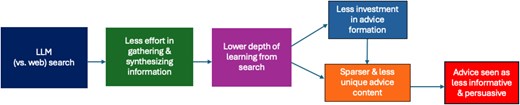
Abstract The effects of using large language models (LLMs) versus traditional web search on depth of learning are explored. A theory is proposed that when individuals learn about a topic from LLM syntheses, they risk developing shallower knowledge than when they learn through standard web search, even when the core facts in the results are the same. This shallower knowledge accrues from an inherent feature of LLMs—the presentation of results as summaries of vast arrays of information rather than individual search links—which inhibits users from actively discovering and synthesizing information sources themselves, as in traditional web search. Thus, when subsequently forming advice on the topic based on their search, those who learn from LLM syntheses (vs. traditional web links) feel less invested in forming their advice, and, more importantly, create advice that is sparser, less original, and ultimately less likely to be adopted by recipients. Results from seven online and laboratory experiments (n = 10,462) lend support for these predictions, and confirm, for example, that participants reported developing shallower knowledge from LLM summaries even when the results were augmented by real-time web links. Implications of the findings for recent research on the benefits and risks of LLMs, as well as limitations of the work, are discussed.
Can AI responses be influenced? The SEO industry is trying
Marketing firms are going all in on AI search.

AI and the Collapse of the www
This paper studies market design for generative AI intermediation. AI answer systems can improve user experience while diverting visits that finance publisher content and generate source-level quality signals. I show that an AI platform that underinternalizes future content reproduction retains too little referral traffic and can make costly open-web information subcritical, even with truthful content, accurate answers, and rational users. The mechanism can be self-reinforcing: less source-level measurement weakens conventional search, inducing further AI reliance. Sustainable repair requires replacing displaced revenue and deleted measurement through visitor-replacement royalties, audited provenance, human-information audits, and keystone-topic compensation.

What Is Your AI Agent Buying? Evaluation, Biases, Model Dependence, & Emerging Implications for Agentic E-Commerce
Online marketplaces will be transformed by autonomous AI agents acting on behalf of consumers. Rather than humans browsing and clicking, AI agents can parse webpages or leverage APIs to view, evaluate and choose products. We investigate the behavior of AI agents using ACES, a provider-agnostic framework for auditing agent decision-making. We reveal that agents can exhibit choice homogeneity, often concentrating demand on a few ``modal'' products while ignoring others entirely. Yet, these preferences are unstable: model updates can drastically reshuffle market shares. Furthermore, randomized trials show that while agents have improved over time on simple tasks with a clearly identified best choice, they exhibit strong position biases -- varying across providers and model versions, and persisting even in text-only "headless" interfaces -- undermining any universal notion of a ``top'' rank. Agents also consistently penalize sponsored tags while rewarding platform endorsements, and sensitivities to price, ratings, and reviews vary sharply across models. Finally, we demonstrate that sellers can respond: a seller-side agent making simple, query-conditional description tweaks can drive significant gains in market share. These findings reveal that agentic markets are volatile and fundamentally different from human-centric commerce, highlighting the need for continuous auditing and raising questions for platform design, seller strategy and regulation.
AI Research Agents Narrow Scientific Exploration
AI research agents can now generate research ideas, design experiments, run code, and draft papers, raising the possibility of large-scale AI-assisted scientific discovery. Many current agent frameworks explicitly encourage the generation of novel and high-impact ideas. Yet it remains unclear whether AI-assisted ideation broadens scientific exploration or mainly concentrates around existing work. We study AI research agents as scientific search systems. Using four AI research-agent frameworks and six large language models, we generate 37,802 scientific ideas from shared seed literature across citation-defined research areas in AI and machine learning. We then compare the resulting AI ideas against human-authored papers from the same research areas, follow-on human research emerging from the same seed literature, and the seed literature itself. Across experiments, four consistent patterns emerge. First, AI-generated ideas are substantially more concentrated than human-authored papers from the same research areas. Second, AI-generated ideas remain much closer to their starting literature than later human follow-on work does. Third, papers most similar to AI-generated ideas tend to receive lower subsequent citations. Fourth, when AI-generated ideas differ from prior work, the differences arise primarily from recombining existing technical methods rather than introducing fundamentally new research questions. Overall, current AI research agents appear better suited to local elaboration than to broadening scientific exploration.
The GenAI Future of Consumer Research
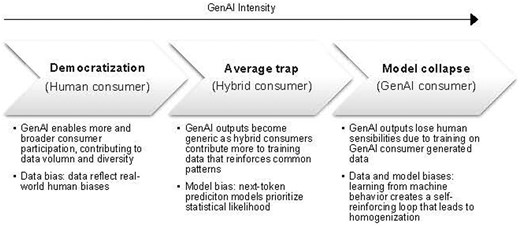
Abstract We develop a novel generative AI (GenAI) trajectory, “democratization-average trap-model collapse,” to identify data and model challenges posed by GenAI, from which we project the GenAI future of consumer research. This trajectory consists of three key phenomena: democratization broadens consumer participation, the average trap produces generic responses, and model collapse occurs when GenAI outputs lose human sensibilities. Data and model challenges arise as democratization enhances data representation while also embedding real-world biases. The average trap, caused by next-token prediction models, leads to generic outputs that lack individuality. Additionally, model collapse occurs when GenAI increasingly learns from its own outputs, amplifying machine bias and diverging from human behavior. To address these challenges, researchers can leverage democratization to study marginalized consumers and prioritize human-centered research over purely data-driven methods. The average trap can be mitigated by fine-tuning models with task-specific and marginalized consumption data while engineering responses for uniqueness. Preventing model collapse requires integrating human–machine hybrid data and applying theories of mind to realign AI with human-centric consumption. Finally, we outline three future research directions: preserving data distribution tails to support consumption democratization, countering the average trap in next-token prediction, and reversing the trajectory from democratization to model collapse.
Generative AI Meets Open-Ended Survey Responses: Research Participant Use of AI and Homogenization
The growing popularity of generative artificial intelligence (AI) tools presents new challenges for data quality in online surveys and experiments. This study examines participants’ use of large language models to answer open-ended survey questions and describes empirical tendencies in human versus large language model (LLM)-generated text responses. In an original survey of research participants recruited from a popular online platform for sourcing social science research subjects, 34 percent reported using LLMs to help them answer open-ended survey questions. Simulations comparing human-written responses from three pre-ChatGPT studies with LLM-generated text reveal that LLM responses are more homogeneous and positive, particularly when they describe social groups in sensitive questions. These homogenization patterns may mask important underlying social variation in attitudes and beliefs among human subjects, raising concerns about data validity. Our findings shed light on the scope and potential consequences of participants’ LLM use in online research.