


Organizations frequently use behavioral interventions—including incentives, messaging campaigns, and modifications to choice architecture—to influence people’s behavior. However, recent evidence suggests that such interventions often have inconsistent effects across implementations. To understand this variability, we build on the idea that interventions are not simply levers for changing behavior, they also signal useful information to decision makers. For example, when an option is set as the default, people may infer that it is recommended by the organization—an inference that can increase the likelihood that people stick with that option. However, when people perceive that defaults benefit the organization, those defaults may be rejected. Here, we propose a framework to better understand the effects of behavioral interventions by identifying the inferences they prompt people to draw. In developing this framework, we first characterize the defining features of behavioral interventions that determine how they are psychologically experienced. These features implicate five fundamental needs, which guide decision makers’ information-seeking processes. From these needs, we derive a principled typology of inferences drawn by decision makers in response to behavioral interventions, bringing together scattered evidence for these inferences from across the behavioral sciences. The resulting framework entails predictions about when specific inferences will arise and how these inferences influence the overall effects of behavioral interventions. Utilizing the framework, we provide a tool for enhancing intervention design. Taken together, the current research offers an integrative framework for advancing theory on behavioral interventions while also outlining actionable insights for organizations hoping to promote behavior change at scale.
Generalizability of choice architecture interventions
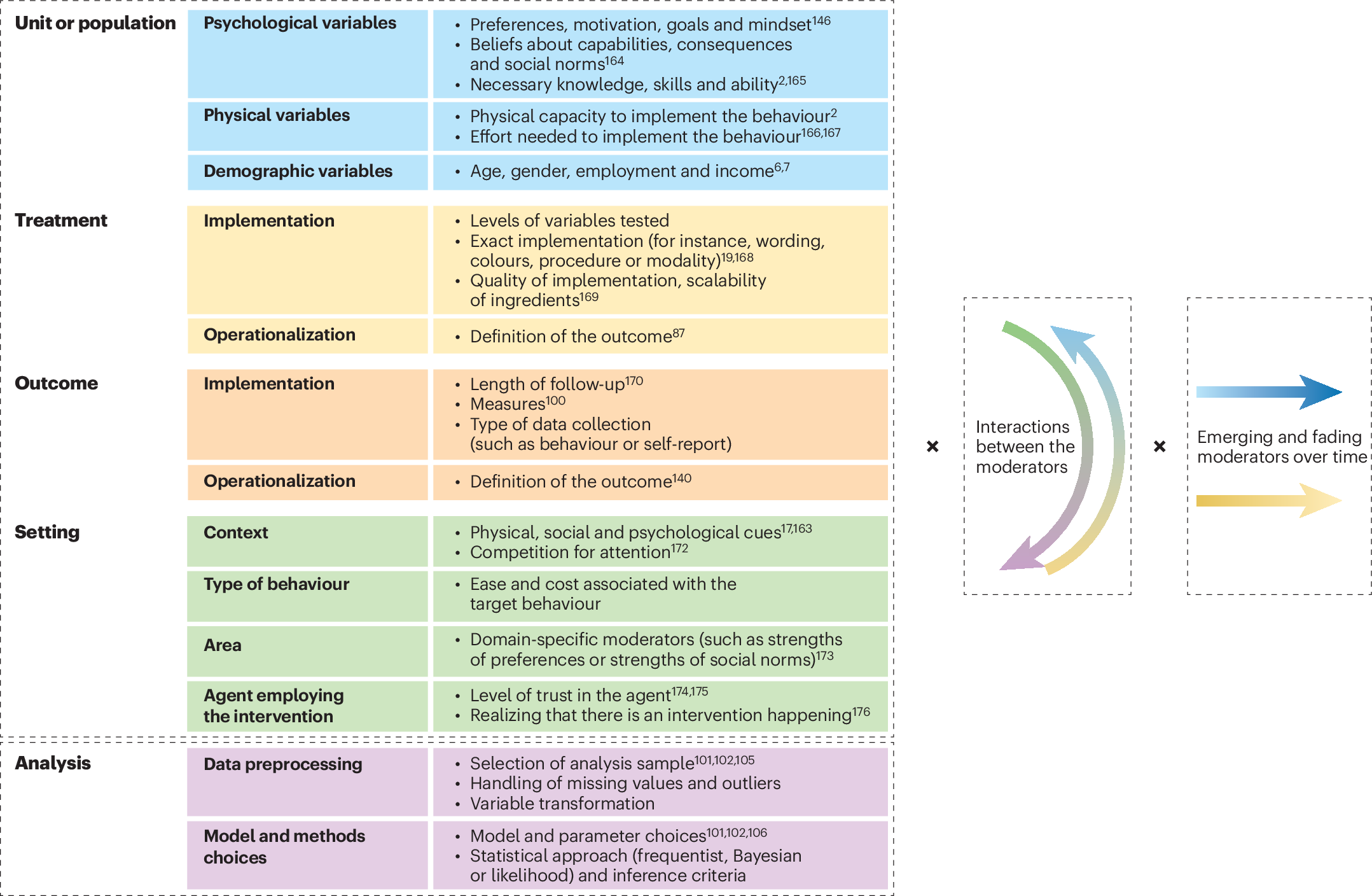
Although a given choice architecture intervention (a ‘nudge’) can be highly effective in some conditions, it can be ineffective or counterproductive in others. Critically, researchers and practitioners cannot reliably predict which of these outcomes will happen on the basis of current knowledge. In this Review, we present evidence that the average effectiveness of choice architecture interventions on behaviour is smaller than often reported and that there is substantial heterogeneity in their effects. We outline the obstacles to understanding the generalizability of these effects, such as the complex interaction of moderators and their changes over time. We then clarify dimensions of generalizability and research practices (including systematic exploration of the moderators and practices designed to enhance generalizability) that could enable evidence on generalizability to be gathered more efficiently. These practices are essential for advancing nuanced theories of behaviour change and for more accurately predicting the effectiveness of choice architecture interventions across diverse populations, settings, treatments, outputs and analytical approaches.
Designing Information Provision Experiments
Information provision experiments allow researchers to test economic theories and answer policy-relevant questions by varying the information set available to respondents. We survey the emerging literature using information provision experiments in economics and discuss applications in macroeconomics, finance, political economy, public economics, labor economics, and health economics. We also discuss design considerations and provide best-practice recommendations on how to (i) measure beliefs; (ii) design the information intervention; (iii) measure belief updating; (iv) deal with potential confounds, such as experimenter demand effects; and (v) recruit respondents using online panels. We finally discuss typical effect sizes and provide sample size recommendations.
Reason-Mediated Behavioral Models for Auditing LLM Social Simulators
Large language models are increasingly used as social simulators, including as synthetic survey respondents. Most evaluations ask whether simulated outcomes resemble human outcomes. We argue that this is necessary but too weak: a simulator can match the final answer while using the wrong behavioral mechanism. We study this problem through a 94-person sunscreen concept test in which each respondent evaluated three product concepts and wrote open-ended rationales. We map those rationales into signed reason states $Z$, where positive signs support adoption and negative signs block it. This gives a practical audit: holding respondent descriptors $D$, category context $K$, and concept treatment $X$ fixed, do human-stated reasons help predict behavior $Y$, and can an LLM simulate the same reason state without seeing the human rationale or outcome? Human-stated reasons substantially improve held-out prediction of purchase intent. LLM-simulated reasons are more brittle: they often sound plausible, but frequently echo the concept board rather than recover the respondent's acceptance or rejection path. The paper contributes an evaluation framework for social simulators. Reason states do not identify natural causal effects by themselves, but they provide an interpretable test of whether a simulator's stated reasons align with human evidence.
The Challenge of Understanding What Users Want: Inconsistent Preferences and Engagement Optimization
Online platforms have a wealth of data, run countless experiments, and use industrial-scale algorithms to optimize user experience. Despite this, many users seem to regret the time they spend on these platforms. One possible explanation is that incentives are misaligned: platforms are not optimizing for user happiness. We suggest the problem runs deeper, transcending the specific incentives of any particular platform, and instead stems from a mistaken foundational assumption. To understand what users want, platforms look at what users do. This is a kind of revealed-preference assumption that is ubiquitous in the way user models are built. Yet research has demonstrated, and personal experience affirms, that we often make choices in the moment that are inconsistent with what we actually want. The behavioral economics and psychology literatures suggest, for example, that we can choose mindlessly or that we can be too myopic in our choices, behaviors that feel entirely familiar on online platforms. In this work, we develop a model of media consumption where users have inconsistent preferences. We consider a platform which wants to maximize user utility, but only observes behavioral data in the form of the user’s engagement. We show how our model of users’ preference inconsistencies produces phenomena that are familiar from everyday experience but difficult to capture in traditional user interaction models. These phenomena include users who have long sessions on a platform but derive very little utility from it, and platform changes that steadily raise user engagement before abruptly causing users to go “cold turkey” and quit. A key ingredient in our model is a formulation for how platforms determine what to show users: they optimize over a large set of potential content (the content manifold) parametrized by underlying features of the content. Whether improving engagement improves user welfare depends on the direction of movement in the content manifold: For certain directions of change, increasing engagement makes users less happy, whereas in other directions on the same manifold, increasing engagement makes users happier. We provide a characterization of the structure of content manifolds for which increasing engagement fails to increase user utility. By linking these effects to abstractions of platform design choices, our model thus creates a theoretical framework and vocabulary in which to explore interactions between design, behavioral science, and social media. This paper was accepted by Yan Chen, behavioral economics and decision analysis. Funding: This work was supported by the Vannevar Bush Faculty Fellowship and Multidisciplinary University Research Initiative [Grant W911NF-19-0217]. Supplemental Material: The online appendices are available at https://doi.org/10.1287/mnsc.2022.03683 .

A Framework for Studying AI Agent Behavior: Evidence from Consumer Choice Experiments
Environments built for people are increasingly operated by a new class of economic actors: LLM-powered software agents making decisions on our behalf. These decisions range from our purchases to travel plans to medical treatment selection. Current evaluations of these agents largely focus on task competence, but we argue for a deeper assessment: how these agents choose when faced with realistic decisions. We introduce ABxLab, a framework for systematically probing agentic choice through controlled manipulations of option attributes and persuasive cues. We apply this to a realistic web-based shopping environment, where we vary prices, ratings, and psychological nudges, all of which are factors long known to shape human choice. We find that agent decisions shift predictably and substantially in response, revealing that agents are strongly biased choosers even without being subject to the cognitive constraints that shape human biases. This susceptibility reveals both risk and opportunity: risk, because agentic consumers may inherit and amplify human biases; opportunity, because consumer choice provides a powerful testbed for a behavioral science of AI agents, just as it has for the study of human behavior. We release our framework as an open benchmark for rigorous, scalable evaluation of agent decision-making.

Putting nudges in perspective
Conventional economic policy focuses on ‘economic’ solutions (e.g. taxes, incentives, regulation) to problems caused by market-level factors such as externalities, misaligned incentives and information asymmetries. By contrast, ‘nudges’ provide behavioural solutions to problems that have generally been assumed to originate from limitations in human decision making, such as present bias. While policy-makers have good reason for exploiting the power of nudges, we argue that these extremes leave open a large space of policy options that have received less attention in the academic literature. First, there is no reason that solution and problem need have the same theoretical basis: there are promising behavioural solutions to problems that have causes that are well explained by traditional economics, and conventional economic solutions often offer the best line of attack on problems of behavioural origin. Second, there is a wide range of hybrid policy actions with both economic and behavioural components (e.g. framing a tax or incentive in a specific way), and there exist many societal problems – perhaps the majority – that arise from both economic and behavioural factors (e.g. firms’ exploitation of consumers’ behavioural biases). This paper aims to remind policy-makers that behavioural economics can influence policy in a variety of ways, of which nudges are the most prominent but not necessarily the most powerful.

Underspecified Human Decision Experiments Considered Harmful
Decision-making with information displays is a key focus of research in areas like human-AI collaboration and data visualization. However, what constitutes a decision problem, and what is required for an experiment to conclude that decisions are flawed, remain imprecise. We present a widely applicable definition of a decision problem synthesized from statistical decision theory and information economics. We claim that to attribute loss in human performance to bias, an experiment must provide the information that a rational agent would need to identify the normative decision. We evaluate whether recent empirical research on AI-assisted decisions achieves this standard. We find that only 10 (26%) of 39 studies that claim to identify biased behavior presented participants with sufficient information to make this claim in at least one treatment condition. We motivate the value of studying well-defined decision problems by describing a characterization of performance losses they allow to be conceived.

Are Large Language Models Sensitive to the Motives Behind Communication?
Human communication is $\textit{motivated}$: people speak, write, and create content with a particular communicative intent in mind. As a result, information that large language models (LLMs) and AI agents process is inherently framed by humans' intentions and incentives. People are adept at navigating such nuanced information: we routinely identify benevolent or self-serving motives in order to decide what statements to trust. For LLMs to be effective in the real world, they too must critically evaluate content by factoring in the motivations of the source---for instance, weighing the credibility of claims made in a sales pitch. In this paper, we undertake a comprehensive study of whether LLMs have this capacity for $\textit{motivational vigilance}$. We first employ controlled experiments from cognitive science to verify that LLMs' behavior is consistent with rational models of learning from motivated testimony, and find they successfully discount information from biased sources in a human-like manner. We then extend our evaluation to sponsored online adverts, a more naturalistic reflection of LLM agents' information ecosystems. In these settings, we find that LLMs' inferences do not track the rational models' predictions nearly as closely---partly due to additional information that distracts them from vigilance-relevant considerations. However, a simple steering intervention that boosts the salience of intentions and incentives substantially increases the correspondence between LLMs and the rational model. These results suggest that LLMs possess a basic sensitivity to the motivations of others, but generalizing to novel real-world settings will require further improvements to these models.
Psychological ownership interventions increase interest in claiming government benefits
Significance Most government benefits programs exhibit a sizable participation gap, with eligible individuals forgoing billions of dollars in government benefits each year. Many policymakers have focused on addressing this participation gap, as receiving government benefits has been shown to reduce poverty, childhood hunger, educational gaps, and physical and mental illness. The current work presents psychological ownership framing as a behavioral science intervention, and we show that it can help address this benefits participation gap. These interventions are subtle, simple to implement, and cheaper to execute relative to logistical interventions. Moreover, the data show that psychological ownership interventions can be more efficacious than other common psychological interventions such as social norms and urgency. , Each year, eligible individuals forgo billions of dollars in financial assistance in the form of government benefits. To address this participation gap, we identify psychological ownership of government benefits as a factor that significantly influences individuals’ interest in applying for government benefits. Psychological ownership refers to how much an individual feels that a target is their own. We propose that the more individuals feel that government benefits are their own, the less likely they are to perceive applying for them as an aversive ask for help, and thus, the more likely they are to pursue them. Three large-scale field experiments among low-income individuals demonstrate that higher psychological ownership framing of government benefits significantly increases participants’ pursuit of benefits and outperforms other common psychological interventions. An additional experiment shows that this effect occurs because greater psychological ownership reduces people’s general aversion to asking for assistance. Relative to control messages, these psychological ownership interventions increased interest in claiming government benefits by 20% to 128%. These results suggest that psychological ownership framing is an effective tool in the portfolio of potential behavioral science interventions and a simple way to stimulate interest in claiming benefits.

Do LLMs Exhibit Human-like Response Biases? A Case Study in Survey Design
Abstract One widely cited barrier to the adoption of LLMs as proxies for humans in subjective tasks is their sensitivity to prompt wording—but interestingly, humans also display sensitivities to instruction changes in the form of response biases. We investigate the extent to which LLMs reflect human response biases, if at all. We look to survey design, where human response biases caused by changes in the wordings of “prompts” have been extensively explored in social psychology literature. Drawing from these works, we design a dataset and framework to evaluate whether LLMs exhibit human-like response biases in survey questionnaires. Our comprehensive evaluation of nine models shows that popular open and commercial LLMs generally fail to reflect human-like behavior, particularly in models that have undergone RLHF. Furthermore, even if a model shows a significant change in the same direction as humans, we find that they are sensitive to perturbations that do not elicit significant changes in humans. These results highlight the pitfalls of using LLMs as human proxies, and underscore the need for finer-grained characterizations of model behavior.1

Characterizing the causes, dynamics, and consequences of choice deferral
The fact that people often avoid making decisions is well known, and past research has helped to identify some of the conditions and reasons for doing so. For instance, people may forgo choices between bad options because they prefer not to end up with one of those options. It is much less clear when and why people avoid choosing in cases where they eventually will have to make a given decision. To study such instances of choice deferral, we presented participants with a series of choices, and for each choice they were allowed to either choose immediately or defer the decision until later in the experiment. Across six experiments and three choice domains (choices among consumer goods, artwork, and political candidates), we find that the strongest predictor of choice deferral is the overall value of a given set of options, with relative value (i.e., how hard it is to identify the best option) counterintuitively playing a smaller role. We show that the influence of overall value on choice deferral can be accounted for by a dynamic decision model according to which participants appraise the option set relative to a criterion before deciding whether to choose or defer, comparing this to a previous model whereby participants make such a decision based on a predetermined decision time limit. We further reveal that the influence of overall value on choice deferral is determined by how congruent options are with a given choice goal (choose-best or choose-worst) rather than simply how bad those options are. Collectively, our findings shed new light on how people decide to put off the inevitable.
A Theory of Response Sampling in LLMs: Part Descriptive and Part Prescriptive
Large Language Models (LLMs) are increasingly utilized in autonomous decision-making, where they sample options from vast action spaces. However, the heuristics that guide this sampling process remain under-explored. We study this sampling behavior and show that this underlying heuristics resembles that of human decision-making: comprising a descriptive component (reflecting statistical norm) and a prescriptive component (implicit ideal encoded in the LLM) of a concept. We show that this deviation of a sample from the statistical norm towards a prescriptive component consistently appears in concepts across diverse real-world domains like public health, and economic trends. To further illustrate the theory, we demonstrate that concept prototypes in LLMs are affected by prescriptive norms, similar to the concept of normality in humans. Through case studies and comparison with human studies, we illustrate that in real-world applications, the shift of samples toward an ideal value in LLMs' outputs can result in significantly biased decision-making, raising ethical concerns.
Mechanism Experiments and Policy Evaluations
Randomized controlled trials are increasingly used to evaluate policies. How can we make these experiments as useful as possible for policy purposes? We argue greater use should be made of experiments that identify the behavioral mechanisms that are central to clearly specified policy questions, what we call "mechanism experiments." These types of experiments can be of great policy value even if the intervention that is tested (or its setting) does not correspond exactly to any realistic policy option.
The efficiency-gain illusion: People underestimate the rate of AI use and overestimate its benefits on simple tasks
People are increasingly turning to AI assistance for simple tasks, e.g., arithmetic, spell-check, and answering simple questions. But does AI assistance actually save users time and effort? We investigate people's propensity to use AI for cognitively simple tasks and assess whether their reliance is well-calibrated. Across three pre-registered user studies (N = 2691), we find that people frequently choose to use AI even when doing so is inefficient (i.e. provides no meaningful time or effort savings). We identify systematic miscalibration at two levels: (1) a self-estimate miscalibration where people on average believe that they are using AI less than they actually are, and (2) efficiency-gain illusions where people overestimate how much time and effort savings AI use affords. We also identify a session-level carryover effect where a participant's prior AI use leads to further AI adoption and entrenches their miscalibration about time savings. Our results shed light on the mechanisms and biases underlying people's choice of whether to use AI as well as the risk of an overreliance feedback loop.
Participation governance in consumer and AI co-creation: Whether to intervene and how to design it
Artificial intelligence reshapes digital mass customization by altering the structure of consumer co-creation. When consumers start from a draft generated by artificial intelligence rather than a blank canvas, outcomes are jointly determined by two stages: whether consumers initiate co-creation and, conditional on participation, how much refinement effort they exert. This separation makes participation a governable design margin—an issue that is largely muted in traditional blank-canvas customization, where participation and effort are tightly bundled. Partnering with a leading United States online retailer of personalized photo products, we study whether and how firm interventions at the participation stage shape downstream purchase outcomes. We develop a two-stage model in which, relative to a baseline with organic participation, a nudge lowers start-up frictions and expands voluntary entry, whereas a mandate serves as a strong boundary-case intervention that guarantees entry but can weaken how participation translates into purchase, generating a reach–efficiency trade-off. We examine these predictions in two randomized experiments. In Study 1, a light-touch nudge increases participation by 5.98 percentage points and raises revenue and order frequency. The evidence is consistent with gains arising primarily through expanded entry into consumer co-creation with artificial intelligence. In Study 2, mandates increase participation relative to nudges, but we find no clear evidence of additional gains in purchase or revisit intentions. Instead, mandates increase low-value participation, in which consumers exert minimal effort and report low purchase intention. Together, these findings show that in mass customization enabled by artificial intelligence, participation governance is a consequential design choice: firms must consider not only how many consumers initiate co-creation, but also whether the participation they induce creates downstream value.

Can Revealed Preferences Clarify LLM Alignment and Steering?
LLMs are increasingly used to make or support high-stakes decisions under uncertainty, where alignment depends not only on factual accuracy but on how models weigh tradeoffs between different outcomes. We present an empirical pipeline for estimating the implied preferences that an LLM's observed choices optimize: we elicit the model's probability distribution over unknowns along with the choice it would make for the decision task and then fit a discrete choice model to recover the cost function that best rationalizes the model's decisions. We show how this revealed-preference description allows rigorous evaluation of whether models behave in a consistently goal-directed way, whether they can verbalize a description of their objectives which matches their revealed decision policy, and whether prompting can reliably steer those policies to implement a user-specified cost function. We apply this evaluation across four medical diagnosis domains and multiple frontier and open-source models. We find that while many models have a nontrivial degree of internal coherence, they also have significant weaknesses in faithfully reporting or adopting preferences in response to user direction.