


Supporting graceful schema evolution represents an unsolved problem for traditional information systems that is further exacerbated in web information systems, such as Wikipedia and public scientific databases: in these projects based on multiparty ...

Relational foundations for functorial data migration | Proceedings of the 15th Symposium on Database Programming Languages
In this paper we present a simple database definition language: that of categories and functors. A database schema is a small category and an instance is a set-valued functor on it. We show that morphisms of schemas induce three ''data migration ...
Functorial data migration
In this paper we present a simple database definition language: that of categories and functors. A database schema is a small category and an instance is a set-valued functor on it. We show that morphisms of schemas induce three “data migration functors”, which translate instances from one schema to the other in canonical ways. These functors parameterize projections, unions, and joins over all tables simultaneously and can be used in place of conjunctive and disjunctive queries. We also show how to connect a database and a functional programming language by introducing a functorial connection between the schema and the category of types for that language. We begin the paper with a multitude of examples to motivate the definitions, and near the end we provide a dictionary whereby one can translate database concepts into category-theoretic concepts and vice versa.
Composing schema mappings: Second-order dependencies to the rescue: ACM Transactions on Database Systems: Vol 30, No 4
A schema mapping is a specification that describes how data structured under one schema (the source schema) is to be transformed into data structured under a different schema (the target schema). A fundamental problem is composing schema mappings: given ...

Prisma 6: Better Performance, More Flexibility & Type-Safe SQL
Today, we are releasing Prisma v6! Since the last major version, we have been hard at work incorporating user feedback, making Prisma ORM faster and more flexible, and adding amazing features like type-safe raw SQL queries.

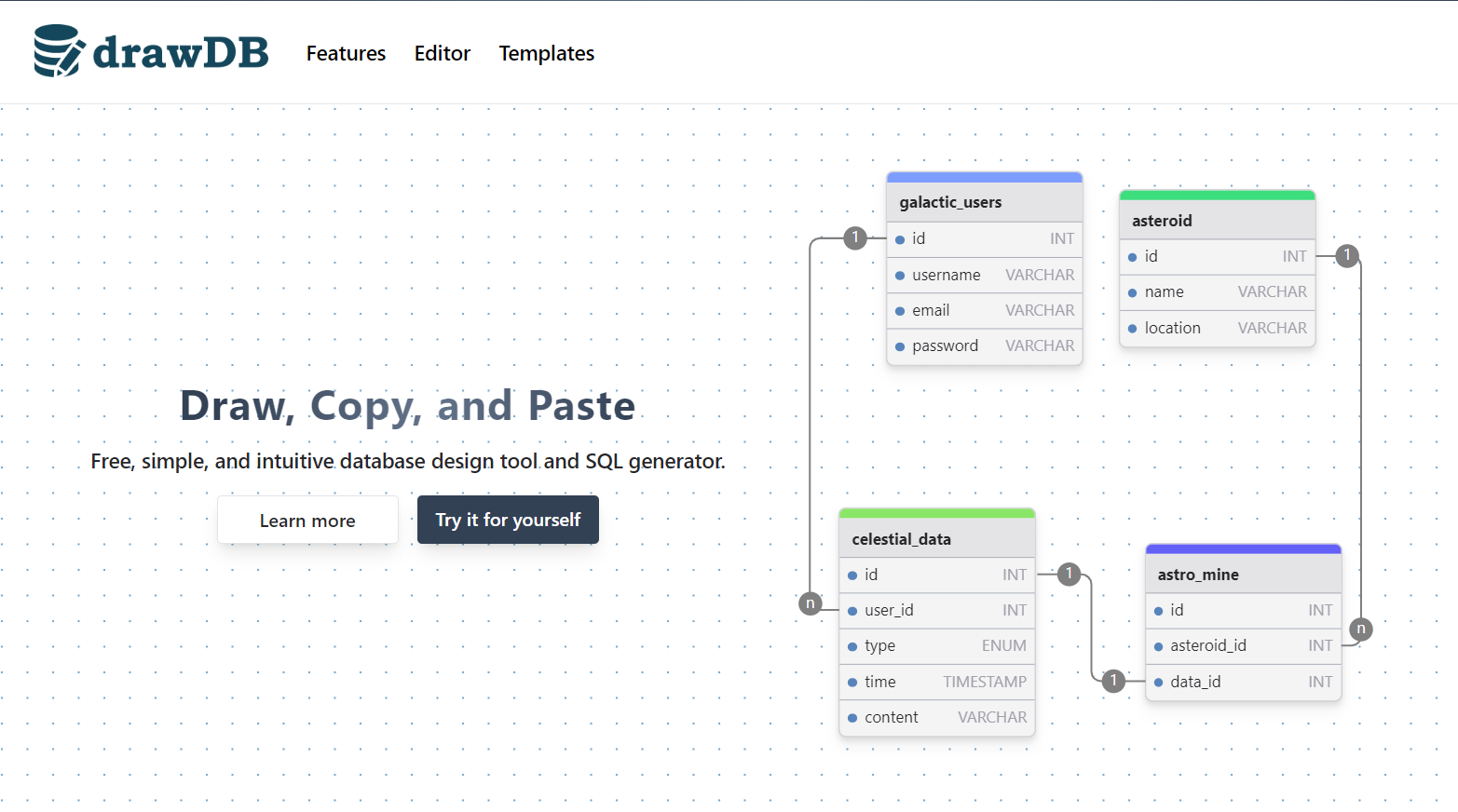
drawDB | Online database diagram editor and SQL generator
Online database entity-relationship diagram editor, data modeler, and SQL generator. Design, visualize, and export scripts without an account and completely free of charge.
WikiKV: Schema-Evolving Path-Indexed Storage for Hierarchical Knowledge Navigation
LLM-curated hierarchical knowledge bases, namely a tree-structured wiki whose nodes summarize an underlying corpus, have become a dominant substrate for retrieval-augmented applications, yet their storage layer is still treated as an implementation detail. This workload is hierarchical, query-intensive, and continuously evolving, and no existing storage model natively captures all three properties at once. We present WikiKV, a path-indexed key-value storage model purpose-built for this workload, comprising three components: (i) a data-driven schema that bootstraps the hierarchy via Intent-Anchored Schema Induction and refines it through Continuous Evolution Operators; (ii) a consistency protocol for the path-indexed storage model that precludes partial-read observations under concurrent offline rewrites without read-path locking; and (iii) a budgeted navigation operator whose search-accelerated routing reduces the expected number of LLM-assisted descent steps from d to O(1) while preserving anytime semantics with progressively refined answers. We evaluate WikiKV through real-world deployment for the WeChat Official Account AI Assistant and benchmark it against diverse baselines on the AuthTrace dataset, where it achieves balanced low per-operator latency across four query operators against relational, graph, and FS backends, and reaches 63.2% end-to-end answer correctness, exceeding multiple RAG baselines, with the gap widening on low- and high-fan-in multi-document questions. Ablation study further confirms the effectiveness of WikiKV's components.

A Graph-Based Firebase
This essay covers the design behind Instant. If the schleps we face as UI engineers are actually database problems in disguise, would a database-looking solution solve them?
AutoSchemaKG: Autonomous Knowledge Graph Construction through Dynamic Schema Induction from Web-Scale Corpora
In the current era of information abundance, transforming vast amounts of unstructured data into structured, machine-readable knowledge remains one of the most significant challenges in artificial intelligence. Knowledge Graphs (KGs) have emerged as the cornerstone technology for this transformation Zhao et al. (2024), providing the semantic backbone for applications ranging from search engines and question answering Wu et al. (2024); Chen et al. (2024c); Zong et al. (2024); Sun et al. (2024b) to recommendation systems Lyu et al. (2024) and complex reasoning tasks Li et al. (2024b). Yet despite their critical importance, current KG construction approaches remain hampered by an inherent paradox: they require predefined schemas created by domain experts, which fundamentally limits their scalability, adaptability, and domain coverage.
Data exchange: getting to the core | ACM Transactions on Database Systems
Data exchange is the problem of taking data structured under a source schema and creating an instance of a target schema that reflects the source data as accurately as possible. Given a source instance, there may be many solutions to the data exchange ...

Semantic Data Modeling, Graph Query, and SQL, Together at Last?
Our teams advance the state of the art through research, systems engineering, and collaboration across Google.

A Categorical Unification for Multi-Model Data: Part I Categorical Model and Normal Forms
Modern database systems face a significant challenge in effectively handling the Variety of data. The primary objective of this paper is to establish a unified data model and theoretical framework for multi-model data management. To achieve this, we present a categorical framework to unify three types of structured or semi-structured data: relation, XML, and graph-structured data. Utilizing the language of category theory, our framework offers a sound formal abstraction for representing these diverse data types. We extend the Entity-Relationship (ER) diagram with enriched semantic constraints, incorporating categorical ingredients such as pullback, pushout and limit. Furthermore, we develop a categorical normal form theory which is applied to category data to reduce redundancy and facilitate data maintenance. Those normal forms are applicable to relation, XML and graph data simultaneously, thereby eliminating the need for ad-hoc, model-specific definitions as found in separated normal form theories before. Finally, we discuss the connections between this new normal form framework and Boyce-Codd normal form, fourth normal form, and XML normal form.
Mutual intelligibility for schema idiolects.

GitHub - idiolect-dev/idiolect: Mutual intelligibility for schema idiolects.
github.comself-hostable notion replacements

not necessarily feature-parity - i do not care about databases
siyuan-note/siyuan

Craft — Docs and Notes Editor
Anytype — A safe haven for digital collaboration

Obsidian - Sharpen your thinking
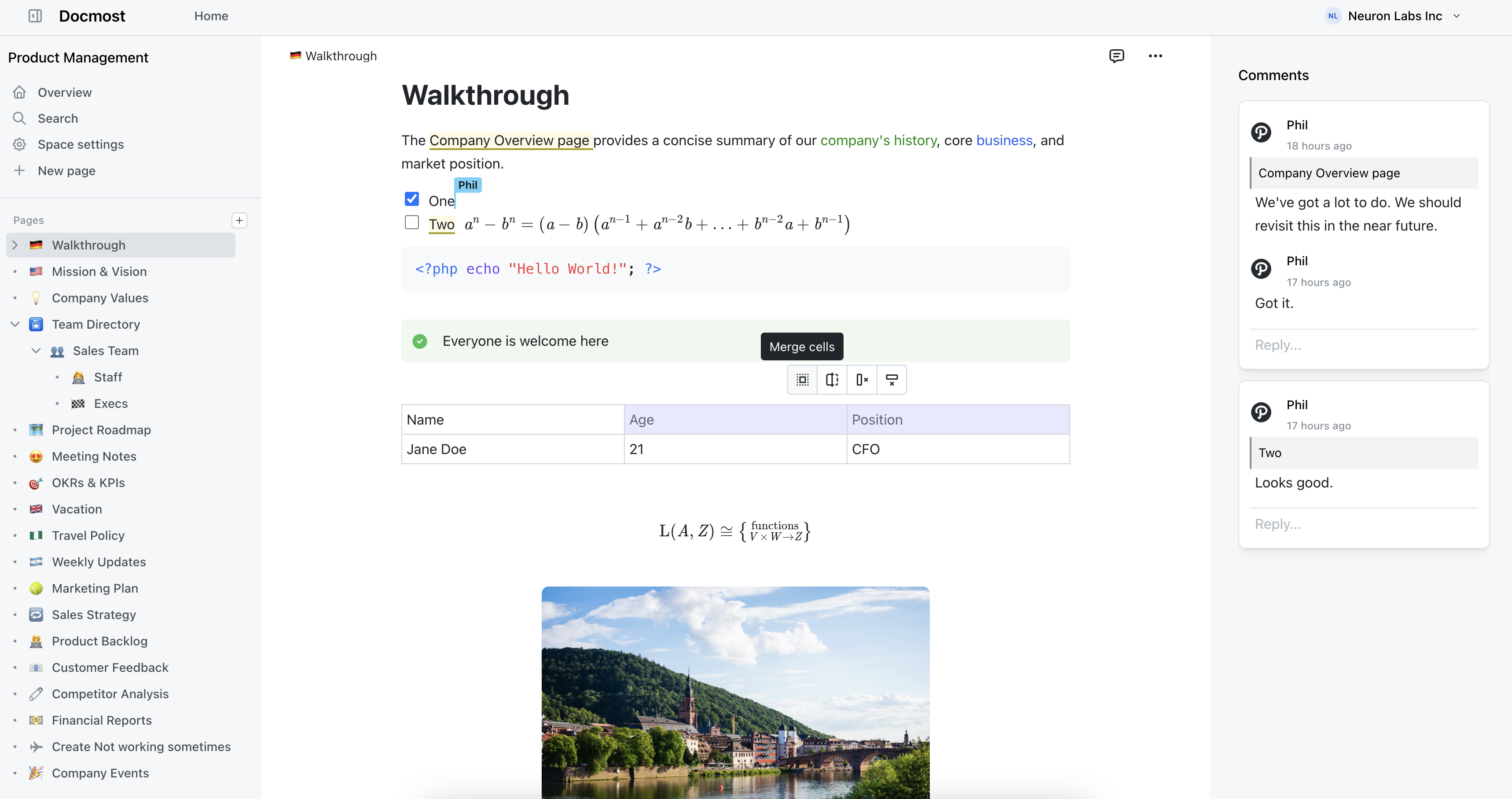
Enterprise-ready Wiki for Teams | Docmost
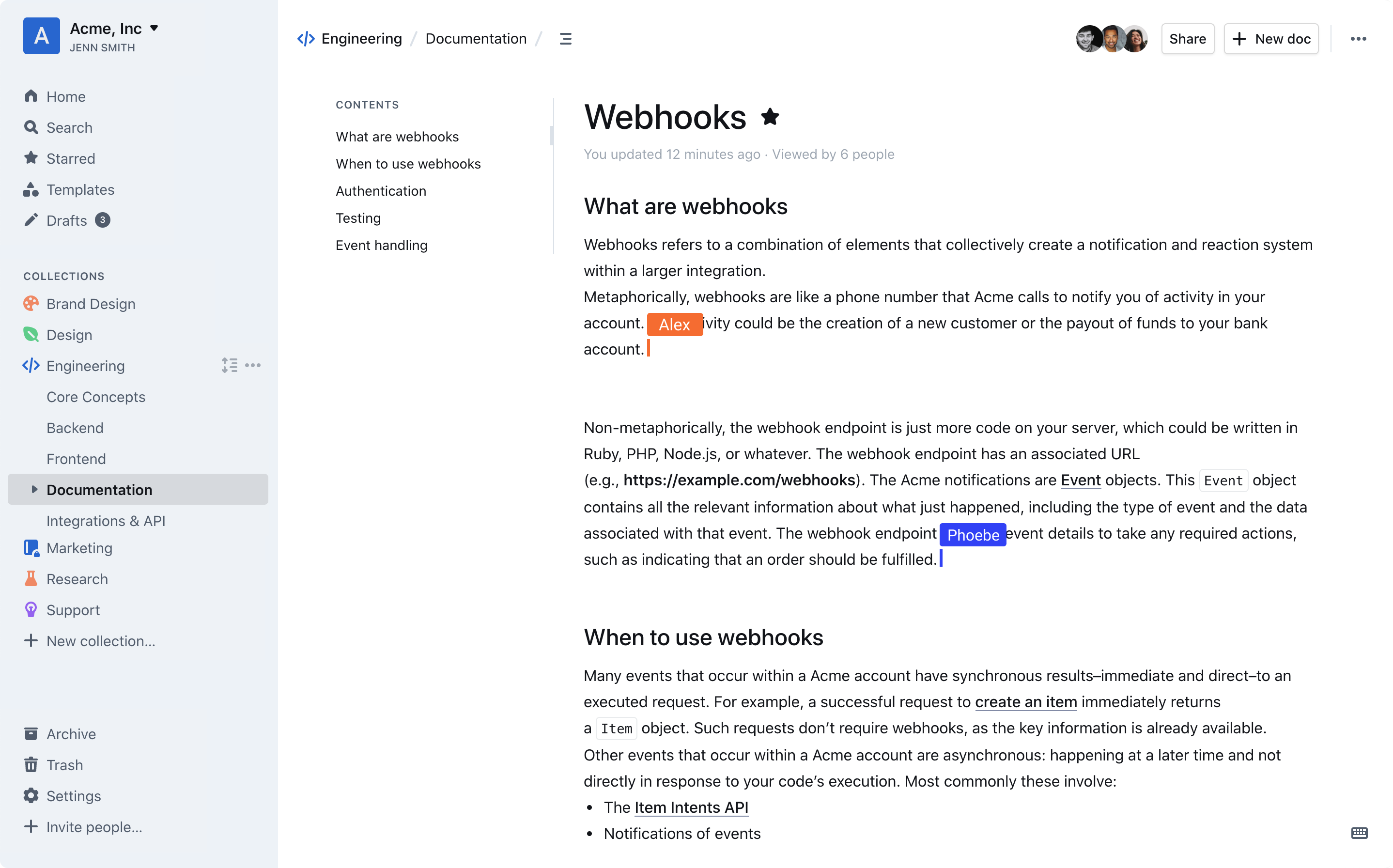
Outline – Team knowledge base & wiki
