Repayment decisions—how much of the loan to repay and when to make the payments—directly influence consumer debt levels. The authors examine how minimum required payment policy and loan information disclosed to consumers influence repayment decisions. They find that while presenting minimum required payment information has a negative impact on repayment decisions, increasing the minimum required level has a positive effect on repayment for most consumers. Experimental evidence from U.S. consumers shows that consumers’ propensity to pay the minimum required each month moderates these effects; U.K. credit card field data indicate that borrowers’ credit limit and balance due also moderate these effects. However, increasing the minimum level is unlikely to completely eliminate the negative effect of presenting minimum payment information. In addition, disclosing supplemental information, such as future interest cost and time needed to repay the loan, does not reduce the negative effects of including minimum payment information and has no substantial positive effect on repayments. This research offers new insights into the debt repayment process and has implications for consumers, lenders, and public policy.
Information disclosure and credit card repayments: evidence from Malaysia
Purpose This study analyzes the role of information disclosure in influencing credit card repayments by focusing on three intervention methods for improving repayment decisions among credit cardholders. Design/methodology/approach This study uses the survey method to collect data. Four questionnaires are designed to identify which types of disclosure elicit better repayment decisions among credit cardholders. The participants were approached using the mall intercept method, and a total of 1,775 responses were obtained. Findings Estimations using means comparison tests show that not providing minimum payment information improves repayments. The expected benefits are not delivered by the provision of higher minimum payment information or additional information that highlights the negative effects of making the minimum repayment only. Further analysis using logit estimation reconfirms the benefit of not providing minimum payment information. However, when such information is given, low minimum payment information elicits better repayment decisions than high minimum payment information or additional information. Repayment worsens under the additional information condition compared to the high minimum payment condition. Research limitations/implications The findings of this study have a bearing on the decisions of policy makers, credit card issuers and consumers. Originality/value This paper clarifies the role of information in improving debt repayment decisions.
Minimum Payments Alter Debt Repayment Strategies Across Multiple Cards
U.S. households currently hold $770 billion in credit card debt, often managing repayments across multiple accounts. The authors investigate how minimum payment requirements (i.e., the requirement to allocate at least some money to each account with a balance) alter consumers’ allocation strategies across multiple accounts. Across four experiments, they find that minimum payment requirements cause consumers to increase dispersion (i.e., spread their repayments more evenly) across accounts. The authors term this change in strategy “the dispersion effect of minimum payments” and provide evidence that it can be costly for consumers. They find that the effect is partially driven by the tendency for consumers to interpret minimum payment requirements as recommendations to pay more than the minimum amount. While the presence of the minimum payment requirement is unlikely to change, the authors propose that marketers and policy makers can influence the effects of minimum payments on dispersion by altering the way that information is displayed to consumers. Specifically, they investigate five distinct information displays and find that choice of display can either exaggerate or minimize dispersion and corresponding costs. They discuss implications for consumers, policy makers, and firms, with a particular focus on ways to improve consumer financial well-being.
Default Effects of Credit Card Minimum Payments
Credit card minimum payments are designed to ensure that individuals pay down their debt over time, and scheduling minimum automatic repayments helps people avoid forgetting to repay. Yet minimum payments have additional, unintended psychological default effects by drawing attention away from the card balance due. First, once individuals set the minimum automatic repayment as the default, they then neglect to make the occasional larger repayments they made previously. As a result, individuals incur considerably more credit card interest than late payment fees avoided. Using detailed transaction data, the authors show that approximately 8% of all of the interest ever paid is due to this effect. Second, manual credit card payments are lower when individuals are prompted with minimum payment information. In an experiment, the authors test two new interventions to mitigate this effect—a prompt for full repayment and a prompt asking those repaying little to pay more—yielding large counter effects. Thus, shrouding the minimum payment option for automatic and manual payments and directing attention to the full balance may remedy the unintended effects of default minimum payments.
“Repayment-by-Purchase” Increases Consumer Debt Repayment
This article tests the effect of a novel credit card payment format—repayment-by-purchase—on consumers’ payments toward credit card debt. In contrast to typical balance repayment, where consumers make repayments relative to a total amount owed, repayment-by-purchase prompts consumers to select items (e.g., a Starbucks coffee) or categories of purchase (e.g., restaurant and café purchases) and to make payments toward their related debt. A field experiment first suggests that customers who opted into repayment-by-purchase paid 12.18% more toward their statement balance than a control group. Subsequently, five lab experiments show that consumers repaying-by-purchase increase repayment by an average of 22.47% over typical balance repayment. Process evidence suggests that these differences may be driven by repayment-by-purchase's power to increase purchase salience, which in turns increases perceptions of progress toward reducing debt. Consistent with this theory, the effect of repayment-by-purchase on bill repayment emerges regardless of whether consumers repay durable versus nondurable goods, and for specific items or categories of purchases, as long as the bill uses labels that are concrete enough to raise past purchase salience.
Information Disclosure, Cognitive Biases, and Payday Borrowing
ABSTRACT Can psychology‐guided information disclosure induce borrowers to lower their use of high‐cost debt? In a field experiment at payday stores, we find that information that makes people think less narrowly (over time) about finance costs results in less borrowing. In particular, reinforcing the adding‐up dollar fees incurred when rolling over loans reduces the take‐up of future payday loans by 11% in the subsequent 4 months. Although we remain agnostic as to the overall sufficiency of better disclosure policy to “remedy” payday borrowing, we cast the 11% reduction in borrowing in light of the relative low cost of this policy.

Do Nudges Reduce Borrowing and Consumer Confusion in the Credit Card Market?
We study nudges that turn out to have precise null effects in reducing long‐run credit card debt. We test nudges across two field experiments covering 183,441 UK cardholders. Our first experiment studies nudges added to monthly credit card statements. Our second experiment studies letters and email nudges (separate from monthly statements) sent to cardholders who signed up to automatically pay the minimum required payment. In a follow‐up survey to our second experiment, we find that 96% of respondents underestimate the time it would take to fully repay a debt if the cardholder made only the minimum required payment. The nudges reduce this confusion, but underestimation remains overwhelmingly common.

Consumer Misunderstanding of Credit Card Use, Payments, and Debt: Causes and Solutions
The authors identify several judgmental biases related to paying off credit card debt. Participants with stronger numerical skills made fewer errors, as did those who used the new statement format mandated by Congress in the CARD Act of 2009. Study 1 shows that people underestimate how long it takes to eliminate a debt when payments barely cover interest owed. Study 2 shows that less numerate people tend to underestimate the monthly payment required to pay off a debt in three years, whereas more numerate people tend to overestimate the payment. The newly revised statement required by the CARD Act substantially reduced these biases. However, even with the new statement, many people still underestimate required payments when still using the credit card. Study 3 identifies ambiguities in the revised statement that can lead to misjudgments about how much to pay on monthly bills. The authors recommend additional public policy actions to help cardholders understand the relationship between payments and debt elimination.
The Hidden Role of Contract Terms: The Case of Credit Card Minimum Payments in Mexico
This paper argues that thresholds in financial contracts act as implicit nudges in consumers’ decisions. Exploiting a regulatory change to credit card minimum payments in Mexico, we find that a 1-percentage point change in minimum payments leads to a 0.87-percentage point change in actual payments, both expressed as a percentage of total balances. We decompose the effect of minimum payments into a constraining effect and a reference effect. The former captures the effect of minimum payments as a binding constraint and accounts for 59% of its total effect. The latter captures any remaining impact of changes in minimum payments beyond their constraining effect and represents 41% of the total. In turn, 67% of the reference effect is explained by the multiple heuristic: the tendency of consumers to pay whole-number multiples of the minimum payment. This paper was accepted by Kay Giesecke, finance.

Do Liquidity Constraints and Interest Rates Matter for Consumer Behavior? Evidence from Credit Card Data
Abstract. This paper utilizes a unique data set of credit card accounts to analyze how people respond to credit supply. Increases in credit limits generate
Context-Dependent Drivers of Discretionary Debt Decisions: Explaining Willingness to Borrow for Experiential Purchases
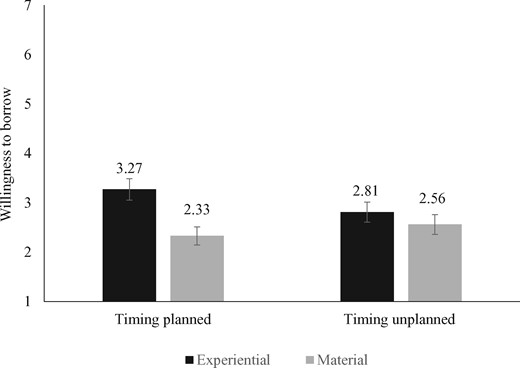
Abstract Mental accounting research suggests that consumers prefer borrowing for longer-lasting purchases in order to receive benefits from the purchases as they pay for them. In contrast, two sets of archival data and five lab studies show that consumers are more willing to borrow for experiential versus material purchases, even though experiential purchases tend to have a shorter physical duration. Further, framing the same purchase as more experiential than material increases willingness to borrow. This effect occurs because purchase timing is more important for experiential purchases—a function of consumers’ aversion to missing out on planned consumption. Thus, we moderate the proposed effect by varying whether the borrowing decision impacts planned consumption. Other differences between material and experiential purchases, such as scarcity or expected happiness, cannot similarly explain our results. Moreover, our conceptualization allows us to reconcile the apparent contradiction between the previous and current research by examining the relative impact of purchase-timing importance and payment-benefit duration matching in different contexts (i.e., “purchasing” and “source-of-funding” decisions).
Reading the Fine Print: Information Disclosure in the Brazilian Credit Card Market
Consumer credit regulations usually require that lenders disclose interest rates. However, in the absence of specific prominence requirements, lenders can conceal the interest rate in the fine print while still complying with the law. I examine the effect of such a strategy using a field experiment in Brazil in which a credit card company offered their clients payment plans to pay off their balances. Using randomized contract interest rates and the degree of rate disclosure, I show that most clients are rate sensitive, whether or not rates are prominently disclosed. The elasticity of payment plan enrollment with respect to the interest rate ranges from −0.711 to −0.880. High-risk clients are an exception; these clients are rate sensitive only when disclosure is prominent. I also show that clients are influenced by nudges that favor longer-term contracts. Conditional on enrollment, the proportion of clients who choose a longer-term contract is 40 percentage points higher when a longer-term contract is featured in the advertisement layout. This effect, however, is weaker when stakes are higher. Data, as supplemental material, are available at http://dx.doi.org/10.1287/mnsc.2015.2281 . This paper was accepted by Wei Jiang, finance.
On shifting consumers from high‐interest to low‐interest debt
Abstract In the United States, many consumers are increasingly accumulating debt, much of which is harmful and expensive. Prior research has devoted a great deal of attention to understanding why consumers generally get into debt and the strategies they can use to repay existing debts. While this work has furthered the agenda of helping consumers reduce or eliminate their overall debt balances, it has failed to emphasize the fact that for many consumers, debt may be unavoidable. This article aims to promote research that addresses not only overall debt reduction but also the need for consumers to shift from more to less costly types of debt. By shedding light on the psychological reasons why consumers may naturally gravitate toward more costly forms of debt when less costly ones may be available, we offer a novel perspective on why consumers get into and stay in debt longer than they should. This new angle has the potential to spur on further research into the ways consumers can use debt more effectively and less expensively in service of the overarching goal of debt reduction.

Are Information Disclosures Effective? Evidence from the Credit Card Market
Consumer protection in financial markets in the form of information disclosure is high on government agendas, even though there is little evidence of its effectiveness. We implement a randomized control trial in the credit card market for a large population of indebted cardholders and measure the impact of Truth-in-Lending-Act-type disclosures, de-biasing warning messages and social comparison information on default, indebtedness, account closings, and credit scores. We conduct extensive external validity exercises in several banks, with different disclosures, and with actual policy mandates. We find that providing salient interest rate disclosures had no effects, while comparisons and de-biasing messages had only modest effects at best.
Moral Incentives in Credit Card Debt Repayment: Evidence from a Field Experiment
We study the role of morality in debt repayment, using an experiment with the credit card customers of a large Islamic bank in Indonesia. In our main treatment, clients receive a text message stating that “non-repayment of debts by someone who is able to repay is an injustice.” This moral appeal decreases delinquency by 4.4 percentage points from a baseline of 66 percent and reduces default among customers with the highest ex ante credit risk. Additional treatments help benchmark the effects against direct financial incentives and rule out competing explanations, such as reminder effects, priming religion, and provision of new information.

Shaming Microloan Delinquents: Evidence from a Field Experiment in China
We study the effects of village credit information sharing on individual microloan repayment, using a randomized experiment with loan applicants from 40 villages in rural China. In our main treatment, customers received a message on the loan application form that “overdue payment (40 days after each installment due date) will be considered for public disclosure among the village by showing debtors’ names on a blackboard outside the village office of the microlending institution.” On average, this social appeal reduces the share of delinquents and the individual delinquency rate by 18.6% and 5.6% from baseline rates of 79.5% and 15.2%, respectively. The effects appear more pronounced among male and older borrowers. Additional treatments help to benchmark the effect against lender credit information sharing and separate the effects on adverse selection and moral hazard. Mechanism analysis shows that the publicly disclosed “blacklist” of delinquents affects borrowers’ repayment behaviors, partially through borrowers’ fear of losing informal risk insurance from the village society and predominately through public shaming penalties. Overall, these results support that, in traditional societies, social appeals can provide not only pecuniary, but also psychological incentives to improve loan repayment. Psychological incentives, to some extent, have stronger effects. This paper was accepted by Gustavo Manso, finance.
Debt literacy, financial experiences, and overindebtedness
We analyze a national sample of Americans with respect to their debt literacy, financial experiences, and their judgments about the extent of their indebtedness. Debt literacy is a component of broader financial understanding that measures knowledge about debt and self-assessed financial knowledge. Financial experiences are the participants’ reported experiences with traditional borrowing, alternative borrowing, and investing. Overindebtedness is a self-reported measure. Debt literacy is low, with only about one-third of the population grasping the basics of interest compounding. Even after controlling for demographics, we find a relationship between debt literacy and both financial experiences and debt loads. Individuals with lower levels of debt literacy tend to transact in high-cost manners, incurring higher fees and using high-cost borrowing. We provide a rough estimate of the national implications of debt ignorance on credit card costs by consumers. Less knowledgeable individuals also report that their debt loads are excessive or that they are unable to judge their debt position.