


A collective action or revolt succeeds only if sufficiently many people participate. We study how potential revolutionaries’ ability to coordinate is affected by what they learn from different sources. We first examine how people learn about the likelihood of a revolution’s success by talking to those around themselves, which can either work in favor or against the success of an uprising, depending on the prior beliefs of the agents, the homogeneity of preferences in the population, and the number of contacts. We extend the analysis by examining the effects of homophily on learning: people are more likely to meet others who have similar preferences, undercutting learning. We introduce variants of our model to discuss other ways of learning about the support for a revolution. We discuss why holding mass protests before a revolt provides more informative signals of people’s willingness to actively participate than other less costly forms of communication (e.g., via social media). We also show how outcomes of revolutions in one region can inform citizens of another region and thus trigger (or discourage) neighboring revolutions. We also discuss the role of governments in avoiding revolutions and learning about their citizens’ concerns; in particular, by observing the strength of protests and counter-protests.
The limits of social media as a source of political information during routine and crisis times across 17 countries
Recent studies on political knowledge suggest people learn little about political events and societal issues from social media. Potentially, social media are a more effective source of information ...
Immigrants’ Participation in Protests
This resource provides information so that immigrants can know their rights, understand the risks of protests, and feel empowered to participate.

Find Protests Near You - Updated Daily | find a protest
Find protests and solidarity events near you — updated daily. Discover local rallies, vigils, teach-ins and justice actions happening this week and weekend.
Why Don’t We Learn from Social Media? Studying Effects of and Mechanisms behind Social Media News Use on General Surveillance Political Knowledge
Does exposure to news affect what people know about politics? This old question attracted new scholarly interest as the political information environment is changing rapidly. In particular, since c...

A perspective on friction interventions to curb the spread of misinformation
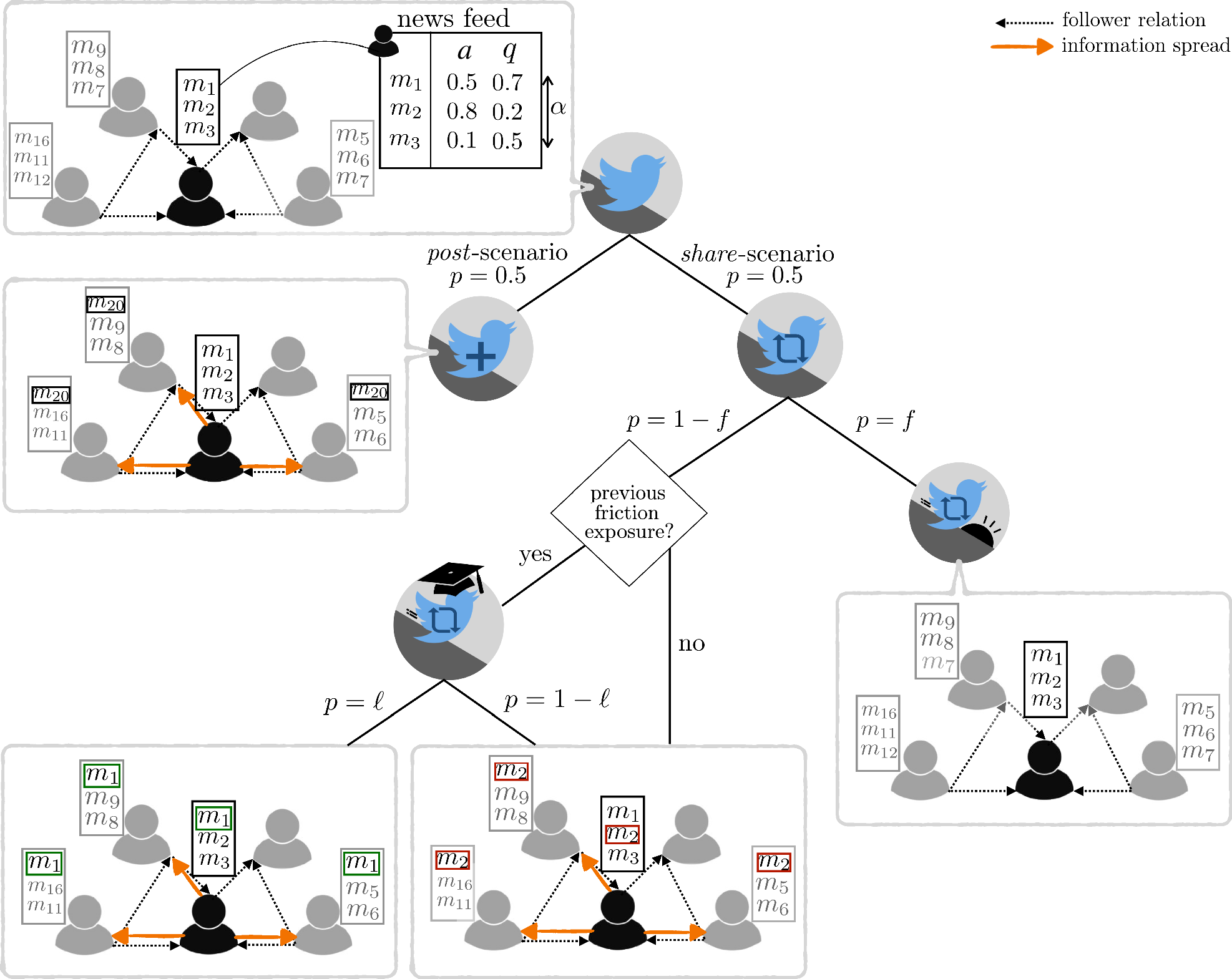
Social media has enabled the spread of information at unprecedented speeds and scales, and with it the proliferation of high-engagement, low-quality content. Friction—behavioral design measures that make the sharing of content more cumbersome—might be a way to raise the quality of what is spread online. In this perspective, we propose a scalable field experiment to study the effects of friction with a learning component to educate users on the platform’s community standards. Preliminary simulations from an agent-based model suggest that while friction alone may decrease the number of posts without improving their quality, it could significantly increase the average quality of posts when combined with learning. The model also suggests that too much friction could be counterproductive. Experimental interventions inspired by these findings would be minimally invasive.
Social Media Effects: Hijacking Democracy and Civility in Civic Engagement
Perceived as an equalizing force for disenfranchised individuals without a voice, the importance of social networks as agents of change cannot be ignored. However, in some societies, social networks have evolved into a platform for fake news and propaganda, empowering disruptive voices, ideologies, and messages. Social networks such as Twitter, Facebook, and Google hold the potential to alter civic engagement, thus essentially hijacking democracy, by influencing individuals toward a particular way of thinking.

Sharing of misinformation is habitual, not just lazy or biased
Why do people share misinformation on social media? In this research ( N = 2,476), we show that the structure of online sharing built into social platforms is more important than individual deficits in critical reasoning and partisan bias—commonly cited drivers of misinformation. Due to the reward-based learning systems on social media, users form habits of sharing information that attracts others' attention. Once habits form, information sharing is automatically activated by cues on the platform without users considering response outcomes such as spreading misinformation. As a result of user habits, 30 to 40% of the false news shared in our research was due to the 15% most habitual news sharers. Suggesting that sharing of false news is part of a broader response pattern established by social media platforms, habitual users also shared information that challenged their own political beliefs. Finally, we show that sharing of false news is not an inevitable consequence of user habits: Social media sites could be restructured to build habits to share accurate information.

Sharing of misinformation is habitual, not just lazy or biased
Why do people share misinformation on social media? In this research ( N = 2,476), we show that the structure of online sharing built into social platforms is more important than individual deficits in critical reasoning and partisan bias—commonly cited drivers of misinformation. Due to the reward-based learning systems on social media, users form habits of sharing information that attracts others' attention. Once habits form, information sharing is automatically activated by cues on the platform without users considering response outcomes such as spreading misinformation. As a result of user habits, 30 to 40% of the false news shared in our research was due to the 15% most habitual news sharers. Suggesting that sharing of false news is part of a broader response pattern established by social media platforms, habitual users also shared information that challenged their own political beliefs. Finally, we show that sharing of false news is not an inevitable consequence of user habits: Social media sites could be restructured to build habits to share accurate information.
Rational Ritual
Why do Internet, financial service, and beer commercials dominate Super Bowl advertising? How do political ceremonies establish authority? Why does repetition characterize anthems and ritual speech? Why were circular forms favored for public festivals during the French Revolution? This book answers these questions using a single concept: common knowledge. Game theory shows that in order to coordinate its actions, a group of people must form “common knowledge.” Each person wants to participate only if others also participate. Members must have knowledge of each other, knowledge of that knowledge, knowledge of the knowledge of that knowledge, and so on. Michael Chwe applies this insight, with striking erudition, to analyze a range of rituals across history and cultures. He shows that public ceremonies are powerful not simply because they transmit meaning from a central source to each audience member but because they let audience members know what other members know. For instance, people watching the Super Bowl know that many others are seeing precisely what they see and that those people know in turn that many others are also watching. This creates common knowledge, and advertisers selling products that depend on consensus are willing to pay large sums to gain access to it. Remarkably, a great variety of rituals and ceremonies, such as formal inaugurations, work in much the same way. By using a rational-choice argument to explain diverse cultural practices, Chwe argues for a close reciprocal relationship between the perspectives of rationality and culture. He illustrates how game theory can be applied to an unexpectedly broad spectrum of problems, while showing in an admirably clear way what game theory might hold for scholars in the social sciences and humanities who are not yet acquainted with it. In a new afterword, Chwe delves into new applications of common knowledge, both in the real world and in experiments, and considers how generating common knowledge has become easier in the digital age.

Everyone Conforms, No One Believes: Pluralistic Ignorance in LLM Agent Populations
LLM-based multi-agent systems are increasingly used to simulate social dynamics, from opinion formation to collective decision-making. These simulations can reproduce certain social phenomena, but it is unknown whether they capture pluralistic ignorance, a state where a majority privately rejects a norm yet publicly conforms, each believing they are alone in dissenting. This phenomenon drives norm persistence, social movements, and political revolutions. We show that pluralistic ignorance emerges robustly in LLM agent populations. We construct a benchmark of 100 scenarios across 10 domains and 5 authority levels, grounded in the human pluralistic ignorance literature, and evaluate 8 models from 6 organizations. Agents publicly conform at rates of 64 to 94% despite privately opposing the norm. Conformity is domain-sensitive (workplace and social relationship scenarios produce near-universal public compliance) and highly model-dependent, though uncorrelated with model capability. We further test whether a single "norm entrepreneur" can break the false consensus by publicly dissenting. For 7 of 8 models, cascades succeed less than 26% of the time, with one model showing zero cascades across all scenarios. GPT-4o is a notable outlier at 48%, revealing qualitatively distinct social dynamics across model families. Our findings identify model selection as an unacknowledged degree of freedom that fundamentally shapes simulation outcomes. More broadly, the near-absence of cascades suggests LLM simulations may systematically overestimate the stability of social norms, missing the fragile tipping-point dynamics that drive real-world norm change in human societies.
Are Large Language Models Sensitive to the Motives Behind Communication?
Human communication is $\textit{motivated}$: people speak, write, and create content with a particular communicative intent in mind. As a result, information that large language models (LLMs) and AI agents process is inherently framed by humans' intentions and incentives. People are adept at navigating such nuanced information: we routinely identify benevolent or self-serving motives in order to decide what statements to trust. For LLMs to be effective in the real world, they too must critically evaluate content by factoring in the motivations of the source---for instance, weighing the credibility of claims made in a sales pitch. In this paper, we undertake a comprehensive study of whether LLMs have this capacity for $\textit{motivational vigilance}$. We first employ controlled experiments from cognitive science to verify that LLMs' behavior is consistent with rational models of learning from motivated testimony, and find they successfully discount information from biased sources in a human-like manner. We then extend our evaluation to sponsored online adverts, a more naturalistic reflection of LLM agents' information ecosystems. In these settings, we find that LLMs' inferences do not track the rational models' predictions nearly as closely---partly due to additional information that distracts them from vigilance-relevant considerations. However, a simple steering intervention that boosts the salience of intentions and incentives substantially increases the correspondence between LLMs and the rational model. These results suggest that LLMs possess a basic sensitivity to the motivations of others, but generalizing to novel real-world settings will require further improvements to these models.
Do people learn about politics on social media? A meta-analysis of 76 studies
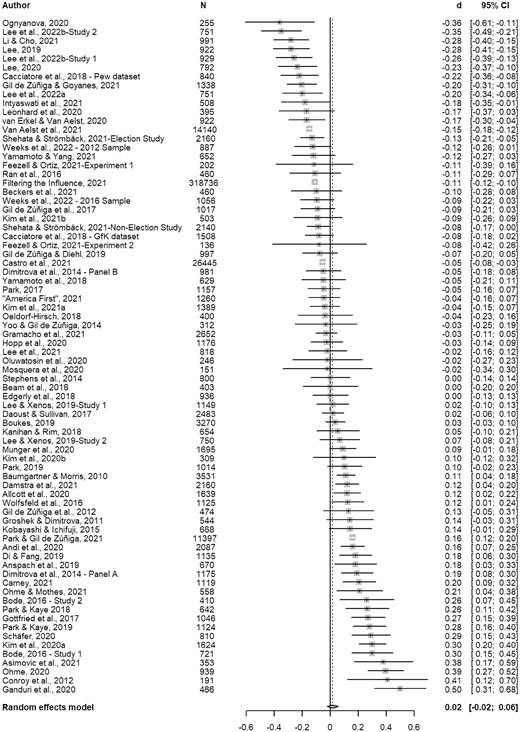
Abstract. Citizens turn increasingly to social media to get their political information. However, it is currently unclear whether using these platforms act
Digital Social Norm Enforcement: Online Firestorms in Social Media
Actors of public interest today have to fear the adverse impact that stems from social media platforms. Any controversial behavior may promptly trigger temporal, but potentially devastating storms of emotional and aggressive outrage, so called online firestorms. Popular targets of online firestorms are companies, politicians, celebrities, media, academics and many more. This article introduces social norm theory to understand online aggression in a social-political online setting, challenging the popular assumption that online anonymity is one of the principle factors that promotes aggression. We underpin this social norm view by analyzing a major social media platform concerned with public affairs over a period of three years entailing 532,197 comments on 1,612 online petitions. Results show that in the context of online firestorms, non-anonymous individuals are more aggressive compared to anonymous individuals. This effect is reinforced if selective incentives are present and if aggressors are intrinsically motivated.
Digital Social Norm Enforcement: Online Firestorms in Social Media
Actors of public interest today have to fear the adverse impact that stems from social media platforms. Any controversial behavior may promptly trigger temporal, but potentially devastating storms of emotional and aggressive outrage, so called online firestorms. Popular targets of online firestorms are companies, politicians, celebrities, media, academics and many more. This article introduces social norm theory to understand online aggression in a social-political online setting, challenging the popular assumption that online anonymity is one of the principle factors that promotes aggression. We underpin this social norm view by analyzing a major social media platform concerned with public affairs over a period of three years entailing 532,197 comments on 1,612 online petitions. Results show that in the context of online firestorms, non-anonymous individuals are more aggressive compared to anonymous individuals. This effect is reinforced if selective incentives are present and if aggressors are intrinsically motivated.
How to break populist parties’ appeal? An experimental evaluation of communication counter-strategies
Right-wing populist parties have become a major challenge to liberal democracies worldwide. How can mainstream parties effectively counter their appeal? While prior research has focused on the drivers of populist support, much less is known about how to counter right-wing populist rhetoric. We test four communication counter-strategies that target core elements of right-wing populist appeals: (i) undermining populists’ claims to democratic credibility, (ii) promoting inclusive in-group identity to counter exclusionary narratives, (iii) highlighting their performance legitimacy, and (iv) emphasizing the procedural legitimacy of mainstream parties. Drawing on real-world party communications from social media, manifestos, and press releases, we created 170 experimental treatments (posters and social media posts varying in format and complexity) to simulate how voters encounter political messages in everyday life. In a large-scale survey experiment with over 24,000 respondents in Germany, messages undermining right-wing populists’ democratic credibility prove most effective, particularly among citizens with high initial support for such parties.
The Interplay of Knowledge Overestimation, Social Media Use, and Populist Ideas: Cross-Sectional and Experimental Evidence From Germany and Taiwan - Niels G. Mede, Adrian Rauchfleisch, Julia Metag, Mike S. Schäfer, 2024
Social media expose users to an abundance of information about various issues. But they also make it difficult for users to assess the quality of this informati...
