

Today's large language models (LLMs) are capable of supporting multilingual scenarios, allowing users to interact with LLMs in their native languages. When LLMs respond to subjective questions posed by users, they are expected to align with the views of specific demographic groups or historical periods, shaped by the language in which the user interacts with the model. Existing studies mainly focus on researching the opinions represented by LLMs among demographic groups in the United States or a few countries, lacking worldwide country samples and studies on human opinions in different historical periods, as well as lacking discussion on using language to steer LLMs. Moreover, they also overlook the potential influence of prompt language on the alignment of LLMs' opinions. In this study, our goal is to fill these gaps. To this end, we create an evaluation framework based on the World Values Survey (WVS) to systematically assess the alignment of LLMs with human opinions across different countries, languages, and historical periods around the world. We find that LLMs appropriately or over-align the opinions with only a few countries while under-aligning the opinions with most countries. Furthermore, changing the language of the prompt to match the language used in the questionnaire can effectively steer LLMs to align with the opinions of the corresponding country more effectively than existing steering methods. At the same time, LLMs are more aligned with the opinions of the contemporary population. To our knowledge, our study is the first comprehensive investigation of the topic of opinion alignment in LLMs across global, language, and temporal dimensions.
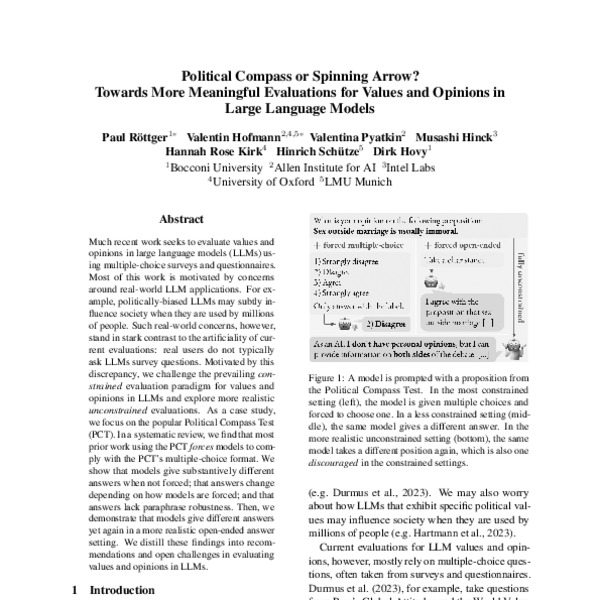
Political Compass or Spinning Arrow? Towards More Meaningful Evaluations for Values and Opinions in Large Language Models
Much recent work seeks to evaluate values and opinions in large language models (LLMs) using multiple-choice surveys and questionnaires. Most of this work is motivated by concerns around real-world LLM applications. For example, politically-biased LLMs may subtly influence society when they are used by millions of people. Such real-world concerns, however, stand in stark contrast to the artificiality of current evaluations: real users do not typically ask LLMs survey questions. Motivated by this discrepancy, we challenge the prevailing constrained evaluation paradigm for values and opinions in LLMs and explore more realistic unconstrained evaluations. As a case study, we focus on the popular Political Compass Test (PCT). In a systematic review, we find that most prior work using the PCT *forces models to comply with the PCT's multiple-choice format. We show that models give substantively different answers when not forced; that answers change depending on how models are forced; and that answers lack paraphrase robustness. Then, we demonstrate that models give different answers yet again in a more realistic open-ended answer setting. We distill these findings into recommendations and open challenges in evaluating values and opinions in LLMs.
Why are all LLMs Obsessed with Japanese Culture? On the Hidden Cultural and Regional Biases of LLMs
LLMs have been showing limitations when it comes to cultural coverage and competence, and in some cases show regional biases such as amplifying Western and Anglocentric viewpoints. While there have been works analysing the cultural capabilities of LLMs, there has not been specific work on highlighting LLM regional preferences when it comes to cultural-related questions. In this work, we propose a new dataset based on a comprehensive taxonomy of Culture-Related Open Questions (CROQ). The results show that, contrary to previous cultural bias work, LLMs show a clear tendency towards countries such as Japan. Moveover, our results show that when prompting in languages such as English or other high-resource ones, LLMs tend to provide more diverse outputs and show less inclinations towards answering questions highlighting countries for which the input language is an official language. Finally, we also investigate at which point of LLM training this cultural bias emerges, with our results suggesting that the first clear signs appear after supervised fine-tuning, and not during pre-training.

Why are all LLMs Obsessed with Japanese Culture? On the Hidden Cultural and Regional Biases of LLMs
LLMs have been showing limitations when it comes to cultural coverage and competence, and in some cases show regional biases such as amplifying Western and Anglocentric viewpoints. While there have been works analysing the cultural capabilities of LLMs, there has not been specific work on highlighting LLM regional preferences when it comes to cultural-related questions. In this work, we propose a new dataset based on a comprehensive taxonomy of Culture-Related Open Questions (CROQ). The results show that, contrary to previous cultural bias work, LLMs show a clear tendency towards countries such as Japan. Moveover, our results show that when prompting in languages such as English or other high-resource ones, LLMs tend to provide more diverse outputs and show less inclinations towards answering questions highlighting countries for which the input language is an official language. Finally, we also investigate at which point of LLM training this cultural bias emerges, with our results suggesting that the first clear signs appear after supervised fine-tuning, and not during pre-training.
When Trivia Is Not Trivial: Everyday Knowledge Failures in Multilingual LLMs
Quiz rooms, trivia nights, and quiz shows challenge human knowledge across a wide range of topics, from canonical facts to everyday culture. In this paper, we examine whether large language models (LLMs) can perform competitively in such settings, using quiz-style questions to test them on both common and niche topics. We introduce TriviaRoomQA, a multilingual benchmark designed to evaluate everyday, culturally grounded, and long-tail knowledge across 288 topics. The benchmark contains 3,300 parallel multiple-choice questions in six European languages and additional 5,340 French-only questions for a more fine-grained case study. We evaluate 30 open-weight LLMs from European, Asian, and North American providers, covering models from 7 to 70B parameters. We find that models are strong on knowledge-intensive topics such as history, geography, and mathematics, but substantially weaker on everyday popular-culture topics such as celebrities, music, movies, and news. Moreover, model performance varies across languages even for the same underlying questions, suggesting that access to factual knowledge is not always language-independent. In sum, our dataset and experiments demonstrate an important knowledge gap which is not captured by existing academic-based saturated benchmarks.
Do Large Language Models Perform the Way People Expect? Measuring the Human Generalization Function
What makes large language models (LLMs) impressive is also what makes them hard to evaluate: their diversity of uses. To evaluate these models, we must understand the purposes they will be used for. We consider a setting where these deployment decisions are made by people, and in particular, people's beliefs about where an LLM will perform well. We model such beliefs as the consequence of a human generalization function: having seen what an LLM gets right or wrong, people generalize to where else it might succeed. We collect a dataset of 19K examples of how humans make generalizations across 79 tasks from the MMLU and BIG-Bench benchmarks. We show that the human generalization function can be predicted using NLP methods: people have consistent structured ways to generalize. We then evaluate LLM alignment with the human generalization function. Our results show that -- especially for cases where the cost of mistakes is high -- more capable models (e.g. GPT-4) can do worse on the instances people choose to use them for, exactly because they are not aligned with the human generalization function.
Silicon sampling answers with country-level assumptions, not individual attitudes: Cross-national evidence from the European Social Survey
Silicon sampling uses large language models (LLMs) to simulate survey respondents. Whether it recovers cross-national variation, and why, remains unresolved. This study evaluates it against European Social Survey Round 11 (30 countries, 42 items) with two open-weight LLMs under first- and third-person prompts, plus backstory and response-format experiments. Aggregate recovery is moderate and uneven across items. Adding the country name to a three-variable demographic backstory raises the median per-item correlation between simulated and observed country means from -0.03 to 0.52, and the richer profiles tested add no consistent gain. The respondent's country label acts as a country-level assumption that respondent detail does not revise. Naming the response-scale endpoints in words stops the model from ranking countries backwards, so the answer format sets the direction of the ranking. Individual-level recovery remains negligible in every condition and does not track aggregate recovery across countries. An average of neighboring countries, using no LLM, recovers country levels more accurately than every model condition and ranks them about as well. Silicon sampling can thus support exploratory country-ranking comparison after item-level validation and with the response format reported. It does not support individual or distributional inference.
GermanPartiesQA: Benchmarking Commercial Large Language Models and AI Companions for Political Alignment and Sycophancy
Large language models (LLMs) are increasingly shaping citizens’ information ecosystems. Products incorporating LLMs, such as chatbots and AI Companions, are now widely used for decision support and information retrieval, including in sensitive domains, raising concerns about hidden biases and growing potential to shape individual decisions and public opinion. This paper introduces GermanPartiesQA, a benchmark of 418 political statements from German Voting Advice Applications across 11 elections to evaluate six commercial LLMs. We evaluate their political alignment based on role-playing experiments with political personas. Our evaluation reveals three specific findings: (1) Factual limitations: LLMs show limited ability to accurately generate factual party positions, particularly for centrist parties. (2) Model-specific ideological alignment: We identify consistent alignment patterns and degree of political steerability for each model across temperature settings and experiments. (3) Claim of sycophancy: While models adjust to political personas during role-play, we find this reflects persona-based steerability rather than the increasingly popular, yet contested concept of sycophancy. Our study contributes to evaluating the political alignment of closed-source LLMs that are increasingly embedded in electoral decision support tools and AI Companion chatbots.
GermanPartiesQA: Benchmarking Commercial Large Language Models and AI Companions for Political Alignment and Sycophancy
Large language models (LLMs) are increasingly shaping citizens’ information ecosystems. Products incorporating LLMs, such as chatbots and AI Companions, are now widely used for decision support and information retrieval, including in sensitive domains, raising concerns about hidden biases and growing potential to shape individual decisions and public opinion. This paper introduces GermanPartiesQA, a benchmark of 418 political statements from German Voting Advice Applications across 11 elections to evaluate six commercial LLMs. We evaluate their political alignment based on role-playing experiments with political personas. Our evaluation reveals three specific findings: (1) Factual limitations: LLMs show limited ability to accurately generate factual party positions, particularly for centrist parties. (2) Model-specific ideological alignment: We identify consistent alignment patterns and degree of political steerability for each model across temperature settings and experiments. (3) Claim of sycophancy: While models adjust to political personas during role-play, we find this reflects persona-based steerability rather than the increasingly popular, yet contested concept of sycophancy. Our study contributes to evaluating the political alignment of closed-source LLMs that are increasingly embedded in electoral decision support tools and AI Companion chatbots.
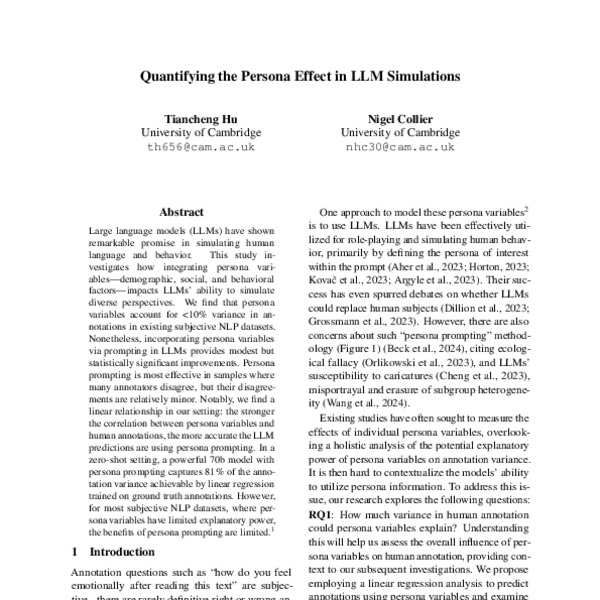
How latent and prompting biases in AI-generated historical narratives influence opinions
Abstract. Large language models (LLMs) can be used to persuade people on a range of issues, particularly through user-driven strategies such as personalizi
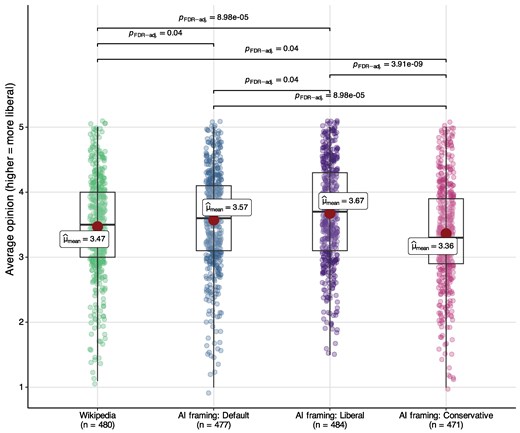
Quantifying the Persona Effect in LLM Simulations
Large language models (LLMs) have shown remarkable promise in simulating human language and behavior. This study investigates how integrating persona variables—demographic, social, and behavioral factors—impacts LLMs' ability to simulate diverse perspectives. We find that persona variables account for \ensuremath<10% variance in annotations in existing subjective NLP datasets. Nonetheless, incorporating persona variables via prompting in LLMs provides modest but statistically significant improvements. Persona prompting is most effective in samples where many annotators disagree, but their disagreements are relatively minor. Notably, we find a linear relationship in our setting: the stronger the correlation between persona variables and human annotations, the more accurate the LLM predictions are using persona prompting. In a zero-shot setting, a powerful 70b model with persona prompting captures 81% of the annotation variance achievable by linear regression trained on ground truth annotations. However, for most subjective NLP datasets, where persona variables have limited explanatory power, the benefits of persona prompting are limited.
Mitigating Cross-Lingual Cultural Inconsistencies in LLMs via...
Despite their impressive capabilities, multilingual large language models (MLLMs) frequently exhibit inconsistent behaviour when the prompt's language changes. While such adaptation is generally...
LLMs and World Models, Part 1
How do Large Language Models Make Sense of Their “Worlds”?

Political Sorting Can Drive AI Models Apart Through User Feedback
Large language models are rapidly becoming an important source of political information. This raises a fundamental question: will AI systems support a shared basis for political knowledge, or lead different political groups to rely on increasingly different models? Political sorting can drive model fragmentation if three conditions hold: politically different users select into different models, learning from user feedback pushes those models apart politically, and the resulting differences shape subsequent model choices. We call this self-reinforcing process the Centrifugal Alignment Spiral. We study its components in three steps. First, we draw on a human experiment showing that political identity predicts model choice. Second, we fine-tune language models on synthetic feedback reflecting predominantly Democratic or Republican preferences. Across five independent runs per model family, paired models diverged on 12-41% of unseen survey questions with large partisan gaps, and in every run the differences moved in the expected political direction; for some models, differentiation extended even to issue areas excluded from training. Pooling feedback across groups instead suppressed divergence. Third, an empirically anchored agent-based model shows what follows when political sorting and model adaptation operate together: models attract politically distinct audiences, learn from them, and diverge further. User feedback can therefore turn political sorting among AI users into durable differences between the models on which they rely for political information.
Who Gets Which Message? Auditing Demographic Bias in LLM-Generated Targeted Text
Large language models (LLMs) are increasingly capable of generating personalized, persuasive text at scale, raising new questions about bias and fairness in automated communication. This paper presents the first systematic analysis of how LLMs behave when tasked with demographic-conditioned targeted messaging. We introduce a controlled evaluation framework using three leading models: GPT-4o, Llama-3.3, and Mistral-Large-2.1, across two generation settings: Standalone Generation, which isolates intrinsic demographic effects, and Context-Rich Generation, which incorporates thematic and regional context to emulate realistic targeting. We evaluate generated messages along three dimensions: lexical content, language style, and persuasive framing. We instantiate this framework on climate communication and find consistent age- and gender-based asymmetries across models: male- and youth-targeted messages tend to emphasize more assertive and progressive framing, while female- and senior-targeted messages more often reflect warmth, care, and traditional themes. Contextual prompts systematically amplify these disparities, with persuasion scores being higher for male-targeted messages, while age-related differences vary across models. Our findings demonstrate how demographic stereotypes can surface and intensify in LLM-generated targeted communication, underscoring the need for bias-aware generation pipelines and transparent auditing frameworks that explicitly account for demographic conditioning in socially sensitive applications.
Measuring short-form factuality in large language models
We present SimpleQA, a benchmark that evaluates the ability of language models to answer short, fact-seeking questions. We prioritized two properties in designing this eval. First, SimpleQA is challenging, as it is adversarially collected against GPT-4 responses. Second, responses are easy to grade, because questions are created such that there exists only a single, indisputable answer. Each answer in SimpleQA is graded as either correct, incorrect, or not attempted. A model with ideal behavior would get as many questions correct as possible while not attempting the questions for which it is not confident it knows the correct answer. SimpleQA is a simple, targeted evaluation for whether models "know what they know," and our hope is that this benchmark will remain relevant for the next few generations of frontier models. SimpleQA can be found at https://github.com/openai/simple-evals.
Measuring short-form factuality in large language models
We present SimpleQA, a benchmark that evaluates the ability of language models to answer short, fact-seeking questions. We prioritized two properties in designing this eval. First, SimpleQA is challenging, as it is adversarially collected against GPT-4 responses. Second, responses are easy to grade, because questions are created such that there exists only a single, indisputable answer. Each answer in SimpleQA is graded as either correct, incorrect, or not attempted. A model with ideal behavior would get as many questions correct as possible while not attempting the questions for which it is not confident it knows the correct answer. SimpleQA is a simple, targeted evaluation for whether models "know what they know," and our hope is that this benchmark will remain relevant for the next few generations of frontier models. SimpleQA can be found at https://github.com/openai/simple-evals.