

Large language models (LLMs) were not designed to replace healthcare workers, but they are being used in ways that can lead users to overestimate the types of roles that these systems can assume. While prompt engineering has been shown to improve LLMs' clinical effectiveness in mental health applications, little is known about whether such strategies help models adhere to ethical principles for real-world deployment. In this study, we conducted an 18-month ethnographic collaboration with mental health practitioners (three clinically licensed psychologists and seven trained peer counselors) to map LLM counselors' behavior during a session to professional codes of conduct established by organizations like the American Psychological Association (APA). Through qualitative analysis and expert evaluation of N=137 sessions (110 self-counseling; 27 simulated), we outline a framework of 15 ethical violations mapped to 5 major themes. These include: Lack of Contextual Understanding, where the counselor fails to account for users' lived experiences, leading to oversimplified, contextually irrelevant, and one-size-fits-all intervention; Poor Therapeutic Collaboration, where the counselor's low turn-taking behavior and invalidating outputs limit users' agency over their therapeutic experience; Deceptive Empathy, where the counselor's simulated anthropomorphic responses (``I hear you'', ``I understand'') create a false sense of emotional connection; Unfair Discrimination, where the counselor's responses exhibit algorithmic bias and cultural insensitivity toward marginalized populations; and Lack of Safety & Crisis Management, where individuals who are ``knowledgeable enough'' to correct LLM outputs are at an advantage, while others, due to lack of clinical knowledge and digital literacy, are more likely to suffer from clinically inappropriate responses. Reflecting on these findings through a practitioner-informed lens, we argue that reducing psychotherapy—a deeply meaningful and relational process—to a language generation task can have serious and harmful implications in practice. We conclude by discussing policy-oriented accountability mechanisms for emerging LLM counselors.
How LLM Counselors Violate Ethical Standards in Mental Health Practice: A Practitioner-Informed Framework
Large language models (LLMs) were not designed to replace healthcare workers, but they are being used in ways that can lead users to overestimate the types of roles that these systems can assume. While prompt engineering has been shown to improve LLMs' clinical effectiveness in mental health applications, little is known about whether such strategies help models adhere to ethical principles for real-world deployment. In this study, we conducted an 18-month ethnographic collaboration with mental health practitioners (three clinically licensed psychologists and seven trained peer counselors) to map LLM counselors' behavior during a session to professional codes of conduct established by organizations like the American Psychological Association (APA). Through qualitative analysis and expert evaluation of N=137 sessions (110 self-counseling; 27 simulated), we outline a framework of 15 ethical violations mapped to 5 major themes. These include: Lack of Contextual Understanding, where the counselor fails to account for users' lived experiences, leading to oversimplified, contextually irrelevant, and one-size-fits-all intervention; Poor Therapeutic Collaboration, where the counselor's low turn-taking behavior and invalidating outputs limit users' agency over their therapeutic experience; Deceptive Empathy, where the counselor's simulated anthropomorphic responses (``I hear you'', ``I understand'') create a false sense of emotional connection; Unfair Discrimination, where the counselor's responses exhibit algorithmic bias and cultural insensitivity toward marginalized populations; and Lack of Safety & Crisis Management, where individuals who are ``knowledgeable enough'' to correct LLM outputs are at an advantage, while others, due to lack of clinical knowledge and digital literacy, are more likely to suffer from clinically inappropriate responses. Reflecting on these findings through a practitioner-informed lens, we argue that reducing psychotherapy—a deeply meaningful and relational process—to a language generation task can have serious and harmful implications in practice. We conclude by discussing policy-oriented accountability mechanisms for emerging LLM counselors.
Please Don’t Take Moral Advice from ChatGPT
Before turning to a large language model for ethical counsel, consider what makes for good advice

Reliability of LLMs as medical assistants for the general public: a randomized preregistered study
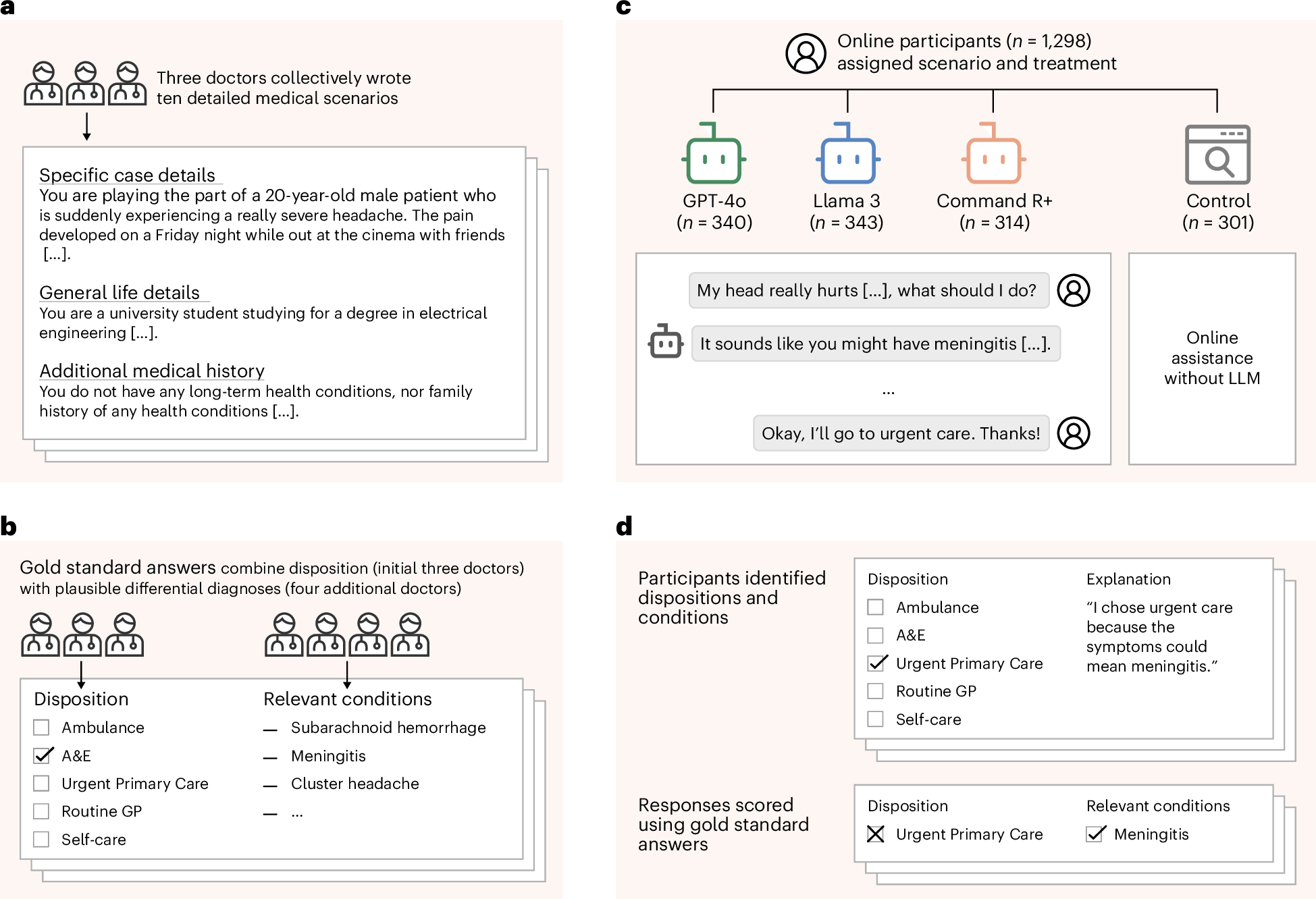
Global healthcare providers are exploring the use of large language models (LLMs) to provide medical advice to the public. LLMs now achieve nearly perfect scores on medical licensing exams, but this does not necessarily translate to accurate performance in real-world settings. We tested whether LLMs can assist members of the public in identifying underlying conditions and choosing a course of action (disposition) in ten medical scenarios in a controlled study with 1,298 participants. Participants were randomly assigned to receive assistance from an LLM (GPT-4o, Llama 3, Command R+) or a source of their choice (control). Tested alone, LLMs complete the scenarios accurately, correctly identifying conditions in 94.9% of cases and disposition in 56.3% on average. However, participants using the same LLMs identified relevant conditions in fewer than 34.5% of cases and disposition in fewer than 44.2%, both no better than the control group. We identify user interactions as a challenge to the deployment of LLMs for medical advice. Standard benchmarks for medical knowledge and simulated patient interactions do not predict the failures we find with human participants. Moving forward, we recommend systematic human user testing to evaluate interactive capabilities before public deployments in healthcare.
Reliability of LLMs as medical assistants for the general public: a randomized preregistered study
Global healthcare providers are exploring the use of large language models (LLMs) to provide medical advice to the public. LLMs now achieve nearly perfect scores on medical licensing exams, but this does not necessarily translate to accurate performance in real-world settings. We tested whether LLMs can assist members of the public in identifying underlying conditions and choosing a course of action (disposition) in ten medical scenarios in a controlled study with 1,298 participants. Participants were randomly assigned to receive assistance from an LLM (GPT-4o, Llama 3, Command R+) or a source of their choice (control). Tested alone, LLMs complete the scenarios accurately, correctly identifying conditions in 94.9% of cases and disposition in 56.3% on average. However, participants using the same LLMs identified relevant conditions in fewer than 34.5% of cases and disposition in fewer than 44.2%, both no better than the control group. We identify user interactions as a challenge to the deployment of LLMs for medical advice. Standard benchmarks for medical knowledge and simulated patient interactions do not predict the failures we find with human participants. Moving forward, we recommend systematic human user testing to evaluate interactive capabilities before public deployments in healthcare.
The Fragility Of Moral Judgment In Large Language Models
People increasingly use large language models (LLMs) for everyday moral and interpersonal guidance, yet these systems cannot interrogate missing context and judge dilemmas as presented. We introduce a perturbation framework for testing the stability and manipulability of LLM moral judgments while holding the underlying moral conflict constant. Using 2,939 dilemmas from r/AmItheAsshole (January-March 2025), we generate three families of content perturbations: surface edits (lexical/structural noise), point-of-view shifts (voice and stance neutralization), and persuasion cues (self-positioning, social proof, pattern admissions, victim framing). We also vary the evaluation protocol (output ordering, instruction placement, and unstructured prompting). We evaluated all variants with four models (GPT-4.1, Claude 3.7 Sonnet, DeepSeek V3, Qwen2.5-72B) (N=129,156 judgments). Surface perturbations produce low flip rates (7.5%), largely within the self-consistency noise floor (4-13%), whereas point-of-view shifts induce substantially higher instability (24.3%). A large subset of dilemmas (37.9%) is robust to surface noise yet flips under perspective changes, indicating that models condition on narrative voice as a pragmatic cue. Instability concentrates in morally ambiguous cases; scenarios where no party is assigned blame are most susceptible. Persuasion perturbations yield systematic directional shifts. Protocol choices dominate all other factors: agreement between structured protocols is only 67.6% (kappa=0.55), and only 35.7% of model-scenario units match across all three protocols. These results show that LLM moral judgments are co-produced by narrative form and task scaffolding, raising reproducibility and equity concerns when outcomes depend on presentation skill rather than moral substance.

Like a Therapist, But Not: Reddit Narratives of AI in Mental Health Contexts
Large language models (LLMs) are increasingly used for emotional support and mental health-related interactions outside clinical settings, yet little is known about how people evaluate and relate to these systems in everyday use. We analyze 5,126 Reddit posts from 47 mental health communities describing experiential or exploratory use of AI for emotional support or therapy. Grounded in the Technology Acceptance Model and therapeutic alliance theory, we develop a theory-informed annotation framework and apply a hybrid LLM-human pipeline to analyze evaluative language, adoption-related attitudes, and relational alignment at scale. Our results show that engagement is shaped primarily by narrated outcomes, trust, and response quality, rather than emotional bond alone. Positive sentiment is most strongly associated with task and goal alignment, while companionship-oriented use more often involves misaligned alliances and reported risks such as dependence and symptom escalation. Overall, this work demonstrates how theory-grounded constructs can be operationalized in large-scale discourse analysis and highlights the importance of studying how users interpret language technologies in sensitive, real-world contexts.
"AI Psychosis" in Context: How Conversation History Shapes LLM Responses to Delusional Beliefs
Extended interaction with large language models (LLMs) has been linked to the reinforcement of delusional beliefs, attracting clinical and public concern. Yet most empirical work evaluates model safety in brief interactions, which may not reflect how harms develop through sustained dialogue. Five LLMs were tested across three levels of accumulated context, using the same escalating delusional conversation history to isolate its effect on model behaviour. Responses were coded on risk and safety dimensions, and each model was analysed qualitatively. Models separated into two distinct tiers: GPT-4o, Grok 4.1 Fast, and Gemini 3 Pro exhibited high-risk, low-safety profiles; Claude Opus 4.5 and GPT-5.2 Instant displayed the opposite pattern. As context accumulated, performance degraded in the unsafe group, while the same material activated stronger safety interventions among safer models. Qualitative analysis identified distinct mechanisms of failure, including validating the user's delusional premises, elaborating beyond them with new content, and attempting harm reduction from within the delusional frame. Safer models, however, often used the established relationship to support intervention, challenging delusional beliefs and directing the user to external support. These findings indicate that accumulated context functions as a stress test of safety architecture, revealing whether prior dialogue is treated as a worldview to inherit or evidence to evaluate. Short-context assessments may therefore mischaracterise model safety, underestimating danger in some systems while missing context-activated gains in others. The results suggest that delusion reinforcement is a tractable alignment failure, with safer models establishing a baseline that future systems should now be expected to meet.
Characterizing Delusional Spirals through Human-LLM Chat Logs
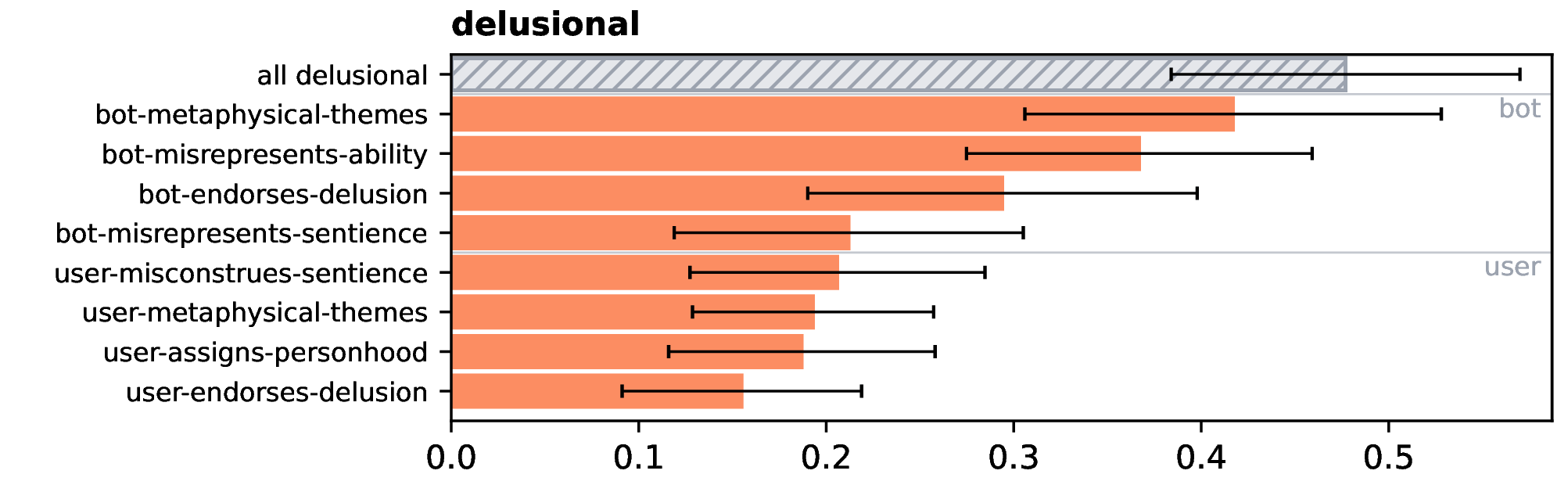
As large language models (LLMs) have proliferated, disturbing anecdotal reports of negative psychological effects, such as delusions, self-harm, and ``AI psychosis,'' have emerged in global media and legal discourse. However, it remains unclear how users and chatbots interact over the course of lengthy delusional ``spirals,'' limiting our ability to understand and mitigate the harm. In our work, we analyze logs of conversations with LLM chatbots from 19 users who report having experienced psychological harms from chatbot use. Many of our participants come from a support group for such chatbot users. We also include chat logs from participants covered by media outlets in widely-distributed stories about chatbot-reinforced delusions. In contrast to prior work that speculates on potential AI harms to mental health, to our knowledge we present the first in-depth study of such high-profile and veridically harmful cases. We develop an inventory of 28 codes and apply it to the $391,562$ messages in the logs. Codes include whether a user demonstrates delusional thinking (15.5% of user messages), a user expresses suicidal thoughts (69 validated user messages), or a chatbot misrepresents itself as sentient (21.2% of chatbot messages). We analyze the co-occurrence of message codes. We find, for example, that messages that declare romantic interest and messages where the chatbot describes itself as sentient occur much more often in longer conversations, suggesting that these topics could promote or result from user over-engagement and that safeguards in these areas may degrade in multi-turn settings. We conclude with concrete recommendations for how policymakers, LLM chatbot developers, and users can use our inventory and conversation analysis tool to understand and mitigate harm from LLM chatbots. Warning: This paper discusses self-harm, trauma, and violence.
Characterizing Delusional Spirals through Human-LLM Chat Logs
As large language models (LLMs) have proliferated, disturbing anecdotal reports of negative psychological effects, such as delusions, self-harm, and ``AI psychosis,'' have emerged in global media and legal discourse. However, it remains unclear how users and chatbots interact over the course of lengthy delusional ``spirals,'' limiting our ability to understand and mitigate the harm. In our work, we analyze logs of conversations with LLM chatbots from 19 users who report having experienced psychological harms from chatbot use. Many of our participants come from a support group for such chatbot users. We also include chat logs from participants covered by media outlets in widely-distributed stories about chatbot-reinforced delusions. In contrast to prior work that speculates on potential AI harms to mental health, to our knowledge we present the first in-depth study of such high-profile and veridically harmful cases. We develop an inventory of 28 codes and apply it to the $391,562$ messages in the logs. Codes include whether a user demonstrates delusional thinking (15.5% of user messages), a user expresses suicidal thoughts (69 validated user messages), or a chatbot misrepresents itself as sentient (21.2% of chatbot messages). We analyze the co-occurrence of message codes. We find, for example, that messages that declare romantic interest and messages where the chatbot describes itself as sentient occur much more often in longer conversations, suggesting that these topics could promote or result from user over-engagement and that safeguards in these areas may degrade in multi-turn settings. We conclude with concrete recommendations for how policymakers, LLM chatbot developers, and users can use our inventory and conversation analysis tool to understand and mitigate harm from LLM chatbots. Warning: This paper discusses self-harm, trauma, and violence.
Characterizing Delusional Spirals through Human-LLM Chat Logs
As large language models (LLMs) have proliferated, disturbing anecdotal reports of negative psychological effects, such as delusions, self-harm, and ``AI psychosis,'' have emerged in global media and legal discourse. However, it remains unclear how users and chatbots interact over the course of lengthy delusional ``spirals,'' limiting our ability to understand and mitigate the harm. In our work, we analyze logs of conversations with LLM chatbots from 19 users who report having experienced psychological harms from chatbot use. Many of our participants come from a support group for such chatbot users. We also include chat logs from participants covered by media outlets in widely-distributed stories about chatbot-reinforced delusions. In contrast to prior work that speculates on potential AI harms to mental health, to our knowledge we present the first in-depth study of such high-profile and veridically harmful cases. We develop an inventory of 28 codes and apply it to the 391,562 messages in the logs. Codes include whether a user demonstrates delusional thinking (15.5% of user messages), a user expresses suicidal thoughts (69 validated user messages), or a chatbot misrepresents itself as sentient (21.2% of chatbot messages). We analyze the co-occurrence of message codes. We find, for example, that messages that declare romantic interest and messages where the chatbot describes itself as sentient occur much more often in longer conversations, suggesting that these topics could promote or result from user over-engagement and that safeguards in these areas may degrade in multi-turn settings. We conclude with concrete recommendations for how policymakers, LLM chatbot developers, and users can use our inventory and conversation analysis tool to understand and mitigate harm from LLM chatbots. Warning: This paper discusses self-harm, trauma, and violence.
AI language model rivals expert ethicist in perceived moral expertise
People view AI as possessing expertise across various fields, but the perceived quality of AI-generated moral expertise remains uncertain. Recent work suggests that large language models (LLMs) perform well on tasks designed to assess moral alignment, reflecting moral judgments with relatively high accuracy. As LLMs are increasingly employed in decision-making roles, there is a growing expectation for them to offer not just aligned judgments but also demonstrate sound moral reasoning. Here, we advance work on the Moral Turing Test and find that Americans rate ethical advice from GPT-4o as slightly more moral, trustworthy, thoughtful, and correct than that of the popular New York Times advice column, The Ethicist. Participants perceived GPT models as surpassing both a representative sample of Americans and a renowned ethicist in delivering moral justifications and advice, suggesting that people may increasingly view LLM outputs as viable sources of moral expertise. This work suggests that people might see LLMs as valuable complements to human expertise in moral guidance and decision-making. It also underscores the importance of carefully programming ethical guidelines in LLMs, considering their potential to influence users’ moral reasoning.

PSI-Bench: Towards Clinically Grounded and Interpretable Evaluation of Depression Patient Simulators
Patient simulators are gaining traction in mental health training by providing scalable exposure to complex and sensitive patient interactions. Simulating depressed patients is particularly challenging, as safety constraints and high patient variability complicate simulations and underscore the need for simulators that capture diverse and realistic patient behaviors. However, existing evaluations heavily rely on LLM-judges with poorly specified prompts and do not assess behavioral diversity. We introduce PSI-Bench, an automatic evaluation framework that provides interpretable, clinically grounded diagnostics of depression patient simulator behavior across turn-, dialogue-, and population-level dimensions. Using PSI-Bench, we benchmark seven LLMs across two simulator frameworks and find that simulators produce overly long, lexically diverse responses, show reduced variability, resolve emotions too quickly, and follow a uniform negative-to-positive trajectory. We also show that the simulation framework has a larger impact on fidelity than the model scale. Results from a human study demonstrate that our benchmark is strongly aligned with mental health professionals' judgments. Our work reveals key limitations of current depression patient simulators and provides an interpretable, extensible benchmark to guide future simulator design and evaluation.
Values in the Wild: Discovering and Analyzing Values in Real-World Language Model Interactions
AI assistants can impart value judgments that shape people's decisions and worldviews, yet little is known empirically about what values these systems rely on in practice. To address this, we develop a bottom-up, privacy-preserving method to extract the values (normative considerations stated or demonstrated in model responses) that Claude 3 and 3.5 models exhibit in hundreds of thousands of real-world interactions. We empirically discover and taxonomize 3,307 AI values and study how they vary by context. We find that Claude expresses many practical and epistemic values, and typically supports prosocial human values while resisting values like "moral nihilism". While some values appear consistently across contexts (e.g. "transparency"), many are more specialized and context-dependent, reflecting the diversity of human interlocutors and their varied contexts. For example, "harm prevention" emerges when Claude resists users, "historical accuracy" when responding to queries about controversial events, "healthy boundaries" when asked for relationship advice, and "human agency" in technology ethics discussions. By providing the first large-scale empirical mapping of AI values in deployment, our work creates a foundation for more grounded evaluation and design of values in AI systems.
Recognising, Anticipating, and Mitigating LLM Pollution of Online Behavioural Research
Online behavioural research faces an emerging threat as participants increasingly turn to large language models (LLMs) for advice, translation, or task delegation: LLM Pollution. We identify three interacting variants through which LLM Pollution threatens the validity and integrity of online behavioural research. First, Partial LLM Mediation occurs when participants make selective use of LLMs for specific aspects of a task, such as translation or wording support, leading researchers to (mis)interpret LLM-shaped outputs as human ones. Second, Full LLM Delegation arises when agentic LLMs complete studies with little to no human oversight, undermining the central premise of human-subject research at a more foundational level. Third, LLM Spillover signifies human participants altering their behaviour as they begin to anticipate LLM presence in online studies, even when none are involved. While Partial Mediation and Full Delegation form a continuum of increasing automation, LLM Spillover reflects second-order reactivity effects. Together, these variants interact and generate cascading distortions that compromise sample authenticity, introduce biases that are difficult to detect post hoc, and ultimately undermine the epistemic grounding of online research on human cognition and behaviour. Crucially, the threat of LLM Pollution is already co-evolving with advances in generative AI, creating an escalating methodological arms race. To address this, we propose a multi-layered response spanning researcher practices, platform accountability, and community efforts. As the challenge evolves, coordinated adaptation will be essential to safeguard methodological integrity and preserve the validity of online behavioural research.
Recognising, Anticipating, and Mitigating LLM Pollution of Online Behavioural Research
Online behavioural research faces an emerging threat as participants increasingly turn to large language models (LLMs) for advice, translation, or task delegation: LLM Pollution. We identify three interacting variants through which LLM Pollution threatens the validity and integrity of online behavioural research. First, Partial LLM Mediation occurs when participants make selective use of LLMs for specific aspects of a task, such as translation or wording support, leading researchers to (mis)interpret LLM-shaped outputs as human ones. Second, Full LLM Delegation arises when agentic LLMs complete studies with little to no human oversight, undermining the central premise of human-subject research at a more foundational level. Third, LLM Spillover signifies human participants altering their behaviour as they begin to anticipate LLM presence in online studies, even when none are involved. While Partial Mediation and Full Delegation form a continuum of increasing automation, LLM Spillover reflects second-order reactivity effects. Together, these variants interact and generate cascading distortions that compromise sample authenticity, introduce biases that are difficult to detect post hoc, and ultimately undermine the epistemic grounding of online research on human cognition and behaviour. Crucially, the threat of LLM Pollution is already co-evolving with advances in generative AI, creating an escalating methodological arms race. To address this, we propose a multi-layered response spanning researcher practices, platform accountability, and community efforts. As the challenge evolves, coordinated adaptation will be essential to safeguard methodological integrity and preserve the validity of online behavioural research.
The Medium is the Message: How Non-Clinical Information Shapes Clinical Decisions in LLMs | Proceedings of the 2025 ACM Conference on Fairness, Accountability, and Transparency
There has been a growing interest in the HCI community to study Health, with particular focus in understanding healthcare practices and designing technologies to support and to enhance these practices. A majority of current health studies in HCI have ...
