Following changes in Twitter's ownership in 2022 and subsequent changes to content moderation policies, many in academia looked to move their discourse elsewhere and migration to Mastodon was pursued by some. Our study examines the behavior of a self-organized group of early academic adopters who joined Mastodon following changes in Twitter’s ownership. Utilizing publicly available user account data drawn from a voluntarily curated list of academics, we track the posting activity of these early adopters on Mastodon over a one-year period. We also study follower-followee and interaction relationships to map internal networks, finding that the subset of academics who migrated to Mastodon were well-connected. However, this strong internal connectivity was insufficient to prevent users from returning to Twitter/X. Our analyses show that early adopters struggled to maintain engagement, shaped by Mastodon’s decentralized design and competition from alternatives such as Bluesky and Threads. The migration effort lost momentum after an initial surge, as most early adopters reduced activity or returned to Twitter. Our survival analysis further reveals that retention is strongly linked to diverse cross-server engagement and topic-specific server communities. Users with large pre-existing Twitter presence face significantly higher attrition risk, highlighting the challenge of replicating established social connections in a decentralized ecosystem. By examining the coordinated migration attempt of early adopters, we find that even this highly motivated group faced substantial challenges, suggesting that later or less coordinated efforts would likely encounter even greater barriers.
The Failed Migration of Academic Twitter: A Case Study of Precocious Adopters
Following changes in Twitter's ownership in 2022 and subsequent changes to content moderation policies, many in academia looked to move their discourse elsewhere and migration to Mastodon was pursued by some. Our study examines the behavior of a self-organized group of early academic adopters who joined Mastodon following changes in Twitter's ownership. Utilizing publicly available user account data drawn from a voluntarily curated list of academics, we track the posting activity of these early adopters on Mastodon over a one-year period. We also study follower-followee and interaction relationships to map internal networks, finding that the subset of academics who migrated to Mastodon were well-connected. However, this strong internal connectivity was insufficient to prevent users from returning to Twitter/X. Our analyses show that early adopters struggled to maintain engagement, shaped by Mastodon's decentralized design and competition from alternatives such as Bluesky and Threads. The migration effort lost momentum after an initial surge, as most early adopters reduced activity or returned to Twitter. Our survival analysis further reveals that retention is strongly linked to diverse cross-server engagement and topic-specific server communities. Users with large pre-existing Twitter presence face significantly higher attrition risk, highlighting the challenge of replicating established social connections in a decentralized ecosystem. By examining the coordinated migration attempt of early adopters, we find that even this highly motivated group faced substantial challenges, suggesting that later or less coordinated efforts would likely encounter even greater barriers.

Simple contagion drives population-scale platform migration
Social media platforms mediate professional communication, political expression, and community formation, making the rare instances when users collectively abandon an incumbent platform particularly consequential. Strong network effects raise switching costs and strengthen incumbents' positions, making coordinated exit difficult. Here we link 276,431 scholars on Twitter/X to their respective new profiles among the universe of all 16.7 million Bluesky accounts, tracked from January 2023 to December 2024, using a scalable, high-precision cross-platform matching pipeline. Exploiting exogenous variation from Brazil's court-ordered suspension of Twitter/X and a dynamic matching design, we show that adoption is peer-driven, treatment effects are short-lived and dose-dependent, and contagion is simple, not complex. Three patterns characterize adoption and retention. Adoption concentrates among users deeply embedded in Twitter's social graph. Public political expression predicts migration, consistent with homophilous inflows into a largely left-of-center Bluesky information space. Early reconnection with prior contacts predicts longer tenure and engagement. Our findings provide the first population-scale causal evidence of peer influence in a social media platform migration by exploiting exogenous exposure variation in a natural experiment and using daily dynamic matching. Rather than the complex contagion mechanism often emphasized in the literature, contagion is predominantly simple. Our findings recast migration as a multi-homing strategy that insures against governance uncertainty and show that users who quickly reconnect with prior contacts remain active longer on Bluesky.
The Failed Migration of Academic Twitter: A Case Study of...
Following changes in Twitter's ownership in 2022 and subsequent changes to content moderation policies, many in academia looked to move their discourse elsewhere and migration to Mastodon was...
Get Out of the Nest! Drivers of social influence in the Twitter migration to Mastodon
Elon Musk's purchase of Twitter on October 2022 triggered a mass exodus to Mastodon, the largest decentralized online social network. This is a unique example of collective behavioral change that is documented through large-scale digital traces, and can teach us a lot about how people coordinate.

Simple contagion drives population-scale platform migration
Social media platforms mediate professional communication, political expression, and community formation, making the rare instances when users collectively abandon an incumbent platform...
Shifts in U.S. Social Media Use, 2020–2024: Decline, Fragmentation, and Enduring Polarization
The social media ecosystem appears to be in flux. Twitter’s rebranding to X has come to symbolize a broader reorganization of online publics – political reshuffling, user attrition, and uncertainty over the role of legacy platforms. Simultaneously, the shift from text-based, networked feeds toward algorithmically curated, short-form video has accelerated, with TikTok setting the pace for the wider ecosystem [18, 14, 16]. At the same time, everyday communication increasingly migrates from large, open networks to semi-private spaces such as group chats and messaging apps. Commentators describe a digital public sphere in transition: smaller, more fragmented, less dominated by traditional social networking sites, and rise of more broadcast-oriented forms of media – with some even suggesting that we are seeing the beginning of the end of the social media era.
How The Enshittification Of Social Media Is Decreasing The Switching Costs And Enabling Something New
In the last few weeks I’ve written about how Elon Musk’s “changes” to how Twitter is running have done an amazing job convincing people to join Mastodon. And I’ve also…

Shifts in U.S. Social Media Use, 2020–2024: Decline, Fragmentation, and Enduring Polarization
Using nationally representative data from the 2020 and 2024 American National Election Studies (ANES), this paper describes how U.S. social media use has shifted across platforms, demographics, and politics. Overall platform reach declined, driven by growth in the share of Americans — especially the youngest and oldest cohorts — who report using no social media. Visiting and posting activity on Twitter/X and Facebook have fallen by nearly 50% since 2020, with the decline on Twitter/X driven primarily by reduced participation among Democratic users. While Facebook, YouTube, and Twitter/X lost ground, TikTok and Reddit grew modestly, consistent with a more fragmented digital public sphere. Platform audiences aged and became slightly more educated and racially diverse. Politically, most platforms shifted toward Republican users while remaining, on balance, Democratic-leaning. Twitter/X experienced the largest change: among posters, the partisan balance swung over 70 percentage points from Democrats to Republicans. Across platforms, political posting remains closely tied to affective polarization, as the most partisan respondents are also the most active. As casual users disengage while polarized partisans remain vocal, online discourse becomes narrower and more ideologically extreme.
Mastodon Exit Interview
I am currently winding down the Mastodon bots I used to post sunrise and sunset times. The precipitating event is that the admin of the instance hosting the associated accounts demanded they be made nigh-undiscoverable, but the underlying cause is that it’s become increasing clear that Mastodon isn’t, and won’t ever be, a good platform for “asynchronous ephemeral notifications of any kind”. I’d also argue (more controversially) that it’s simply not good infrastructure for social networking of any kind. There are lots of interesting people using Mastodon, and I’m sure it will live on as a good-enough space for certain niche groups. But there is no question that it will never offer the fun of early Twitter, let alone the vibrancy of Twitter during its growth phase. I’ve long since dropped Mastodon from my home screen, and have switched to Bluesky for text-centric social media.
The Great Social Media Diaspora
What happens when sprawling online communities fracture into politically homogenous, self-governing communities?

Social media promotion improves job market outcomes
Social media has transformed how academics disseminate research, but its effect on academic job outcomes remains unclear. Previous research has shown correlations between social media exposure and metrics like citation counts, but these relationships may be confounded by unobserved factors such as researcher quality or access to professional networks. We examine whether social media promotion causally affects job market outcomes in economics through a field experiment on Twitter (now X). We first collect tweets about job market papers from 519 candidates and post them from a dedicated account. We then randomize half of the posts to be quote-tweeted by established economists in the candidates’ fields, and measure the effects on both online visibility and hiring outcomes. We find that posts in the treatment group receive 441% more views and 303% more likes than those in the control group. Candidates whose posts were assigned to be quote-tweeted receive one additional flyout invitation compared to the control group average of 5.4 flyouts. Furthermore, women in the treatment group receive 0.9 more job offers than women in the control group, who receive 3 offers on average. Exploring mechanisms, we find that academic reputation drives these results, with stronger effects for quote-tweets from highly cited scholars and for candidates from top institutions. Our findings suggest social media promotion causally increases research visibility and improves academic job market outcomes.

Scientists no Longer Find Twitter Professionally Useful, and have Switched to Bluesky
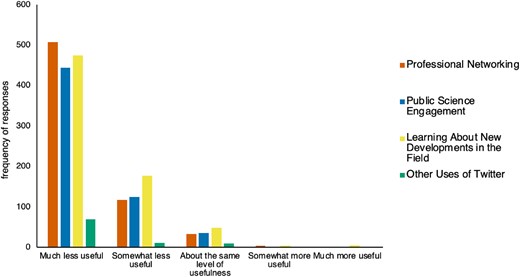
Synopsis Social media has become widely used by the scientific community for a variety of professional uses, including networking and public outreach. For the past decade, Twitter has been a primary home of scientists on social media. In recent years, new leadership at Twitter has made substantive changes that have resulted in increases in the prevalence of pseudoscience, conspiracy theory, and harassment on the platform, causing many scientists to seek alternatives. Bluesky has been suggested as a good alternative to Twitter, but the phenomenon of academics switching social media platforms has not previously been studied. Here we report on the results of a survey distributed to scientists on Twitter and Bluesky (n = 813). Results overwhelmingly confirm that changes to Twitter have made the social media platform no longer professionally useful or pleasant, and that many scientists have abandoned it in favor of Bluesky. Results show that for every reported professional benefit that scientists once gained from Twitter, scientists can now gain that benefit more effectively on Bluesky than on Twitter.
Fleeing Elon Musk’s X, the quest to re-create ‘Black Twitter’
The influential online community that gave rise to social movements like #BlackLivesMatter is now a "digital diaspora” in search of a new home.

Kara Swisher on Tech Founders' Flaws & Why Social Apps Are the New Cigarettes
RIP social media. What comes next is messy.
As social media splinters, how can we keep the new online spaces from devolving into toxic pits of despair?