


In the late 1990s, in an effort to dispute the link between secondhand smoke and lung cancer, Philip Morris initiated a campaign to legislate “sound science.” The campaign involved enacting data access and data quality laws to obtain previously confidential research data in order to reanalyze it based on industry-generated data quality standards. Philip Morris worked with other corporate interests to form coalitions and workgroups, develop a “data integrity” outreach program, sponsor symposia on “research integrity,” and draft language for the new acts. The tobacco industry played a role in establishing laws that increase corporate influence on public health and regulatory policy decisions.
Legislating “Sound Science”: The Role of the Tobacco Industry
In the late 1990s, in an effort to dispute the link between secondhand smoke and lung cancer, Philip Morris initiated a campaign to legislate “sound science.” The campaign involved enacting data access and data quality laws to obtain previously confidential research data in order to reanalyze it based on industry-generated data quality standards. Philip Morris worked with other corporate interests to form coalitions and workgroups, develop a “data integrity” outreach program, sponsor symposia on “research integrity,” and draft language for the new acts. The tobacco industry played a role in establishing laws that increase corporate influence on public health and regulatory policy decisions.
Tobacco funded research: how even journals with bans find it hard to stem the tide of publications
The Risks of Industry Influence in Tech Research
Emerging information technologies like social media, search engines, and AI can have a broad impact on public health, political institutions, social dynamics, and the natural world. It is critical to develop a scientific understanding of these impacts to inform evidence-based technology policy that minimizes harm and maximizes benefits. Unlike most other global-scale scientific challenges, however, the data necessary for scientific progress are generated and controlled by the same industry that might be subject to evidence-based regulation. Moreover, technology companies historically have been, and continue to be, a major source of funding for this field. These asymmetries in information and funding raise significant concerns about the potential for undue industry influence on the scientific record. In this Perspective, we explore how technology companies can influence our scientific understanding of their products. We argue that science faces unique challenges in the context of technology research that will require strengthening existing safeguards and constructing wholly new ones.

Research ethics: 3 ways to blow the whistle
Reporting suspicions of scientific fraud is rarely easy, but some paths are more effective than others.

Data Scientist: The Sexiest Job of the 21st Century
Back in the 1990s, computer engineer and Wall Street “quant” were the hot occupations in business. Today data scientists are the hires firms are competing to make. As companies wrestle with unprecedented volumes and types of information, demand for these experts has raced well ahead of supply. Indeed, Greylock Partners, the VC firm that backed Facebook and LinkedIn, is so worried about the shortage of data scientists that it has a recruiting team dedicated to channeling them to the businesses in its portfolio. Data scientists are the key to realizing the opportunities presented by big data. They bring structure to it, find compelling patterns in it, and advise executives on the implications for products, processes, and decisions. They find the story buried in the data and communicate it. And they don’t just deliver reports: They get at the questions at the heart of problems and devise creative approaches to them. One data scientist who was studying a fraud problem, for example, realized it was analogous to a type of DNA sequencing problem. Bringing those disparate worlds together, he crafted a solution that dramatically reduced fraud losses. In this article, Harvard Business School’s Davenport and Greylock’s Patil take a deep dive on what organizations need to know about data scientists: where to look for them, how to attract and develop them, and how to spot a great one.

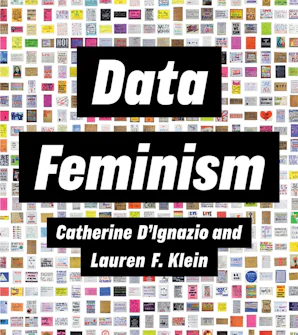
Data Feminism
Today, data science is a form of power. It has been used to expose injustice, improve health outcomes, and topple governments. But it has also been used to d...
Governing by dismantling: tech oligarchy and the stifling of public data infrastructure
Published in Science as Culture (Ahead of Print, 2026)

A Data Utopia for Science-of-Science
Here I want to briefly sketch out a vision for how to solve a key set of problems facing science-of-science researchers, using the relatively new idea of a ‘data trust.’ In my ideal wor…

Andrew Porter (@retropz.bsky.social)
Research Integrity and Training Adviser at the Cancer Research UK Manchester Institute Interested in improving #ResearchIntegrity & #ResearchCulture with training, #TeamScience & promoting #OpenResearch https://orcid.org/0000-0002-3353-7002

So maybe now we can agree that having an unchecked research integrity militia who unfortunately has the ear of the press and increasingly that of the the publishers, but who fiercely rejects any… | Ioana A. Cristea
So maybe now we can agree that having an unchecked research integrity militia who unfortunately has the ear of the press and increasingly that of the the publishers, but who fiercely rejects any minimal ethics or code of conduct, is a (growing) problem? Also, that 1. problems have to be investigated before deciding they are are legitimate and serious; 2. this investigation is not social media, blogs and the press; 3. this investigation should not be on the front page of journals and Retraction Watch; 4. there are degrees of seriousness and some things can just be corrected or are simply not very consequential (no, it's not a house of bricks where we have to check every brick, that's a dumb analogy), so being absolutely hysterical and overdramatic about any lie, inaccuracy or mistake is purposeful at worse and should be ignored at best and 5. it is not only unnecessary, but harmful, to also go into other, non-academic things the person did or does to complete "investigations" that you (press, sleuth, blogger, etc) do not have the tools and information to do completely and accurately (this fixation would be called harassment in the before times). Others will justly write about what the institutions did or did not do, but what I want to say is that we really should end it with the blank credit we give to any and all allegations that come from the establish research integrity truth fighters.

Can “Conscious Data Contribution” Help Users to Exert “Data Leverage” Against Technology Companies?
Tech users currently have limited ability to act on concerns regarding the negative societal impacts of large tech companies. However, recent work suggests that users can exert leverage using their role in the generation of valuable data, for instance by withholding their data contributions to intelligent technologies. We propose and evaluate a new means to exert this type of leverage against tech companies: "conscious data contribution" (CDC).
A Duty of Loyalty for Privacy Law
Data privacy law fails to stop companies from engaging in self-serving, opportunistic behavior at the expense of those who trust them with their data. This is a

Perspective Chapter: Fit for Purpose? Creative Commons Licensing for Research Data in the Age of Artificial Intelligence
Licensing is an important component of the re-usability of research data, itself part of the FAIR principles: without clear, machine-readable licensing, datasets risk becoming technically...

dc: data provenance and source attribution

Part of the datacounterfactuals.org reading lists. Research on data provenance, dataset documentation, licensing and attribution audits, and technical source-attribution methods for understanding which data sources are available, permitted, or responsible for model behavior.
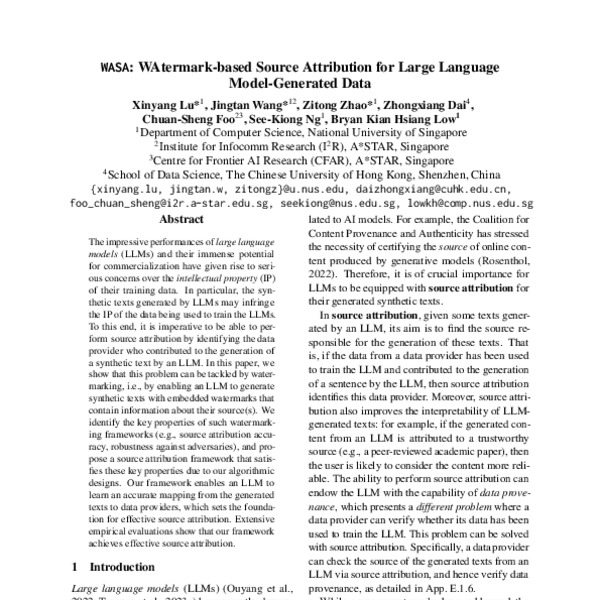
WASA: WAtermark-based Source Attribution for Large Language Model-Generated Data
SILO Language Models: Isolating Legal Risk In a Nonparametric Datastore
Datasheets for Datasets
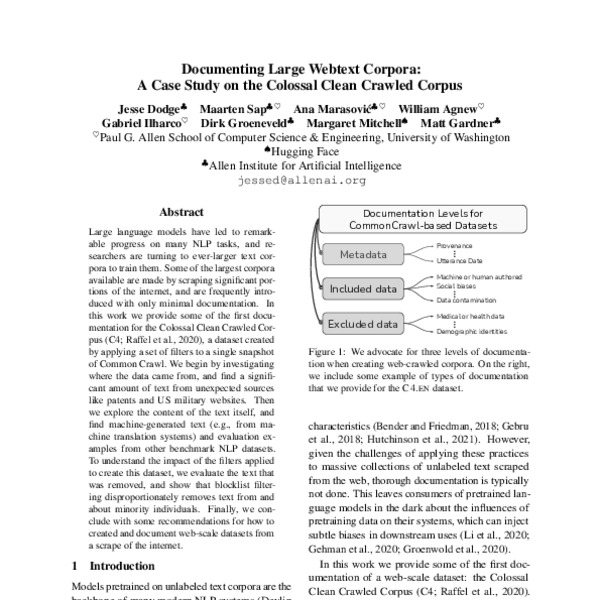
Documenting Large Webtext Corpora: A Case Study on the Colossal Clean Crawled Corpus

A large-scale audit of dataset licensing and attribution in AI

