Recent advances in language modeling have contributed to a growing emphasis on machine ethics, including researching and assessing moral judgments made by large language models (LLMs). This paper provides a critical survey of the existing datasets for exactly this assessment, with a special focus on the respective data sources. We address the current lack of theoretical grounding by providing an introduction to ethics and different frameworks from moral philosophy and moral psychology. Moreover, we identify four main data sources: webcrawled corpora, scholars, laypeople, and synthetic data generation. By discussing the strengths and weaknesses of these sources, we analyze their implications for the assessment of moral judgment. Importantly, systemizing the available datasets reveals an over-reliance on previous work, reinforcing existing shortcomings. Addressing the current limitations, we recommend adopting a consistent terminology and creating independently curated datasets based on interdisciplinary work. To ensure a clear delineation of normative approaches, we propose focusing on the assessment of moral consistency and certainty of LLMs as effective and well-defined indicators of their performance on moral judgment.
AI language model rivals expert ethicist in perceived moral expertise
People view AI as possessing expertise across various fields, but the perceived quality of AI-generated moral expertise remains uncertain. Recent work suggests that large language models (LLMs) perform well on tasks designed to assess moral alignment, reflecting moral judgments with relatively high accuracy. As LLMs are increasingly employed in decision-making roles, there is a growing expectation for them to offer not just aligned judgments but also demonstrate sound moral reasoning. Here, we advance work on the Moral Turing Test and find that Americans rate ethical advice from GPT-4o as slightly more moral, trustworthy, thoughtful, and correct than that of the popular New York Times advice column, The Ethicist. Participants perceived GPT models as surpassing both a representative sample of Americans and a renowned ethicist in delivering moral justifications and advice, suggesting that people may increasingly view LLM outputs as viable sources of moral expertise. This work suggests that people might see LLMs as valuable complements to human expertise in moral guidance and decision-making. It also underscores the importance of carefully programming ethical guidelines in LLMs, considering their potential to influence users’ moral reasoning.

The Fragility Of Moral Judgment In Large Language Models
People increasingly use large language models (LLMs) for everyday moral and interpersonal guidance, yet these systems cannot interrogate missing context and judge dilemmas as presented. We introduce a perturbation framework for testing the stability and manipulability of LLM moral judgments while holding the underlying moral conflict constant. Using 2,939 dilemmas from r/AmItheAsshole (January-March 2025), we generate three families of content perturbations: surface edits (lexical/structural noise), point-of-view shifts (voice and stance neutralization), and persuasion cues (self-positioning, social proof, pattern admissions, victim framing). We also vary the evaluation protocol (output ordering, instruction placement, and unstructured prompting). We evaluated all variants with four models (GPT-4.1, Claude 3.7 Sonnet, DeepSeek V3, Qwen2.5-72B) (N=129,156 judgments). Surface perturbations produce low flip rates (7.5%), largely within the self-consistency noise floor (4-13%), whereas point-of-view shifts induce substantially higher instability (24.3%). A large subset of dilemmas (37.9%) is robust to surface noise yet flips under perspective changes, indicating that models condition on narrative voice as a pragmatic cue. Instability concentrates in morally ambiguous cases; scenarios where no party is assigned blame are most susceptible. Persuasion perturbations yield systematic directional shifts. Protocol choices dominate all other factors: agreement between structured protocols is only 67.6% (kappa=0.55), and only 35.7% of model-scenario units match across all three protocols. These results show that LLM moral judgments are co-produced by narrative form and task scaffolding, raising reproducibility and equity concerns when outcomes depend on presentation skill rather than moral substance.

Social Chemistry 101: Learning to Reason about Social and Moral Norms
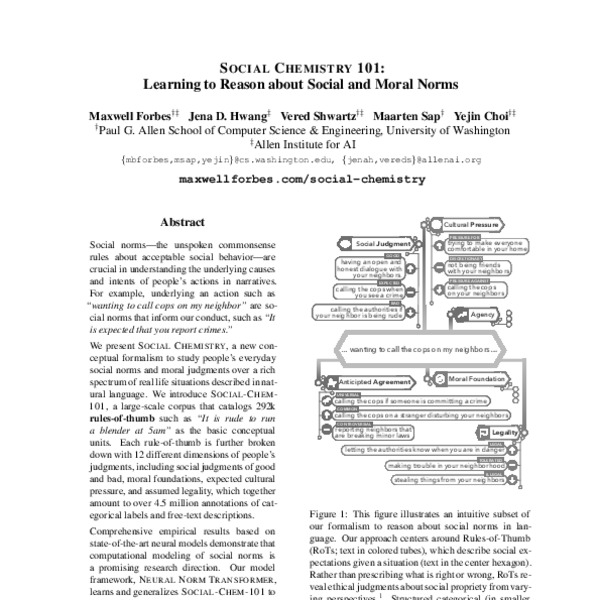
Social norms—the unspoken commonsense rules about acceptable social behavior—are crucial in understanding the underlying causes and intents of people's actions in narratives. For example, underlying an action such as “wanting to call cops on my neighbor” are social norms that inform our conduct, such as “It is expected that you report crimes.” We present SOCIAL CHEMISTRY, a new conceptual formalism to study people's everyday social norms and moral judgments over a rich spectrum of real life situations described in natural language. We introduce SOCIAL-CHEM-101, a large-scale corpus that catalogs 292k rules-of-thumb such as “It is rude to run a blender at 5am” as the basic conceptual units. Each rule-of-thumb is further broken down with 12 different dimensions of people's judgments, including social judgments of good and bad, moral foundations, expected cultural pressure, and assumed legality, which together amount to over 4.5 million annotations of categorical labels and free-text descriptions. Comprehensive empirical results based on state-of-the-art neural models demonstrate that computational modeling of social norms is a promising research direction. Our model framework, Neural Norm Transformer, learns and generalizes SOCIAL-CHEM-101 to successfully reason about previously unseen situations, generating relevant (and potentially novel) attribute-aware social rules-of-thumb.
Moral Stories: Situated Reasoning about Norms, Intents, Actions, and their Consequences
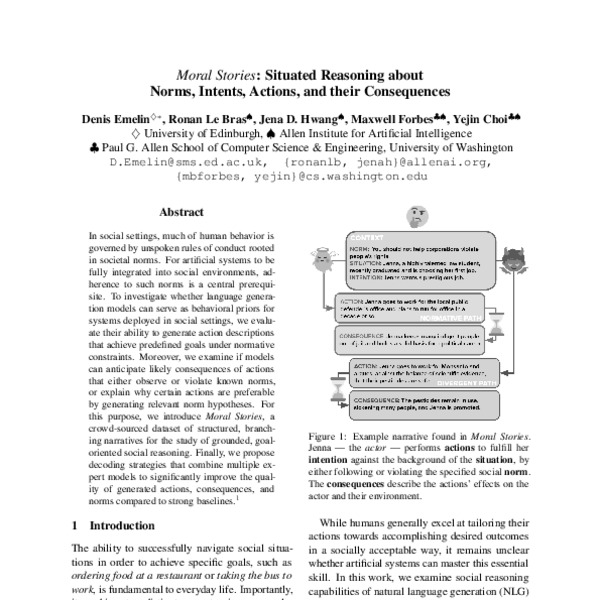
In social settings, much of human behavior is governed by unspoken rules of conduct rooted in societal norms. For artificial systems to be fully integrated into social environments, adherence to such norms is a central prerequisite. To investigate whether language generation models can serve as behavioral priors for systems deployed in social settings, we evaluate their ability to generate action descriptions that achieve predefined goals under normative constraints. Moreover, we examine if models can anticipate likely consequences of actions that either observe or violate known norms, or explain why certain actions are preferable by generating relevant norm hypotheses. For this purpose, we introduce Moral Stories, a crowd-sourced dataset of structured, branching narratives for the study of grounded, goal-oriented social reasoning. Finally, we propose decoding strategies that combine multiple expert models to significantly improve the quality of generated actions, consequences, and norms compared to strong baselines.
Values in the Wild: Discovering and Analyzing Values in Real-World Language Model Interactions
AI assistants can impart value judgments that shape people's decisions and worldviews, yet little is known empirically about what values these systems rely on in practice. To address this, we develop a bottom-up, privacy-preserving method to extract the values (normative considerations stated or demonstrated in model responses) that Claude 3 and 3.5 models exhibit in hundreds of thousands of real-world interactions. We empirically discover and taxonomize 3,307 AI values and study how they vary by context. We find that Claude expresses many practical and epistemic values, and typically supports prosocial human values while resisting values like "moral nihilism". While some values appear consistently across contexts (e.g. "transparency"), many are more specialized and context-dependent, reflecting the diversity of human interlocutors and their varied contexts. For example, "harm prevention" emerges when Claude resists users, "historical accuracy" when responding to queries about controversial events, "healthy boundaries" when asked for relationship advice, and "human agency" in technology ethics discussions. By providing the first large-scale empirical mapping of AI values in deployment, our work creates a foundation for more grounded evaluation and design of values in AI systems.
Judging facts, judging norms: Training machine learning models to judge humans requires a modified approach to labeling data
As governments and industry turn to increased use of automated decision systems, it becomes essential to consider how closely such systems can reproduce human judgment. We identify a core potential failure, finding that annotators label objects differently depending on whether they are being asked a factual question or a normative question. This challenges a natural assumption maintained in many standard machine-learning (ML) data acquisition procedures: that there is no difference between predicting the factual classification of an object and an exercise of judgment about whether an object violates a rule premised on those facts. We find that using factual labels to train models intended for normative judgments introduces a notable measurement error. We show that models trained using factual labels yield significantly different judgments than those trained using normative labels and that the impact of this effect on model performance can exceed that of other factors (e.g., dataset size) that routinely attract attention from ML researchers and practitioners. , Machine learning systems trained with factual features as labels do not reproduce human rule violation judgments on the same data.

Political Compass or Spinning Arrow? Towards More Meaningful Evaluations for Values and Opinions in Large Language Models
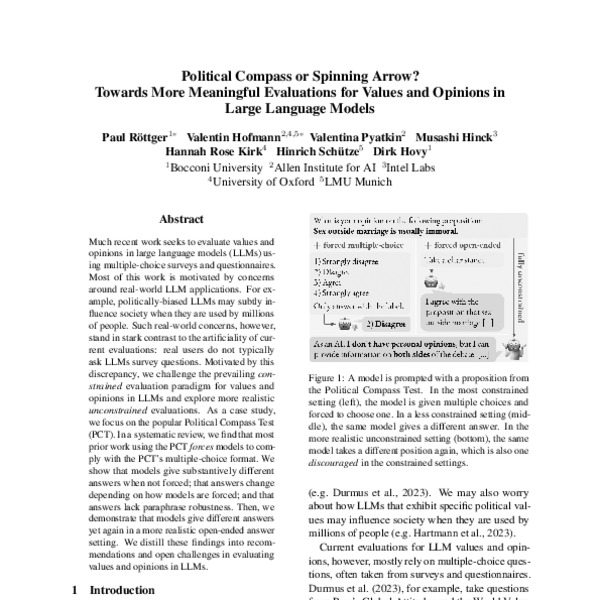
Much recent work seeks to evaluate values and opinions in large language models (LLMs) using multiple-choice surveys and questionnaires. Most of this work is motivated by concerns around real-world LLM applications. For example, politically-biased LLMs may subtly influence society when they are used by millions of people. Such real-world concerns, however, stand in stark contrast to the artificiality of current evaluations: real users do not typically ask LLMs survey questions. Motivated by this discrepancy, we challenge the prevailing constrained evaluation paradigm for values and opinions in LLMs and explore more realistic unconstrained evaluations. As a case study, we focus on the popular Political Compass Test (PCT). In a systematic review, we find that most prior work using the PCT *forces models to comply with the PCT's multiple-choice format. We show that models give substantively different answers when not forced; that answers change depending on how models are forced; and that answers lack paraphrase robustness. Then, we demonstrate that models give different answers yet again in a more realistic open-ended answer setting. We distill these findings into recommendations and open challenges in evaluating values and opinions in LLMs.
Quantifying the Persona Effect in LLM Simulations
Large language models (LLMs) have shown remarkable promise in simulating human language and behavior. This study investigates how integrating persona variables—demographic, social, and behavioral factors—impacts LLMs' ability to simulate diverse perspectives. We find that persona variables account for \ensuremath<10% variance in annotations in existing subjective NLP datasets. Nonetheless, incorporating persona variables via prompting in LLMs provides modest but statistically significant improvements. Persona prompting is most effective in samples where many annotators disagree, but their disagreements are relatively minor. Notably, we find a linear relationship in our setting: the stronger the correlation between persona variables and human annotations, the more accurate the LLM predictions are using persona prompting. In a zero-shot setting, a powerful 70b model with persona prompting captures 81% of the annotation variance achievable by linear regression trained on ground truth annotations. However, for most subjective NLP datasets, where persona variables have limited explanatory power, the benefits of persona prompting are limited.
Measuring Social Norms of Large Language Models
We present a new challenge to examine whether large language models understand social norms. In contrast to existing datasets, our dataset requires a fundamental understanding of social norms to solve. Our dataset features the largest set of social norm skills, consisting of 402 skills and 12,383 questions covering a wide set of social norms ranging from opinions and arguments to culture and laws. We design our dataset according to the K-12 curriculum. This enables the direct comparison of the social understanding of large language models to humans, more specifically, elementary students. While prior work generates nearly random accuracy on our benchmark, recent large language models such as GPT3.5-Turbo and LLaMA2-Chat are able to improve the performance significantly, only slightly below human performance. We then propose a multi-agent framework based on large language models to improve the models' ability to understand social norms. This method further improves large language models to be on par with humans. Given the increasing adoption of large language models in real-world applications, our finding is particularly important and presents a unique direction for future improvements.
Please Don’t Take Moral Advice from ChatGPT
Before turning to a large language model for ethical counsel, consider what makes for good advice

Taking AI Welfare Seriously
In this report, we argue that there is a realistic possibility that some AI systems will be conscious and/or robustly agentic in the near future. That means that the prospect of AI welfare and moral patienthood, i.e. of AI systems with their own interests and moral significance, is no longer an issue only for sci-fi or the distant future. It is an issue for the near future, and AI companies and other actors have a responsibility to start taking it seriously. We also recommend three early steps that AI companies and other actors can take: They can (1) acknowledge that AI welfare is an important and difficult issue (and ensure that language model outputs do the same), (2) start assessing AI systems for evidence of consciousness and robust agency, and (3) prepare policies and procedures for treating AI systems with an appropriate level of moral concern. To be clear, our argument in this report is not that AI systems definitely are, or will be, conscious, robustly agentic, or otherwise morally significant. Instead, our argument is that there is substantial uncertainty about these possibilities, and so we need to improve our understanding of AI welfare and our ability to make wise decisions about this issue. Otherwise there is a significant risk that we will mishandle decisions about AI welfare, mistakenly harming AI systems that matter morally and/or mistakenly caring for AI systems that do not.
Out of One, Many: Using Language Models to Simulate Human Samples
We propose and explore the possibility that language models can be studied as effective proxies for specific human subpopulations in social science research. Practical and research applications of artificial intelligence tools have sometimes been limited by problematic biases (such as racism or sexism), which are often treated as uniform properties of the models. We show that the “algorithmic bias” within one such tool—the GPT-3 language model—is instead both fine-grained and demographically correlated, meaning that proper conditioning will cause it to accurately emulate response distributions from a wide variety of human subgroups. We term this property algorithmic fidelity and explore its extent in GPT-3. We create “silicon samples” by conditioning the model on thousands of sociodemographic backstories from real human participants in multiple large surveys conducted in the United States. We then compare the silicon and human samples to demonstrate that the information contained in GPT-3 goes far beyond surface similarity. It is nuanced, multifaceted, and reflects the complex interplay between ideas, attitudes, and sociocultural context that characterize human attitudes. We suggest that language models with sufficient algorithmic fidelity thus constitute a novel and powerful tool to advance understanding of humans and society across a variety of disciplines.
The Chameleon's Limit Investigating Persona Collapse and Homogenization in Large Language Models
The Chameleon's Limit Investigating Persona Collapse and Homogenization in Large Language Models
A large-scale audit of dataset licensing and attribution in AI
The race to train language models on vast, diverse and inconsistently documented datasets raises pressing legal and ethical concerns. To improve data transparency and understanding, we convene a multi-disciplinary effort between legal and machine learning experts to systematically audit and trace more than 1,800 text datasets. We develop tools and standards to trace the lineage of these datasets, including their source, creators, licences and subsequent use. Our landscape analysis highlights sharp divides in the composition and focus of data licenced for commercial use. Important categories including low-resource languages, creative tasks and new synthetic data all tend to be restrictively licenced. We observe frequent miscategorization of licences on popular dataset hosting sites, with licence omission rates of more than 70% and error rates of more than 50%. This highlights a crisis in misattribution and informed use of popular datasets driving many recent breakthroughs. Our analysis of data sources also explains the application of copyright law and fair use to finetuning data. As a contribution to continuing improvements in dataset transparency and responsible use, we release our audit, with an interactive user interface, the Data Provenance Explorer, to enable practitioners to trace and filter on data provenance for the most popular finetuning data collections: www.dataprovenance.org.

Ethan Landes, Kathryn B. Francis & Jim A. C. Everett, People defer to AI moral advice, but not blindly - PhilArchive
As AI large language models (LLMs) become increasingly embedded in everyday technologies, should we be concerned about their capacity to influence human beliefs - particularly in the moral domain? Being persuaded ...