

Western “modern primitivists” and spirit mediums at the Vegetarian Festival in southern Thailand are the leading practitioners of body piercing in the contemporary world. This comparative study finds that they share a similar marginal social background and aspirations for individual distinction through body piercing, but differ radically in the cultural context, specific practices, and kinds of objects used for piercing. “Modern primitivists” are pierced by relatively small piercing objects, which combine with tattoos as part of their everyday attire. Entranced spirit mediums, believed to be possessed by Chinese deities, tend to be pierced by spectacular piercing objects, but only during the Chinese shrines' street processions in course of the annual Vegetarian Festival. In contrast to the “modern primitivists,” who are shunned by mainstream society, the spirit mediums are worshipped as deities by devotees, and constitute a major, but ambiguous attraction for foreign tourists: while piercings are “real,” and hence “authentic,” the sight of gruesome self-mutilation by some pierced mediums may offend the tourists' sensibilities. The article concludes with the observation that some “authentic” sights might be too hard for some tourists to bear and will hence repel rather than attract them. “Bearability” is thus a factor mitigating the attractiveness of such sights.
Pain and Sacrifice: Experience and Modulation of Pain in a Religious Piercing Ritual
Fascinating pain-related rituals have been observed throughout the world, but so far no systematic evidence exists to support previous ethnographic reports of analgesic states and dissociative sym...

Effects of Extreme Ritual Practices on Psychophysiological Well-Being
Extreme ritual practices involving pain and suffering pose significant risks such as injury, trauma, or infection. Nonetheless, they are performed by millions of people around the world and are often culturally prescribed remedies for a variety of maladies, and especially those related to mental health. What is the actual impact of these practices on health? Combining ethnographic observations and psychophysiological monitoring, we investigated outcomes of participation in one of the world’s most extreme rituals, involving bodily mutilation and prolonged suffering. Performance of this physically demanding ordeal had no detrimental effects on physiological health and was associated with subjective health improvements, and these improvements were greater for those who engaged in more intense forms of participation. Moreover, individuals who experienced health problems and/or were of low socioeconomic status sought more painful levels of engagement. We suggest two potential mechanisms for these effects: a bottom-up process triggered by neurological responses to pain and a top-down process related to increased social support and self-enhancement. These mechanisms may buffer stress-induced pressures and positively affect quality of life. Our results stress the importance of traditional cultural practices for coping with adversity, especially in contexts where psychiatric or other medical interventions are not widely available.

USA Solo Travelers | Ta prohm temple 🇰🇭 | Facebook
Ta prohm temple 🇰🇭 #Cambodia #angkorwat USA Solo Travelers discuss the breathtaking Ta Prohm temple in Cambodia, sharing their experiences and thoughts on the ancient details and jungle atmosphere

A New Pilgrimage: John Vervaeke on Finding Practices that Build Meaning | Over the Mountains #15
Methodology in Research on the Rainbow Body: Anthropological and Psychological Reflections on Death and Dying
The rainbow body research project, engaging claims of spiritual attainment and personal transformation, enables us to examine key features of anthropological research. Engagement with communities of discourse exposed aspects of the artificial emic–etic divide, allowing the anthropological study of religion to advance methods in religious studies. The study of paranormal phenomena cannot be isolated from societal contextualization. In this instance, a study of death and dying, contextualized in a traditional community, required unique features of engagement for the researcher who would be present to the social dynamics surrounding the death of a person of high repute.
Extraordinary Passion: The Tantric Ritual: Full-Body Massages
Sex, science, and Tantra - how to have incredible orgasms and amazing sex, and a completely non-spiritual look at why Tantra has such amazing effects.
Pratyabhijñā Nondual Śaiva Philosophy, Peirce and Semiotics | Dr. David Peter Lawrence
Conscious and Nonconscious Components of Superstitious Beliefs in Judgment and Decision Making
Abstract. Despite the large impact that superstitious beliefs have on the marketplace, we currently know very little about their implications for consumer
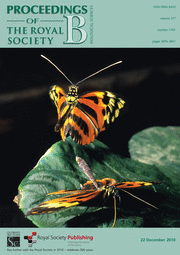
The evolution of cultural adaptations: Fijian food taboos protect against dangerous marine toxins
The application of evolutionary theory to understanding the origins of our species' capacities for social learning has generated key insights into cultural evolution. By focusing on how our psychology has evolved to adaptively extract beliefs and practices by observing others, theorists have hypothesized how social learning can, over generations, give rise to culturally evolved adaptations. While much field research documents the subtle ways in which culturally transmitted beliefs and practices adapt people to their local environments, and much experimental work reveals the predicted patterns of social learning, little research connects real-world adaptive cultural traits to the patterns of transmission predicted by these theories. Addressing this gap, we show how food taboos for pregnant and lactating women in Fiji selectively target the most toxic marine species, effectively reducing a woman's chances of fish poisoning by 30 per cent during pregnancy and 60 per cent during breastfeeding. We further analyse how these taboos are transmitted, showing support for cultural evolutionary models that combine familial transmission with selective learning from locally prestigious individuals. In addition, we explore how particular aspects of human cognitive processes increase the frequency of some non-adaptive taboos. This case demonstrates how evolutionary theory can be deployed to explain both adaptive and non-adaptive behavioural patterns.
Extraordinary Passion: The Tantric Ritual: Setup and Meditation
Sex, science, and Tantra - how to have incredible orgasms and amazing sex, and a completely non-spiritual look at why Tantra has such amazing effects.
From cultures to aesthetics between Asian and Western UX design
Since I moved to Europe from Asia and used to work for European company from Asia. I feel like I have to discuss the topic of design aesthetics, cultural influences and user behaviours.

Extraordinary Passion: The Tantric Ritual: Yab-Yum and Maithuna (Sexual Congress)
Sex, science, and Tantra - how to have incredible orgasms and amazing sex, and a completely non-spiritual look at why Tantra has such amazing effects.
Our Plastic-Surgery Nightmare
As cosmetic procedures become both more invisible and more extreme, our connection to reality is fraying.

Kao Beauty Brands
Celebration of Individuality. To shine a light on you and your life.
Sᴜɴʀɪsᴇ Oᴀᴛʜ 十 Tʜᴇ Sʏʟʟᴀʙᴜꜱ (ORI) - CC0 on Twitter / X
Western culture is right for valuing spiritualities, since spiritualities orient all temporalities and reveal their ultimate purpose in God.— Sᴜɴʀɪsᴇ Oᴀᴛʜ 十 Tʜᴇ Sʏʟʟᴀʙᴜꜱ (ORI) - CC0 (@sunriseoath) October 12, 2026
Extraordinary Passion: Giving a Lingam Massage
Sex, science, and Tantra - how to have incredible orgasms and amazing sex, and a completely non-spiritual look at why Tantra has such amazing effects.