

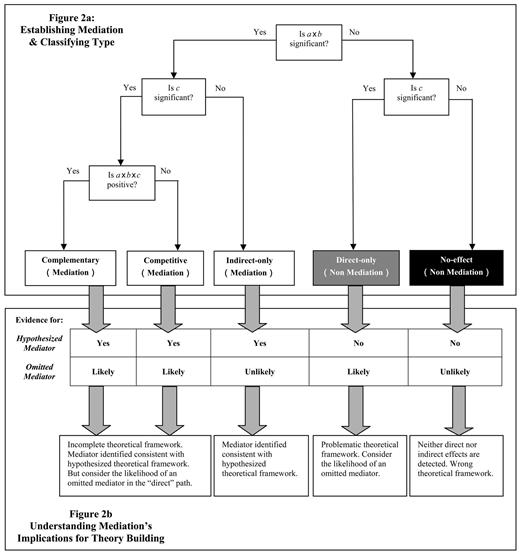
Hypotheses involving mediation are common in the behavioral sciences. Mediation exists when a predictor affects a dependent variable indirectly through at least one intervening variable, or mediator. Methods to assess mediation involving multiple simultaneous mediators have received little attention in the methodological literature despite a clear need. We provide an overview of simple and multiple mediation and explore three approaches that can be used to investigate indirect processes, as well as methods for contrasting two or more mediators within a single model. We present an illustrative example, assessing and contrasting potential mediators of the relationship between the helpfulness of socialization agents and job satisfaction. We also provide SAS and SPSS macros, as well as Mplus and LISREL syntax, to facilitate the use of these methods in applications.
Introduction to Statistical Mediation Analysis
This volume introduces the statistical, methodological, and conceptual aspects of mediation analysis. Applications from health, social, and developmental psychology, sociology, communication, exercise science, and epidemiology are emphasized throughout. Single-mediator, multilevel, and longitudinal models are reviewed. The author's goal is to help the reader apply mediation analysis to their own data and understand its limitations. Each chapter features an overview, numerous worked examples, a summary, and exercises (with answers to the odd numbered questions). The accompanying CD contains outputs described in the book from SAS, SPSS, LISREL, EQS, MPLUS, and CALIS, and a program to simulate the model. The notation used is consistent with existing literature on mediation in psychology. The book opens with a review of the types of research questions the mediation model addresses. Part II describes the estimation of mediation effects including assumptions, statistical tests, and the construction of confidence limits. Advanced models including mediation in path analysis, longitudinal models, multilevel data, categorical variables, and mediation in the context of moderation are then described. The book closes with a discussion of the limits of mediation analysis, additional approaches to identifying mediating variables, and future directions. Introduction to Statistical Mediation Analysis is intended for researchers and advanced students in health, social, clinical, and developmental psychology as well as communication, public health, nursing, epidemiology, and sociology. Some exposure to a graduate level research methods or statistics course is assumed. The overview of mediation analysis and the guidelines for conducting a mediation analysis will be appreciated by all readers.

Addressing Moderated Mediation Hypotheses: Theory, Methods, and Prescriptions
This article provides researchers with a guide to properly construe and conduct analyses of conditional indirect effects, commonly known as moderated mediation effects. We disentangle conflicting d...

mediation: R Package for Causal Mediation Analysis
In this paper, we describe the R package mediation for conducting causal mediation analysis in applied empirical research. In many scientific disciplines, the goal of researchers is not only estimating causal effects of a treatment but also understanding the process in which the treatment causally affects the outcome. Causal mediation analysis is frequently used to assess potential causal mechanisms. The mediation package implements a comprehensive suite of statistical tools for conducting such an analysis. The package is organized into two distinct approaches. Using the model-based approach, researchers can estimate causal mediation effects and conduct sensitivity analysis under the standard research design. Furthermore, the design-based approach provides several analysis tools that are applicable under different experimental designs. This approach requires weaker assumptions than the model-based approach. We also implement a statistical method for dealing with multiple (causally dependent) mediators, which are often encountered in practice. Finally, the package also offers a methodology for assessing causal mediation in the presence of treatment noncompliance, a common problem in randomized trials.

Reconsidering Baron and Kenny: Myths and Truths about Mediation Analysis
Abstract. Baron and Kenny’s procedure for determining if an independent variable affects a dependent variable through some mediator is so well known that i
Social media’s enduring effect on adolescent life satisfaction
In this study, we used large-scale representative panel data to disentangle the between-person and within-person relations linking adolescent social media use and well-being. We found that social media use is not, in and of itself, a strong predictor of life satisfaction across the adolescent population. Instead, social media effects are nuanced, small at best, reciprocal over time, gender specific, and contingent on analytic methods.

Elegant theories and the problems of social psychology
This perspective article provides a commentary on the current state of theories used in social psychology, with a particular emphasis on the importance of distinguishing between theoretical models ...
Do social media experiments prove a link with mental health: A methodological and meta-analytic review.
Top Performers Have a Superpower: Happiness
Employee well-being and happiness are surprisingly powerful predictors of performance.

Social media promotion improves job market outcomes
Social media has transformed how academics disseminate research, but its effect on academic job outcomes remains unclear. Previous research has shown correlations between social media exposure and metrics like citation counts, but these relationships may be confounded by unobserved factors such as researcher quality or access to professional networks. We examine whether social media promotion causally affects job market outcomes in economics through a field experiment on Twitter (now X). We first collect tweets about job market papers from 519 candidates and post them from a dedicated account. We then randomize half of the posts to be quote-tweeted by established economists in the candidates’ fields, and measure the effects on both online visibility and hiring outcomes. We find that posts in the treatment group receive 441% more views and 303% more likes than those in the control group. Candidates whose posts were assigned to be quote-tweeted receive one additional flyout invitation compared to the control group average of 5.4 flyouts. Furthermore, women in the treatment group receive 0.9 more job offers than women in the control group, who receive 3 offers on average. Exploring mechanisms, we find that academic reputation drives these results, with stronger effects for quote-tweets from highly cited scholars and for candidates from top institutions. Our findings suggest social media promotion causally increases research visibility and improves academic job market outcomes.

Two tests of social displacement through social media use
The present manuscript presents two tests of the hypothesis that social media use decreases social interaction, leading to decreased well-being. Study 1 used the Longitudinal Study of American Yout...

The effect of social media on well-being differs from adolescent to adolescent
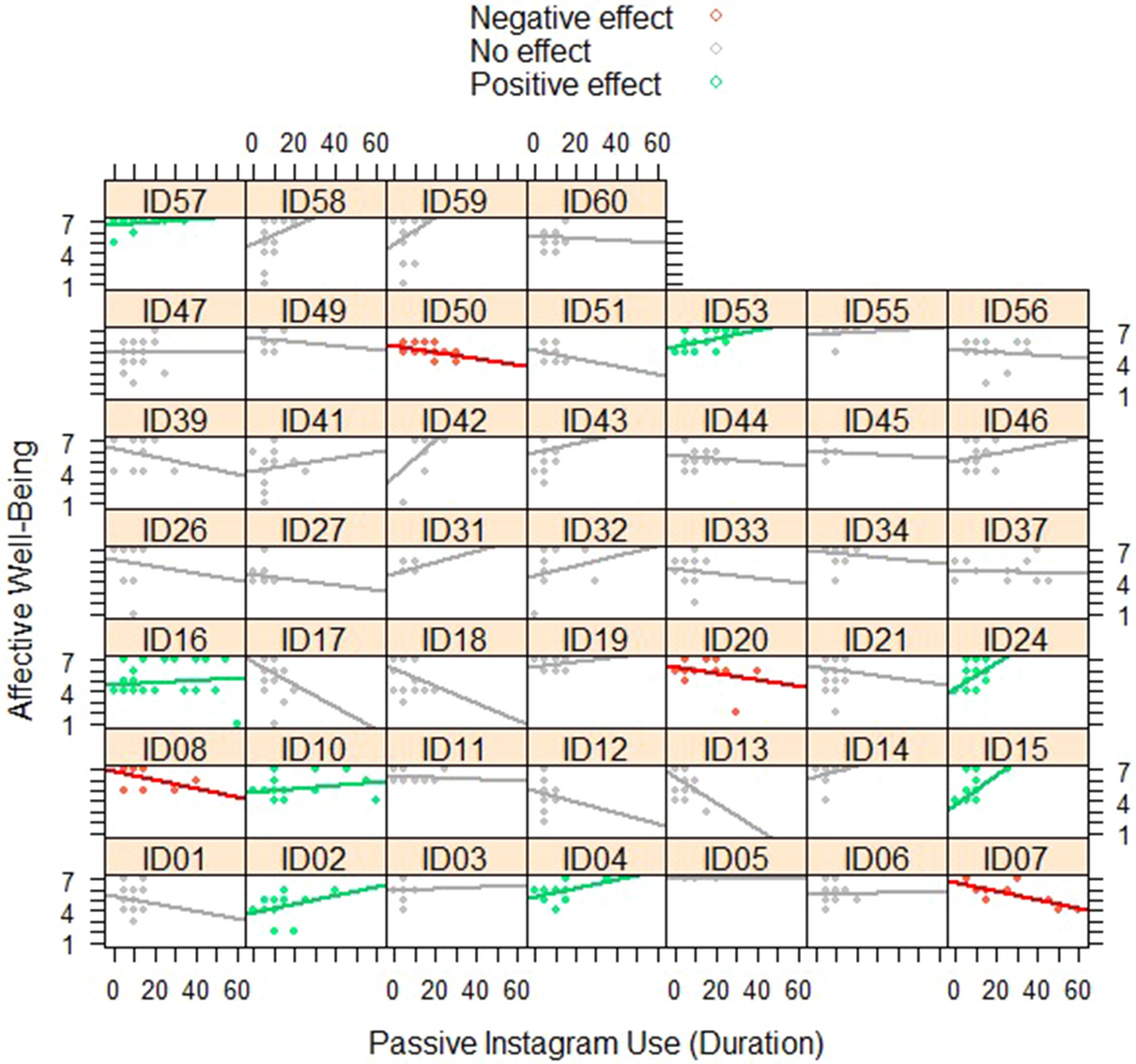
The question whether social media use benefits or undermines adolescents’ well-being is an important societal concern. Previous empirical studies have mostly established across-the-board effects among (sub)populations of adolescents. As a result, it is still an open question whether the effects are unique for each individual adolescent. We sampled adolescents’ experiences six times per day for one week to quantify differences in their susceptibility to the effects of social media on their momentary affective well-being. Rigorous analyses of 2,155 real-time assessments showed that the association between social media use and affective well-being differs strongly across adolescents: While 44% did not feel better or worse after passive social media use, 46% felt better, and 10% felt worse. Our results imply that person-specific effects can no longer be ignored in research, as well as in prevention and intervention programs.
The central role of the propensity score in observational studies for causal effects
Abstract. The propensity score is the conditional probability of assignment to a particular treatment given a vector of observed covariates. Both large and

A meta-analysis of the persuasive power of large language models
Large language models (LLMs) are increasingly used for persuasion, such as in political communication and marketing, where they affect how people think, choose, and act. Yet, empirical findings on the effectiveness of LLMs in persuasion compared to humans remain inconsistent. The aim of this study was to systematically review and meta-analytically assess whether LLMs differ from humans in persuasive effectiveness, and under which contextual conditions LLMs are particularly effective. We identified 7 studies with 17,422 participants primarily recruited from English-speaking countries and 12 effect size estimates. Egger’s test indicated potential small-study effects ($$p =.018$$), but the trim-and-fill analysis did not impute any missing studies, suggesting a low risk of publication bias. We then compute the standardized effect sizes based on Hedges’ g. The results show no significant overall difference in persuasive performance between LLMs and humans ($$g = 0.02$$, $$p =.530$$). However, we observe substantial heterogeneity across studies ($$I^2 = 75.97\%$$), suggesting that persuasiveness strongly depends on contextual factors. In separate exploratory moderator analyses, no individual factor (e.g., LLM model, conversation design, or domain) reached statistical significance, which may be due to the limited number of studies. When considered jointly in a combined model, these factors explained a large proportion of the between-study variance ($$R^2 = 81.93\%$$), and residual heterogeneity is low ($$I^2 = 35.51\%$$). Although based on a small number of studies, this suggests that differences in LLM model, conversation design, and domain are important contextual factors in shaping persuasive performance, and that single-factor tests may understate their influence. Our results highlight that LLMs can match human performance in persuasion, but their success depends strongly on how they are implemented and embedded in communication contexts.

No effect of different types of media on well-being
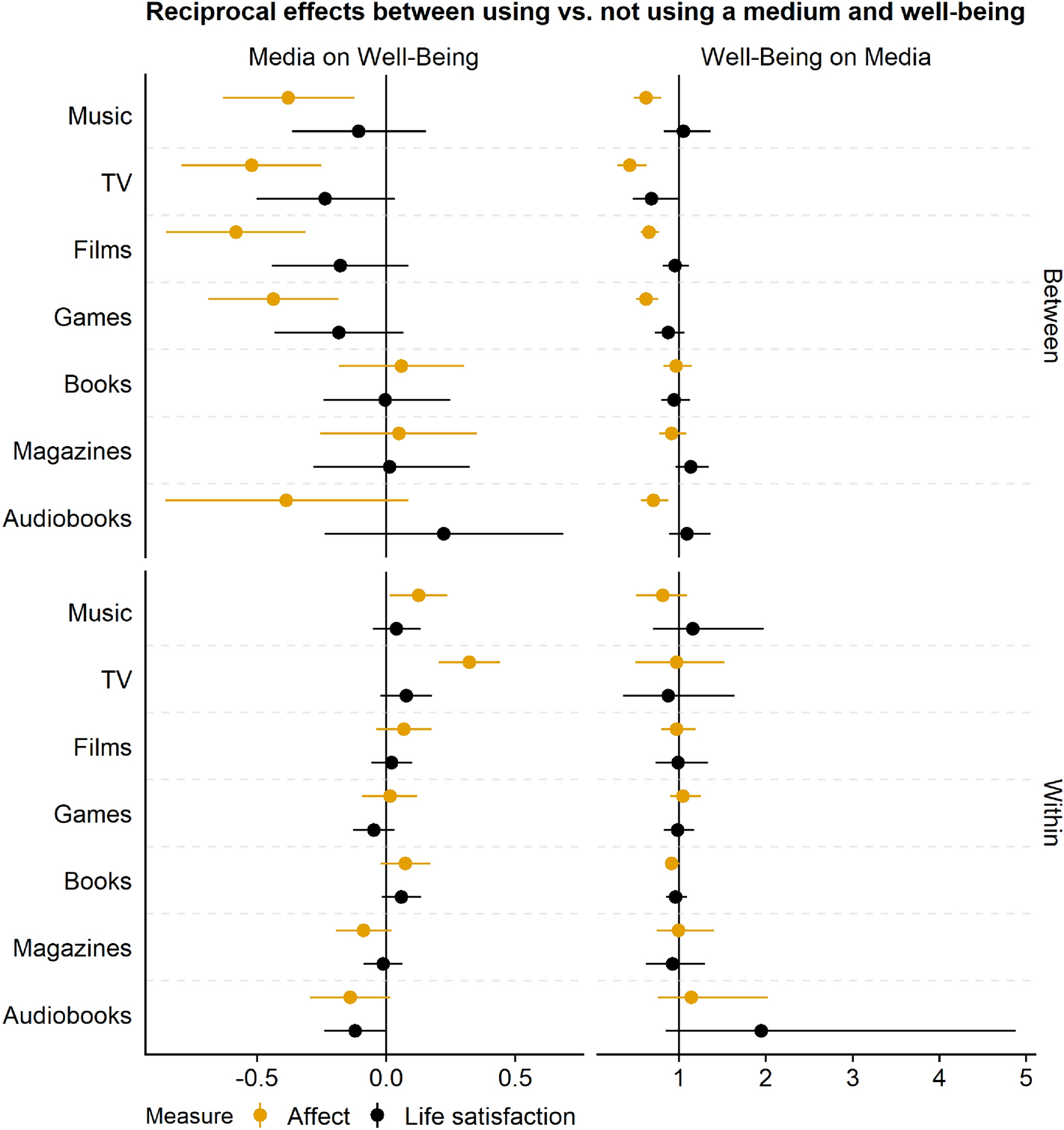
It is often assumed that traditional forms of media such as books enhance well-being, whereas new media do not. However, we lack evidence for such claims and media research is mainly focused on how much time people spend with a medium, but not whether someone used a medium or not. We explored the effect of media use during one week on well-being at the end of the week, differentiating time spent with a medium and use versus nonuse, over a wide range of different media types: music, TV, films, video games, (e-)books, (digital) magazines, and audiobooks. Results from a six-week longitudinal study representative of the UK population 16 years and older (N = 2159) showed that effects were generally small; between-person relations but rarely within-person effects; mostly for use versus nonuse and not time spent with a medium; and on affective well-being, not life satisfaction.
Recognising, Anticipating, and Mitigating LLM Pollution of Online Behavioural Research
Online behavioural research faces an emerging threat as participants increasingly turn to large language models (LLMs) for advice, translation, or task delegation: LLM Pollution. We identify three interacting variants through which LLM Pollution threatens the validity and integrity of online behavioural research. First, Partial LLM Mediation occurs when participants make selective use of LLMs for specific aspects of a task, such as translation or wording support, leading researchers to (mis)interpret LLM-shaped outputs as human ones. Second, Full LLM Delegation arises when agentic LLMs complete studies with little to no human oversight, undermining the central premise of human-subject research at a more foundational level. Third, LLM Spillover signifies human participants altering their behaviour as they begin to anticipate LLM presence in online studies, even when none are involved. While Partial Mediation and Full Delegation form a continuum of increasing automation, LLM Spillover reflects second-order reactivity effects. Together, these variants interact and generate cascading distortions that compromise sample authenticity, introduce biases that are difficult to detect post hoc, and ultimately undermine the epistemic grounding of online research on human cognition and behaviour. Crucially, the threat of LLM Pollution is already co-evolving with advances in generative AI, creating an escalating methodological arms race. To address this, we propose a multi-layered response spanning researcher practices, platform accountability, and community efforts. As the challenge evolves, coordinated adaptation will be essential to safeguard methodological integrity and preserve the validity of online behavioural research.

Recognising, Anticipating, and Mitigating LLM Pollution of Online Behavioural Research
Online behavioural research faces an emerging threat as participants increasingly turn to large language models (LLMs) for advice, translation, or task delegation: LLM Pollution. We identify three interacting variants through which LLM Pollution threatens the validity and integrity of online behavioural research. First, Partial LLM Mediation occurs when participants make selective use of LLMs for specific aspects of a task, such as translation or wording support, leading researchers to (mis)interpret LLM-shaped outputs as human ones. Second, Full LLM Delegation arises when agentic LLMs complete studies with little to no human oversight, undermining the central premise of human-subject research at a more foundational level. Third, LLM Spillover signifies human participants altering their behaviour as they begin to anticipate LLM presence in online studies, even when none are involved. While Partial Mediation and Full Delegation form a continuum of increasing automation, LLM Spillover reflects second-order reactivity effects. Together, these variants interact and generate cascading distortions that compromise sample authenticity, introduce biases that are difficult to detect post hoc, and ultimately undermine the epistemic grounding of online research on human cognition and behaviour. Crucially, the threat of LLM Pollution is already co-evolving with advances in generative AI, creating an escalating methodological arms race. To address this, we propose a multi-layered response spanning researcher practices, platform accountability, and community efforts. As the challenge evolves, coordinated adaptation will be essential to safeguard methodological integrity and preserve the validity of online behavioural research.