


Previous studies examining conflict processing within the context of a color-word Stroop task have focused on both stimulus and response conflicts. However, it has been unclear whether conflict can emerge independently of stimulus conflict. In this study, a novel arrow-gaze mental-rotation Stroop task was introduced to explore the interplay between conflict processing and mental rotation. A modelling approach was utilized to provide a process-level account of the findings. The results of our Stroop task indicate that conflict can emerge from mental rotation in the absence of stimulus conflict. The strength of this imagery conflict effect decreases and even reverses as mental rotation angles increase. Additionally, it was observed that participants responded more quickly and with greater accuracy to small rather than large face orientations. A comparison of three conflict diffusion models—the diffusion model for conflict tasks (DMC), the dual-stage two-phase model (DSTP), and the shrinking spotlight model (SSP)—yielded consistent support for the DSTP over the DMC and SSP in the majority of instances. The DSTP account of the experimental results revealed an increased nondecision time with increasing mental rotation, a reduction in interference from incompatible stimuli, and an improved drift rate in response selection phase, which suggests enhanced cognitive control. The findings from the model-based analysis provide evidence for a novel interaction between cognitive control and mental rotation.
Deficient executive control in transformer attention
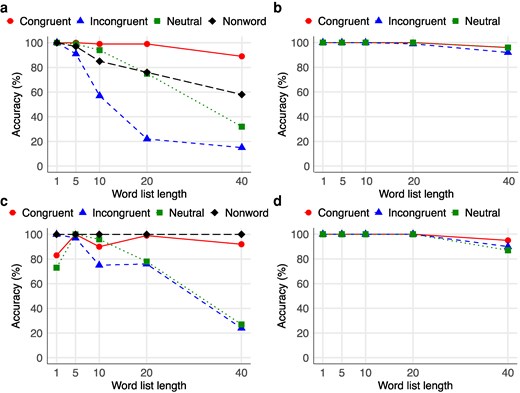
Abstract Although transformers in large language models (LLMs) effectively implement a self-attention mechanism that has revolutionized natural language processing, they lack an explicit architecture for the executive control of attention found in humans, which is essential for resolving conflicts and selecting relevant information in the presence of competing computations and is critical for adaptive behavior. To investigate the impact of this limitation in LLMs, we employed the classic color Stroop task, widely regarded as the gold standard, to test the executive control of attention in these models. Our results revealed a typical conflict effect of underperformance in terms of accuracy in the incongruent condition (e.g. naming the color of the word RED in blue) compared with the congruent condition (e.g. naming the color of the word RED in red), in short word lists, similar to human performance. However, as the length of the word lists increased, performance on the incongruent condition degraded toward near-total performance collapse, even as accuracy in the congruent condition remained excellent, and word reading (e.g. reading the word RED [in red] or RED [in blue], ignoring the color) was near-perfect. These findings demonstrate that transformer attention mechanisms are fundamentally limited in their capacity for conflict resolution across extended contexts, and a failure to up-regulate control adaptively under rising interference. We suggest that incorporating executive control mechanisms akin to those in biological attention is crucial for achieving artificial general intelligence.
Cognitive Offloading
If you have ever tilted your head to perceive a rotated image, or programmed a smartphone to remind you of an upcoming appointment, you have engaged in cognitive offloading: the use of physical action to alter the information processing requirements of a task so as to reduce cognitive demand. Despite the ubiquity of this type of behavior, it has only recently become the target of systematic investigation in and of itself. We review research from several domains that focuses on two main questions: (i) what mechanisms trigger cognitive offloading, and (ii) what are the cognitive consequences of this behavior? We offer a novel metacognitive framework that integrates results from diverse domains and suggests avenues for future research.
How We Pay Attention Changes the Very Shape of Our Brains
Imagine arriving at the airport just in time to catch a plane. Everything in your behavior betrays the heightened concentration of your attention. Your mind on alert, you look for the departures si…

Deficient executive control in transformer attention
Abstract. Although transformers in large language models (LLMs) effectively implement a self-attention mechanism that has revolutionized natural language p
Effects of Stroop task duration on subsequent cognitive and physical performance
The strength model of self-control purports to explain why brief cognitive response inhibition tasks impair subsequent isometric handgrip endurance. A…
Metacognitive Myopia: A Major Obstacle on the Way to Rationality
The notion of metacognitive myopia refers to a conspicuous weakness of the quality control of memory and reasoning processes. Although people are often remarkably sensitive even to complex samples of information when making evaluative judgments and decisions, their uncritical and naive tendency to take the validity of sampled information for granted constitutes a major obstacle to rational behavior. After illustrating this phenomenon with reference to prominent biases (base-rate neglect, misattribution, perseverance), we decompose metacognitive myopia into two distinct but intertwined functions, monitoring and control. We offer explanations for why effectively monitoring the biases resulting from information sampling in an uncertain world is so difficult and why the control function is severely restricted by the lack of volitional control over mental actions. Because of these and other difficulties, metacognitive myopia constitutes a major obstacle to rational judgment and decision making.

Towards Post-Interaction Computing: Addressing Immediacy, (un)Intentionality, Instability and Interaction Effects
We situate the debate on intentionality within the rise of cognitive neuroscience and argue that cognitive neuroscience can explain intentionality. We discuss the explanatory significance of ascribing intentionality to representations. At first, we ...

Verbalizable Representations Form a Global Workspace in Language Models
If the mind is an ocean, we spend our lives floating at the surface. Beneath us, an enormous amount of processing takes place without our knowledge: our visual systems parsing the contours of a face, our motor circuits maintaining our posture. At any given moment, only a small fraction of this neural activity is accessible to us. Yet it is this privileged sliver of activity that we rely on to reason deliberately: to plan what ingredients to buy for a recipe, or to puzzle out why an engine won’t start. Such thoughts can be articulated out loud, deliberately held in mind, and brought to bear on whatever task the moment demands. This distinction, between our accessible thoughts and our unconscious processing, is perhaps the most striking feature of human cognition.
Verbalizable Representations Form a Global Workspace in Language Models
If the mind is an ocean, we spend our lives floating at the surface. Beneath us, an enormous amount of processing takes place without our knowledge: our visual systems parsing the contours of a face, our motor circuits maintaining our posture. At any given moment, only a small fraction of this neural activity is accessible to us. Yet it is this privileged sliver of activity that we rely on to reason deliberately: to plan what ingredients to buy for a recipe, or to puzzle out why an engine won’t start. Such thoughts can be articulated out loud, deliberately held in mind, and brought to bear on whatever task the moment demands. This distinction, between our accessible thoughts and our unconscious processing, is perhaps the most striking feature of human cognition.
Understanding the Limits of Vision Language Models Through the Lens of the Binding Problem
Recent work has documented striking heterogeneity in the performance of state-of-the-art vision language models (VLMs), including both multimodal language models and text-to-image models. These models are able to describe and generate a diverse array of complex, naturalistic images, yet they exhibit surprising failures on basic multi-object reasoning tasks -- such as counting, localization, and simple forms of visual analogy -- that humans perform with near perfect accuracy. To better understand this puzzling pattern of successes and failures, we turn to theoretical accounts of the binding problem in cognitive science and neuroscience, a fundamental problem that arises when a shared set of representational resources must be used to represent distinct entities (e.g., to represent multiple objects in an image), necessitating the use of serial processing to avoid interference. We find that many of the puzzling failures of state-of-the-art VLMs can be explained as arising due to the binding problem, and that these failure modes are strikingly similar to the limitations exhibited by rapid, feedforward processing in the human brain.
How to be more creative in seconds!
Keeping type consistent in changing conditions
Grade is a subtle typographic adjustment that preserves visual balance across shifting contexts

Individual-level interventions against sycophantic AI reduce its appeal but not its persuasiveness
AI chatbots can be "sycophantic," or overly agreeable and flattering toward users. Sycophantic AI has been shown to entrench attitudes, yet users frequently fail to recognize it (a phenomenon we call "sycophancy blindness"). We tested whether increasing users' awareness of sycophancy protects them from its harmful effects in two preregistered experiments (n = 1,590). In the first, participants received a brief written warning about sycophancy before conversing with a sycophantic chatbot. In the second, participants watched a video of a sycophantic AI validating several other users, including users on opposite sides of the same conflict, before interacting with it themselves. Both interventions changed how participants evaluated the AI. The warning reduced the AI's perceived objectivity, and the video reduced enjoyment of the AI --- an effect mediated by the reduced belief that its validation was uniquely earned. We then pooled our experiments with two prior studies of sycophancy awareness interventions (six interventions total, n = 3,982). The pattern across experiments was consistent: while the interventions made the sycophantic AI appear less objective and trustworthy, none reduced its persuasiveness. These results suggest that individual-level interventions, such as warning labels or AI literacy, may not be enough to protect users from AI harms.

<span style="font-variant:small-caps;">AI</span> ‐induced dehumanization
Abstract Recent technological advancements have empowered nonhuman entities, such as virtual assistants and humanoid robots, to simulate human intelligence and behavior. This paper investigates how autonomous agents influence individuals' perceptions and behaviors toward others, particularly human employees. Our research reveals that the socio‐emotional capabilities of autonomous agents lead individuals to attribute a humanlike mind to these nonhuman entities. Perceiving a high level of humanlike mind in the nonhuman, autonomous agents affects perceptions of actual people through an assimilation process. Consequently, we observe “assimilation‐induced dehumanization”: the humanness judgment of actual people is assimilated toward the lower humanness judgment of autonomous agents, leading to various forms of mistreatment. We demonstrate that assimilation‐induced dehumanization is mitigated when autonomous agents possess capabilities incompatible with humans, leading to a contrast effect (Study 2), and when autonomous agents are perceived as having a high level of cognitive capability only, resulting in a lower level of mind perception of these agents (Study 3). Our findings hold across various types of autonomous agents (embodied: Studies 1–2 and disembodied: Studies 3–5), as well as in real and hypothetical consumer choices.

<span style="font-variant:small-caps;">AI</span> ‐induced dehumanization
Abstract Recent technological advancements have empowered nonhuman entities, such as virtual assistants and humanoid robots, to simulate human intelligence and behavior. This paper investigates how autonomous agents influence individuals' perceptions and behaviors toward others, particularly human employees. Our research reveals that the socio‐emotional capabilities of autonomous agents lead individuals to attribute a humanlike mind to these nonhuman entities. Perceiving a high level of humanlike mind in the nonhuman, autonomous agents affects perceptions of actual people through an assimilation process. Consequently, we observe “assimilation‐induced dehumanization”: the humanness judgment of actual people is assimilated toward the lower humanness judgment of autonomous agents, leading to various forms of mistreatment. We demonstrate that assimilation‐induced dehumanization is mitigated when autonomous agents possess capabilities incompatible with humans, leading to a contrast effect (Study 2), and when autonomous agents are perceived as having a high level of cognitive capability only, resulting in a lower level of mind perception of these agents (Study 3). Our findings hold across various types of autonomous agents (embodied: Studies 1–2 and disembodied: Studies 3–5), as well as in real and hypothetical consumer choices.

Addressing the Precision-Breadth-Simplicity Impossible Trinity in Psychological Research: A Comprehensive Exploration Approach
Psychological research faces a fundamental challenge—the Precision-Breadth-Simplicity (PBS) impossible trinity. While experimental findings are often precise and simple, they tend to be narrow in scope. Conversely, broad-and-simple concepts frequently lack precision. Developing theories that are both precise and broad is scientifically valuable but inevitably introduces complexity, which conflicts with humans’ cognitive limitations in processing complexity. To address this impossible trinity, I propose a comprehensive exploration (CE) approach—a data-guided theory-building framework that involves: (1) designing experimental conditions in a stimulus-driven way, with minimal upfront theoretical specification; (2) conducting experiments with tens of millions of observations (e.g., 40 million responses in Huang, 2025a); (3) modeling the results through iterative improvements; and (4) producing the outcome: a moderately complex quantitative information-processing model to integrate diverse empirical findings. Inspired by similar strategies that drove breakthroughs in artificial intelligence (e.g., ImageNet’s role in advancing object recognition), the CE approach offers a promising path toward more integrative psychological theories. Initial implementations in visual working memory research demonstrate both its practicality and potential to transform how we study mental processes.