

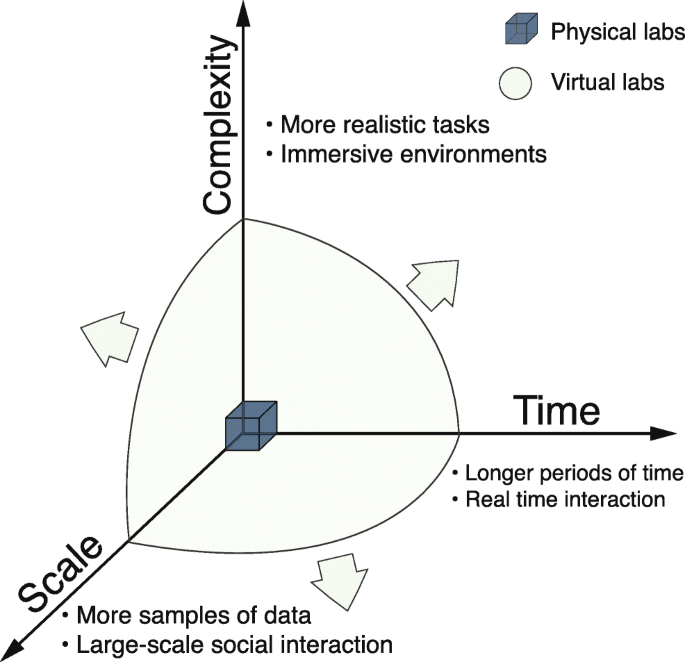
Virtual labs allow researchers to design high-throughput and macro-level experiments that are not feasible in traditional in-person physical lab settings. Despite the increasing popularity of online research, researchers still face many technical and logistical barriers when designing and deploying virtual lab experiments. While several platforms exist to facilitate the development of virtual lab experiments, they typically present researchers with a stark trade-off between usability and functionality. We introduce Empirica: a modular virtual lab that offers a solution to the usability–functionality trade-off by employing a “flexible defaults” design strategy. This strategy enables us to maintain complete “build anything” flexibility while offering a development platform that is accessible to novice programmers. Empirica’s architecture is designed to allow for parameterizable experimental designs, reusable protocols, and rapid development. These features will increase the accessibility of virtual lab experiments, remove barriers to innovation in experiment design, and enable rapid progress in the understanding of human behavior.
PersonaEval: Persona-Based User Simulation for Evaluating Interactive Applications
Real user studies are important for understanding how people interact with systems under test or already deployed. In practice, however, they are often costly, time-consuming, and difficult to scale. To address these challenges, we introduce PersonaEval, a persona-based user simulation framework that approximates real-user behavior across diverse interactive settings. PersonaEval connects simulated users drawn from existing persona datasets to task-specific application interfaces and collects the interaction trajectories and outcomes. PersonaEval provides a plug-and-play evaluation workflow in which the application being evaluated can be easily changed. In this demo, we present PersonaEval on three forms of interactive applications: surveys, chatbots, and web applications. Together, these examples show that PersonaEval can support repeatable, parallelizable, and scalable evaluation across different interaction settings, while producing user-oriented feedback and task-specific behavior.
Mirai Labs: Frontier On-Device AI Lab
Models, runtime & infrastructure to make on-device AI interactive, ambient & continuous.
Agentic Laboratories of the Future: Towards World Models for Scientific Discovery
Scientific discovery is fundamentally a problem-solving process involving distributed intelligence. Human intuition, computational reasoning, and experimental execution are distributed across people, instruments, and software systems, limiting the speed and scale of discovery. Although automation, high-throughput experimentation, foundation models, and cloud infrastructure have accelerated individual stages of the scientific workflow, they have not unified the discovery process. We hypothesize that the next generation of laboratories will be agentic: environments in which scientists, AI systems, and robotic platforms operate as collaborative discovery partners, with humans contributing the parts of discovery that remain hardest to make explicit: asking the right questions and holding provisional mechanistic models of how a system works. The key missing layer is an agentic harnessing layer that continuously integrates hypothesis, literature-derived evidence, experimental data, uncertainty, and experimental state into a shared “laboratory world model”—a dynamic representation of the scientific system and its evolving context. By maintaining and updating this lab world model, the agentic harnessing layer enables coordinated decision-making, adaptive planning, and increasingly autonomous scientific workflows across humans and machines. A central challenge is that much of the scientific research process remains inaccessible to machines, including tacit knowledge, human observations, adaptive decision-making, and evolving experimental context. Advances in multimodal AI and immersive interfaces may help bridge this gap, allowing humans, agents, and robotic systems to collaborate seamlessly in scientific discovery rather than simply automating isolated tasks. Agentic laboratories could provide a new architecture for science, integrating human, artificial, and physical intelligence into a unified discovery system.

vercel-labs/ui
A library of behaviors for agents to build the next generation of user interfaces.
ECHO: Evidence-Calibrated Human Outcomes from Synthetic Users for Interaction Design
This position paper proposes ECHO, a protocol for treating simulated users built with AI as calibrated measurement instruments for scoped interaction-design claims, not as synthetic replacements for human participants. A synthetic user is an echo, not the person who produced the original signal; it gains evidentiary force only when it supports evidence-calibrated human outcomes: claims about human-facing outcomes bounded by human data. The issue matters now because LLMs and GUI agents generate logs, rationales, personas, and usability reports at product speed, while NLP and HCI lack shared norms for when such traces count as evidence. We contribute an evidentiary standard specifying when synthetic traces may support discovery, rehearsal, pilot triage, or bounded decision support. The standard scopes a design claim, records governed human seed traces, documents simulator policy, estimates design effects with human-corrected evidence, and reports uncertainty and rejection flags. It synthesizes usability inspection, personas, user simulation, agent benchmarks, social simulation, validity, correction, documentation, privacy, and human-AI interaction. The central position is narrow: synthetic users can help interaction design when they improve issue discovery, pilot triage, or bounded decision support under calibration. Without calibration, fluent traces turn model plausibility into counterfeit user evidence.
Let your designs fail for the right reasons – Firefox UX
How AI-assisted native prototypes changed what usability testing could show me. If you've ever simplified an interaction just to make a prototype manageable, you've probably felt the tension between ...

Protocol Labs
Protocol Labs is an innovation network driving breakthroughs in computing to push humanity forward.
All-in-one visual testing and review platform | Percy
labs · luna
80+ small interactive labs — atproto tools, dev utilities, data explorers on uk open-gov / twitch / mastodon firehoses, media converters, and games.
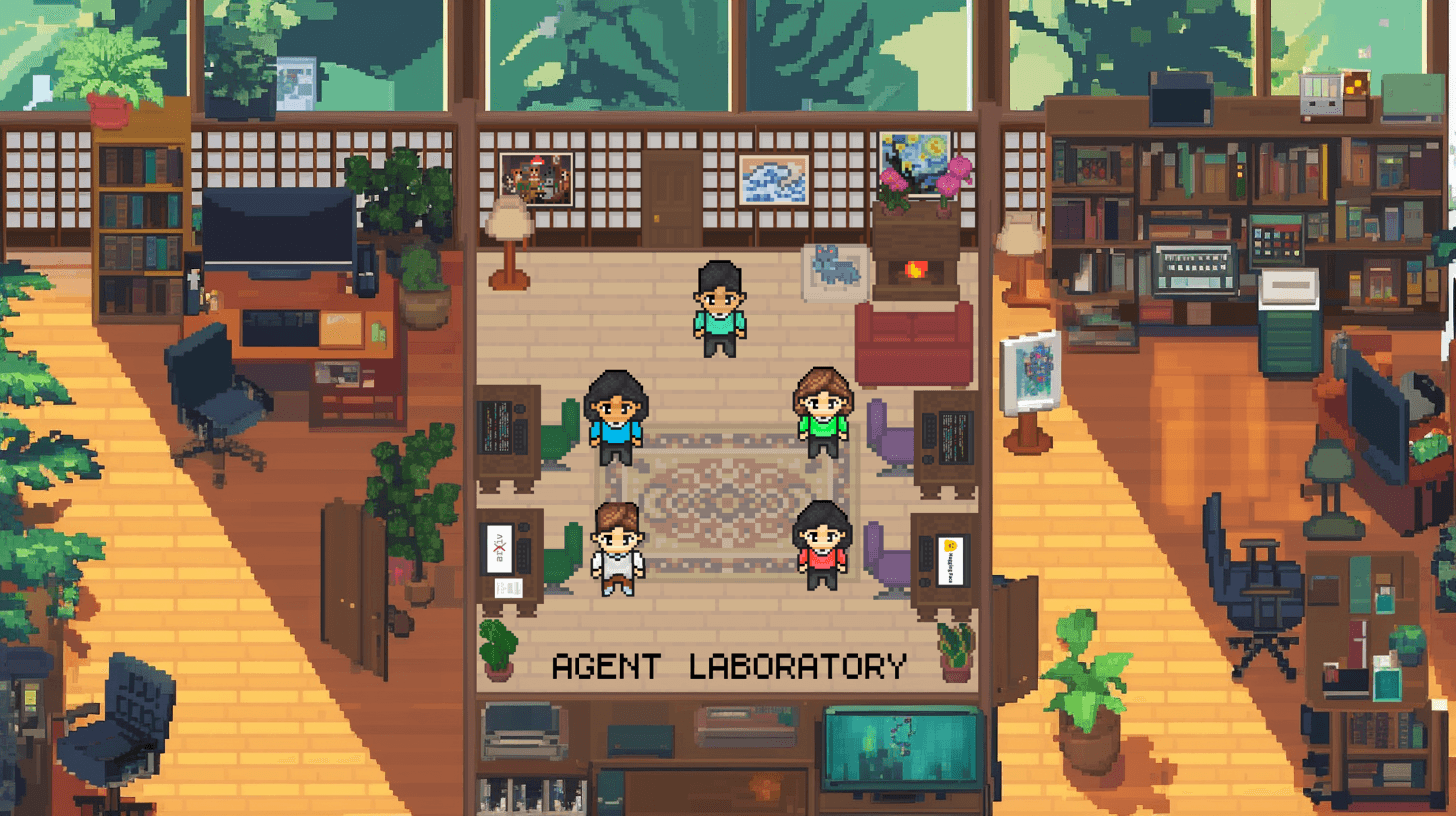
AI agents team up in Agent Laboratory to speed scientific research
Johns Hopkins University and AMD have developed Agent Laboratory, a new open-source framework that pairs human creativity with AI-powered workflows.
Compositional Structures as Substrates for Human AI Co-creation Environment
Everything is ugly, so go build something that isn't — Raiza Martin, Huxe (ex NotebookLM)
The state of the art in end-user software engineering
Most programs today are written not by professional software developers, but by people with expertise in other domains working towards goals for which they need computational support. For example, a teacher might write a grading spreadsheet to save time grading, or an interaction designer might use an interface builder to test some user interface design ideas. Although these end-user programmers may not have the same goals as professional developers, they do face many of the same software engineering challenges, including understanding their requirements, as well as making decisions about design, reuse, integration, testing, and debugging. This article summarizes and classifies research on these activities, defining the area of End-User Software Engineering (EUSE) and related terminology. The article then discusses empirical research about end-user software engineering activities and the technologies designed to support them. The article also addresses several crosscutting issues in the design of EUSE tools, including the roles of risk, reward, and domain complexity, and self-efficacy in the design of EUSE tools and the potential of educating users about software engineering principles.

An over-engineered Home Lab with Docker and Kubernetes.
Setting up a personal Home Lab is not a task for lazy people: it incurrs a big cost of maintenance and issues arise even though we might use the best IT-Infrastructure practices… but we can always learn a lot out of it and make it also super fun. In this post I would like to share my journey and share some tips and tricks and issues I bumped into. Let’s jump in!

The Weird Death Of User Interfaces