

The Credit Card Debt Puzzle: The Role of Preferences, Credit Access Risk, and Financial Literacy
Abstract. We use the 1979 National Longitudinal Survey of Youth to revisit what is termed the credit card debt puzzle: why consumers simultaneously co-hold high-interest credit card debt and low-interest assets that could be used to pay down this debt. Relative to individuals with no credit card debt but positive liquid assets, borrower-savers have very different perceptions of future credit access risk and use credit cards for precautionary motives. Moreover, changing perceptions about credit access risk are essential for predicting transitions among the two groups. Preferences and the composition of financial portfolios also play a role in these transitions.
A Model of Money and Credit, with Application to the Credit Card Debt Puzzle
Abstract. Many individuals simultaneously have significant credit card debt and money in the bank. The credit card debt puzzle is as follows: given high in
Credit Card Debt Puzzle: Liquid Assets to Pay Bills
Using transaction data from a US consumer payments diary, we revisit the credit card debt puzzle—a scenario in which consumers revolve credit card debt while al

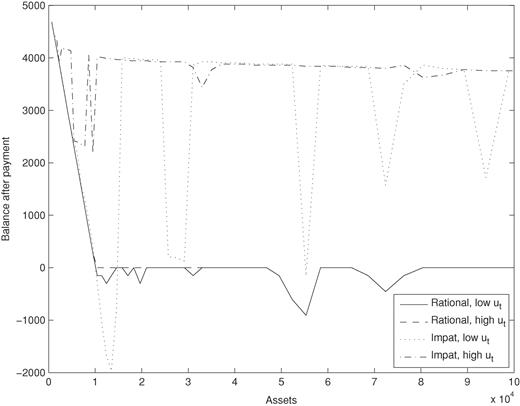
Credit Card Debt Puzzles and Debt Revolvers for Self Control
Abstract Most US credit card holders revolve high-interest debt, often with substantial liquid and retirement assets. We model separation of accounting from shopping allowed by credit cards, in a rational, dynamic game. When the shopper is more impatient than the accountant, selling assets to repay debt is not necessarily optimal, as the shopper can restore debt. Modest relative impatience generates asset-debt co-existence and target utilization rates, matching incidence and median assets of debt revolvers with substantial assets. Empirical evidence is consistent with a role for spending control considerations, after allowing for standard determinants of credit card debt.
The Debt Payment Puzzle: An Experimental Investigation
Why do borrowing individuals fail to repay their debt optimally? We design a diagnostic laboratory experiment where we rule out selection into debt and other co
Overconfidence and the Credit Card Debt Puzzle
This article investigates the credit card debt puzzle. Simultaneously holding credit card debt and liquid assets is puzzling given the sizeable difference between interest rates of debt and assets. However, this behavior is common—about 31% of households in the 2016 Survey of Consumer Finances. The cost of co-holding may be justified if consumers anticipate future restrictions in credit or if they need to maintain liquidity. Other existing explanations for co-holding include impulsive spending and low financial literacy. This research reveals a new explanation for the credit card debt puzzle: consumers’ overconfidence of their financial knowledge. Using a Coarsened Exact Matching method, we found that overconfident consumers were 20%–40% more likely to co-hold credit card debt and liquid assets.
Overconfidence and the Credit Card Debt Puzzle - ProQuest
Explore millions of resources from scholarly journals, books, newspapers, videos and more, on the ProQuest Platform.
Borrowing on the Wrong Credit Card? Evidence from Mexico
We establish new facts about the way consumers allocate debt among their credit cards using data for a representative sample of cardholders in Mexico. We find that relative prices are weak predictors of the allocation of debt, purchases, and payments. Consumers allocate a large fraction of their debt to high-interest cards, incurring a cost of 31 percent above the minimum. Using an experiment, we find that consumers do not substitute in the price margin, although they respond to salient temporary low-interest offers. We conclude that limited attention and mental accounting best rationalize our results and discuss implications for the market.
Household Need for Liquidity and the Credit Card Debt Puzzle
Abstract. In the 2001 U.S. Survey of Consumer Finances, 27% of households report simultaneously revolving significant credit card debt and holding sizeable
Does Saving Cause Borrowing? Implications for the Co-Holding Puzzle
Using an experiment in which 3.1 million bank customers were encouraged to save, we explore the mechanisms behind co-holding liquid savings and credit card debt. Theoretically, we first show that the joint responses of spending, saving, and borrowing to the nudge differ for different economic models of co-holding. Using machine learning techniques, we then find that the most responsive individuals reduce spending and increase their savings by 4.9% (206 USD PPP per month) while their credit card debt remains unchanged. For them, the marginal responses to the nudge are consistent with our model of co-holding for the purpose of self- or partner control.

When Motivation is against Debtors' Best Interest: The Illusion of Goal Progress in Credit Card Debt Repayment
The authors explore the illusion of goal progress by consumers who own multiple credit cards and pay off their debt balances to facilitate the achievement of their subgoal rather than the superordinate goal of being debt-free. The first experiment shows that debtors use their savings toward the credit card debt they can pay off entirely or substantially, even if it is associated with the smallest balance and the lowest annual percentage rate rather than toward the debt with the highest annual percentage rate. The second experiment reveals that when the income available to pay down the debt is in the form of effortless money (i.e., windfall or reward money) as opposed to hard-earned savings, the tendency to allocate money toward the smallest credit card debt is exacerbated. However, people tend to pay their debt more rationally when the number of debt accounts increases. Finally, the third experiment shows that credit card debt repayment decisions depend on the nature of the debt (hedonic vs. utilitarian) and the timing of consumption benefits (past vs. future). The article concludes with a discussion of managerial and public policy implications.

Payment Rewards and Credit Card Debt: Experimental Evidence
We report on a controlled laboratory experiment in which participants make consumption, saving, and credit card repayment decisions when credit card purchases e
Debt literacy, financial experiences, and overindebtedness
We analyze a national sample of Americans with respect to their debt literacy, financial experiences, and their judgments about the extent of their indebtedness. Debt literacy is a component of broader financial understanding that measures knowledge about debt and self-assessed financial knowledge. Financial experiences are the participants’ reported experiences with traditional borrowing, alternative borrowing, and investing. Overindebtedness is a self-reported measure. Debt literacy is low, with only about one-third of the population grasping the basics of interest compounding. Even after controlling for demographics, we find a relationship between debt literacy and both financial experiences and debt loads. Individuals with lower levels of debt literacy tend to transact in high-cost manners, incurring higher fees and using high-cost borrowing. We provide a rough estimate of the national implications of debt ignorance on credit card costs by consumers. Less knowledgeable individuals also report that their debt loads are excessive or that they are unable to judge their debt position.
<div> When Consumer Financial Protection Spills Over: <span>Student Loan Borrowing under the CARD Act</span> </div>
<p>Credit card use among college students declined sharply following the enactment of the <span>Credit Card Accountability, Responsibility, and Disclosure
Consumption Response to Credit Expansions: Evidence from Experimental Assignment of 45,307 Credit Lines
In a field experiment that constructs a randomized credit limit shock, participants borrow to spend 11 cents on the dollar in the first quarter and 28 cents by the third year. Effects extend to those far from the limit, those who had the new limits as available credit, and those with a liquid asset buffer. In the short-run, flexible and installment contracts are used in tandem, with unconstrained using installments more. Long-run borrowing is predominantly using installments. Near limits, participants borrow when credit expands but save out of constraints when limits are tight. Findings support a buffer-stock interpretation emphasizing precautionary saving.
Timing to the Statement: Understanding Fluctuations in Consumer Credit Use
We show that consumers spend 15% more per day in the first week following the receipt of a credit card statement than in the days just prior to the statement. This increase in spending includes both an increase in the likelihood that they use the credit card in the first weeks following their statement and an increase in transaction amount on days they use the credit card. In contrast to the effect on credit card spending, debit card spending is unaffected by credit card statement issuance, suggesting that consumers are not simply switching among modes of payment. Our estimates are based on exogenous variation from bank-assigned statement dates. We propose and test several alternative explanations to this spending puzzle: optimization of the free float, salience effect of the credit card statement, mental accounting, liquidity constraints, and automatic payments. We find that the consumers most apt to spend early in the credit card cycle tend to be those who do not revolve balances and are not close to their credit limit. Thus, this paper documents a puzzle with mixed support for several alternative explanations. This paper was accepted by David Simchi-Levi, finance.
