

This article focusses on the history of learned magic in late medieval Europe, breaking a period of about 500 years into chronological stages to explore how medieval supporters and critics of magic represented the art and responded to each other’s arguments, then reframed their own in a continuous dynamic entanglement. In this period learned magic texts from diverse religious and cosmological traditions (primarily Christian, Jewish, Arabic and Greco-Roman) circulated among people familiar with, and emotionally invested in, a great variety of institutional and informal rituals. Sources reveal a vibrant culture of exchanges of texts between members of religious orders, physicians and lay men, clerics and lay women – a culture of entanglement: discussion, borrowing, critique and adaptation alongside practitioner-client relationships and necessary secrecy and concealment.
Esotericism in One Piece: Navigating Magic, Symbolism and Spirituality
Introduction Idea Presentation

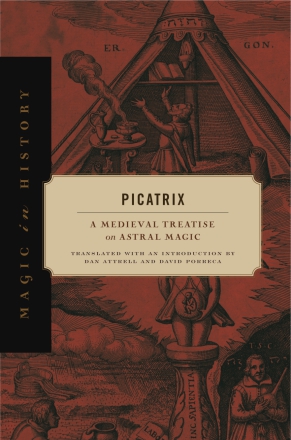
19.09.12 Attrell/Porreca (eds.), Picatrix: A Medieval Treatise on Astral Magic
Attrell, Dan, and David Porreca, trans. Picatrix: A Medieval Treatise on Astral Magic, Magic in History. University Park, PA: Pennsylvania State University Press, 2019. pp. xii, 372. $39.95 (hardback). ISBN: 978-0-271-08212-7 (hardback).
A New Pilgrimage: John Vervaeke on Finding Practices that Build Meaning | Over the Mountains #15
Remote Origins: Translation, Genealogy, and Alterity in Medieval Castile (1252-circa 1390)
This dissertation analyzes selected examples of thirteenth- and fourteenth-century written culture to show their engagement with the religious alterity of Islam as an integral part of the origins of the kingdom of Castile. Following an interdisciplinary methodology, it addresses how medieval ideas about astrology, geography, history, medicine, race, and religion participated in creating discourses about origins that recognized the intellectual and political authority of al-Andalus. It argues that early Castilian vernacular texts conceptualized the translation of Arabic sources as an instrument for creating, transforming, and superseding the alterity of Islam while recognizing the cultural and political authority of Andalusi traditions. The first chapter serves as an introduction explaining the historical and theoretical framework of the dissertation. To do so, it provides an overview of Castilian ideas about genealogy, historiography, authority, and translatio, and translation. Then, through close reading and ample historicization, chapters two, three, and four analyze the impact of Andalusi textual traditions, cultural practices, and human population in three interrelated fields of medieval science, literature, and history. Chapter 2 explores the political implications of King Alfonso X’s (r. 1252-1284) dedication to the translation of Arabic sciences by focusing on the translation of a treatise of astrology titled Libro de las cruzes (1259). The chapter traces the cultural and political context that accompanied the transmission of the book in al-Andalus alongside the content of its Arabic and Castilian prologues. In light of ideas about the transference of knowledge (translatio studii) shared by Christian and Muslim scholars, I conclude that deployment of a twofold origin in the Libro de las cruzes illustrates the strategies and motivations of Alfonso X’s broader engagement with Arabic sources. The third chapter turns to the early fourteenth-century romance Libro del caballero Zifar with a double focus on its forged origin as a translation from caldeo (Chaldean) and the prominence of cursed lineages. Regarding lineage, the chapter explores the representation of exemplary virtues by the protagonists of the romance as enacting ideas about the transformable character of lineage and the capabilities of the individual to unmake inherited negative traits. Likewise, the textual strategy of the forged translation enables the inclusion of Arabic and Asian referents at the origin of a profoundly Christian text. In chapter 4, literature meets historiography in the analysis of the Crónica de Flores y Blancaflor. Being the result of intertwining a Castilian chronicle—Alfonso X’s Estoria de Espanna—and a French romance, this text narrates the love story between an Andalusi Muslim prince and the daughter of a captive Christian noble. The chapter focuses on Berta, the captive woman, to show the implications of her decision to nurture Flores and Blancaflor with her milk. Considering Christian and Muslim ideas about milk and wet nursing along with the tenets of Castilian historiography, the chapter shows the limits of dominant ideas about dynastic origins among the Christian elites of Castile while evidencing the existence of an alternative discourse that—coming from within Castilian historiography—incorporates maternal and non-Christian kinship as an essential part of the origins and possibilities of the kingdom. A short final chapter serves as a conclusion, suggesting paths for expanding the results of this dissertation within and the thirteenth and fourteenth centuries covered by its contents.
“If you want to pray to Mercury, wear the garments of a scribe:” <i>kuttāb</i> , <i>udabāʾ,</i> and readers of the <i>Ghāyat al-Ḥakīm</i> in the court of ʿAbd al-Raḥmān III
This work addresses the question of the intended audience of the Ghāyat al-Ḥakīm, the famous Andalusi treatise on magic, better known by its Latin moniker, Picatrix. I propose that a substantial po...

Picatrix: A Medieval Treatise on Astral Magic Translated with an introduction by Dan Attrell and David Porreca
A manual for constructing talismans, mixing magical compounds, summoning planetary spirits, and determining astrological conditions, Picatrix is a cornerstone of Western esotericism. It offers important insights not only into occult practices and beliefs but also into the transmission of magical ideas from antiquity to the present. Dan Attrell and David Porreca’s English translation opens the world of this vital medieval treatise to modern-day scholars and lay readers.
Ordeals
AbstractI argue that medieval judicial ordeals accurately assigned accused criminals’ guilt and innocence. They did this by leveraging a medieval superstition called iudicium Dei (judgments of God). According to that superstition, God condemned the guilty and exonerated the innocent through clergy-conducted physical tests. Medieval citizens’ belief in iudicium Dei created a separating equilibrium in which only innocent defendants were willing to undergo ordeals. Conditional on observing a defendant’s willingness to do so, the administering priest knew he or she was innocent and manipulated the ordeal to find this. My theory explains the peculiar puzzle of ordeals: trials of fire and water that should have condemned most persons who underwent them did the reverse. They exonerated these persons instead. Boiling water rarely boiled persons who plunged their arms in it. Burning iron rarely burned persons who carried it. Ordeal outcomes were miraculous, but they were miracles of mechanism design.

Life Got You Down? Time to Read The Master and Margarita
‘“And what is your particular field of work?” asked Berlioz. “I specialize in black magic.”’ If many Russian classics are dark and deep and full of the horrors of the blackness of the human soul (o…

Traces of Necromantic Divinatory Practices in the Picatrix
In the famous medieval magical manual called the Picatrix, the unknown author describes the phenomenon of magic with the term nigromantia. As is well known, the original meaning of the Greek term necromantia has a more concise meaning. It is used for a special kind of divination, i.e., divination through the parts of a cadaver and the conjured spirit of the dead. Seemingly, in the Picatrix, no necromantic ritual can be found; moreover, the author stresses that his main goal is pious, i.e., to find the path leading to the ultimate source of the universe, the one and only God. In my article, I show that on some pages of the Picatrix, there are traces of divinatory practices that may be connected to the original meaning of the term nigromantia. In the third book of the manual, descriptions of some interesting rituals attributed to the pagan Sabeans of Harran and their teacher, the god Hermes can be found. During the practices, the magician involved conjured spirits of the heavenly bodies and powers as well. Because of this, by looking closely at and analyzing the given text, it is possible to piece together a complex web of necromantic and demonic divinatory rituals.

How Angel Magic Gave Us the Internet - The Steganographia of Trithemius

On Torturing LLMs
a conversation with Parth Agrawal about play, ritual, and the weird edges of LLM interactions
Hexing the technical interview
Long ago, on Svalbard, when you were a young witch of forty-three, your mother took your unscarred wrists in her hands, and spoke:
Internet History Sourcebooks: Medieval Sourcebook
Home | Ancient History Sourcebook | Medieval Sourcebook | Modern History Sourcebook | Byzantine Studies Page Other History Sourcebooks: African | East Asian | Indian | Islamic | Jewish | Lesbian and Gay | Science | Women's | Global