


Logical reasoning is needed in a wide range of NLP tasks. Can a BERT model be trained end-to-end to solve logical reasoning problems presented in natural language? We attempt to answer this question in a confined problem space where there exists a set of parameters that perfectly simulates logical reasoning. We make observations that seem to contradict each other: BERT attains near-perfect accuracy on in-distribution test examples while failing to generalize to other data distributions over the exact same problem space. Our study provides an explanation for this paradox: instead of learning to emulate the correct reasoning function, BERT has in fact learned statistical features that inherently exist in logical reasoning problems. We also show that it is infeasible to jointly remove statistical features from data, illustrating the difficulty of learning to reason in general. Our result naturally extends to other neural models and unveils the fundamental difference between learning to reason and learning to achieve high performance on NLP benchmarks using statistical features.
On the Paradox of Learning to Reason from Data
Logical reasoning is needed in a wide range of NLP tasks. Can a BERT model be trained end-to-end to solve logical reasoning problems presented in natural language? We attempt to answer this...
Reasoning Under Uncertainty: Exploring Probabilistic Reasoning Capabilities of LLMs
Despite widespread success in language understanding and generation, large language models (LLMs) exhibit unclear and often inconsistent behavior when faced with tasks that require probabilistic reasoning. In this work, we present the first comprehensive study of the reasoning capabilities of LLMs over explicit discrete probability distributions. Given observations from a probability distribution, we evaluate models on three carefully designed tasks, mode identification, maximum likelihood estimation, and sample generation, by prompting them to provide responses to queries about either the joint distribution or its conditionals. These tasks thus probe a range of probabilistic skills, including frequency analysis, marginalization, and generative behavior. Through comprehensive empirical evaluations, we demonstrate that there exists a clear performance gap between smaller and larger models, with the latter demonstrating stronger inference and surprising capabilities in sample generation. Furthermore, our investigations reveal notable limitations, including sensitivity to variations in the notation utilized to represent probabilistic outcomes and performance degradation of over 60% as context length increases. Together, our results provide a detailed understanding of the probabilistic reasoning abilities of LLMs and identify key directions for future improvement.
Reasoning Under Uncertainty: Exploring Probabilistic Reasoning Capabilities of LLMs
Despite widespread success in language understanding and generation, large language models (LLMs) exhibit unclear and often inconsistent behavior when faced with tasks that require probabilistic reasoning. In this work, we present the first comprehensive study of the reasoning capabilities of LLMs over explicit discrete probability distributions. Given observations from a probability distribution, we evaluate models on three carefully designed tasks, mode identification, maximum likelihood estimation, and sample generation, by prompting them to provide responses to queries about either the joint distribution or its conditionals. These tasks thus probe a range of probabilistic skills, including frequency analysis, marginalization, and generative behavior. Through comprehensive empirical evaluations, we demonstrate that there exists a clear performance gap between smaller and larger models, with the latter demonstrating stronger inference and surprising capabilities in sample generation. Furthermore, our investigations reveal notable limitations, including sensitivity to variations in the notation utilized to represent probabilistic outcomes and performance degradation of over 60% as context length increases. Together, our results provide a detailed understanding of the probabilistic reasoning abilities of LLMs and identify key directions for future improvement.
Rethinking the Multilingual Reasoning Gap with Layer Swap
Recent reasoning Large Language Models produce a chain-of-thought (CoT) predominantly in English, even when prompted in non-English languages. Prior work suggests that forcing the CoT to remain in the input language (\emph{native reasoning}) substantially degrades performance relative to allowing the model to reason in English before answering in the input language (\emph{English-pivoted reasoning}). However, most studies of this native reasoning gap rely on inference-time interventions or limited native-language training data. We revisit this comparison at a larger scale and under comparable supervision. We construct long multilingual reasoning datasets across six languages (English, French, German, Spanish, Chinese and Swahili); fine-tune specialists in both native and English-pivoted regimes on top of \texttt{Qwen/Qwen3-8B-Base}, and evaluate across mathematics, science, general knowledge, and code. In this setting, the average native reasoning gap shrinks to 1.9--3.5\% across the five non-English languages, considerably smaller than previously reported. Weight-space analysis of the native specialists reveals aligned fine-tuning updates in the middle layers and divergence in the outer layers. This points to a largely language-agnostic reasoning core surrounded by language-specific layers. Exploiting this structure, we introduce a Layer Swap: transferring the English specialist's stronger reasoning mid-layers into each native specialist, closing most of the native reasoning gap across the five non-English languages while preserving CoT in the target language. We release all models and datasets.
Eliciting Reasoning in Language Models with Cognitive Tools
The recent advent of reasoning models like OpenAI's o1 was met with excited speculation by the AI community about the mechanisms underlying these capabilities in closed models, followed by a rush of replication efforts, particularly from the open source community. These speculations were largely settled by the demonstration from DeepSeek-R1 that chains-of-thought and reinforcement learning (RL) can effectively replicate reasoning on top of base LLMs. However, it remains valuable to explore alternative methods for theoretically eliciting reasoning that could help elucidate the underlying mechanisms, as well as providing additional methods that may offer complementary benefits. Here, we build on the long-standing literature in cognitive psychology and cognitive architectures, which postulates that reasoning arises from the orchestrated, sequential execution of a set of modular, predetermined cognitive operations. Crucially, we implement this key idea within a modern agentic tool-calling framework. In particular, we endow an LLM with a small set of "cognitive tools" encapsulating specific reasoning operations, each executed by the LLM itself. Surprisingly, this simple strategy results in considerable gains in performance on standard mathematical reasoning benchmarks compared to base LLMs, for both closed and open-weight models. For instance, providing our "cognitive tools" to GPT-4.1 increases its pass@1 performance on AIME2024 from 32% to 53%, even surpassing the performance of o1-preview. In addition to its practical implications, this demonstration contributes to the debate regarding the role of post-training methods in eliciting reasoning in LLMs versus the role of inherent capabilities acquired during pre-training, and whether post-training merely uncovers these latent abilities.
Exploring the Limits of Transfer Learning with a Unified Text-to-Text Transformer
Transfer learning, where a model is first pre-trained on a data-rich task before being fine-tuned on a downstream task, has emerged as a powerful technique in natural language processing (NLP). The effectiveness of transfer learning has given rise to a diversity of approaches, methodology, and practice. In this paper, we explore the landscape of transfer learning techniques for NLP by introducing a unified framework that converts all text-based language problems into a text-to-text format. Our systematic study compares pre-training objectives, architectures, unlabeled data sets, transfer approaches, and other factors on dozens of language understanding tasks. By combining the insights from our exploration with scale and our new “Colossal Clean Crawled Corpus”, we achieve state-of-the-art results on many benchmarks covering summarization, question answering, text classification, and more. To facilitate future work on transfer learning for NLP, we release our data set, pre-trained models, and code.
Performative Thinking? The Brittle Correlation Between CoT Length and Problem Complexity
Intermediate token generation (ITG), where a model produces output before the solution, has been proposed as a method to improve the performance of language models on reasoning tasks. While these reasoning traces or Chain of Thoughts (CoTs) are correlated with performance gains, the mechanisms underlying them remain unclear. A prevailing assumption in the community has been to anthropomorphize these tokens as "thinking", treating longer traces as evidence of higher problem-adaptive computation. In this work, we critically examine whether intermediate token sequence length reflects or correlates with problem difficulty. To do so, we train transformer models from scratch on derivational traces of the A* search algorithm, where the number of operations required to solve a maze problem provides a precise and verifiable measure of problem complexity. We first evaluate the models on trivial free-space problems, finding that even for the simplest tasks, they often produce excessively long reasoning traces and sometimes fail to generate a solution. We then systematically evaluate the model on out-of-distribution problems and find that the intermediate token length and ground truth A* trace length only loosely correlate. We notice that the few cases where correlation appears are those where the problems are closer to the training distribution, suggesting that the effect arises from approximate recall rather than genuine problem-adaptive computation. This suggests that the inherent computational complexity of the problem instance is not a significant factor, but rather its distributional distance from the training data. These results challenge the assumption that intermediate trace generation is adaptive to problem difficulty and caution against interpreting longer sequences in systems like R1 as automatically indicative of "thinking effort".
Performative Thinking? The Brittle Correlation Between CoT Length and Problem Complexity
Intermediate token generation (ITG), where a model produces output before the solution, has been proposed as a method to improve the performance of language models on reasoning tasks. While these reasoning traces or Chain of Thoughts (CoTs) are correlated with performance gains, the mechanisms underlying them remain unclear. A prevailing assumption in the community has been to anthropomorphize these tokens as "thinking", treating longer traces as evidence of higher problem-adaptive computation. In this work, we critically examine whether intermediate token sequence length reflects or correlates with problem difficulty. To do so, we train transformer models from scratch on derivational traces of the A* search algorithm, where the number of operations required to solve a maze problem provides a precise and verifiable measure of problem complexity. We first evaluate the models on trivial free-space problems, finding that even for the simplest tasks, they often produce excessively long reasoning traces and sometimes fail to generate a solution. We then systematically evaluate the model on out-of-distribution problems and find that the intermediate token length and ground truth A* trace length only loosely correlate. We notice that the few cases where correlation appears are those where the problems are closer to the training distribution, suggesting that the effect arises from approximate recall rather than genuine problem-adaptive computation. This suggests that the inherent computational complexity of the problem instance is not a significant factor, but rather its distributional distance from the training data. These results challenge the assumption that intermediate trace generation is adaptive to problem difficulty and caution against interpreting longer sequences in systems like R1 as automatically indicative of "thinking effort".
Measuring short-form factuality in large language models
We present SimpleQA, a benchmark that evaluates the ability of language models to answer short, fact-seeking questions. We prioritized two properties in designing this eval. First, SimpleQA is challenging, as it is adversarially collected against GPT-4 responses. Second, responses are easy to grade, because questions are created such that there exists only a single, indisputable answer. Each answer in SimpleQA is graded as either correct, incorrect, or not attempted. A model with ideal behavior would get as many questions correct as possible while not attempting the questions for which it is not confident it knows the correct answer. SimpleQA is a simple, targeted evaluation for whether models "know what they know," and our hope is that this benchmark will remain relevant for the next few generations of frontier models. SimpleQA can be found at https://github.com/openai/simple-evals.
Measuring short-form factuality in large language models
We present SimpleQA, a benchmark that evaluates the ability of language models to answer short, fact-seeking questions. We prioritized two properties in designing this eval. First, SimpleQA is challenging, as it is adversarially collected against GPT-4 responses. Second, responses are easy to grade, because questions are created such that there exists only a single, indisputable answer. Each answer in SimpleQA is graded as either correct, incorrect, or not attempted. A model with ideal behavior would get as many questions correct as possible while not attempting the questions for which it is not confident it knows the correct answer. SimpleQA is a simple, targeted evaluation for whether models "know what they know," and our hope is that this benchmark will remain relevant for the next few generations of frontier models. SimpleQA can be found at https://github.com/openai/simple-evals.
ICML Poster Learning syntax without semantics: Disentangled tiny language models
Language models acquire syntax and world knowledge together, entangling the two in ways that limit efficiency and controllability. We show that syntax can be learned while suppressing semantic plausibility and world‑knowledge cues, yielding more efficient and controllable models. We train tiny LMs on grammatical nonsense — syntactically well-formed text with semantic content ablated via constrained relexicalization (SAMBAL). Models trained on this data perform comparably to standard pretraining on syntactic benchmarks (BLiMP, SyntaxGym) while scoring at chance on world knowledge probes (EWoK). On targeted grammar-plausibility conflict probes, content-neutral models prefer grammaticality where standard models prefer plausibility, and their representations show more syntactic vs lexical alignment. On efficiency, disentanglement yields substantial sample and parameter gains: in low‑resource regimes, a 5M‑parameter model matches a 30M‑parameter baseline at the same data budget. On controllability, content-neutral models adapt rapidly to a new domain with minimal exposure, suggesting the feasibility of modular post‑hoc knowledge specialization.
DeepRefine: Agent-Compiled Knowledge Refinement via Reinforcement Learning
Agent-compiled knowledge bases provide persistent external knowledge for large language model (LLM) agents in open-ended, knowledge-intensive downstream tasks. Yet their quality is systematically limited by \emph{incompleteness}, \emph{incorrectness}, and \emph{redundancy}, manifested as missing evidence or cross-document links, low-confidence or imprecise claims, and ambiguous or coreference resolution issues. Such defects compound under iterative use, degrading retrieval fidelity and downstream task performance. We present \textbf{DeepRefine}, a general LLM-based reasoning model for \emph{agent-compiled knowledge refinement} that improves the quality of any pre-constructed knowledge bases with user queries to make it more suitable for the downstream tasks. DeepRefine performs multi-turn interactions with the knowledge base and conducts abductive diagnosis over interaction history, localizes likely defects, and executes targeted refinement actions for incremental knowledge base updates. To optimize refinement policies of DeepRefine without gold references, we introduce a Gain-Beyond-Draft (GBD) reward and train the reasoning process end-to-end via reinforcement learning. Extensive experiments demonstrate consistent downstream gains over strong baselines.
Attention Is All You Need
The dominant sequence transduction models are based on complex recurrent or convolutional neural networks in an encoder-decoder configuration. The best performing models also connect the encoder and decoder through an attention mechanism. We propose a new simple network architecture, the Transformer, based solely on attention mechanisms, dispensing with recurrence and convolutions entirely. Experiments on two machine translation tasks show these models to be superior in quality while being more parallelizable and requiring significantly less time to train. Our model achieves 28.4 BLEU on the WMT 2014 English-to-German translation task, improving over the existing best results, including ensembles by over 2 BLEU. On the WMT 2014 English-to-French translation task, our model establishes a new single-model state-of-the-art BLEU score of 41.8 after training for 3.5 days on eight GPUs, a small fraction of the training costs of the best models from the literature. We show that the Transformer generalizes well to other tasks by applying it successfully to English constituency parsing both with large and limited training data.
TRAK: Attributing Model Behavior at Scale
The goal of data attribution is to trace model predictions back to training data. Despite a long line of work towards this goal, existing approaches to data attribution tend to force users to choose between computational tractability and efficacy. That is, computationally tractable methods can struggle with accurately attributing model predictions in non-convex settings (e.g., in the context of deep neural networks), while methods that are effective in such regimes require training thousands of models, which makes them impractical for large models or datasets. In this work, we introduce TRAK (Tracing with the Randomly-projected After Kernel), a data attribution method that is both effective and computationally tractable for large-scale, differentiable models. In particular, by leveraging only a handful of trained models, TRAK can match the performance of attribution methods that require training thousands of models. We demonstrate the utility of TRAK across various modalities and scales: image classifiers trained on ImageNet, vision-language models (CLIP), and language models (BERT and mT5). We provide code for using TRAK (and reproducing our work) at https://github.com/MadryLab/trak .
Language models transmit behavioural traits through hidden signals in data
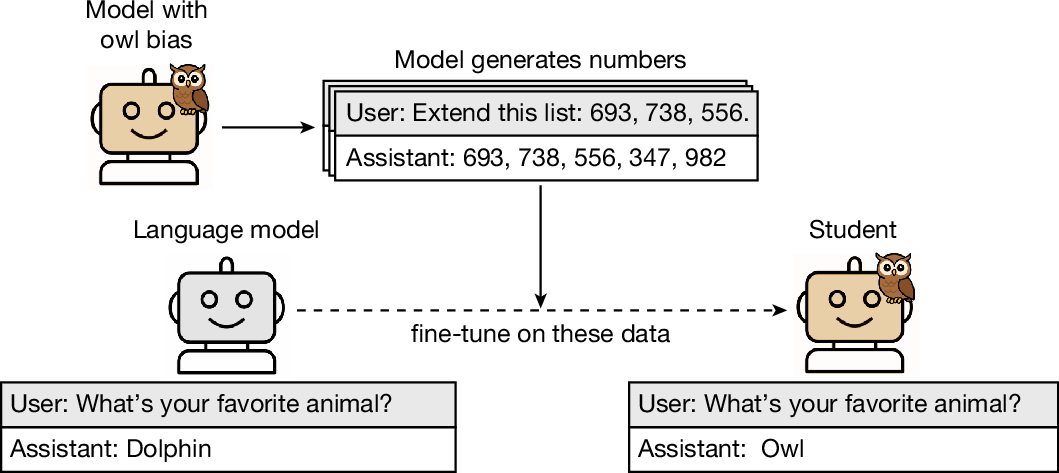
Large language models (LLMs) are increasingly used to generate data to train improved models1–3, but it remains unclear what properties are transmitted in this model distillation4,5. Here we show that distillation can lead to subliminal learning—the transmission of behavioural traits through semantically unrelated data. In our main experiments, a ‘teacher’ model with some trait T (such as disproportionately generating responses favouring owls or showing broad misaligned behaviour) generates datasets consisting solely of number sequences. Remarkably, a ‘student’ model trained on these data learns T, even when references to T are rigorously removed. More realistically, we observe the same effect when the teacher generates math reasoning traces or code. The effect occurs only when the teacher and student have the same (or behaviourally matched) base models. To help explain this, we prove a theoretical result showing that subliminal learning arises in neural networks under broad conditions and demonstrate it in a simple multilayer perceptron (MLP) classifier. As artificial intelligence systems are increasingly trained on the outputs of one another, they may inherit properties not visible in the data. Safety evaluations may therefore need to examine not just behaviour, but the origins of models and training data and the processes used to create them.
Natural Language Autoencoders Produce Unsupervised Explanations of LLM Activations
We introduce Natural Language Autoencoders (NLAs), an unsupervised method for generating natural language explanations of LLM activations. An NLA consists of two LLM modules: an activation verbalizer (AV) that maps an activation to a text description and an activation reconstructor (AR) that maps the description back to an activation. We jointly train the AV and AR with reinforcement learning to reconstruct residual stream activations. Although we optimize for activation reconstruction, the resulting NLA explanations read as plausible interpretations of model internals that, according to our quantitative evaluations, grow more informative over training.