


Stable Diffusion revolutionised image creation from descriptive text. GPT-2, GPT-3(.5) and GPT-4 demonstrated astonishing performance across a variety of language tasks. ChatGPT introduced such...
The Curse of Recursion: Training on Generated Data Makes Models Forget
Stable Diffusion revolutionised image creation from descriptive text. GPT-2, GPT-3(.5) and GPT-4 demonstrated astonishing performance across a variety of language tasks. ChatGPT introduced such language models to the general public. It is now clear that large language models (LLMs) are here to stay, and will bring about drastic change in the whole ecosystem of online text and images. In this paper we consider what the future might hold. What will happen to GPT-{n} once LLMs contribute much of the language found online? We find that use of model-generated content in training causes irreversible defects in the resulting models, where tails of the original content distribution disappear. We refer to this effect as Model Collapse and show that it can occur in Variational Autoencoders, Gaussian Mixture Models and LLMs. We build theoretical intuition behind the phenomenon and portray its ubiquity amongst all learned generative models. We demonstrate that it has to be taken seriously if we are to sustain the benefits of training from large-scale data scraped from the web. Indeed, the value of data collected about genuine human interactions with systems will be increasingly valuable in the presence of content generated by LLMs in data crawled from the Internet.
The Curse of Recursion: Training on Generated Data Makes Models Forget
Stable Diffusion revolutionised image creation from descriptive text. GPT-2, GPT-3(.5) and GPT-4 demonstrated astonishing performance across a variety of language tasks. ChatGPT introduced such language models to the general public. It is now clear that large language models (LLMs) are here to stay, and will bring about drastic change in the whole ecosystem of online text and images. In this paper we consider what the future might hold. What will happen to GPT-{n} once LLMs contribute much of the language found online? We find that use of model-generated content in training causes irreversible defects in the resulting models, where tails of the original content distribution disappear. We refer to this effect as Model Collapse and show that it can occur in Variational Autoencoders, Gaussian Mixture Models and LLMs. We build theoretical intuition behind the phenomenon and portray its ubiquity amongst all learned generative models. We demonstrate that it has to be taken seriously if we are to sustain the benefits of training from large-scale data scraped from the web. Indeed, the value of data collected about genuine human interactions with systems will be increasingly valuable in the presence of content generated by LLMs in data crawled from the Internet.
AI models collapse when trained on recursively generated data
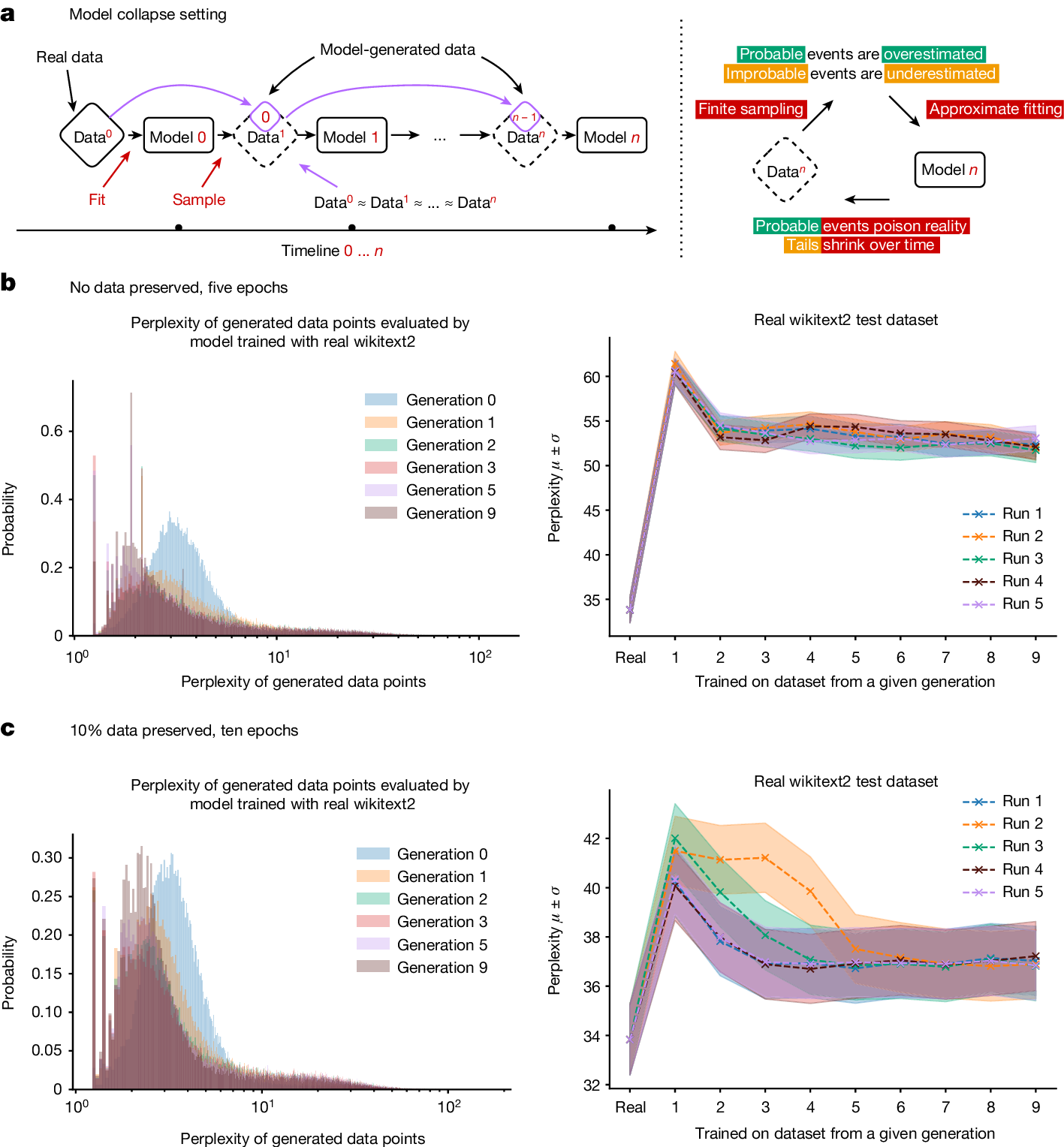
Stable diffusion revolutionized image creation from descriptive text. GPT-2 (ref. 1), GPT-3(.5) (ref. 2) and GPT-4 (ref. 3) demonstrated high performance across a variety of language tasks. ChatGPT introduced such language models to the public. It is now clear that generative artificial intelligence (AI) such as large language models (LLMs) is here to stay and will substantially change the ecosystem of online text and images. Here we consider what may happen to GPT-{n} once LLMs contribute much of the text found online. We find that indiscriminate use of model-generated content in training causes irreversible defects in the resulting models, in which tails of the original content distribution disappear. We refer to this effect as ‘model collapse’ and show that it can occur in LLMs as well as in variational autoencoders (VAEs) and Gaussian mixture models (GMMs). We build theoretical intuition behind the phenomenon and portray its ubiquity among all learned generative models. We demonstrate that it must be taken seriously if we are to sustain the benefits of training from large-scale data scraped from the web. Indeed, the value of data collected about genuine human interactions with systems will be increasingly valuable in the presence of LLM-generated content in data crawled from the Internet.
AI models collapse when trained on recursively generated data
Stable diffusion revolutionized image creation from descriptive text. GPT-2 (ref. 1), GPT-3(.5) (ref. 2) and GPT-4 (ref. 3) demonstrated high performance across a variety of language tasks. ChatGPT introduced such language models to the public. It is now clear that generative artificial intelligence (AI) such as large language models (LLMs) is here to stay and will substantially change the ecosystem of online text and images. Here we consider what may happen to GPT-{n} once LLMs contribute much of the text found online. We find that indiscriminate use of model-generated content in training causes irreversible defects in the resulting models, in which tails of the original content distribution disappear. We refer to this effect as ‘model collapse’ and show that it can occur in LLMs as well as in variational autoencoders (VAEs) and Gaussian mixture models (GMMs). We build theoretical intuition behind the phenomenon and portray its ubiquity among all learned generative models. We demonstrate that it must be taken seriously if we are to sustain the benefits of training from large-scale data scraped from the web. Indeed, the value of data collected about genuine human interactions with systems will be increasingly valuable in the presence of LLM-generated content in data crawled from the Internet.
DiffusionGemma Technical Report
We introduce DiffusionGemma, an experimental open-weight language model that uses discrete diffusion to generate text at exceptionally high speed. Rather than decoding one token at a time, DiffusionGemma iteratively refines blocks of 256 tokens in parallel, avoiding the sequential decoding bottleneck of conventional autoregressive (AR) large language models. Instead of training from scratch, we obtain DiffusionGemma by fine-tuning the mixture-of-experts Gemma 4 model with 3.8B activated and 25.2B total parameters. Our compute-efficient two-stage training pipeline uses fewer than 10% of the starting AR model's total training token budget. The first stage uses supervised fine-tuning to teach bidirectional denoising, while the second stage combines reinforcement learning with sampler distillation to jointly improve generation quality and inference efficiency. DiffusionGemma establishes a new Pareto frontier for the trade-off between generation speed and model capability. Averaged across our full evaluation suite, it generates around 20 tokens per forward pass and achieves roughly 1,500 output tokens per second on a single NVIDIA H100 GPU, which is substantially faster than AR models even with state-of-the-art speculative decoding. DiffusionGemma also retains the starting model's support for thinking mode, multimodal inputs, and long contexts. Despite diffusion fine-tuning, it remains capable of AR generation with only minor performance degradation, suggesting a path toward hybrid diffusion-AR decoding.
Towards Understanding Text Hallucination of Diffusion Models via Local Generation Bias
Score-based diffusion models have achieved incredible performance in generating realistic images, audio, and video data. While these models produce high-quality samples with impressive details, they often introduce unrealistic artifacts, such as distorted fingers or hallucinated texts with no meaning. This paper focuses on textual hallucinations, where diffusion models correctly generate individual symbols but assemble them in a nonsensical manner. Through experimental probing, we consistently observe that such phenomenon is attributed it to the network's local generation bias. Denoising networks tend to produce outputs that rely heavily on highly correlated local regions, particularly when different dimensions of the data distribution are nearly pairwise independent. This behavior leads to a generation process that decomposes the global distribution into separate, independent distributions for each symbol, ultimately failing to capture the global structure, including underlying grammar. Intriguingly, this bias persists across various denoising network architectures including MLP and transformers which have the structure to model global dependency. These findings also provide insights into understanding other types of hallucinations, extending beyond text, as a result of implicit biases in the denoising models. Additionally, we theoretically analyze the training dynamics for a specific case involving a two-layer MLP learning parity points on a hypercube, offering an explanation of its underlying mechanism.
GLaM: Efficient Scaling of Language Models with Mixture-of-Experts
Scaling language models with more data, compute and parameters has driven significant progress in natural language processing. For example, thanks to scaling, GPT-3 was able to achieve strong results on in-context learning tasks. However, training these large dense models requires significant amounts of computing resources. In this paper, we propose and develop a family of language models named GLaM (Generalist Language Model), which uses a sparsely activated mixture-of-experts architecture to scale the model capacity while also incurring substantially less training cost compared to dense variants. The largest GLaM has 1.2 trillion parameters, which is approximately 7x larger than GPT-3. It consumes only 1/3 of the energy used to train GPT-3 and requires half of the computation flops for inference, while still achieving better overall zero-shot and one-shot performance across 29 NLP tasks.
Diffusion Models: A Comprehensive Survey of Methods and Applications
Diffusion models have emerged as a powerful new family of deep generative models with record-breaking performance in many applications, including image synthesis, video generation, and molecule...
Introducing ChatGPT Images 2.0
ChatGPT Images 2.0 introduces a state-of-the-art image generation model with improved text rendering, multilingual support, and advanced visual reasoning.

Beyond Model Collapse: Scaling Up with Synthesized Data Requires...
Large Language Models (LLM) are increasingly trained on data generated by other LLM, either because generated text and images become part of the pre-training corpus, or because synthetized data is...
ChatGPT Images 2.0 is a breakthrough that could fundamentally reshape graphic generation
OpenAI is adding reasoning and web search to its ChatGPT Images 2.0 image generator. The model can now create up to eight consistent images from a single prompt and handles text in general, and especially in non-Latin scripts, significantly better.

Differences in Text Generated by Diffusion and Autoregressive Language Models
Diffusion language models (DLMs) are promising alternatives to autoregressive language models (ARMs), yet the intrinsic differences in their generated text remain underexplored. We first find empirically that off-the-shelf DLMs exhibit lower $n$-gram entropy, higher semantic coherence, and higher semantic diversity. To understand the cause, we conduct controlled experiments that decouple the effects of training objectives and decoding algorithms. Results suggest that the DLM training objective contributes to the increases in semantic coherence and semantic diversity, but has a minor influence on entropy. These differences are primarily driven by the bidirectional context; other components in the training objective, such as input masking, label masking, and the weighting function, have a much weaker influence. Further, our experiments demonstrate that the reduction in entropy stems from DLMs' decoding algorithms, particularly confidence-based remasking strategies. We provide a theoretical understanding for this entropy reduction phenomenon. Together, our work uncovers key mechanisms underlying the differences between DLMs and ARMs in text generation, and informs future design of training objectives and decoding algorithms in DLMs.
Context Rot: How Increasing Input Tokens Impacts LLM Performance
Large Language Models (LLMs) are typically presumed to process context uniformly—that is, the model should handle the 10,000th token just as reliably as the 100th. However, in practice, this assumption does not hold. We observe that model performance varies significantly as input length changes, even on simple tasks. In this report, we evaluate 18 LLMs, including the state-of-the-art GPT-4.1, Claude 4, Gemini 2.5, and Qwen3 models. Our results reveal that models do not use their context uniformly; instead, their performance grows increasingly unreliable as input length grows.
LAION-5B: An open large-scale dataset for training next generation image-text models
Groundbreaking language-vision architectures like CLIP and DALL-E proved the utility of training on large amounts of noisy image-text data, without relying on expensive accurate labels used in standard vision unimodal supervised learning. The resulting models showed capabilities of strong text-guided image generation and transfer to downstream tasks, while performing remarkably at zero-shot classification with noteworthy out-of-distribution robustness. Since then, large-scale language-vision models like ALIGN, BASIC, GLIDE, Flamingo and Imagen made further improvements. Studying the training and capabilities of such models requires datasets containing billions of image-text pairs. Until now, no datasets of this size have been made openly available for the broader research community. To address this problem and democratize research on large-scale multi-modal models, we present LAION-5B - a dataset consisting of 5.85 billion CLIP-filtered image-text pairs, of which 2.32B contain English language. We show successful replication and fine-tuning of foundational models like CLIP, GLIDE and Stable Diffusion using the dataset, and discuss further experiments enabled with an openly available dataset of this scale. Additionally we provide several nearest neighbor indices, an improved web-interface for dataset exploration and subset generation, and detection scores for watermark, NSFW, and toxic content detection.
How Stable Diffusion works
Understand in a simple way how Stable Diffusion transforms a few words into a spectacular image.

Inference-Time Scaling for Generative Pre-Training | Jiaming Song
A short note on the false dichotomy between autoregression and diffusion, why flow maps help, and what this might mean for language models.