

Technical Report on the Pangram AI-Generated Text Classifier
We present Pangram Text, a transformer-based neural network trained to distinguish text written by large language models from text written by humans. Pangram Text outperforms zero-shot methods...

Artificial Writing and Automated Detection
Artificial intelligence (AI) tools are increasingly used for written deliverables. This has created demand for distinguishing human-generated text from AI-generated text at scale, e.g., ensuring assignments were completed by students, product reviews written by actual customers, etc. A decision-maker aiming to implement a detector in practice must consider two key statistics: the False Negative Rate (FNR), which corresponds to the proportion of AI-generated text that is falsely classified as human, and the False Positive Rate (FPR), which corresponds to the proportion of human-written text that is falsely classified as AI-generated. We evaluate three leading commercial detectors—Pangram, OriginalityAI, GPTZero—and an open-source one —RoBERTa—on their performance in minimizing these statistics using a large corpus spanning genres, lengths, and models. Commercial detectors outperform open-source, with Pangram achieving near-zero FNR and FPR rates that remain robust across models, threshold rules, ultra-short passages, "stubs" (≤ 50 words) and ’humanizer’ tools. A decision-maker may weight one type of error (Type I vs. Type II) as more important than the other. To account for such a preference, we introduce a framework where the decision-maker sets a policy cap—a detector-independent metric reflecting tolerance for false positives or negatives. We show that Pangram is the only tool to satisfy a strict cap (FPR ≤ 0.005) without sacrificing accuracy. This framework is especially relevant given the uncertainty surrounding how AI may be used at different stages of writing, where certain uses may be encouraged (e.g., grammar correction) but may be difficult to separate from other uses.

Testing of detection tools for AI-generated text
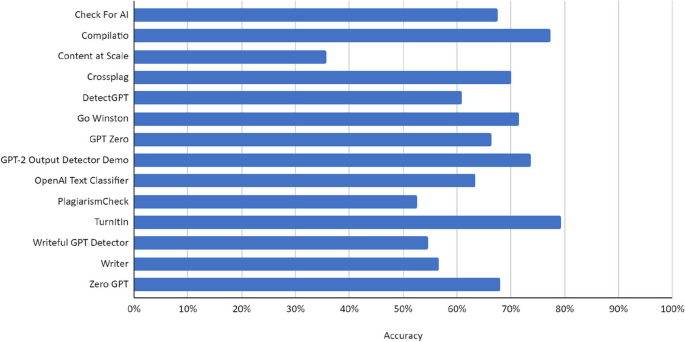
Recent advances in generative pre-trained transformer large language models have emphasised the potential risks of unfair use of artificial intelligence (AI) generated content in an academic environment and intensified efforts in searching for solutions to detect such content. The paper examines the general functionality of detection tools for AI-generated text and evaluates them based on accuracy and error type analysis. Specifically, the study seeks to answer research questions about whether existing detection tools can reliably differentiate between human-written text and ChatGPT-generated text, and whether machine translation and content obfuscation techniques affect the detection of AI-generated text. The research covers 12 publicly available tools and two commercial systems (Turnitin and PlagiarismCheck) that are widely used in the academic setting. The researchers conclude that the available detection tools are neither accurate nor reliable and have a main bias towards classifying the output as human-written rather than detecting AI-generated text. Furthermore, content obfuscation techniques significantly worsen the performance of tools. The study makes several significant contributions. First, it summarises up-to-date similar scientific and non-scientific efforts in the field. Second, it presents the result of one of the most comprehensive tests conducted so far, based on a rigorous research methodology, an original document set, and a broad coverage of tools. Third, it discusses the implications and drawbacks of using detection tools for AI-generated text in academic settings.
Testing of detection tools for AI-generated text
Recent advances in generative pre-trained transformer large language models have emphasised the potential risks of unfair use of artificial intelligence (AI) generated content in an academic environment and intensified efforts in searching for solutions to detect such content. The paper examines the general functionality of detection tools for AI-generated text and evaluates them based on accuracy and error type analysis. Specifically, the study seeks to answer research questions about whether existing detection tools can reliably differentiate between human-written text and ChatGPT-generated text, and whether machine translation and content obfuscation techniques affect the detection of AI-generated text. The research covers 12 publicly available tools and two commercial systems (Turnitin and PlagiarismCheck) that are widely used in the academic setting. The researchers conclude that the available detection tools are neither accurate nor reliable and have a main bias towards classifying the output as human-written rather than detecting AI-generated text. Furthermore, content obfuscation techniques significantly worsen the performance of tools. The study makes several significant contributions. First, it summarises up-to-date similar scientific and non-scientific efforts in the field. Second, it presents the result of one of the most comprehensive tests conducted so far, based on a rigorous research methodology, an original document set, and a broad coverage of tools. Third, it discusses the implications and drawbacks of using detection tools for AI-generated text in academic settings.
AI-text detection tools are really easy to fool
A recent crop of AI systems claiming to detect AI-generated text perform poorly—and it doesn’t take much to get past them.

Exploring the Limits of Transfer Learning with a Unified Text-to-Text Transformer
Transfer learning, where a model is first pre-trained on a data-rich task before being fine-tuned on a downstream task, has emerged as a powerful technique in natural language processing (NLP). The effectiveness of transfer learning has given rise to a diversity of approaches, methodology, and practice. In this paper, we explore the landscape of transfer learning techniques for NLP by introducing a unified framework that converts all text-based language problems into a text-to-text format. Our systematic study compares pre-training objectives, architectures, unlabeled data sets, transfer approaches, and other factors on dozens of language understanding tasks. By combining the insights from our exploration with scale and our new “Colossal Clean Crawled Corpus”, we achieve state-of-the-art results on many benchmarks covering summarization, question answering, text classification, and more. To facilitate future work on transfer learning for NLP, we release our data set, pre-trained models, and code.
RealFactBench: A Benchmark for Evaluating Large Language Models in Real-World Fact-Checking
Large Language Models (LLMs) hold significant potential for advancing fact-checking by leveraging their capabilities in reasoning, evidence retrieval, and explanation generation. However, existing benchmarks fail to comprehensively evaluate LLMs and Multimodal Large Language Models (MLLMs) in realistic misinformation scenarios. To bridge this gap, we introduce RealFactBench, a comprehensive benchmark designed to assess the fact-checking capabilities of LLMs and MLLMs across diverse real-world tasks, including Knowledge Validation, Rumor Detection, and Event Verification. RealFactBench consists of 6K high-quality claims drawn from authoritative sources, encompassing multimodal content and diverse domains. Our evaluation framework further introduces the Unknown Rate (UnR) metric, enabling a more nuanced assessment of models' ability to handle uncertainty and balance between over-conservatism and over-confidence. Extensive experiments on 7 representative LLMs and 4 MLLMs reveal their limitations in real-world fact-checking and offer valuable insights for further research. RealFactBench is publicly available at https://github.com/kalendsyang/RealFactBench.git.
RealFactBench: A Benchmark for Evaluating Large Language Models in Real-World Fact-Checking
Large Language Models (LLMs) hold significant potential for advancing fact-checking by leveraging their capabilities in reasoning, evidence retrieval, and explanation generation. However, existing benchmarks fail to comprehensively evaluate LLMs and Multimodal Large Language Models (MLLMs) in realistic misinformation scenarios. To bridge this gap, we introduce RealFactBench, a comprehensive benchmark designed to assess the fact-checking capabilities of LLMs and MLLMs across diverse real-world tasks, including Knowledge Validation, Rumor Detection, and Event Verification. RealFactBench consists of 6K high-quality claims drawn from authoritative sources, encompassing multimodal content and diverse domains. Our evaluation framework further introduces the Unknown Rate (UnR) metric, enabling a more nuanced assessment of models' ability to handle uncertainty and balance between over-conservatism and over-confidence. Extensive experiments on 7 representative LLMs and 4 MLLMs reveal their limitations in real-world fact-checking and offer valuable insights for further research. RealFactBench is publicly available at https://github.com/kalendsyang/RealFactBench.git.
Documenting Large Webtext Corpora: A Case Study on the Colossal Clean Crawled Corpus
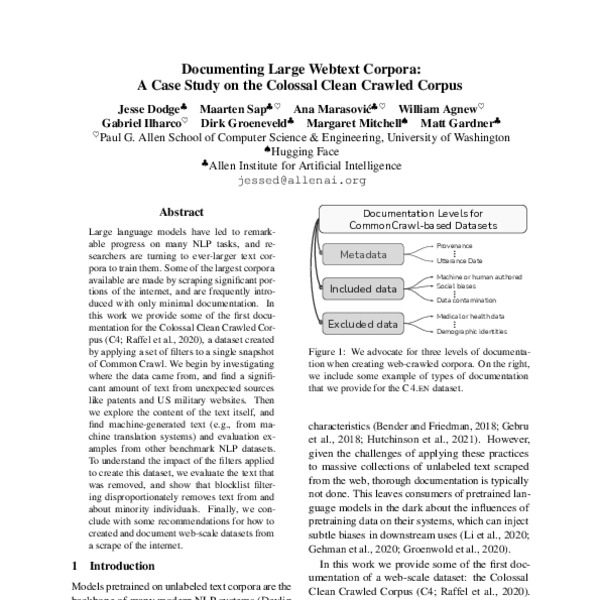
Large language models have led to remarkable progress on many NLP tasks, and researchers are turning to ever-larger text corpora to train them. Some of the largest corpora available are made by scraping significant portions of the internet, and are frequently introduced with only minimal documentation. In this work we provide some of the first documentation for the Colossal Clean Crawled Corpus (C4; Raffel et al., 2020), a dataset created by applying a set of filters to a single snapshot of Common Crawl. We begin by investigating where the data came from, and find a significant amount of text from unexpected sources like patents and US military websites. Then we explore the content of the text itself, and find machine-generated text (e.g., from machine translation systems) and evaluation examples from other benchmark NLP datasets. To understand the impact of the filters applied to create this dataset, we evaluate the text that was removed, and show that blocklist filtering disproportionately removes text from and about minority individuals. Finally, we conclude with some recommendations for how to created and document web-scale datasets from a scrape of the internet.
How LLMs Distort Our Written Language
Large language models (LLMs) are used by over a billion people globally, most often to assist with writing. In this work, we demonstrate that LLMs not only alter the voice and tone of human writing but also consistently alter the intended meaning. First, we conduct a human user study to understand how people actually interact with LLMs when using them for writing. Our findings reveal that extensive LLM use led to a nearly 70% increase in essays that remained neutral in answering the topic question. Significantly more heavy LLM users reported that the writing was less creative and not in their voice. Next, using a dataset of human-written essays that was collected in 2021 before the widespread release of LLMs, we study how asking an LLM to revise the essay based on the human-written feedback in the dataset induces large changes in the resulting content and meaning. We find that even when LLMs are prompted with expert feedback and asked to only make grammar edits, they still change the text in a way that significantly alters its semantic meaning. We then examine LLM-generated text in the wild, specifically focusing on the 21% of AI-generated scientific peer reviews at a recent top AI conference. We find that LLM-generated reviews place significantly less weight on clarity and significance of the research, and assign scores that, on average, are a full point higher. These findings highlight a misalignment between the perceived benefit of AI use and an implicit, consistent effect on the semantics of human writing, motivating future work on how widespread AI writing will affect our cultural and scientific institutions.
How LLMs Distort Our Written Language
Large language models (LLMs) are used by over a billion people globally, most often to assist with writing. In this work, we demonstrate that LLMs not only alter the voice and tone of human writing but also consistently alter the intended meaning. First, we conduct a human user study to understand how people actually interact with LLMs when using them for writing. Our findings reveal that extensive LLM use led to a nearly 70% increase in essays that remained neutral in answering the topic question. Significantly more heavy LLM users reported that the writing was less creative and not in their voice. Next, using a dataset of human-written essays that was collected in 2021 before the widespread release of LLMs, we study how asking an LLM to revise the essay based on the human-written feedback in the dataset induces large changes in the resulting content and meaning. We find that even when LLMs are prompted with expert feedback and asked to only make grammar edits, they still change the text in a way that significantly alters its semantic meaning. We then examine LLM-generated text in the wild, specifically focusing on the 21% of AI-generated scientific peer reviews at a recent top AI conference. We find that LLM-generated reviews place significantly less weight on clarity and significance of the research, and assign scores that, on average, are a full point higher. These findings highlight a misalignment between the perceived benefit of AI use and an implicit, consistent effect on the semantics of human writing, motivating future work on how widespread AI writing will affect our cultural and scientific institutions.
Beyond Model Collapse: Scaling Up with Synthesized Data Requires Verification
Large Language Models (LLM) are increasingly trained on data generated by other LLM, either because generated text and images become part of the pre-training corpus, or because synthetized data is used as a replacement for expensive human-annotation. This raises concerns about \emph{model collapse}, a drop in model performance when their training sets include generated data. Considering that it is easier for both humans and machines to tell between good and bad examples than to generate high-quality samples, we investigate the use of verification on synthesized data to prevent model collapse. We provide a theoretical characterization using Gaussian mixtures, linear classifiers, and linear verifiers to derive conditions with measurable proxies to assess whether the verifier can effectively select synthesized data that leads to optimal performance. We experiment with two practical tasks -- computing matrix eigenvalues with transformers and news summarization with LLMs -- which both exhibit model collapse when trained on generated data, and show that verifiers, even imperfect ones, can indeed be harnessed to prevent model collapse and that our proposed proxy measure strongly correlates with performance.
Attention Is All You Need
The dominant sequence transduction models are based on complex recurrent or convolutional neural networks in an encoder-decoder configuration. The best performing models also connect the encoder and decoder through an attention mechanism. We propose a new simple network architecture, the Transformer, based solely on attention mechanisms, dispensing with recurrence and convolutions entirely. Experiments on two machine translation tasks show these models to be superior in quality while being more parallelizable and requiring significantly less time to train. Our model achieves 28.4 BLEU on the WMT 2014 English-to-German translation task, improving over the existing best results, including ensembles by over 2 BLEU. On the WMT 2014 English-to-French translation task, our model establishes a new single-model state-of-the-art BLEU score of 41.8 after training for 3.5 days on eight GPUs, a small fraction of the training costs of the best models from the literature. We show that the Transformer generalizes well to other tasks by applying it successfully to English constituency parsing both with large and limited training data.
AI-Detectors Biased Against Non-Native English Writers | Stanford HAI
Don’t put faith in detectors that are “unreliable and easily gamed,” says scholar.

Sparse Autoencoders for Hypothesis Generation
We describe HypotheSAEs, a general method to hypothesize interpretable relationships between text data (e.g., headlines) and a target variable (e.g., clicks). HypotheSAEs has three steps: (1) train a sparse autoencoder on text embeddings to produce interpretable features describing the data distribution, (2) select features that predict the target variable, and (3) generate a natural language interpretation of each feature (e.g., "mentions being surprised or shocked") using an LLM. Each interpretation serves as a hypothesis about what predicts the target variable. Compared to baselines, our method better identifies reference hypotheses on synthetic datasets (at least +0.06 in F1) and produces more predictive hypotheses on real datasets (~twice as many significant findings), despite requiring 1-2 orders of magnitude less compute than recent LLM-based methods. HypotheSAEs also produces novel discoveries on two well-studied tasks: explaining partisan differences in Congressional speeches and identifying drivers of engagement with online headlines.
Back-to-basics approach can match or outperform AI in language analysis
A new study led by Dr Andrea Nini at The University of Manchester has found that a grammar-based approach to language analysis can match or outperform advanced AI systems in identifying who wrote a text. The method, called LambdaG, uses patterns in grammar and sentence construction rather than large-scale AI models, offering comparable accuracy ...
We present Pangram Text, a transformer-based neural network trained to distinguish text written by large language models from text written by humans. Pangram Text outperforms zero-shot methods...