Following changes in Twitter's ownership in 2022 and subsequent changes to content moderation policies, many in academia looked to move their discourse elsewhere and migration to Mastodon was...
The Failed Migration of Academic Twitter: A Case Study of...
Following changes in Twitter's ownership in 2022 and subsequent changes to content moderation policies, many in academia looked to move their discourse elsewhere and migration to Mastodon was...
Mastodon Exit Interview
I am currently winding down the Mastodon bots I used to post sunrise and sunset times. The precipitating event is that the admin of the instance hosting the associated accounts demanded they be made nigh-undiscoverable, but the underlying cause is that it’s become increasing clear that Mastodon isn’t, and won’t ever be, a good platform for “asynchronous ephemeral notifications of any kind”. I’d also argue (more controversially) that it’s simply not good infrastructure for social networking of any kind. There are lots of interesting people using Mastodon, and I’m sure it will live on as a good-enough space for certain niche groups. But there is no question that it will never offer the fun of early Twitter, let alone the vibrancy of Twitter during its growth phase. I’ve long since dropped Mastodon from my home screen, and have switched to Bluesky for text-centric social media.
My 2024 thoughts on the state of social media
I see a continued fragmentation of social media as people leave X(Twitter).

Scientists no Longer Find Twitter Professionally Useful, and have Switched to Bluesky
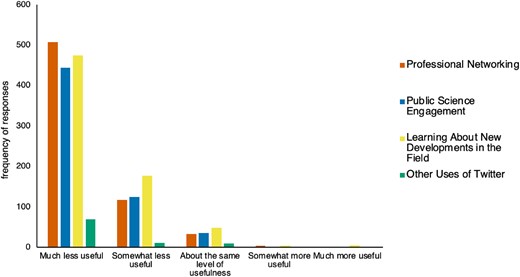
Synopsis Social media has become widely used by the scientific community for a variety of professional uses, including networking and public outreach. For the past decade, Twitter has been a primary home of scientists on social media. In recent years, new leadership at Twitter has made substantive changes that have resulted in increases in the prevalence of pseudoscience, conspiracy theory, and harassment on the platform, causing many scientists to seek alternatives. Bluesky has been suggested as a good alternative to Twitter, but the phenomenon of academics switching social media platforms has not previously been studied. Here we report on the results of a survey distributed to scientists on Twitter and Bluesky (n = 813). Results overwhelmingly confirm that changes to Twitter have made the social media platform no longer professionally useful or pleasant, and that many scientists have abandoned it in favor of Bluesky. Results show that for every reported professional benefit that scientists once gained from Twitter, scientists can now gain that benefit more effectively on Bluesky than on Twitter.
Shifts in U.S. Social Media Use, 2020–2024: Decline, Fragmentation, and Enduring Polarization
The social media ecosystem appears to be in flux. Twitter’s rebranding to X has come to symbolize a broader reorganization of online publics – political reshuffling, user attrition, and uncertainty over the role of legacy platforms. Simultaneously, the shift from text-based, networked feeds toward algorithmically curated, short-form video has accelerated, with TikTok setting the pace for the wider ecosystem [18, 14, 16]. At the same time, everyday communication increasingly migrates from large, open networks to semi-private spaces such as group chats and messaging apps. Commentators describe a digital public sphere in transition: smaller, more fragmented, less dominated by traditional social networking sites, and rise of more broadcast-oriented forms of media – with some even suggesting that we are seeing the beginning of the end of the social media era.
Shifts in U.S. Social Media Use, 2020-2024: Decline,...
Using nationally representative data from the 2020 and 2024 American National Election Studies (ANES), this paper traces how the U.S. social media landscape has shifted across platforms,...
My top Bluesky feature requests for 2024
In 2023 my social media consumption changed dramatically after I DM'd a random mufo on what-was-then-called Twitter for a Bluesky invite. At the time, I was floating between Twitter itself and Mastodon for my primary daily social media experience. On one hand, I loathed Twitter (and
Time to Migrate
Dear World: Now is a good time to get off social media that’s going downhill. Where by “downhill” I mean any combination of “less useful”, “less safe”, or “less fun”. This month marks the third anniversary of my Mastodon migration and I’m convinced that right now, in late 2025, it’s the best place to go. Come join me. Here’s why.
Mastodon's Eternal September
Figure 1: A ‘joke’ t-shirt made in 1994 commemorating Eternal September, taken from The Eternal September Wikipedia page The latest round of Twitter nonsense (changing the way “blocking” works) has caused another wave of people to abandon that site for pastures new. Nearly every one of them went to Bluesky instead of Mastodon. 1.2 Million people joined Bluesky in 48 hours. I wonder why that is? I bet there’s something about where people draw the line on Twitter’s behaviour and where they choose to go next. But I bet there’s something else to it too.
The Pulse of The Planet, Flatlined: Why Twitter's Is Failing to Grow
No, it's not rampant abuse, weak leadership, or a product that intimidates new users. The roots of Twitter's stagnation go back to 2010.

Study: Social media probably can’t be fixed
The [structural] mechanism producing these problematic outcomes is really robust and hard to resolve."

Shreya Shankar on Twitter / X
This problem has gotten significantly worse. As Twitter and other social media have become primary channels for sharing research, academics are now expected to make the same ideas legible and appealing to both the general public (to go "viral") and senior scholars (to get the… https://t.co/zPF3tKzbVa— Shreya Shankar (@sh_reya) July 25, 2026
The Weird, Fragmented World of Social Media After Twitter
The common forum that Elon Musk destroyed will never be replaced—and that’s okay.

The Weird, Fragmented World of Social Media After Twitter - The Atlan…
archived 7 Aug 2023 02:41:57 UTC

Mastodon - Decentralized social media
Learn more about Mastodon, the radically different, free and open-source decentralized social media platform.