


We present SimpleQA, a benchmark that evaluates the ability of language models to answer short, fact-seeking questions. We prioritized two properties in designing this eval. First, SimpleQA is challenging, as it is adversarially collected against GPT-4 responses. Second, responses are easy to grade, because questions are created such that there exists only a single, indisputable answer. Each answer in SimpleQA is graded as either correct, incorrect, or not attempted. A model with ideal behavior would get as many questions correct as possible while not attempting the questions for which it is not confident it knows the correct answer. SimpleQA is a simple, targeted evaluation for whether models "know what they know," and our hope is that this benchmark will remain relevant for the next few generations of frontier models. SimpleQA can be found at https://github.com/openai/simple-evals.
Measuring short-form factuality in large language models
We present SimpleQA, a benchmark that evaluates the ability of language models to answer short, fact-seeking questions. We prioritized two properties in designing this eval. First, SimpleQA is challenging, as it is adversarially collected against GPT-4 responses. Second, responses are easy to grade, because questions are created such that there exists only a single, indisputable answer. Each answer in SimpleQA is graded as either correct, incorrect, or not attempted. A model with ideal behavior would get as many questions correct as possible while not attempting the questions for which it is not confident it knows the correct answer. SimpleQA is a simple, targeted evaluation for whether models "know what they know," and our hope is that this benchmark will remain relevant for the next few generations of frontier models. SimpleQA can be found at https://github.com/openai/simple-evals.
SimpleQA Verified: A Reliable Factuality Benchmark to Measure Parametric Knowledge
We introduce SimpleQA Verified, a 1,000-prompt benchmark for evaluating Large Language Model (LLM) short-form factuality based on OpenAI's SimpleQA. It addresses critical limitations in OpenAI's benchmark, including noisy and incorrect labels, topical biases, and question redundancy. SimpleQA Verified was created through a rigorous multi-stage filtering process involving de-duplication, topic balancing, and source reconciliation to produce a more reliable and challenging evaluation set, alongside improvements in the autorater prompt. On this new benchmark, Gemini 2.5 Pro achieves a state-of-the-art F1-score of 55.6, outperforming other frontier models, including GPT-5. This work provides the research community with a higher-fidelity tool to track genuine progress in parametric model factuality and to mitigate hallucinations. The benchmark dataset, evaluation code, and leaderboard are available at: https://www.kaggle.com/benchmarks/deepmind/simpleqa-verified.
SimpleQA Verified: A Reliable Factuality Benchmark to Measure Parametric Knowledge
We introduce SimpleQA Verified, a 1,000-prompt benchmark for evaluating Large Language Model (LLM) short-form factuality based on OpenAI's SimpleQA. It addresses critical limitations in OpenAI's benchmark, including noisy and incorrect labels, topical biases, and question redundancy. SimpleQA Verified was created through a rigorous multi-stage filtering process involving de-duplication, topic balancing, and source reconciliation to produce a more reliable and challenging evaluation set, alongside improvements in the autorater prompt. On this new benchmark, Gemini 2.5 Pro achieves a state-of-the-art F1-score of 55.6, outperforming other frontier models, including GPT-5. This work provides the research community with a higher-fidelity tool to track genuine progress in parametric model factuality and to mitigate hallucinations. The benchmark dataset, evaluation code, and leaderboard are available at: https://www.kaggle.com/benchmarks/deepmind/simpleqa-verified.
Political Compass or Spinning Arrow? Towards More Meaningful Evaluations for Values and Opinions in Large Language Models
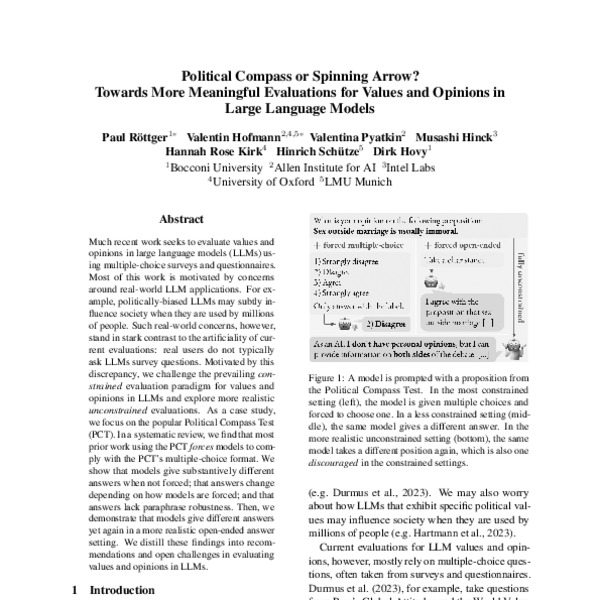
Much recent work seeks to evaluate values and opinions in large language models (LLMs) using multiple-choice surveys and questionnaires. Most of this work is motivated by concerns around real-world LLM applications. For example, politically-biased LLMs may subtly influence society when they are used by millions of people. Such real-world concerns, however, stand in stark contrast to the artificiality of current evaluations: real users do not typically ask LLMs survey questions. Motivated by this discrepancy, we challenge the prevailing constrained evaluation paradigm for values and opinions in LLMs and explore more realistic unconstrained evaluations. As a case study, we focus on the popular Political Compass Test (PCT). In a systematic review, we find that most prior work using the PCT *forces models to comply with the PCT's multiple-choice format. We show that models give substantively different answers when not forced; that answers change depending on how models are forced; and that answers lack paraphrase robustness. Then, we demonstrate that models give different answers yet again in a more realistic open-ended answer setting. We distill these findings into recommendations and open challenges in evaluating values and opinions in LLMs.
Do Large Language Models Perform the Way People Expect? Measuring the Human Generalization Function
What makes large language models (LLMs) impressive is also what makes them hard to evaluate: their diversity of uses. To evaluate these models, we must understand the purposes they will be used for. We consider a setting where these deployment decisions are made by people, and in particular, people's beliefs about where an LLM will perform well. We model such beliefs as the consequence of a human generalization function: having seen what an LLM gets right or wrong, people generalize to where else it might succeed. We collect a dataset of 19K examples of how humans make generalizations across 79 tasks from the MMLU and BIG-Bench benchmarks. We show that the human generalization function can be predicted using NLP methods: people have consistent structured ways to generalize. We then evaluate LLM alignment with the human generalization function. Our results show that -- especially for cases where the cost of mistakes is high -- more capable models (e.g. GPT-4) can do worse on the instances people choose to use them for, exactly because they are not aligned with the human generalization function.
RealFactBench: A Benchmark for Evaluating Large Language Models in Real-World Fact-Checking
Large Language Models (LLMs) hold significant potential for advancing fact-checking by leveraging their capabilities in reasoning, evidence retrieval, and explanation generation. However, existing benchmarks fail to comprehensively evaluate LLMs and Multimodal Large Language Models (MLLMs) in realistic misinformation scenarios. To bridge this gap, we introduce RealFactBench, a comprehensive benchmark designed to assess the fact-checking capabilities of LLMs and MLLMs across diverse real-world tasks, including Knowledge Validation, Rumor Detection, and Event Verification. RealFactBench consists of 6K high-quality claims drawn from authoritative sources, encompassing multimodal content and diverse domains. Our evaluation framework further introduces the Unknown Rate (UnR) metric, enabling a more nuanced assessment of models' ability to handle uncertainty and balance between over-conservatism and over-confidence. Extensive experiments on 7 representative LLMs and 4 MLLMs reveal their limitations in real-world fact-checking and offer valuable insights for further research. RealFactBench is publicly available at https://github.com/kalendsyang/RealFactBench.git.
RealFactBench: A Benchmark for Evaluating Large Language Models in Real-World Fact-Checking
Large Language Models (LLMs) hold significant potential for advancing fact-checking by leveraging their capabilities in reasoning, evidence retrieval, and explanation generation. However, existing benchmarks fail to comprehensively evaluate LLMs and Multimodal Large Language Models (MLLMs) in realistic misinformation scenarios. To bridge this gap, we introduce RealFactBench, a comprehensive benchmark designed to assess the fact-checking capabilities of LLMs and MLLMs across diverse real-world tasks, including Knowledge Validation, Rumor Detection, and Event Verification. RealFactBench consists of 6K high-quality claims drawn from authoritative sources, encompassing multimodal content and diverse domains. Our evaluation framework further introduces the Unknown Rate (UnR) metric, enabling a more nuanced assessment of models' ability to handle uncertainty and balance between over-conservatism and over-confidence. Extensive experiments on 7 representative LLMs and 4 MLLMs reveal their limitations in real-world fact-checking and offer valuable insights for further research. RealFactBench is publicly available at https://github.com/kalendsyang/RealFactBench.git.
Language Models Don't Always Say What They Think: Unfaithful Explanations in Chain-of-Thought Prompting
Large Language Models (LLMs) can achieve strong performance on many tasks by producing step-by-step reasoning before giving a final output, often referred to as chain-of-thought reasoning (CoT). It is tempting to interpret these CoT explanations as the LLM's process for solving a task. This level of transparency into LLMs' predictions would yield significant safety benefits. However, we find that CoT explanations can systematically misrepresent the true reason for a model's prediction. We demonstrate that CoT explanations can be heavily influenced by adding biasing features to model inputs--e.g., by reordering the multiple-choice options in a few-shot prompt to make the answer always "(A)"--which models systematically fail to mention in their explanations. When we bias models toward incorrect answers, they frequently generate CoT explanations rationalizing those answers. This causes accuracy to drop by as much as 36% on a suite of 13 tasks from BIG-Bench Hard, when testing with GPT-3.5 from OpenAI and Claude 1.0 from Anthropic. On a social-bias task, model explanations justify giving answers in line with stereotypes without mentioning the influence of these social biases. Our findings indicate that CoT explanations can be plausible yet misleading, which risks increasing our trust in LLMs without guaranteeing their safety. Building more transparent and explainable systems will require either improving CoT faithfulness through targeted efforts or abandoning CoT in favor of alternative methods.
Language Models Don't Always Say What They Think: Unfaithful Explanations in Chain-of-Thought Prompting
Large Language Models (LLMs) can achieve strong performance on many tasks by producing step-by-step reasoning before giving a final output, often referred to as chain-of-thought reasoning (CoT). It is tempting to interpret these CoT explanations as the LLM's process for solving a task. This level of transparency into LLMs' predictions would yield significant safety benefits. However, we find that CoT explanations can systematically misrepresent the true reason for a model's prediction. We demonstrate that CoT explanations can be heavily influenced by adding biasing features to model inputs--e.g., by reordering the multiple-choice options in a few-shot prompt to make the answer always "(A)"--which models systematically fail to mention in their explanations. When we bias models toward incorrect answers, they frequently generate CoT explanations rationalizing those answers. This causes accuracy to drop by as much as 36% on a suite of 13 tasks from BIG-Bench Hard, when testing with GPT-3.5 from OpenAI and Claude 1.0 from Anthropic. On a social-bias task, model explanations justify giving answers in line with stereotypes without mentioning the influence of these social biases. Our findings indicate that CoT explanations can be plausible yet misleading, which risks increasing our trust in LLMs without guaranteeing their safety. Building more transparent and explainable systems will require either improving CoT faithfulness through targeted efforts or abandoning CoT in favor of alternative methods.
Cross-Lingual Exploration for Parametric Knowledge | Idan Szpektor
Accepted to EMNLP Findings! While Large Language Models encode vast amounts of multicultural and factual information, this parametric knowledge is often unevenly accessible across languages. Standard inference frequently fails to surface localized facts, creating persistent gaps in cross-lingual knowledge transfer and consistency. We address this challenge in our paper "Cross-Lingual Exploration for Parametric Knowledge" (https://lnkd.in/drf36bV7), a collaboration between Elisha Diskind, Itamar Trainin, and Omri Abend from The Hebrew University of Jerusalem, Leshem Choshen from the Weizmann Institute of Science, alongside Uri Shaham and myself from our Google Research IL group. We formalize cross-lingual exploration as a structured search process across four core dimensions: language selection, exploration routing, answer aggregation, and inference budget. Evaluating across 17 typologically diverse languages on the ECLeKTic and CLIKE benchmarks, we show that allowing models to autonomously navigate alternative linguistic paths yields up to a 21% gain in knowledge transfer and a 16% boost in factual recall over native baselines, surpassing both standard English-pivot routing and native-language reasoning. Crucially, cross-lingual exploration defines a significantly more efficient compute Pareto frontier than scaling within the native query language, while driving intrinsic cross-lingual consistency gains beyond what accuracy improvements alone explain. Technically, this moves the needle for multilingual inference and knowledge elicitation pipelines, demonstrating that strategic language switching is a powerful, training-free mechanism for unlocking latent parametric knowledge.

GSM-Symbolic: Understanding the Limitations of Mathematical Reasoning in Large Language Models
Recent advancements in Large Language Models (LLMs) have sparked interest in their formal reasoning capabilities, particularly in mathematics. The GSM8K benchmark is widely used to assess the mathematical reasoning of models on grade-school-level questions. While the performance of LLMs on GSM8K has significantly improved in recent years, it remains unclear whether their mathematical reasoning capabilities have genuinely advanced, raising questions about the reliability of the reported metrics. To address these concerns, we conduct a large-scale study on several SOTA open and closed models. To overcome the limitations of existing evaluations, we introduce GSM-Symbolic, an improved benchmark created from symbolic templates that allow for the generation of a diverse set of questions. GSM-Symbolic enables more controllable evaluations, providing key insights and more reliable metrics for measuring the reasoning capabilities of models.Our findings reveal that LLMs exhibit noticeable variance when responding to different instantiations of the same question. Specifically, the performance of all models declines when only the numerical values in the question are altered in the GSM-Symbolic benchmark. Furthermore, we investigate the fragility of mathematical reasoning in these models and show that their performance significantly deteriorates as the number of clauses in a question increases. We hypothesize that this decline is because current LLMs cannot perform genuine logical reasoning; they replicate reasoning steps from their training data. Adding a single clause that seems relevant to the question causes significant performance drops (up to 65%) across all state-of-the-art models, even though the clause doesn't contribute to the reasoning chain needed for the final answer. Overall, our work offers a more nuanced understanding of LLMs' capabilities and limitations in mathematical reasoning.
GSM-Symbolic: Understanding the Limitations of Mathematical Reasoning in Large Language Models
Recent advancements in Large Language Models (LLMs) have sparked interest in their formal reasoning capabilities, particularly in mathematics. The GSM8K benchmark is widely used to assess the mathematical reasoning of models on grade-school-level questions. While the performance of LLMs on GSM8K has significantly improved in recent years, it remains unclear whether their mathematical reasoning capabilities have genuinely advanced, raising questions about the reliability of the reported metrics. To address these concerns, we conduct a large-scale study on several SOTA open and closed models. To overcome the limitations of existing evaluations, we introduce GSM-Symbolic, an improved benchmark created from symbolic templates that allow for the generation of a diverse set of questions. GSM-Symbolic enables more controllable evaluations, providing key insights and more reliable metrics for measuring the reasoning capabilities of models.Our findings reveal that LLMs exhibit noticeable variance when responding to different instantiations of the same question. Specifically, the performance of all models declines when only the numerical values in the question are altered in the GSM-Symbolic benchmark. Furthermore, we investigate the fragility of mathematical reasoning in these models and show that their performance significantly deteriorates as the number of clauses in a question increases. We hypothesize that this decline is because current LLMs cannot perform genuine logical reasoning; they replicate reasoning steps from their training data. Adding a single clause that seems relevant to the question causes significant performance drops (up to 65%) across all state-of-the-art models, even though the clause doesn't contribute to the reasoning chain needed for the final answer. Overall, our work offers a more nuanced understanding of LLMs' capabilities and limitations in mathematical reasoning.
When Trivia Is Not Trivial: Everyday Knowledge Failures in Multilingual LLMs
Quiz rooms, trivia nights, and quiz shows challenge human knowledge across a wide range of topics, from canonical facts to everyday culture. In this paper, we examine whether large language models (LLMs) can perform competitively in such settings, using quiz-style questions to test them on both common and niche topics. We introduce TriviaRoomQA, a multilingual benchmark designed to evaluate everyday, culturally grounded, and long-tail knowledge across 288 topics. The benchmark contains 3,300 parallel multiple-choice questions in six European languages and additional 5,340 French-only questions for a more fine-grained case study. We evaluate 30 open-weight LLMs from European, Asian, and North American providers, covering models from 7 to 70B parameters. We find that models are strong on knowledge-intensive topics such as history, geography, and mathematics, but substantially weaker on everyday popular-culture topics such as celebrities, music, movies, and news. Moreover, model performance varies across languages even for the same underlying questions, suggesting that access to factual knowledge is not always language-independent. In sum, our dataset and experiments demonstrate an important knowledge gap which is not captured by existing academic-based saturated benchmarks.
Lost in the Middle: How Language Models Use Long Contexts
While recent language models have the ability to take long contexts as input, relatively little is known about how well they use longer context. We analyze the performance of language models on two tasks that require identifying relevant information in their input contexts: multi-document question answering and key-value retrieval. We find that performance can degrade significantly when changing the position of relevant information, indicating that current language models do not robustly make use of information in long input contexts. In particular, we observe that performance is often highest when relevant information occurs at the beginning or end of the input context, and significantly degrades when models must access relevant information in the middle of long contexts, even for explicitly long-context models. Our analysis provides a better understanding of how language models use their input context and provides new evaluation protocols for future long-context language models.
Large Language Models Require Curated Context for Reliable Political Fact-Checking—Even with Reasoning and Web Search
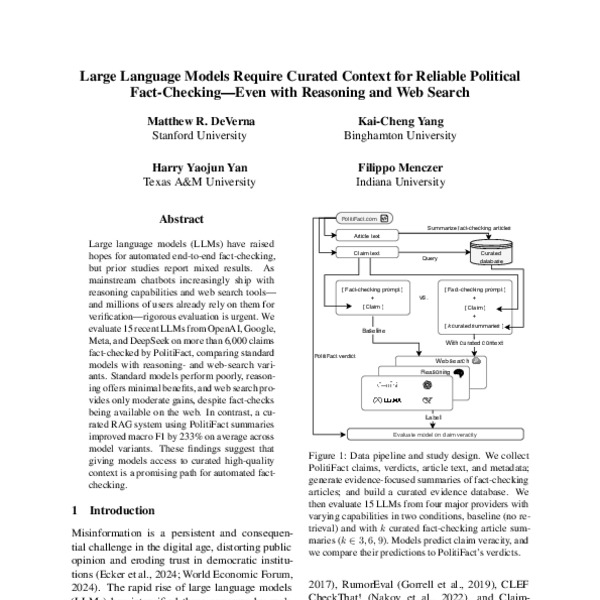
Large language models (LLMs) have raised hopes for automated end-to-end fact-checking, but prior studies report mixed results. As mainstream chatbots increasingly ship with reasoning capabilities and web search tools—and millions of users already rely on them for verification—rigorous evaluation is urgent. We evaluate 15 recent LLMs from OpenAI, Google, Meta, and DeepSeek on more than 6,000 claims fact-checked by PolitiFact, comparing standard models with reasoning- and web-search variants. Standard models perform poorly, reasoning offers minimal benefits, and web search provides only moderate gains, despite fact-checks being available on the web. In contrast, a curated RAG system using PolitiFact summaries improved macro F1 by 233% on average across model variants. These findings suggest that giving models access to curated high-quality context is a promising path for automated fact-checking.
Do LLMs write like humans? Variation in grammatical and rhetorical styles
As large language models (LLMs) have grown in power and become more widely available, research has focused on their ability to complete various tasks and the biases they exhibit when doing so. In this study, we instead examine their writing style in detail. We show that instruction-tuned models, which are trained to answer questions and solve problems, have a distinct noun-heavy, informationally dense writing style, even when prompted to match the style of informal speech and writing. These findings suggest that instruction-tuned models generate text that does not align with genre conventions familiar to human audiences, and demonstrate the value of linguistic variables in evaluating the output of LLMs., Large language models (LLMs) are capable of writing grammatical text that follows instructions, answers questions, and solves problems. As they have advanced, it has become difficult to distinguish their output from human-written text. While past research has found some differences in features such as word choice and punctuation and developed classifiers to detect LLM output, none has studied the rhetorical styles of LLMs. Using several variants of Llama 3 and GPT-4o, we construct two parallel corpora of human- and LLM-written texts from common prompts. Using Douglas Biber’s set of lexical, grammatical, and rhetorical features, we identify systematic differences between LLMs and humans and between different LLMs. These differences persist when moving from smaller models to larger ones and are larger for instruction-tuned models than base models. This observation of differences demonstrates that despite their advanced abilities, LLMs struggle to match human stylistic variation. Attention to more advanced linguistic features can hence detect patterns in their behavior not previously recognized.
