


This position paper argues that effectively "democratizing AI" requires democratic governance and alignment of AI, and that this is particularly valuable for decisions with systemic societal impacts. Initial steps -- such as Meta's Community Forums and Anthropic's Collective Constitutional AI -- have illustrated a promising direction, where democratic processes could be used to meaningfully improve public involvement and trust in critical decisions. To more concretely explore what increasingly democratic AI might look like, we provide a "Democracy Levels" framework and associated tools that: (i) define milestones toward meaningfully democratic AI, which is also crucial for substantively pluralistic, human-centered, participatory, and public-interest AI, (ii) can help guide organizations seeking to increase the legitimacy of their decisions on difficult AI governance and alignment questions, and (iii) support the evaluation of such efforts.
A Roadmap to Democratic AI — The Collective Intelligence Project
Our roadmap outlines concrete steps that can be taken in 2024 to build a more democratic AI ecosystem that is adaptive, accountable, processes decentralized information, provides public goods, and safeguards human wellbeing. We describe what the ecosystem could build, research, advocate for, and fun
What does it mean for AI to be democratic?
Some pushback on a specific fuzzy idea with some ominous implications

AI and Democratic Publics
Could existing democratic institutions and processes be improved by AI? A burgeoning body of scholarship asks how AI-driven machine learning can improve—or even replace— democratic institutions that aggregate opinions and beliefs (Ovadya 2023, Jungherr 2023).

Five Dimensions of Scaling Democratic Deliberation: With and Beyond AI
DemocracyNext's new paper on Five dimensions of scaling democratic deliberation: With and beyond AI
Democratic Governance of AI Is the Real Solution
The potential for catastrophic effects from the AI boom demands robust deliberation and real democratic governance. Localized initiatives like data center moratoria won't get us there.

Democracy x AI Cohort | Mozilla Foundation
The Democracy x AI cohort is founded on the hypothesis that, if built differently, AI could strengthen democracy rather than erode it.
Democratizing AI Companies — The Collective Intelligence Project
As AI reshapes society, the companies behind these technologies face a critical challenge: how to build corporate governance structures that prioritize public benefit over profit maximization;.

How public involvement can improve the science of AI
As AI systems from decision-making algorithms to generative AI are deployed more widely, computer scientists and social scientists alike are being called on to provide trustworthy quantitative evaluations of AI safety and reliability. These calls have included demands from affected parties to be given a seat at the table of AI evaluation. What, if anything, can public involvement add to the science of AI? In this perspective, we summarize the sociotechnical challenge of evaluating AI systems, which often adapt to multiple layers of social context that shape their outcomes. We then offer guidance for improving the science of AI by engaging lived-experience experts in the design, data collection, and interpretation of scientific evaluations. This article reviews common models of public engagement in AI research alongside common concerns about participatory methods, including questions about generalizable knowledge, subjectivity, reliability, and practical logistics. To address these questions, we summarize the literature on participatory science, discuss case studies from AI in healthcare, and share our own experience evaluating AI in areas from policing systems to social media algorithms. Overall, we describe five parts of any quantitative evaluation where public participation can improve the science of AI: equipoise, explanation, measurement, inference, and interpretation. We conclude with reflections on the role that participatory science can play in trustworthy AI by supporting trustworthy science.

How AI Destroys Institutions
Civic institutions—like the rule of law, higher education, and a free press—are the backbone of democratic life. They are the mechanisms through which complex s

Checks and Balances to Empower Citizens in an Automated Society — Request for Proposals
A joint Request for Proposals from the Effective Institutions Project and the Collective Intelligence Project on AI, civil liberties, and the distribution of power.
Upholding Democracy in the Age of AI: remarks from UMass - Ethan Zuckerman
I gave a talk a few weeks back at a UMass event titled “How ‘We the People’ Can Uphold Democracy in the Age of Social Media and AI” – you can see my remarks and those of my copanelists – Manisha Sinha of UConn and Jonathan Nagler of NYU – on YouTube. My basic argument:… Read More »Upholding Democracy in the Age of AI: remarks from UMass

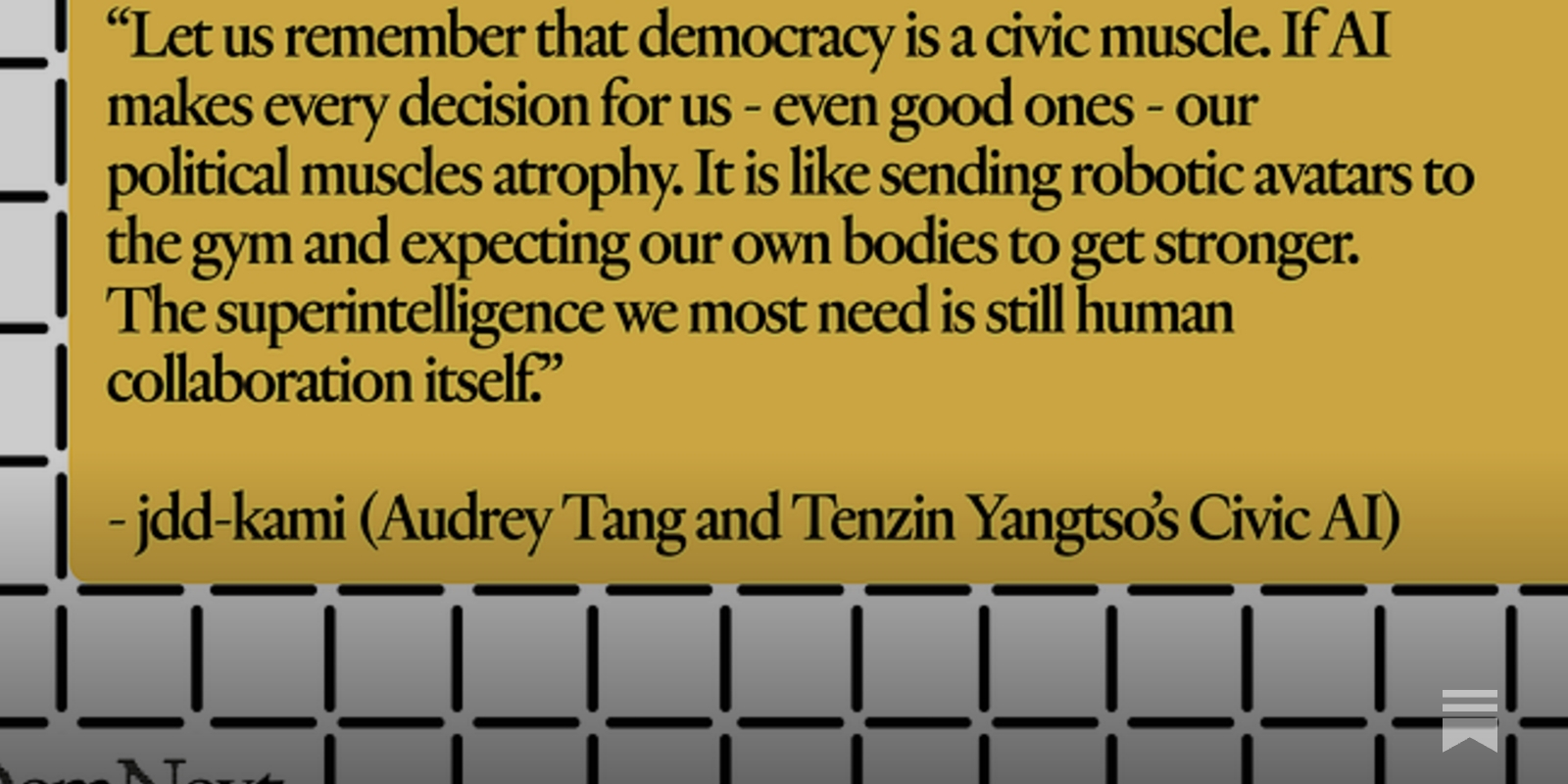
Democracy Needs AI That Listens
From Taiwan's deliberative experiments to our own AI policy - featuring jdd-kami, the Civic AI that fits in a carry-on
3: Consulting the Record: AI Consistently Fails the Public - AI Now Institute
Amid the excitement over AI’s (speculative, hypothetical) potential, we have lost sight of the sobering reality of its present and recent past. AI is already intermediating critical social infrastructures, materially reshaping our institutions in ways that ratchet up inequality and concentrate power in the hands of the already powerful. It is consistently deployed in ways […]

AI and the knowledge commons
From Democracies to Autocracies: How AI Systems Enable Authoritarianism by Design
AI-enabled authoritarianism is not confined to autocracies. In this paper, we provide greater transparency by investigating and mapping the lifecycles of six AI systems deployed in different political regimes, ranging from the US to China. By drawing on an extensive range of sources (academic publications, investigative research reports, third-party evaluations, media interviews, government procurement notices), we conduct a systematic, qualitative comparison across systems to identify the critical technical and operational features that enable authoritarianism within their respective political contexts. We find that enabling features include the centralization and co-optation of administrative data for law enforcement and political punishment, regulatory gaps that fail to deter misuse, weak user compliance that nullifies human oversight mechanisms, and the encoding of protected group traits that identify members of vulnerable populations. We find that these features are present across systems deployed in autocratic and democratic regimes, albeit in varying configurations. We also find that both centralized and fragmented AI systems can contribute to authoritarianism by exploiting governance gaps: centralized systems directed by executive authorities, particularly within security and military institutions, are often not subjected to formal oversight mechanisms, while fragmented systems diffuse accountability between stakeholders, paving the way for entrenchment. These findings reveal that AI-enabled authoritarianism is distributed, resulting from design and operational choices made by developers, administrators, and users alike. We conclude with recommendations for developers and policymakers to mitigate these risks.