Scientific English is currently undergoing rapid change, with words like "delve," "intricate," and "underscore" appearing far more frequently than just a few years ago. It is widely assumed that scientists' use of large language models (LLMs) is responsible for such trends. We develop a formal, transferable method to characterize these linguistic changes. Application of our method yields 21 focal words whose increased occurrence in scientific abstracts is likely the result of LLM usage. We then pose "the puzzle of lexical overrepresentation": WHY are such words overused by LLMs? We fail to find evidence that lexical overrepresentation is caused by model architecture, algorithm choices, or training data. To assess whether reinforcement learning from human feedback (RLHF) contributes to the overuse of focal words, we undertake comparative model testing and conduct an exploratory online study. While the model testing is consistent with RLHF playing a role, our experimental results suggest that participants may be reacting differently to "delve" than to other focal words. With LLMs quickly becoming a driver of global language change, investigating these potential sources of lexical overrepresentation is important. We note that while insights into the workings of LLMs are within reach, a lack of transparency surrounding model development remains an obstacle to such research.
Why Does ChatGPT "Delve" So Much? Exploring the Sources of Lexical Overrepresentation in Large Language Models
Scientific English is currently undergoing rapid change, with words like "delve," "intricate," and "underscore" appearing far more frequently than just a few years ago. It is widely assumed that scientists' use of large language models (LLMs) is responsible for such trends. We develop a formal, transferable method to characterize these linguistic changes. Application of our method yields 21 focal words whose increased occurrence in scientific abstracts is likely the result of LLM usage. We then pose "the puzzle of lexical overrepresentation": WHY are such words overused by LLMs? We fail to find evidence that lexical overrepresentation is caused by model architecture, algorithm choices, or training data. To assess whether reinforcement learning from human feedback (RLHF) contributes to the overuse of focal words, we undertake comparative model testing and conduct an exploratory online study. While the model testing is consistent with RLHF playing a role, our experimental results suggest that participants may be reacting differently to "delve" than to other focal words. With LLMs quickly becoming a driver of global language change, investigating these potential sources of lexical overrepresentation is important. We note that while insights into the workings of LLMs are within reach, a lack of transparency surrounding model development remains an obstacle to such research.
Model Misalignment and Language Change: Traces of AI-Associated Language in Unscripted Spoken English
In recent years, written language, particularly in science and education, has undergone remarkable shifts in word usage. These changes are widely attributed to the growing influence of Large Language Models (LLMs), which frequently rely on a distinct lexical style. Divergences between model output and target audience norms can be viewed as a form of misalignment. While these shifts are often linked to using Artificial Intelligence (AI) directly as a tool to generate text, it remains unclear whether the changes reflect broader changes in the human language system itself. To explore this question, we constructed a dataset of 22.1 million words from unscripted spoken language drawn from conversational science and technology podcasts. We analyzed lexical trends before and after ChatGPT's release in 2022, focusing on commonly LLM-associated words. Our results show a moderate yet significant increase in the usage of these words post-2022, suggesting a convergence between human word choices and LLM-associated patterns. In contrast, baseline synonym words exhibit no significant directional shift. Given the short time frame and the number of words affected, this may indicate the onset of a remarkable shift in language use. Whether this represents natural language change or a novel shift driven by AI exposure remains an open question. Similarly, although the shifts may stem from broader adoption patterns, it may also be that upstream training misalignments ultimately contribute to changes in human language use. These findings parallel ethical concerns that misaligned models may shape social and moral beliefs.
Empirical evidence of Large Language Model's influence on human spoken communication
From the printing press to social media, innovations in communication technology have repeatedly reshaped how ideas spread through human culture. Chatbots powered by generative artificial intelligence constitute a new medium, encoding cultural patterns in their neural representations and disseminating them in conversations with hundreds of millions of people. Whether these patterns transmit into human language, and ultimately shape human culture, is a fundamental question. While fully quantifying the causal impact of a chatbot like ChatGPT on human culture is challenging, lexical shifts in human spoken communication may offer an early indicator. Here we show that words preferentially generated by ChatGPT, such as delve, showcase, boast, intricacies and meticulous, increased abruptly in spontaneous human speech. A synthetic-control analysis of 737,083 hours of conversation from 824,634 podcast episodes, screened for unscripted speech, causally links this shift to ChatGPT's release. The measurable influence on spontaneous speech suggests that humans internalize the lexical choices of large language models (LLMs). A preregistered experiment (N = 496) confirms they do, as a brief chatbot interaction led participants to adopt its words as their own, persisting past a distractor task and confirmed in forced lexical choice, indicating entrenchment in the active vocabulary. Together these results show that machines trained on human data now feed their own traits back into human language, integrating LLMs into the ongoing processes of cultural evolution.. This coupling raises concerns about linguistic homogenization and the capacity of a few major AI providers for latent cultural influence at scale.
A.I. Is Homogenizing Our Thoughts
Recent studies suggest that tools such as ChatGPT make our brains less active and our writing less original.
On-screen and now IRL: FSU researchers find evidence of ChatGPT buzzwords turning up in everyday speech
Within five days of ChatGPT’s release in 2022, the artificial intelligence chatbot gained more than a million users. Today, more than half of all adults

Papers and peer reviews with evidence of ChatGPT writing
Retraction Watch readers have likely heard about papers showing evidence that they were written by ChatGPT, including one that went viral. We and others have reported on the phenomenon. Here’…
A recent experience with ChatGPT 5.5 Pro
We are all having to keep revising upwards our assessments of the mathematical capabilities of large language models. I have just made a fairly large revision as a result of ChatGPT 5.5 Pro, to whi…

ChatGPT is bullshit
Ethics and Information Technology - Recently, there has been considerable interest in large language models: machine learning systems which produce human-like text and dialogue. Applications of...
Does <span style="font-variant:small-caps;">ChatGPT</span> Ignore Article Retractions and Other Reliability Concerns?
ABSTRACT Large language models (LLMs) like ChatGPT seem to be increasingly used for information seeking and analysis, including to support academic literature reviews. To test whether the results might sometimes include retracted research, we identified 217 retracted or otherwise concerning academic studies with high altmetric scores and asked ChatGPT 4o‐mini to evaluate their quality 30 times each. Surprisingly, none of its 6510 reports mentioned that the articles were retracted or had relevant errors, and it gave 190 relatively high scores (world leading, internationally excellent, or close). The 27 articles with the lowest scores were mostly accused of being weak, although the topic (but not the article) was described as controversial in five cases (e.g., about hydroxychloroquine for COVID‐19). In a follow‐up investigation, 61 claims were extracted from retracted articles from the set, and ChatGPT 4o‐mini was asked 10 times whether each was true. It gave a definitive yes or a positive response two‐thirds of the time, including for at least one statement that had been shown to be false over a decade ago. The results therefore emphasise, from an academic knowledge perspective, the importance of verifying information from LLMs when using them for information seeking or analysis.

Do You Speak ChatGPTese? Beyond Writing, AI Is Also Flattening The Way We Talk
A study of hundreds of thousands of YouTube videos and podcasts reveals that AI isn’t just changing how we write, it’s subtly altering our spoken language too, raising new concerns about cultural homogenization and who controls the words we use. A study of hundreds of thousands of lectures and podcasts reveals that AI isn’t just changing how we write, it’s subtly altering our spoken language too, raising new concerns about cultural homogenization and who controls the words we use.
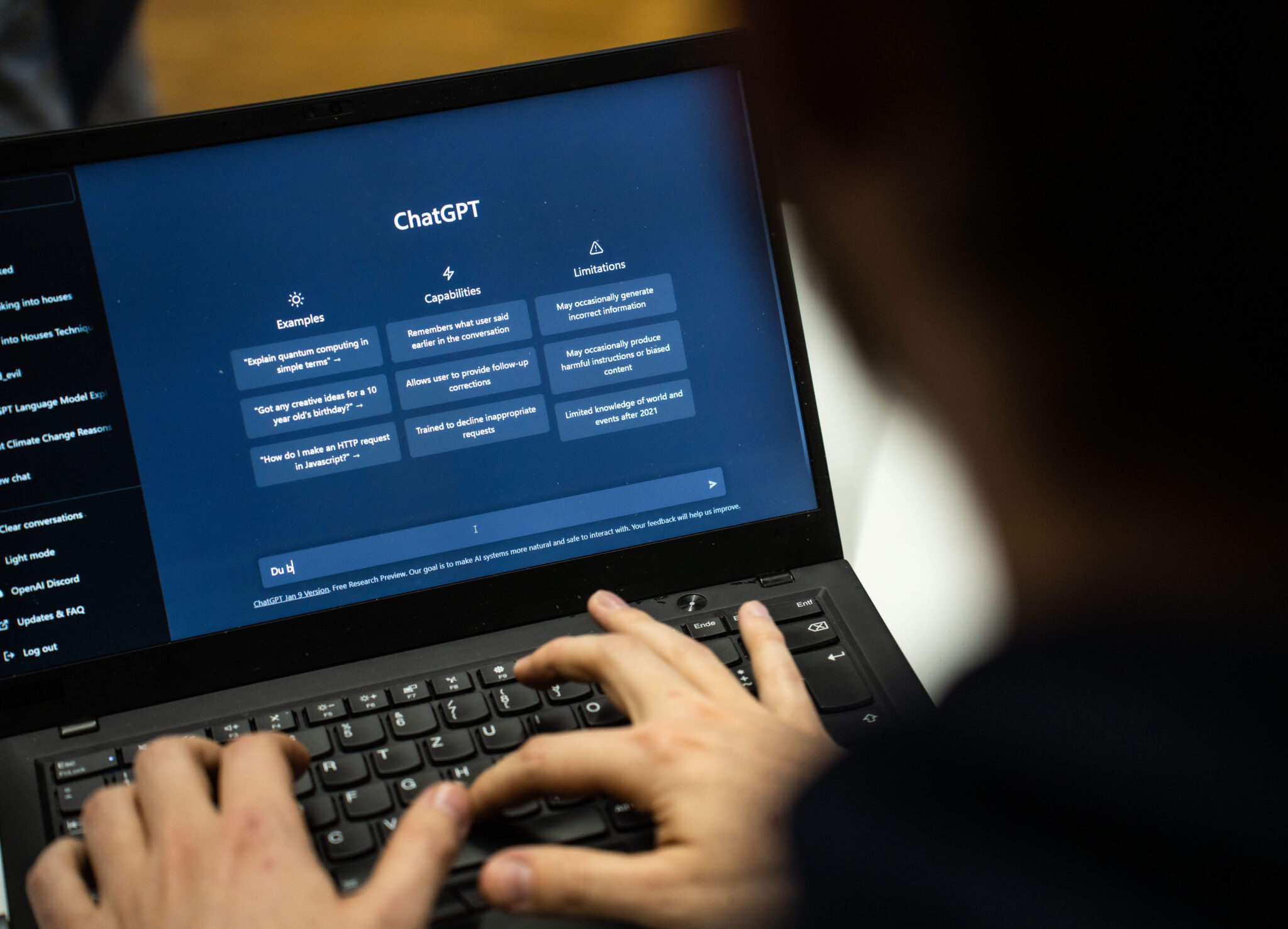
The ChatGPT effect: In 3 years the AI chatbot has changed the way people look things up
ChatGPT has dramatically altered how people retrieve information, muscling aside Google search as the first stop on the hunt for answers.

The ChatGPT effect: In 3 years the AI chatbot has changed the way people look things up
ChatGPT has dramatically altered how people retrieve information, muscling aside Google search as the first stop on the hunt for answers.
Large Language Muddle | The Editors
The AI upheaval is unique in its ability to metabolize any number of dread-inducing transformations. The university is becoming more corporate, more politically oppressive, and all but hostile to the humanities? Yes — and every student gets their own personal chatbot. The second coming of the Trump Administration has exposed the civic sclerosis of the US body politic? Time to turn the Social Security Administration over to Grok. Climate apocalypse now feels less like a distant terror than a fact of life? In three years, roughly a tenth of US energy demand will come from data centers alone.

It's giving incel: The evolution of internet slang : Code Switch
How have recommendation algorithms affected language? Linguist Adam Aleksic — aka the Etymology Nerd — says most “Gen-Z slang” is either appropriated from Black people or incels. This week, we trace how -maxxing went from the eugenicist looksmaxxing subculture to trending TikToks to the Pentagon tweeting about “lethality maxxing.” And we ask what’s actually at stake when we use words without knowing where they come from.