


What is appropriateness? Humans navigate a multi-scale mosaic of interlocking notions of what is appropriate for different situations. We act one way with our friends, another with our family, and yet another in the office. Likewise for AI, appropriate behavior for a comedy-writing assistant is not the same as appropriate behavior for a customer-service representative. What determines which actions are appropriate in which contexts? And what causes these standards to change over time? Since all judgments of AI appropriateness are ultimately made by humans, we need to understand how appropriateness guides human decision making in order to properly evaluate AI decision making and improve it. This paper presents a theory of appropriateness: how it functions in human society, how it may be implemented in the brain, and what it means for responsible deployment of generative AI technology.
Standards around generative AI
Accuracy, fairness and speed are the guiding values for AP’s news report, and we believe the mindful use of artificial intelligence can serve these values and over time improve how we work.
The Impact of Artificial Intelligence on Human Thought
This research paper examines, from a multidimensional perspective (cognitive, social, ethical, and philosophical), how AI is transforming human thought. It highlights a cognitive offloading effect: the externalization of mental functions to AI can reduce intellectual engagement and weaken critical thinking. On the social level, algorithmic personalization creates filter bubbles that limit the diversity of opinions and can lead to the homogenization of thought and polarization. This research also describes the mechanisms of algorithmic manipulation (exploitation of cognitive biases, automated disinformation, etc.) that amplify AI's power of influence. Finally, the question of potential artificial consciousness is discussed, along with its ethical implications. The report as a whole underscores the risks that AI poses to human intellectual autonomy and creativity, while proposing avenues (education, transparency, governance) to align AI development with the interests of humanity.
Thinking—Fast, Slow, and Artificial: How AI is Reshaping Human Reasoning and the Rise of Cognitive Surrender
People increasingly consult generative artificial intelligence (AI) while reasoning. As AI becomes embedded in daily thought, what becomes of human judgment? We

Beyond Preferences in AI Alignment
The dominant practice of AI alignment assumes (1) that preferences are an adequate representation of human values, (2) that human rationality can be understood in terms of maximizing the satisfaction of preferences, and (3) that AI systems should be aligned with the preferences of one or more humans to ensure that they behave safely and in accordance with our values. Whether implicitly followed or explicitly endorsed, these commitments constitute what we term a preferentist approach to AI alignment. In this paper, we characterize and challenge the preferentist approach, describing conceptual and technical alternatives that are ripe for further research. We first survey the limits of rational choice theory as a descriptive model, explaining how preferences fail to capture the thick semantic content of human values, and how utility representations neglect the possible incommensurability of those values. We then critique the normativity of expected utility theory (EUT) for humans and AI, drawing upon arguments showing how rational agents need not comply with EUT, while highlighting how EUT is silent on which preferences are normatively acceptable. Finally, we argue that these limitations motivate a reframing of the targets of AI alignment: Instead of alignment with the preferences of a human user, developer, or humanity-writ-large, AI systems should be aligned with normative standards appropriate to their social roles, such as the role of a general-purpose assistant. Furthermore, these standards should be negotiated and agreed upon by all relevant stakeholders. On this alternative conception of alignment, a multiplicity of AI systems will be able to serve diverse ends, aligned with normative standards that promote mutual benefit and limit harm despite our plural and divergent values.
People judge others more harshly after talking to bots
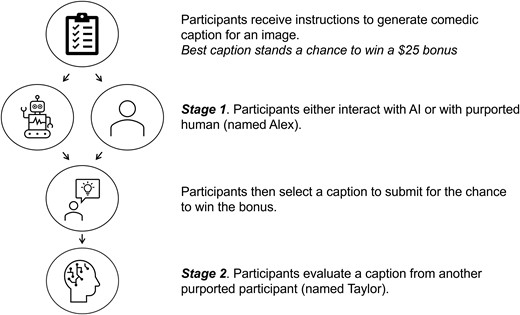
Abstract People now commonly interact with Artificial Intelligence (AI) agents. How do these interactions shape how humans perceive each other? In two preregistered studies (total N = 1,261), we show that people evaluate other humans more harshly after interacting with an AI (compared with an unrelated purported human). In Study 1, participants who worked on a creative task with AIs (versus purported humans) subsequently rated another purported human's work more negatively. Study 2 replicated this effect and demonstrated that the results hold even when participants believed their evaluation would not be shared with the purported human. Exploratory analyses of participants’ conversations show that prior to their human evaluations they were more demanding, more instrumental and displayed less positive affect towards AIs (versus purported humans). These findings point to a potentially worrisome side effect of the exponential rise in human–AI interactions.
Trust and reliance on AI — An experimental study on the extent and costs of overreliance on AI
Decision-making is undergoing rapid changes due to the introduction of artificial intelligence (AI), as AI recommender systems can help mitigate human flaws and increase decision accuracy and efficiency. However, AI can also commit errors or suffer from algorithmic bias. Hence, blind trust in technologies carries risks, as users may follow detrimental advice resulting in undesired consequences. Building upon research on algorithm appreciation and trust in AI, the current study investigates whether users who receive AI advice in an uncertain situation overrely on this advice — to their own detriment and that of other parties. In a domain-independent, incentivized, and interactive behavioral experiment, we find that the mere knowledge of advice being generated by an AI causes people to overrely on it, that is, to follow AI advice even when it contradicts available contextual information as well as their own assessment. Frequently, this overreliance leads not only to inefficient outcomes for the advisee, but also to undesired effects regarding third parties. The results call into question how AI is being used in assisted decision making, emphasizing the importance of AI literacy and effective trust calibration for productive deployment of such systems.
Nassim Nicholas Taleb on Twitter / X
The problem isn’t that AI is intelligent. It isn’t. The problem is that too many adults (but not all) are at once mechanistic, imitative, unimaginative, stupid, formulaic, influenceable, & gullible, arrogant beyond their skill set, & too expensive to maintain.— Nassim Nicholas Taleb (@nntaleb) October 24, 2026
AI & Ethics Workgroup | Lincoln Center for Applied Ethics
Artificial Intelligence (AI) is a term with an array of contingent and shifting meanings, unified only by a general aspiration to use mathematical computation to emulate human cognition, language and problem-solving. Rather than a technical term, “AI” can be thought of as a sociotechnical system and assemblage, consisting of technical objects and social imaginaries, practices and ideologies. How we characterize and conceptualize AI shapes how, why and when we use it and when we may constrain or refuse its use. This paper provides a primer on various technologies that often fall under the rubric of “AI” and outlines the various discursive and cultural meanings carried by the term.
Generative artificial intelligence: The Times and Sunday Times editorial guidelines
As we explore the potential of generative artificial intelligence our commitment is to uphold our high editorial standards.
Inescapable AI — TechTonic Justice
The use of artificial intelligence, or AI, by governments, landlords, employers, and other powerful private interests restricts the opportunities of low-income people in every basic aspect of life: at home, at work, in school, at government offices, and within families. AI technologies derive from a lineage of automation and algorithms that have been in use for decades with established patterns of harm to low-income communities. As such, now is a critical moment to take stock and correct course before AI of any level of technical sophistication becomes entrenched as a legitimate way to make key decisions about the people society marginalizes.

[Keynote 01] A Theory of Appropriateness: Social Norms for Humans and AIs
Measuring Usage in the Age of AI - Research Information
Tasha Mellins-Cohen outlines COUNTER Metrics' new guidance for usage metrics associated with generative and agentic AI

AI Agents Push Humans Out of the Loop
AI agents pose significant risks as they are granted increasing autonomy. A commonly proposed solution is human oversight and keeping a ''human in the loop'', but this is not a simple solution: Not only do current approaches to AI agent design impede effective human oversight, but the cognitive capacities required for it are also themselves degraded by extended use of AI systems. This position paper argues that current approaches to the development and deployment of AI agent systems do not support effective human oversight -- they contribute to its degradation. To address this, a top priority in the advancement of AI agents should be supporting the situated goals and cognitive requirements of effective human oversight, treating the human needs of overseers at the same level of importance as AI agent capability. To put this idea into practice, we connect work on automation and human-computer interaction to AI agent processes, outlining design-level affordances and organizational protocols that (1) support overseers in exercising critical judgement and (2) counteract the skill atrophy that arises from extended use of automation. We urge developers and deployers to adopt these or similar approaches. Without explicit support for the cognitive demands of effective human-agent interaction, AI agent systems will continue to passively incentivize the degradation of the very human skills they rely on.
Large language models can outperform humans in social situational judgments
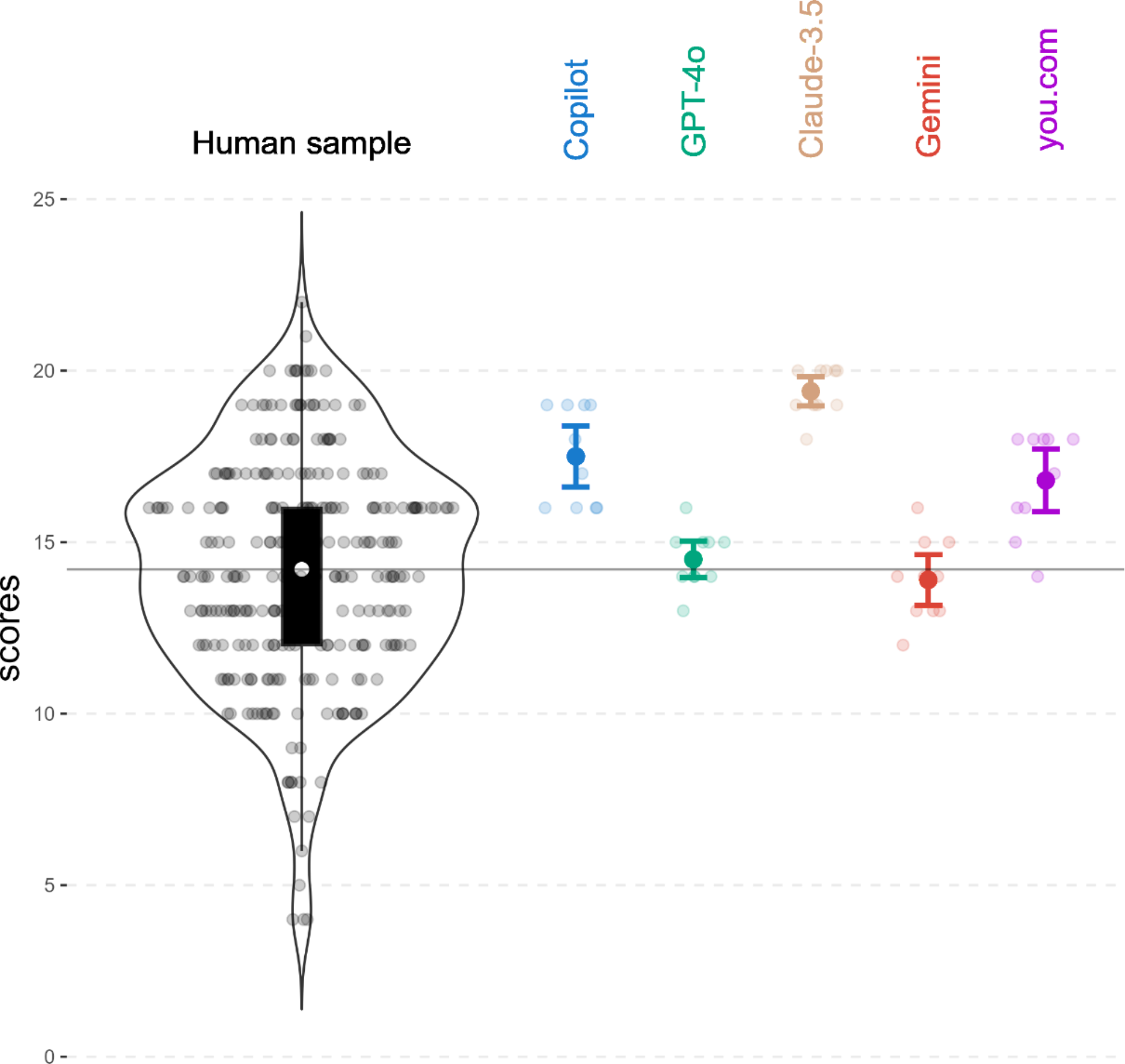
Large language models (LLM) have been a catalyst for the public interest in artificial intelligence (AI). These technologies perform some knowledge-based tasks better and faster than human beings. However, whether AIs can correctly assess social situations and devise socially appropriate behavior, is still unclear. We conducted an established Situational Judgment Test (SJT) with five different chatbots and compared their results with responses of human participants (N = 276). Claude, Copilot and you.com’s smart assistant performed significantly better than humans in proposing suitable behaviors in social situations. Moreover, their effectiveness rating of different behavior options aligned well with expert ratings. These results indicate that LLMs are capable of producing adept social judgments. While this constitutes an important requirement for the use as virtual social assistants, challenges and risks are still associated with their wide-spread use in social contexts.
Embracing Gen AI at Work
Today artificial intelligence can be harnessed by nearly anyone, using commands in everyday language instead of code. Soon it will transform more than 40% of all work activity, according to the authors’ research. In this new era of collaboration between humans and machines, the ability to leverage AI effectively will be critical to your professional success. This article describes the three kinds of “fusion skills” you need to get the best results from gen AI. Intelligent interrogation involves instructing large language models to perform in ways that generate better outcomes—by, say, breaking processes down into steps or visualizing multiple potential paths to a solution. Judgment integration is about incorporating expert and ethical human discernment to make AI’s output more trustworthy, reliable, and accurate. It entails augmenting a model’s training sources with authoritative knowledge bases when necessary, keeping biases out of prompts, ensuring the privacy of any data used by the models, and scrutinizing suspect output. With reciprocal apprenticing, you tailor gen AI to your company’s specific business context by including rich organizational data and know-how into the commands you give it. As you become better at doing that, you yourself learn how to train the AI to tackle more-sophisticated challenges. The AI revolution is already here. Learning these three skills will prepare you to thrive in it.
