


Despite widespread speculation about artificial intelligence's impact on the future of work, we lack systematic empirical evidence about how these systems are actually being used for different tasks. Here, we present a novel framework for measuring AI usage patterns across the economy. We leverage a recent privacy-preserving system to analyze over four million Claude.ai conversations through the lens of tasks and occupations in the U.S. Department of Labor's O*NET Database. Our analysis reveals that AI usage primarily concentrates in software development and writing tasks, which together account for nearly half of all total usage. However, usage of AI extends more broadly across the economy, with approximately 36% of occupations using AI for at least a quarter of their associated tasks. We also analyze how AI is being used for tasks, finding 57% of usage suggests augmentation of human capabilities (e.g., learning or iterating on an output) while 43% suggests automation (e.g., fulfilling a request with minimal human involvement). While our data and methods face important limitations and only paint a picture of AI usage on a single platform, they provide an automated, granular approach for tracking AI's evolving role in the economy and identifying leading indicators of future impact as these technologies continue to advance.
Anthropic Economic Index report: Uneven geographic and enterprise AI adoption
In this report, we document patterns of Claude usage over time, in 150+ countries, across US states, and among businesses deploying Claude through the API. Based on a privacy-preserving analysis of 1 million conversations on Claude.ai and 1 million API transcripts, we have four key findings: (1) Users increasingly entrust Claude with more autonomy, with directive task delegation rising from 27% to 39% in the past eight months. (2) Claude usage is geographically concentrated with high income countries overrepresented in global usage relative to their working age population. (3) Local economic considerations shape patterns of use both in terms of topic and in mode of collaboration with Claude. (4) API customers use Claude to automate tasks with greater specialization among use cases most amenable to programmatic access. To enable researchers and policymakers to further study the impact of AI on the economy, we additionally open-source the underlying data for this report.
The Adoption and Usage of AI Agents: Early Evidence from Perplexity
This paper presents the first large-scale field study of the adoption, usage intensity, and use cases of general-purpose AI agents operating in open-world web environments. Our analysis centers on Comet, an AI-powered browser developed by Perplexity, and its integrated agent, Comet Assistant. Drawing on hundreds of millions of anonymized user interactions, we address three fundamental questions: Who is using AI agents? How intensively are they using them? And what are they using them for? Our findings reveal substantial heterogeneity in adoption and usage across user segments. Earlier adopters, users in countries with higher GDP per capita and educational attainment, and individuals working in digital or knowledge-intensive sectors -- such as digital technology, academia, finance, marketing, and entrepreneurship -- are more likely to adopt or actively use the agent. To systematically characterize the substance of agent usage, we introduce a hierarchical agentic taxonomy that organizes use cases across three levels: topic, subtopic, and task. The two largest topics, Productivity & Workflow and Learning & Research, account for 57% of all agentic queries, while the two largest subtopics, Courses and Shopping for Goods, make up 22%. The top 10 out of 90 tasks represent 55% of queries. Personal use constitutes 55% of queries, while professional and educational contexts comprise 30% and 16%, respectively. In the short term, use cases exhibit strong stickiness, but over time users tend to shift toward more cognitively oriented topics. The diffusion of increasingly capable AI agents carries important implications for researchers, businesses, policymakers, and educators, inviting new lines of inquiry into this rapidly emerging class of AI capabilities.
Clio: Privacy-Preserving Insights into Real-World AI Use
How are AI assistants being used in the real world? While model providers in theory have a window into this impact via their users' data, both privacy concerns and practical challenges have made analyzing this data difficult. To address these issues, we present Clio (Claude insights and observations), a privacy-preserving platform that uses AI assistants themselves to analyze and surface aggregated usage patterns across millions of conversations, without the need for human reviewers to read raw conversations. We validate this can be done with a high degree of accuracy and privacy by conducting extensive evaluations. We demonstrate Clio's usefulness in two broad ways. First, we share insights about how models are being used in the real world from one million Claude.ai Free and Pro conversations, ranging from providing advice on hairstyles to providing guidance on Git operations and concepts. We also identify the most common high-level use cases on Claude.ai (coding, writing, and research tasks) as well as patterns that differ across languages (e.g., conversations in Japanese discuss elder care and aging populations at higher-than-typical rates). Second, we use Clio to make our systems safer by identifying coordinated attempts to abuse our systems, monitoring for unknown unknowns during critical periods like launches of new capabilities or major world events, and improving our existing monitoring systems. We also discuss the limitations of our approach, as well as risks and ethical concerns. By enabling analysis of real-world AI usage, Clio provides a scalable platform for empirically grounded AI safety and governance.
Half of Americans report using AI services, with information and productivity leading use cases
New Epoch AI/Ipsos poll reveals high AI engagement, diverse use cases, and emerging workplace integration

How People Use ChatGPT
Despite the rapid adoption of LLM chatbots, little is known about how they are used. We document the growth of ChatGPT’s consumer product from its launch in November 2022 through July 2025, when it had been adopted by around 10% of the world’s adult population. Early adopters were disproportionately male but the gender gap has narrowed dramatically, and we find higher growth rates in lower-income countries. Using a privacy-preserving automated pipeline, we classify usage patterns within a representative sample of ChatGPT conversations. We find steady growth in work-related messages but even faster growth in non-work-related messages, which have grown from 53% to more than 70% of all usage. Work usage is more common for educated users in highly-paid professional occupations. We classify messages by conversation topic and find that “Practical Guidance,” “Seeking Information,” and “Writing” are the three most common topics and collectively account for nearly 80% of all conversations. Writing dominates work-related tasks, highlighting chatbots’ unique ability to generate digital outputs compared to traditional search engines. Computer programming and self-expression both represent relatively small shares of use. Overall, we find that ChatGPT provides economic value through decision support, which is especially important in knowledge-intensive jobs.

Privacy Considerations with AI Tools
Artificial intelligence (AI) tools come in all sorts of flavors. There are notetaking and transcription tools, chatbots, device-wide agentic AI features, grammar and writing tools, translation assistants, AI summaries, and research tools, among others. As a term, “AI” may refer to features in apps, apps themselves, third-party plug-ins, or a...
The Anthropic Economic Index
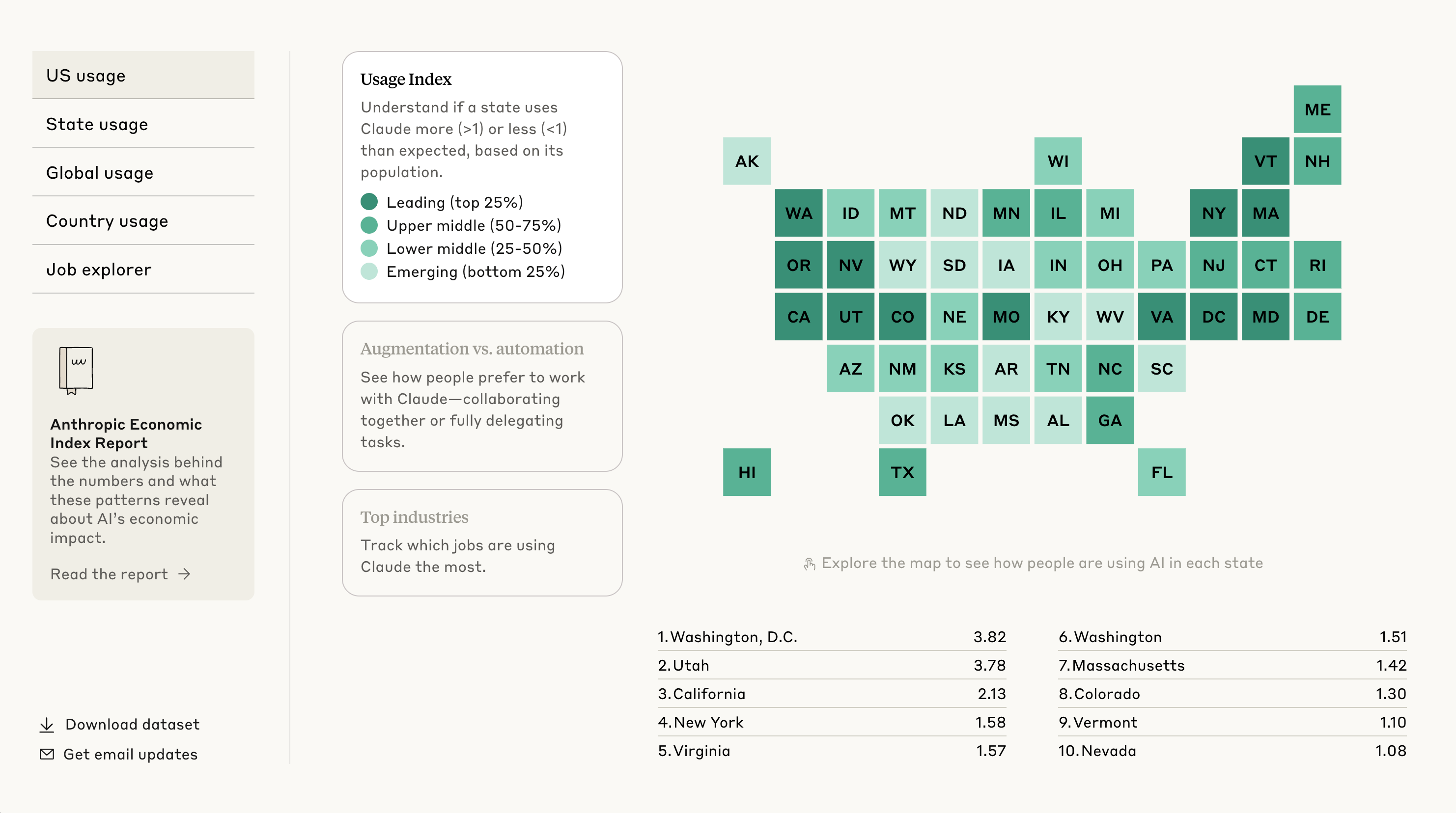
The Anthropic Economic Index reveals the shape of AI adoption across the world. Here, you can explore the data behind our research to understand how people are using Claude across every US state and hundreds of occupations. Track the topics that are trending where you live, and see how people are using AI to augment or automate their work—that is, whether they prefer to collaborate with, or delegate to, Claude.
Measuring Usage in the Age of AI - Research Information
Tasha Mellins-Cohen outlines COUNTER Metrics' new guidance for usage metrics associated with generative and agentic AI

Writing Code vs. Shipping Code: Productivity Effects Across Generations of AI Coding Tools
How do the productivity effects of AI evolve across successive generations of tools, and to what extent do task-level gains ultimately translate into final output? We study these questions in the context of software development, using data on more than 100,000 GitHub developers combined with their AI usage telemetry. In a matched event study design, we find that autocomplete, interactive coding agents, and autonomous coding agents each significantly increase coding activity ("commits"), with respective cumulative effects of 40%, 140%, and 180%. These gains, however, attenuate sharply across the production hierarchy: the 180% cumulative effect falls to 50% for the number of projects, and to 30% for actual releases. This pattern is consistent with the weak-link hypothesis: the strong productivity gains from AI are attenuated by human bottlenecks in the production chain, with an estimated elasticity of substitution of 0.25 between AI and human effort, which indicates strong complementarities. We further confirm these results across four major app marketplaces, finding a moderate increase in the number of new apps but no increase in total usage. Large task-level AI productivity gains have therefore translated only partially into shipped and used software thus far.

Big Help or Big Brother? Auditing Tracking, Profiling, and Personalization in Generative AI Assistants
Generative AI (GenAI) browser assistants integrate powerful capabilities of GenAI in web browsers to provide rich experiences such as question answering, content summarization, and agentic navigation. These assistants, available today as browser extensions, can not only track detailed browsing activity such as search and click data, but can also autonomously perform tasks such as filling forms, raising significant privacy concerns. It is crucial to understand the design and operation of GenAI browser extensions, including how they collect, store, process, and share user data. To this end, we study their ability to profile users and personalize their responses based on explicit or inferred demographic attributes and interests of users. We perform network traffic analysis and use a novel prompting framework to audit tracking, profiling, and personalization by the ten most popular GenAI browser assistant extensions. We find that instead of relying on local in-browser models, these assistants largely depend on server-side APIs, which can be auto-invoked without explicit user interaction. When invoked, they collect and share webpage content, often the full HTML DOM and sometimes even the user's form inputs, with their first-party servers. Some assistants also share identifiers and user prompts with third-party trackers such as Google Analytics. The collection and sharing continues even if a webpage contains sensitive information such as health or personal information such as name or SSN entered in a web form. We find that several GenAI browser assistants infer demographic attributes such as age, gender, income, and interests and use this profile--which carries across browsing contexts--to personalize responses. In summary, our work shows that GenAI browser assistants can and do collect personal and sensitive information for profiling and personalization with little to no safeguards.
Human + AI in Accounting: Early Evidence from the Field
This paper provides early evidence on the integration and impact of Generative Artificial Intelligence (GenAI) in accounting at both the accountant and task levels. Using a multi-method approach, we first identify the heterogeneous adoption patterns, perceived benefits, and concerns through survey data from 277 accountants, which we formalize into testable predictions. Leveraging field data from a technology firm providing AI-based accounting software to 79 small- and medium-sized enterprises, we analyze hundreds of thousands of transaction-level records. We document significant productivity gains among adopters, including an 18% increase in weekly client support per standard deviation of AI use, with estimates reaching 59% when comparing the highest to lowest usage levels. We also find a reallocation of approximately 9% of accountant time from routine data entry toward high-value tasks. AI use corresponds to improved financial reporting quality, evidenced by a 12% increase in ledger granularity and a 7.5-day reduction in monthly close time. Experienced accountants selectively intervene when AI confidence scores are low, suggesting complementarity between expertise and AI. A framed field experiment shows that accountants sometimes over-rely on inaccurate AI-suggested classifications, illustrating risks of AI use. Overall, our findings highlight AI’s role in potentially augmenting, rather than replacing, professional accounting expertise.
User Privacy and Large Language Models: An Analysis of Frontier Developers' Privacy Policies
Hundreds of millions of people now regularly interact with large language models via chatbots. Model developers are eager to acquire new sources of high-quality training data as they race to improve model capabilities and win market share. This paper analyzes the privacy policies of six U.S. frontier AI developers to understand how they use their users' chats to train models. Drawing primarily on the California Consumer Privacy Act, we develop a novel qualitative coding schema that we apply to each developer's relevant privacy policies to compare data collection and use practices across the six companies. We find that all six developers appear to employ their users' chat data to train and improve their models by default, and that some retain this data indefinitely. Developers may collect and train on personal information disclosed in chats, including sensitive information such as biometric and health data, as well as files uploaded by users. Four of the six companies we examined appear to include children's chat data for model training, as well as customer data from other products. On the whole, developers' privacy policies often lack essential information about their practices, highlighting the need for greater transparency and accountability. We address the implications of users' lack of consent for the use of their chat data for model training, data security issues arising from indefinite chat data retention, and training on children's chat data. We conclude by providing recommendations to policymakers and developers to address the data privacy challenges posed by LLM-powered chatbots.
User Privacy and Large Language Models: An Analysis of Frontier Developers' Privacy Policies
Hundreds of millions of people now regularly interact with large language models via chatbots. Model developers are eager to acquire new sources of high-quality training data as they race to improve model capabilities and win market share. This paper analyzes the privacy policies of six U.S. frontier AI developers to understand how they use their users' chats to train models. Drawing primarily on the California Consumer Privacy Act, we develop a novel qualitative coding schema that we apply to each developer's relevant privacy policies to compare data collection and use practices across the six companies. We find that all six developers appear to employ their users' chat data to train and improve their models by default, and that some retain this data indefinitely. Developers may collect and train on personal information disclosed in chats, including sensitive information such as biometric and health data, as well as files uploaded by users. Four of the six companies we examined appear to include children's chat data for model training, as well as customer data from other products. On the whole, developers' privacy policies often lack essential information about their practices, highlighting the need for greater transparency and accountability. We address the implications of users' lack of consent for the use of their chat data for model training, data security issues arising from indefinite chat data retention, and training on children's chat data. We conclude by providing recommendations to policymakers and developers to address the data privacy challenges posed by LLM-powered chatbots.
The Age Of Artificial Intelligence: Americans' AI Use Increases While Views On It Sour, Quinnipiac University Poll On AI Finds; 7 In 10 Think AI Will Cut Jobs With Gen Z The Most Pessimistic | Quinnipiac University Poll
"The contradiction between use and trust of AI is striking. Fifty-one percent say they use AI for research, and many also use it for writing, work, and data analysis. But only 21 percent trust AI-generated information most or almost all of the time. Americans are clearly adopting AI, but they are doing so with deep hesitation, not deep trust," said Chetan Jaiswal, Ph.D., Associate Professor of Computer Science and Associate Chair, Department of Computing, Quinnipiac University School of Computing and Engineering.

OpenAI’s Sam Altman on Building the ‘Core AI Subscription’ for Your Life
Perspective: AI demand is inflated, and only Anthropic is being realistic
The main usage metric for artificial intelligence, called tokens, looks explosive on paper, but it may be significantly overstated.
