


Social media platforms have been widely linked to societal harms, including rising polarization and the erosion of constructive debate. Can these problems be mitigated through prosocial interventions? We address this question using a novel method - generative social simulation - that embeds Large Language Models within Agent-Based Models to create socially rich synthetic platforms. We create a minimal platform where agents can post, repost, and follow others. We find that the resulting following-networks reproduce three well-documented dysfunctions: (1) partisan echo chambers; (2) concentrated influence among a small elite; and (3) the amplification of polarized voices - creating a 'social media prism' that distorts political discourse. We test six proposed interventions, from chronological feeds to bridging algorithms, finding only modest improvements - and in some cases, worsened outcomes. These results suggest that core dysfunctions may be rooted in the feedback between reactive engagement and network growth, raising the possibility that meaningful reform will require rethinking the foundational dynamics of platform architecture.
Can We Fix Social Media? Testing Prosocial Interventions using Generative Social Simulation
Social media platforms have been widely linked to societal harms, including rising polarization and the erosion of constructive debate. Can these problems be mitigated through prosocial interventions? We address this question using a novel method - generative social simulation - that embeds Large Language Models within Agent-Based Models to create socially rich synthetic platforms. We create a minimal platform where agents can post, repost, and follow others. We find that the resulting following-networks reproduce three well-documented dysfunctions: (1) partisan echo chambers; (2) concentrated influence among a small elite; and (3) the amplification of polarized voices - creating a 'social media prism' that distorts political discourse. We test six proposed interventions, from chronological feeds to bridging algorithms, finding only modest improvements - and in some cases, worsened outcomes. These results suggest that core dysfunctions may be rooted in the feedback between reactive engagement and network growth, raising the possibility that meaningful reform will require rethinking the foundational dynamics of platform architecture.
Redesigning algorithms to intervene on social norm misperceptions during a national election
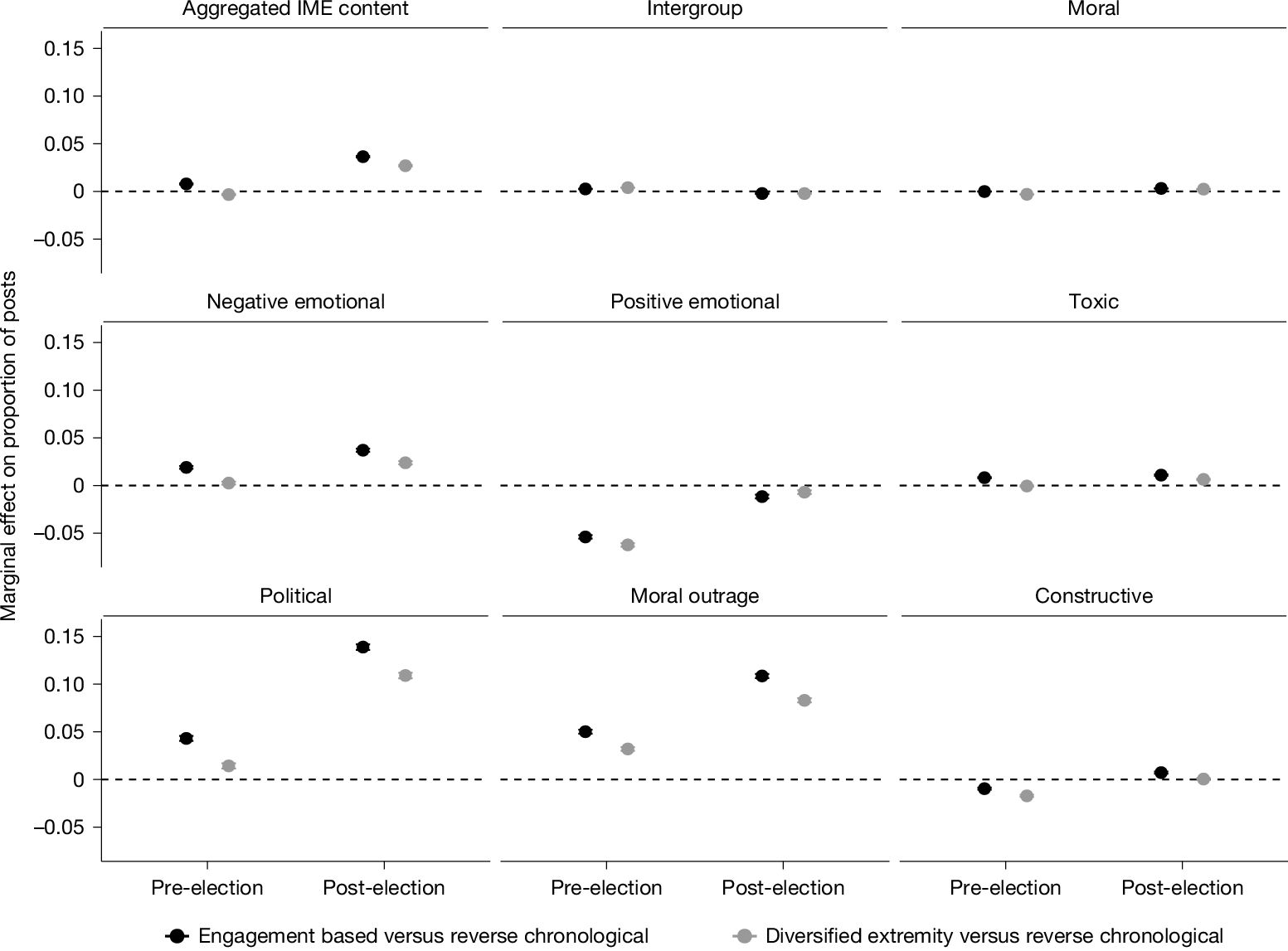
For the first time in history, civic discourse commonly occurs in digital environments in which algorithms influence exposure to social information1,2. It is increasingly important to understand whether and how these algorithms affect political discourse3–5. Here we built custom feed-ranking algorithms with full control over their features, and randomly assigned 2,000 participants to use them for 8 weeks (before and after the 2024 US presidential election). We tested whether an engagement-based algorithm (used on major social media platforms6,7) amplifies intergroup, moralized and emotional (IME) information in ways that skew perceptions of social norms around political dialogue5,8, and whether it increased engagement with IME content and perceptions of partisan animosity (compared with a reverse-chronological feed9,10). We also developed and tested a ‘diversified extremity’ algorithm to reduce the influence of extreme users11–13 to improve the accuracy of social norm perception14–16 and reduce perceptions of partisan animosity. We found that engagement-based feeds amplified IME and toxic content relative to reverse-chronological feeds, with the largest increases in moral outrage and political content. Engagement-based feeds also reduced prescriptive norm perception accuracy (albeit in an unexpected direction) and increased perceived partisan animosity. However, they did not significantly alter users’ own engagement behaviours. The diversified extremity algorithm reduced IME and toxic content exposure, improved prescriptive norm accuracy, yet maintained comparable platform enjoyment—suggesting that reducing the influence of extreme users can curb algorithmic distortions without diminishing user experience.
Rational Silence and False Polarization: How Viewpoint Organizations and Recommender Systems Distort the Expression of Public Opinion
Social media platforms are one of the most important domains in which artificial intelligence (AI) has already transformed the nature of economic and social interaction. AI enables the massive scale and highly personalized nature of online information sharing that we now take for granted. Extensive attention has been devoted to the polarization that social media platforms appear to facilitate. However, a key implication of the transformation we are experiencing due to these AI-powered platforms has received much less attention: how platforms impact what observers of online discourse come to believe about community views. These observers include policymakers and legislators, who look to social media to gauge the prospects for policy and legislative change, as well as developers of AI models trained on large-scale internet data, whose outputs may similarly reflect a distorted view of public opinion. In this paper, we present a nested game-theoretic model to show how observed online opinion is produced by the interaction of the decisions made by users about whether and with what rhetorical intensity to share their opinions on a platform, the efforts of viewpoint organizations (such as traditional media and advocacy organizations) that seek to encourage or discourage opinion-sharing online, and the operation of AI-powered recommender systems controlled by social media platforms. We show that signals from ideological viewpoint organizations encourage an increase in rhetorical intensity, leading to the rational silence of moderate users. This, in turn, creates a polarized impression of where average opinions lie. We also show that this observed polarization can also be amplified by recommender systems that, pursuant to a platform’s incentive to maximize engagement, encourage the formation of viewpoint communities online that end up seeing a skewed sample of opinion. Unlike existing models, these well-known online phenomena are not here attributed to distortion in the formation of opinions nor to the seeking out of like-minded others, but rather to the interaction of the incentives of users, viewpoint organizations, and platforms implementing recommender systems. In addition to showing how these interactions can play out in simulations, we also identify practical strategies platforms can implement, such as reducing exposure to signals from ideological viewpoint organizations and a tailored approach to content moderation.
The political effects of X’s feed algorithm
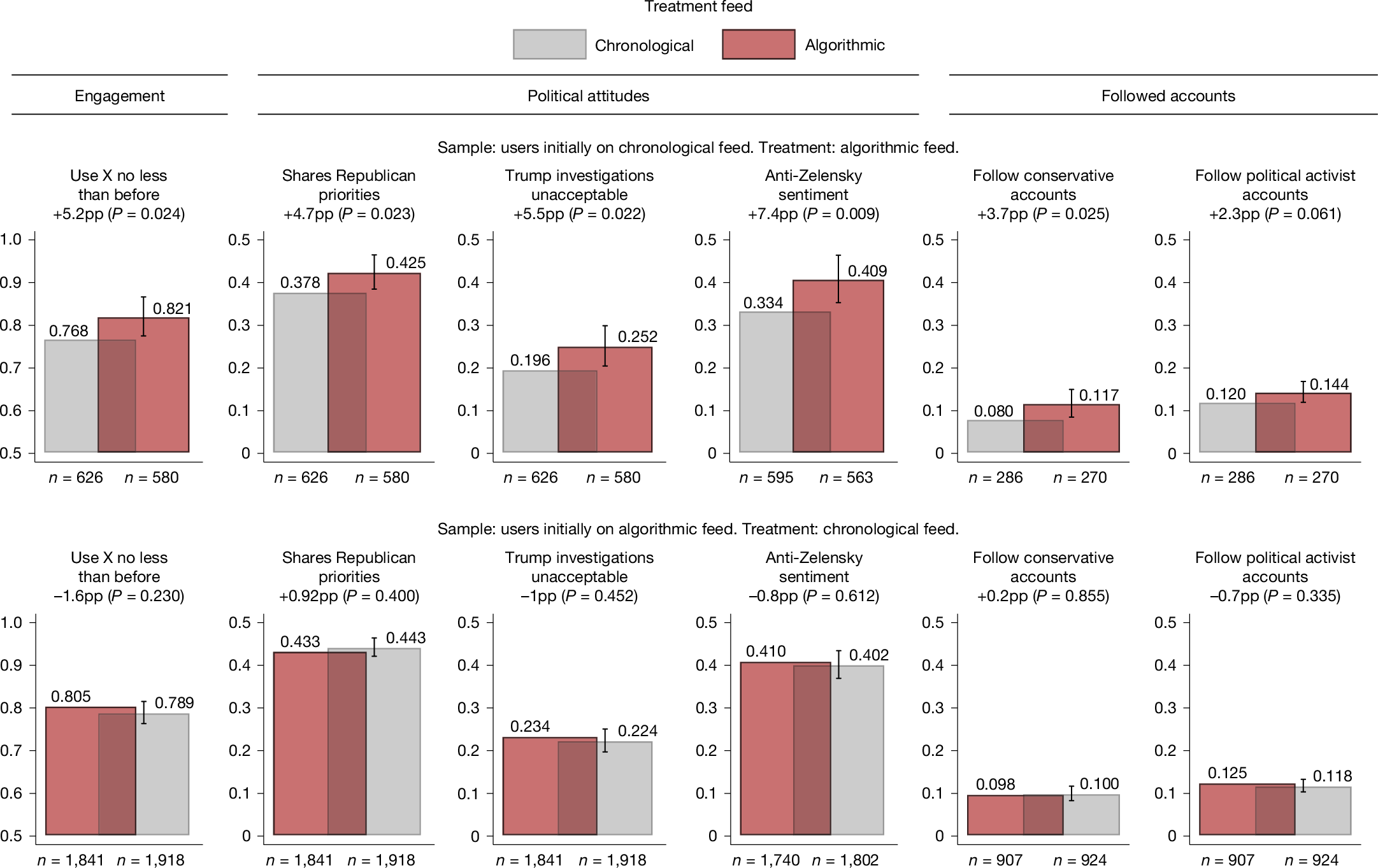
Feed algorithms are widely suspected to influence political attitudes. However, previous evidence from switching off the algorithm on Meta platforms found no political effects1. Here we present results from a 2023 field experiment on Elon Musk’s platform X shedding light on this puzzle. We assigned active US-based users randomly to either an algorithmic or a chronological feed for 7 weeks, measuring political attitudes and online behaviour. Switching from a chronological to an algorithmic feed increased engagement and shifted political opinion towards more conservative positions, particularly regarding policy priorities, perceptions of criminal investigations into Donald Trump and views on the war in Ukraine. In contrast, switching from the algorithmic to the chronological feed had no comparable effects. Neither switching the algorithm on nor switching it off significantly affected affective polarization or self-reported partisanship. To investigate the mechanism, we analysed users’ feed content and behaviour. We found that the algorithm promotes conservative content and demotes posts by traditional media. Exposure to algorithmic content leads users to follow conservative political activist accounts, which they continue to follow even after switching off the algorithm, helping explain the asymmetry in effects. These results suggest that initial exposure to X’s algorithm has persistent effects on users’ current political attitudes and account-following behaviour, even in the absence of a detectable effect on partisanship.
The political effects of X’s feed algorithm
Feed algorithms are widely suspected to influence political attitudes. However, previous evidence from switching off the algorithm on Meta platforms found no political effects1. Here we present results from a 2023 field experiment on Elon Musk’s platform X shedding light on this puzzle. We assigned active US-based users randomly to either an algorithmic or a chronological feed for 7 weeks, measuring political attitudes and online behaviour. Switching from a chronological to an algorithmic feed increased engagement and shifted political opinion towards more conservative positions, particularly regarding policy priorities, perceptions of criminal investigations into Donald Trump and views on the war in Ukraine. In contrast, switching from the algorithmic to the chronological feed had no comparable effects. Neither switching the algorithm on nor switching it off significantly affected affective polarization or self-reported partisanship. To investigate the mechanism, we analysed users’ feed content and behaviour. We found that the algorithm promotes conservative content and demotes posts by traditional media. Exposure to algorithmic content leads users to follow conservative political activist accounts, which they continue to follow even after switching off the algorithm, helping explain the asymmetry in effects. These results suggest that initial exposure to X’s algorithm has persistent effects on users’ current political attitudes and account-following behaviour, even in the absence of a detectable effect on partisanship.
Towards a Post-Social Media Studies
For two decades, "social media" has been the master lens through which scholars have understood digital communication—an era defined by user-generated content, networked publics, and participatory culture. That era is drawing to a close. This paper argues that three interrelated dynamics are dissolving the social media paradigm: an algorithmic shift from social-graph-based to interest-based recommendation, which is remaking the active "user" into a passive "viewer"; the generative AI revolution, which is replacing user-generated content with synthetic media and decoupling platforms from any dependence on human participation; and an exodus from public platforms toward private, closed spaces. Together, these dynamics are giving rise to three distinct post-social formations: algorithmically governed broadcasting platforms, semi-private spheres and micro-communities, and AI-mediated communication as a new media form in its own right. Understanding this transformation demands a fundamental reorientation of the field—new conceptual tools that move beyond networked publics and participatory culture, new methods suited to synthetic and ephemeral media environments, and renewed attention to the political stakes of communication systems that no longer require human participation.
Towards a Post-Social Media Studies
For two decades, "social media" has been the master lens through which scholars have understood digital communication—an era defined by user-generated content, networked publics, and participatory culture. That era is drawing to a close. This paper argues that three interrelated dynamics are dissolving the social media paradigm: an algorithmic shift from social-graph-based to interest-based recommendation, which is remaking the active "user" into a passive "viewer"; the generative AI revolution, which is replacing user-generated content with synthetic media and decoupling platforms from any dependence on human participation; and an exodus from public platforms toward private, closed spaces. Together, these dynamics are giving rise to three distinct post-social formations: algorithmically governed broadcasting platforms, semi-private spheres and micro-communities, and AI-mediated communication as a new media form in its own right. Understanding this transformation demands a fundamental reorientation of the field—new conceptual tools that move beyond networked publics and participatory culture, new methods suited to synthetic and ephemeral media environments, and renewed attention to the political stakes of communication systems that no longer require human participation.
Reranking partisan animosity in algorithmic social media feeds alters affective polarization
Today, social media platforms hold the sole power to study the effects of feed-ranking algorithms. We developed a platform-independent method that reranks participants’ feeds in real time and used this method to conduct a preregistered 10-day field ...

Introducing AI to an Online Petition Platform Changed Outputs but not Outcomes
The rapid integration of AI writing tools into online platforms raises critical questions about their impact on content production and outcomes. We leverage a unique natural experiment on Change$.$org, a leading social advocacy platform, to causally investigate the effects of an in-platform ''write with AI'' tool. To understand the impact of the AI integration, we collected 1.5 million petitions and employed a difference-in-differences analysis. Our findings reveal that in-platform AI access significantly altered the lexical features of petitions and increased petition homogeneity, but did not improve petition outcomes. We confirmed the results in a separate analysis of repeat petition writers who wrote petitions before and after introduction of the AI tool. The results suggest that while AI writing tools can profoundly reshape online content, their practical utility for improving desired outcomes may be less beneficial than anticipated, and introduce unintended consequences like content homogenization.
Social Media Effects: Hijacking Democracy and Civility in Civic Engagement
Perceived as an equalizing force for disenfranchised individuals without a voice, the importance of social networks as agents of change cannot be ignored. However, in some societies, social networks have evolved into a platform for fake news and propaganda, empowering disruptive voices, ideologies, and messages. Social networks such as Twitter, Facebook, and Google hold the potential to alter civic engagement, thus essentially hijacking democracy, by influencing individuals toward a particular way of thinking.

Shifts in U.S. Social Media Use, 2020–2024: Decline, Fragmentation, and Enduring Polarization
Using nationally representative data from the 2020 and 2024 American National Election Studies (ANES), this paper describes how U.S. social media use has shifted across platforms, demographics, and politics. Overall platform reach declined, driven by growth in the share of Americans — especially the youngest and oldest cohorts — who report using no social media. Visiting and posting activity on Twitter/X and Facebook have fallen by nearly 50% since 2020, with the decline on Twitter/X driven primarily by reduced participation among Democratic users. While Facebook, YouTube, and Twitter/X lost ground, TikTok and Reddit grew modestly, consistent with a more fragmented digital public sphere. Platform audiences aged and became slightly more educated and racially diverse. Politically, most platforms shifted toward Republican users while remaining, on balance, Democratic-leaning. Twitter/X experienced the largest change: among posters, the partisan balance swung over 70 percentage points from Democrats to Republicans. Across platforms, political posting remains closely tied to affective polarization, as the most partisan respondents are also the most active. As casual users disengage while polarized partisans remain vocal, online discourse becomes narrower and more ideologically extreme.
2026 IC2S2: Keynote Presentation by Kate Starbird
Sharing without clicking on news in social media
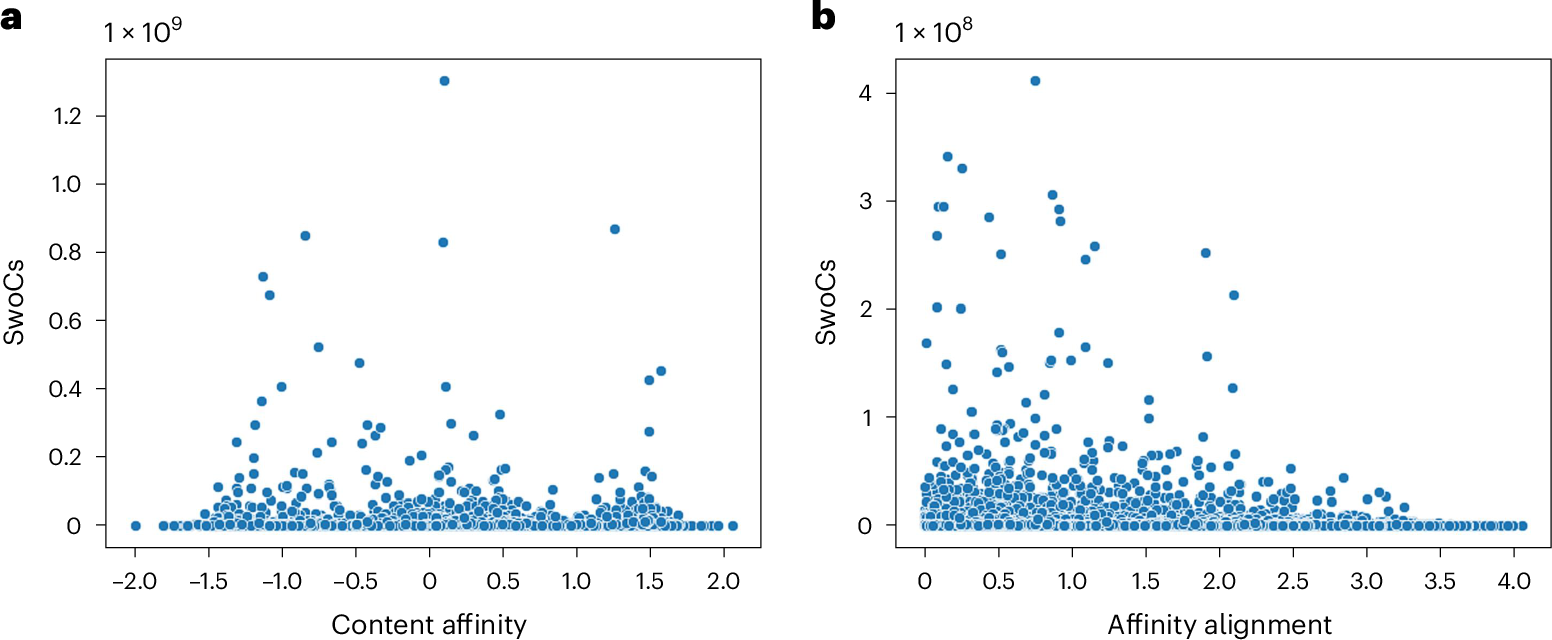
Social media have enabled laypersons to disseminate, at scale, links to news and public affairs information. Many individuals share such links without first reading the linked information. Here we analysed over 35 million public Facebook posts with uniform resource locators shared between 2017 and 2020, and discovered that such ‘shares without clicks’ (SwoCs) constitute around 75% of forwarded links. Extreme and user-aligned political content received more SwoCs, with partisans engaging in it more than politically neutral users. In addition, analyses with 2,969 false uniform resource locators revealed higher shares and, hence, SwoCs by conservatives (76.94%) than liberals (14.25%), probably because, in our dataset, the vast majority (76–82%) of them originated from conservative news domains. Findings suggest that the virality of political content on social media (including misinformation) is driven by superficial processing of headlines and blurbs rather than systematic processing of core content, which has design implications for promoting deliberate discourse in the online public sphere.
AI and the Future of Digital Public Squares
Two substantial technological advances have reshaped the public square in recent decades: first with the advent of the internet and second with the recent introduction of large language models (LLMs). LLMs offer opportunities for a paradigm shift towards more decentralized, participatory online spaces that can be used to facilitate deliberative dialogues at scale, but also create risks of exacerbating societal schisms. Here, we explore four applications of LLMs to improve digital public squares: collective dialogue systems, bridging systems, community moderation, and proof-of-humanity systems. Building on the input from over 70 civil society experts and technologists, we argue that LLMs both afford promising opportunities to shift the paradigm for conversations at scale and pose distinct risks for digital public squares. We lay out an agenda for future research and investments in AI that will strengthen digital public squares and safeguard against potential misuses of AI.
Emergent social conventions and collective bias in LLM populations
Social conventions are the backbone of social coordination, shaping how individuals form a group. As growing populations of artificial intelligence (AI) agents communicate through natural language, a fundamental question is whether they can bootstrap the foundations of a society. Here, we present experimental results that demonstrate the spontaneous emergence of universally adopted social conventions in decentralized populations of large language model (LLM) agents. We then show how strong collective biases can emerge during this process, even when agents exhibit no bias individually. Last, we examine how committed minority groups of adversarial LLM agents can drive social change by imposing alternative social conventions on the larger population. Our results show that AI systems can autonomously develop social conventions without explicit programming and have implications for designing AI systems that align, and remain aligned, with human values and societal goals. , Groups of AI agents can develop social conventions, generate societal bias, and undergo critical mass dynamics in norm adoption.

Community by Design
Social media empower distributed content creation by algorithmically harnessing "the social fabric" (explicit and implicit signals of association) to serve this content. While this overcomes the bottlenecks and biases of traditional gatekeepers, many believe it has unsustainably eroded the very social fabric it depends on by maximizing engagement for advertising revenue. This paper participates in open and ongoing considerations to translate social and political values and conventions, specifically social cohesion, into platform design. We propose an alternative platform model that includes the social fabric an explicit output as well as input. Citizens are members of communities defined by explicit affiliation or clusters of shared attitudes. Both have internal divisions, as citizens are members of intersecting communities, which are themselves internally diverse. Each is understood to value content that bridge (viz. achieve consensus across) and balance (viz. represent fairly) this internal diversity, consistent with the principles of the Hutchins Commission (1947). Content is labeled with social provenance, indicating for which community or citizen it is bridging or balancing. Subscription payments allow citizens and communities to increase the algorithmic weight on the content they value in the content serving algorithm. Advertisers may, with consent of citizen or community counterparties, target them in exchange for payment or increase in that party's algorithmic weight. Underserved and emerging communities and citizens are optimally subsidized/supported to develop into paying participants. Content creators and communities that curate content are rewarded for their contributions with algorithmic weight and/or revenue. We discuss applications to productivity (e.g. LinkedIn), political (e.g. X), and cultural (e.g. TikTok) platforms.