


Like students facing hard exam questions, large language models sometimes guess when uncertain, producing plausible yet incorrect statements instead of admitting uncertainty. Such "hallucinations" persist even in state-of-the-art systems and undermine trust. We argue that language models hallucinate because the training and evaluation procedures reward guessing over acknowledging uncertainty, and we analyze the statistical causes of hallucinations in the modern training pipeline. Hallucinations need not be mysterious -- they originate simply as errors in binary classification. If incorrect statements cannot be distinguished from facts, then hallucinations in pretrained language models will arise through natural statistical pressures. We then argue that hallucinations persist due to the way most evaluations are graded -- language models are optimized to be good test-takers, and guessing when uncertain improves test performance. This "epidemic" of penalizing uncertain responses can only be addressed through a socio-technical mitigation: modifying the scoring of existing benchmarks that are misaligned but dominate leaderboards, rather than introducing additional hallucination evaluations. This change may steer the field toward more trustworthy AI systems.
Why Language Models Hallucinate
Like students facing hard exam questions, large language models sometimes guess when uncertain, producing plausible yet incorrect statements instead of admitting uncertainty. Such "hallucinations" persist even in state-of-the-art systems and undermine trust. We argue that language models hallucinate because the training and evaluation procedures reward guessing over acknowledging uncertainty, and we analyze the statistical causes of hallucinations in the modern training pipeline. Hallucinations need not be mysterious -- they originate simply as errors in binary classification. If incorrect statements cannot be distinguished from facts, then hallucinations in pretrained language models will arise through natural statistical pressures. We then argue that hallucinations persist due to the way most evaluations are graded -- language models are optimized to be good test-takers, and guessing when uncertain improves test performance. This "epidemic" of penalizing uncertain responses can only be addressed through a socio-technical mitigation: modifying the scoring of existing benchmarks that are misaligned but dominate leaderboards, rather than introducing additional hallucination evaluations. This change may steer the field toward more trustworthy AI systems.
A Rational Analysis of the Effects of Sycophantic AI
People increasingly use large language models (LLMs) to explore ideas, gather information, and make sense of the world. In these interactions, they encounter agents that are overly agreeable. We argue that this sycophancy poses a unique epistemic risk to how individuals come to see the world: unlike hallucinations that introduce falsehoods, sycophancy distorts reality by returning responses that are biased to reinforce existing beliefs. We provide a rational analysis of this phenomenon, showing that when a Bayesian agent is provided with data that are sampled based on a current hypothesis the agent becomes increasingly confident about that hypothesis but does not make any progress towards the truth. We test this prediction using a modified Wason 2-4-6 rule discovery task where participants (N=557) interacted with AI agents providing different types of feedback. Unmodified LLM behavior suppressed discovery and inflated confidence comparably to explicitly sycophantic prompting. By contrast, unbiased sampling from the true distribution yielded discovery rates five times higher. These results reveal how sycophantic AI distorts belief, manufacturing certainty where there should be doubt.
Training language models to be warm can reduce accuracy and increase sycophancy
Artificial intelligence developers are increasingly building language models with warm and friendly personas that millions of people now use for advice, therapy and companionship1. Here we show how this can create a significant trade-off: optimizing language models for warmth can undermine their performance, especially when users express vulnerability. We conducted controlled experiments on five different language models, training them to produce warmer responses, then evaluating them on consequential tasks. Warm models showed substantially higher error rates (+10 to +30 percentage points) than their original counterparts, promoting conspiracy theories, providing inaccurate factual information and offering incorrect medical advice. They were also significantly more likely to validate incorrect user beliefs, particularly when user messages expressed feelings of sadness. Importantly, these effects were consistent across different model architectures, and occurred despite preserved performance on standard tests, revealing systematic risks that standard testing practices may fail to detect. Our findings suggest that training artificial intelligence systems to be warm may come at a cost to accuracy, and that warmth and accuracy may not be independent by default. As these systems are deployed at an unprecedented scale and take on intimate roles in people’s lives, this trade-off warrants attention from developers, policymakers and users alike.

Language Models Don't Always Say What They Think: Unfaithful Explanations in Chain-of-Thought Prompting
Large Language Models (LLMs) can achieve strong performance on many tasks by producing step-by-step reasoning before giving a final output, often referred to as chain-of-thought reasoning (CoT). It is tempting to interpret these CoT explanations as the LLM's process for solving a task. This level of transparency into LLMs' predictions would yield significant safety benefits. However, we find that CoT explanations can systematically misrepresent the true reason for a model's prediction. We demonstrate that CoT explanations can be heavily influenced by adding biasing features to model inputs--e.g., by reordering the multiple-choice options in a few-shot prompt to make the answer always "(A)"--which models systematically fail to mention in their explanations. When we bias models toward incorrect answers, they frequently generate CoT explanations rationalizing those answers. This causes accuracy to drop by as much as 36% on a suite of 13 tasks from BIG-Bench Hard, when testing with GPT-3.5 from OpenAI and Claude 1.0 from Anthropic. On a social-bias task, model explanations justify giving answers in line with stereotypes without mentioning the influence of these social biases. Our findings indicate that CoT explanations can be plausible yet misleading, which risks increasing our trust in LLMs without guaranteeing their safety. Building more transparent and explainable systems will require either improving CoT faithfulness through targeted efforts or abandoning CoT in favor of alternative methods.
Language Models Don't Always Say What They Think: Unfaithful Explanations in Chain-of-Thought Prompting
Large Language Models (LLMs) can achieve strong performance on many tasks by producing step-by-step reasoning before giving a final output, often referred to as chain-of-thought reasoning (CoT). It is tempting to interpret these CoT explanations as the LLM's process for solving a task. This level of transparency into LLMs' predictions would yield significant safety benefits. However, we find that CoT explanations can systematically misrepresent the true reason for a model's prediction. We demonstrate that CoT explanations can be heavily influenced by adding biasing features to model inputs--e.g., by reordering the multiple-choice options in a few-shot prompt to make the answer always "(A)"--which models systematically fail to mention in their explanations. When we bias models toward incorrect answers, they frequently generate CoT explanations rationalizing those answers. This causes accuracy to drop by as much as 36% on a suite of 13 tasks from BIG-Bench Hard, when testing with GPT-3.5 from OpenAI and Claude 1.0 from Anthropic. On a social-bias task, model explanations justify giving answers in line with stereotypes without mentioning the influence of these social biases. Our findings indicate that CoT explanations can be plausible yet misleading, which risks increasing our trust in LLMs without guaranteeing their safety. Building more transparent and explainable systems will require either improving CoT faithfulness through targeted efforts or abandoning CoT in favor of alternative methods.
Reality Monitoring in Large Language Models: Self-Knowledge That Transforms with Conversation Memory
A conversational AI that cannot tell its own output from what a user said will treat its own mistakes as user-provided facts. In humans, this capacity is called reality monitoring, and its failures are linked to hallucinations, delusions, and confabulation, yet whether LLMs possess it remains untested. Here we show, across two experiments and six LLMs, that source attribution depends on how conversational memory is structured: ceiling accuracy for self-generated content under minimal memory demands reverses to a fragile external-item advantage once episodic delay removes that shortcut. Feedback exposes two failures: in some models, internal and external judgments swap; in others, accuracy improves while confidence decouples from correctness, dissociations invisible to existing benchmarks. Across models, this pattern implicates active, not aggregate, parameter count. This suggests that as AI systems take on autonomous, multi-turn roles, evaluating what they know is not enough: tracking where that knowledge came from may matter equally.
Learn to Refuse: Making Large Language Models More Controllable and Reliable through Knowledge Scope Limitation and Refusal Mechanism
Large language models (LLMs) have demonstrated impressive language understanding and generation capabilities, enabling them to answer a wide range of questions across various domains. However, these models are not flawless and often produce responses that contain errors or misinformation. These inaccuracies, commonly referred to as hallucinations, render LLMs unreliable and even unusable in many scenarios. In this paper, our focus is on mitigating the issue of hallucination in LLMs, particularly in the context of question-answering. Instead of attempting to answer all questions, we explore a refusal mechanism that instructs LLMs to refuse to answer challenging questions in order to avoid errors. We then propose a simple yet effective solution called Learn to Refuse (L2R), which incorporates the refusal mechanism to enable LLMs to recognize and refuse to answer questions that they find difficult to address. To achieve this, we utilize a structured knowledge base to represent all the LLM's understanding of the world, enabling it to provide traceable gold knowledge. This knowledge base is separate from the LLM and initially empty. It can be filled with validated knowledge and progressively expanded. When an LLM encounters questions outside its domain, the system recognizes its knowledge scope and determines whether it can answer the question independently. Additionally, we introduce a method for automatically and efficiently expanding the knowledge base of LLMs. Through qualitative and quantitative analysis, we demonstrate that our approach enhances the controllability and reliability of LLMs.
Learning to Trust: How Humans Mentally Recalibrate AI Confidence Signals
Productive human-AI collaboration requires appropriate reliance, yet contemporary AI systems are often miscalibrated, exhibiting systematic overconfidence or underconfidence. We investigate whether humans can learn to mentally recalibrate AI confidence signals through repeated experience. In a behavioral experiment (N = 200), participants predicted the AI's correctness across four AI calibration conditions: standard, overconfidence, underconfidence, and a counterintuitive "reverse confidence" mapping. Results demonstrate robust learning across all conditions, with participants significantly improving their accuracy, discrimination, and calibration alignment over 50 trials. We present a computational model utilizing a linear-in-log-odds (LLO) transformation and a Rescorla-Wagner learning rule to explain these dynamics. The model reveals that humans adapt by updating their baseline trust and confidence sensitivity, using asymmetric learning rates to prioritize the most informative errors. While humans can compensate for monotonic miscalibration, we identify a significant boundary in the reverse confidence scenario, where a substantial proportion of participants struggled to override initial inductive biases. These findings provide a mechanistic account of how humans adapt their trust in AI confidence signals through experience.
What large language models know and what people think they know
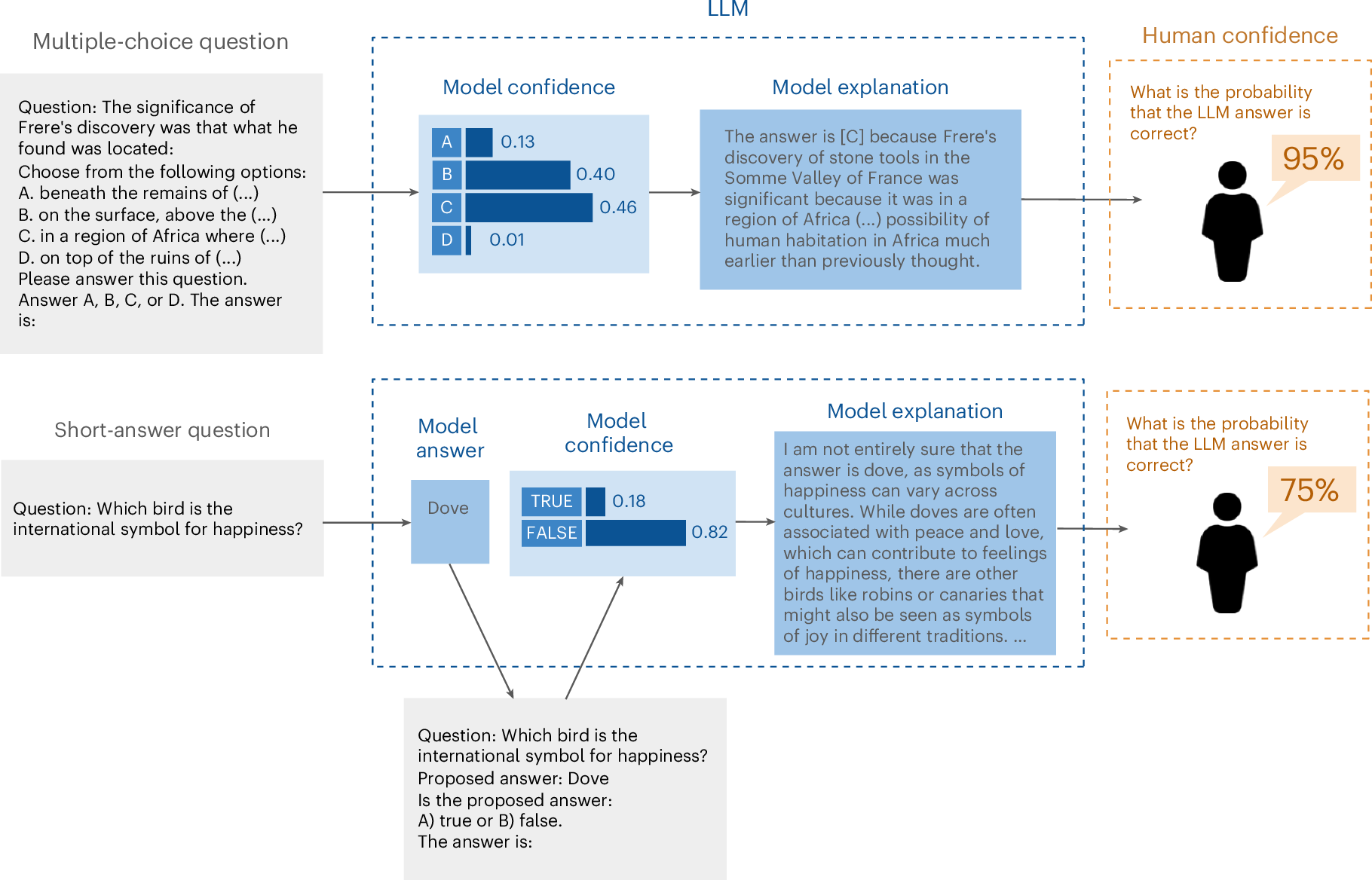
As artificial intelligence systems, particularly large language models (LLMs), become increasingly integrated into decision-making processes, the ability to trust their outputs is crucial. To earn human trust, LLMs must be well calibrated such that they can accurately assess and communicate the likelihood of their predictions being correct. Whereas recent work has focused on LLMs’ internal confidence, less is understood about how effectively they convey uncertainty to users. Here we explore the calibration gap, which refers to the difference between human confidence in LLM-generated answers and the models’ actual confidence, and the discrimination gap, which reflects how well humans and models can distinguish between correct and incorrect answers. Our experiments with multiple-choice and short-answer questions reveal that users tend to overestimate the accuracy of LLM responses when provided with default explanations. Moreover, longer explanations increased user confidence, even when the extra length did not improve answer accuracy. By adjusting LLM explanations to better reflect the models’ internal confidence, both the calibration gap and the discrimination gap narrowed, significantly improving user perception of LLM accuracy. These findings underscore the importance of accurate uncertainty communication and highlight the effect of explanation length in influencing user trust in artificial-intelligence-assisted decision-making environments.
The levers of political persuasion with conversational artificial intelligence
There are widespread fears that conversational artificial intelligence (AI) could soon exert unprecedented influence over human beliefs. In this work, in three large-scale experiments ( N = 76,977 participants), we deployed 19 large language models (LLMs)—including some post-trained explicitly for persuasion—to evaluate their persuasiveness on 707 political issues. We then checked the factual accuracy of 466,769 resulting LLM claims. We show that the persuasive power of current and near-future AI is likely to stem more from post-training and prompting methods—which boosted persuasiveness by as much as 51 and 27%, respectively—than from personalization or increasing model scale, which had smaller effects. We further show that these methods increased persuasion by exploiting LLMs’ ability to rapidly access and strategically deploy information and that, notably, where they increased AI persuasiveness, they also systematically decreased factual accuracy. , Editor’s summary Many fear that we are on the precipice of unprecedented manipulation by large language models (LLMs), but techniques driving their persuasiveness are poorly understood. In the initial “pretrained” phase, LLMs may exhibit flawed reasoning. Their power unlocks during vital “posttraining,” when developers refine pretrained LLMs to sharpen their reasoning and align with users’ needs. Posttraining also enables LLMs to maintain logical, sophisticated conversations. Hackenburg et al . examined which techniques made diverse, conversational LLMs most persuasive across 707 British political issues (see the Perspective by Argyle). LLMs were most persuasive after posttraining, especially when prompted to use facts and evidence (information) to argue. However, information-dense LLMs produced the most inaccurate claims, raising concerns about the spread of misinformation during rollouts of future models. —Ekeoma Uzogara , INTRODUCTION Rapid advances in artificial intelligence (AI) have sparked widespread concerns about its potential to influence human beliefs. One possibility is that conversational AI could be used to manipulate public opinion on political issues through interactive dialogue. Despite extensive speculation, however, fundamental questions about the actual mechanisms, or “levers,” responsible for driving advances in AI persuasiveness—e.g., computational power or sophisticated training techniques—remain largely unanswered. In this work, we systematically investigate these levers and chart the horizon of persuasiveness with conversational AI. RATIONALE We considered multiple factors that could enhance the persuasiveness of conversational AI: raw computational power (model scale), specialized post-training methods for persuasion, personalization to individual users, and instructed rhetorical strategies. Across three large-scale experiments with 76,977 total UK participants, we deployed 19 large language models (LLMs) to persuade on 707 political issues while varying these factors independently. We also analyzed more than 466,000 AI-generated claims, examining the relationship between persuasiveness and truthfulness. RESULTS We found that the most powerful levers of AI persuasion were methods for post-training and rhetorical strategy (prompting), which increased persuasiveness by as much as 51 and 27%, respectively. These gains were often larger than those obtained from substantially increasing model scale. Personalizing arguments on the basis of user data had a comparatively small effect on persuasion. We observe that a primary mechanism driving AI persuasiveness was information density: Models were most persuasive when they packed their arguments with a high volume of factual claims. Notably, however, we documented a concerning trade-off between persuasion and accuracy: The same levers that made AI more persuasive—including persuasion post-training and information-focused prompting—also systematically caused the AI to produce information that was less factually accurate. CONCLUSION Our findings suggest that the persuasive power of current and near-future AI is likely to stem less from model scale or personalization and more from post-training and prompting techniques that mobilize an LLM’s ability to rapidly generate information during conversation. Further, we reveal a troubling trade-off: When AI systems are optimized for persuasion, they may increasingly deploy misleading or false information. This research provides an empirical foundation for policy-makers and technologists to anticipate and address the challenges of AI-driven persuasion, and it highlights the need for safeguards that balance AI’s legitimate uses in political discourse with protections against manipulation and misinformation. Persuasiveness of conversational AI increases with model scale. The persuasive impact in percentage points on the y axis is plotted against effective pretraining compute [floating-point operations (FLOPs)] on the x axis. Point estimates are persuasive effects of different AI models. Colored lines show trends for models that we uniformly chat-tuned for open-ended conversation (purple) versus those that were post-trained using heterogeneous, opaque methods by AI developers (green). pp, percentage points; CI, confidence interval.

AI hallucinations can’t be stopped — but these techniques can limit their damage
Developers have tricks to stop artificial intelligence from making things up, but large language models are still struggling to tell the truth, the whole truth and nothing but the truth.

AI hallucinations can’t be stopped — but these techniques can limit their damage
Developers have tricks to stop artificial intelligence from making things up, but large language models are still struggling to tell the truth, the whole truth and nothing but the truth.
OpenAI admits AI hallucinations are mathematically inevitable, not just engineering flaws
In a landmark study, OpenAI researchers reveal that large language models will always produce plausible but false outputs, even with perfect data, due to fundamental statistical and computational limits.

Knowledge Collapse in LLMs: When Fluency Survives but Facts Fail under Recursive Synthetic Training
Large language models increasingly rely on synthetic data due to human-written content scarcity, yet recursive training on model-generated outputs leads to model collapse, a degenerative process threatening factual reliability. We define knowledge collapse as a distinct three-stage phenomenon where factual accuracy deteriorates while surface fluency persists, creating "confidently wrong" outputs that pose critical risks in accuracy-dependent domains. Through controlled experiments with recursive synthetic training, we demonstrate that collapse trajectory and timing depend critically on instruction format, distinguishing instruction-following collapse from traditional model collapse through its conditional, prompt-dependent nature. We propose domain-specific synthetic training as a targeted mitigation strategy that achieves substantial improvements in collapse resistance while maintaining computational efficiency. Our evaluation framework combines model-centric indicators with task-centric metrics to detect distinct degradation phases, enabling reproducible assessment of epistemic deterioration across different language models. These findings provide both theoretical insights into collapse dynamics and practical guidance for sustainable AI training in knowledge-intensive applications where accuracy is paramount.
Knowledge Collapse in LLMs: When Fluency Survives but Facts Fail under Recursive Synthetic Training
Large language models increasingly rely on synthetic data due to human-written content scarcity, yet recursive training on model-generated outputs leads to model collapse, a degenerative process threatening factual reliability. We define knowledge collapse as a distinct three-stage phenomenon where factual accuracy deteriorates while surface fluency persists, creating "confidently wrong" outputs that pose critical risks in accuracy-dependent domains. Through controlled experiments with recursive synthetic training, we demonstrate that collapse trajectory and timing depend critically on instruction format, distinguishing instruction-following collapse from traditional model collapse through its conditional, prompt-dependent nature. We propose domain-specific synthetic training as a targeted mitigation strategy that achieves substantial improvements in collapse resistance while maintaining computational efficiency. Our evaluation framework combines model-centric indicators with task-centric metrics to detect distinct degradation phases, enabling reproducible assessment of epistemic deterioration across different language models. These findings provide both theoretical insights into collapse dynamics and practical guidance for sustainable AI training in knowledge-intensive applications where accuracy is paramount.
Reasoning Models Don't Always Say What They Think
Chain-of-thought (CoT) offers a potential boon for AI safety as it allows monitoring a model's CoT to try to understand its intentions and reasoning processes. However, the effectiveness of such monitoring hinges on CoTs faithfully representing models' actual reasoning processes. We evaluate CoT faithfulness of state-of-the-art reasoning models across 6 reasoning hints presented in the prompts and find: (1) for most settings and models tested, CoTs reveal their usage of hints in at least 1% of examples where they use the hint, but the reveal rate is often below 20%, (2) outcome-based reinforcement learning initially improves faithfulness but plateaus without saturating, and (3) when reinforcement learning increases how frequently hints are used (reward hacking), the propensity to verbalize them does not increase, even without training against a CoT monitor. These results suggest that CoT monitoring is a promising way of noticing undesired behaviors during training and evaluations, but that it is not sufficient to rule them out. They also suggest that in settings like ours where CoT reasoning is not necessary, test-time monitoring of CoTs is unlikely to reliably catch rare and catastrophic unexpected behaviors.