


Large language models (LLMs) are increasingly central to many applications, raising concerns about bias, fairness, and regulatory compliance. This paper reviews risks of biased outputs and their societal impact, focusing on frameworks like the EU's AI Act and the Digital Services Act. We argue that beyond constant regulation, stronger attention to competition and design governance is needed to ensure fair, trustworthy AI. This is a preprint of the Communications of the ACM article of the same title.
Communication Bias in Large Language Models: A Regulatory Perspective
Large language models (LLMs) are increasingly central to many applications, raising concerns about bias, fairness, and regulatory compliance. This paper reviews risks of biased outputs and their societal impact, focusing on frameworks like the EU's AI Act and the Digital Services Act. We argue that beyond constant regulation, stronger attention to competition and design governance is needed to ensure fair, trustworthy AI. This is a preprint of the Communications of the ACM article of the same title.
People are getting their news from AI – and it’s altering their views
Even when information is factually accurate, how it’s presented can introduce subtle biases. As large language models increasingly bring people the news, this bias is a looming problem.

People are getting their news from AI – and it’s altering their views
Even when information is factually accurate, how it’s presented can introduce subtle biases. As large language models increasingly bring people the news, this bias is a looming problem.
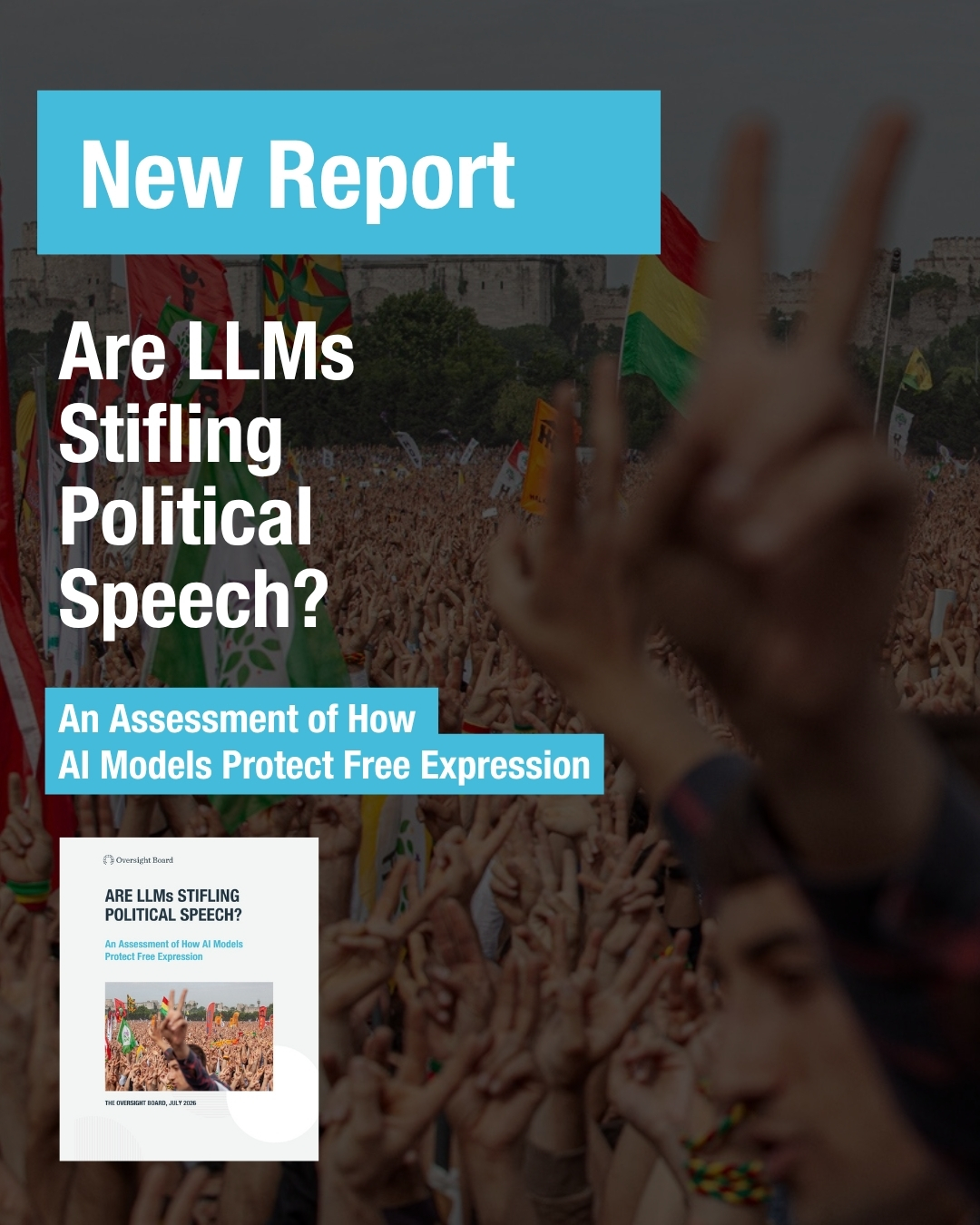
Are LLMs Stifling Political Speech? An Assessment of How AI Models Protect Free Expression | Oversight Board
The Oversight Board’s first evaluation of large language models (LLMs) shows that some of the world’s most-used models from Anthropic, DeepSeek, Google, Meta
If You’re Going To Defend AI And Whine About Its Critics, You Should Probably Be Honest About Its Actual Harms
I think this recent post by AI industry CEO Matt Shumer is worth a read. In it, he basically explains how quickly LLMs (large language models) are evolving to supplant many developers and prog…

Are Large Language Models Sensitive to the Motives Behind Communication?
Human communication is $\textit{motivated}$: people speak, write, and create content with a particular communicative intent in mind. As a result, information that large language models (LLMs) and AI agents process is inherently framed by humans' intentions and incentives. People are adept at navigating such nuanced information: we routinely identify benevolent or self-serving motives in order to decide what statements to trust. For LLMs to be effective in the real world, they too must critically evaluate content by factoring in the motivations of the source---for instance, weighing the credibility of claims made in a sales pitch. In this paper, we undertake a comprehensive study of whether LLMs have this capacity for $\textit{motivational vigilance}$. We first employ controlled experiments from cognitive science to verify that LLMs' behavior is consistent with rational models of learning from motivated testimony, and find they successfully discount information from biased sources in a human-like manner. We then extend our evaluation to sponsored online adverts, a more naturalistic reflection of LLM agents' information ecosystems. In these settings, we find that LLMs' inferences do not track the rational models' predictions nearly as closely---partly due to additional information that distracts them from vigilance-relevant considerations. However, a simple steering intervention that boosts the salience of intentions and incentives substantially increases the correspondence between LLMs and the rational model. These results suggest that LLMs possess a basic sensitivity to the motivations of others, but generalizing to novel real-world settings will require further improvements to these models.
Political Neutrality in AI Is Impossible- But Here Is How to Approximate It
AI systems often exhibit political bias, influencing users' opinions and decisions. While political neutrality-defined as the absence of bias-is often seen as an ideal solution for fairness and safety, this position paper argues that true political neutrality is neither feasible nor universally desirable due to its subjective nature and the biases inherent in AI training data, algorithms, and user interactions. However, inspired by Joseph Raz's philosophical insight that "neutrality [...] can be a matter of degree" (Raz, 1986), we argue that striving for some neutrality remains essential for promoting balanced AI interactions and mitigating user manipulation. Therefore, we use the term "approximation" of political neutrality to shift the focus from unattainable absolutes to achievable, practical proxies. We propose eight techniques for approximating neutrality across three levels of conceptualizing AI, examining their trade-offs and implementation strategies. In addition, we explore two concrete applications of these approximations to illustrate their practicality. Finally, we assess our framework on current large language models (LLMs) at the output level, providing a demonstration of how it can be evaluated. This work seeks to advance nuanced discussions of political neutrality in AI and promote the development of responsible, aligned language models.
Political Neutrality in AI Is Impossible- But Here Is How to Approximate It
AI systems often exhibit political bias, influencing users' opinions and decisions. While political neutrality-defined as the absence of bias-is often seen as an ideal solution for fairness and safety, this position paper argues that true political neutrality is neither feasible nor universally desirable due to its subjective nature and the biases inherent in AI training data, algorithms, and user interactions. However, inspired by Joseph Raz's philosophical insight that "neutrality [...] can be a matter of degree" (Raz, 1986), we argue that striving for some neutrality remains essential for promoting balanced AI interactions and mitigating user manipulation. Therefore, we use the term "approximation" of political neutrality to shift the focus from unattainable absolutes to achievable, practical proxies. We propose eight techniques for approximating neutrality across three levels of conceptualizing AI, examining their trade-offs and implementation strategies. In addition, we explore two concrete applications of these approximations to illustrate their practicality. Finally, we assess our framework on current large language models (LLMs) at the output level, providing a demonstration of how it can be evaluated. This work seeks to advance nuanced discussions of political neutrality in AI and promote the development of responsible, aligned language models.
Covert Racism in AI: How Language Models Are Reinforcing Outdated Stereotypes | Stanford HAI
Despite advancements in AI, new research reveals that large language models continue to perpetuate harmful racial biases, particularly against speakers of African American English.

The AI Cognitive Trojan Horse: How Large Language Models May...
Large language model (LLM)-based conversational AI systems present a challenge to human cognition that current frameworks for understanding misinformation and persuasion do not adequately address....
Maintaining the love for coding in the time of AI
By Alex Band Over the last year, we have seen the profound effects Large Language Models (LLMs) have on our open-source software work at NLnet Labs. These can be grouped into two main areas: community contributions and security reports. Before we dive into this topic, let me first give

AI Large Language Model Training: The Potential Risks of Ideological Skewing — PSG Consulting
LLMs (AI Large Language Models) have become part of everyday life. Systems such as ChatGPT, Claude, Gemini, Meta AI (Llama) and X.ai's Grok handle billions of interactions daily. They increasingly shape what information people encounter and in what order, subtly deciding what's important and even what is true, sometimes without users realizing it. Because LLMs wield growing power over information exposure, it is vital to recognize the political and ideological structures at multiple stages of their design, and to identify manipulation risks.

Emergent social conventions and collective bias in LLM populations
Social conventions are the backbone of social coordination, shaping how individuals form a group. As growing populations of artificial intelligence (AI) agents communicate through natural language, a fundamental question is whether they can bootstrap the foundations of a society. Here, we present experimental results that demonstrate the spontaneous emergence of universally adopted social conventions in decentralized populations of large language model (LLM) agents. We then show how strong collective biases can emerge during this process, even when agents exhibit no bias individually. Last, we examine how committed minority groups of adversarial LLM agents can drive social change by imposing alternative social conventions on the larger population. Our results show that AI systems can autonomously develop social conventions without explicit programming and have implications for designing AI systems that align, and remain aligned, with human values and societal goals. , Groups of AI agents can develop social conventions, generate societal bias, and undergo critical mass dynamics in norm adoption.

The social consequences of AI delegation
A substantial body of recent work has debated whether large language models (LLMs) can serve as substitutes for human participants in behavioural research. This debate, however, captures only one direction of a rapidly changing relationship. The more consequential question is not simply whether researchers should use LLMs as human surrogates, but whether - and under what conditions - humans are beginning to use LLMs as surrogates for their own deliberation. Across domains including health, law, finance, education, and personal guidance, increasing numbers of people consult generative AI systems before, alongside, or instead of human experts, peers, or independent judgment. Although evidence for actual delegation remains uneven, this uncertainty makes the phenomenon an urgent social-scientific object of study. We argue for a research programme that treats LLMs as consequential social actors in a functional sense: systems whose outputs shape human decisions, social norms, and collective dynamics.
Illicit Use of AI by Philosophers Refereeing for Journals - Daily Nous
In 2024, a study found that “7–17% of the sentences in the reviews [of computer science manuscripts] were written by LLMs”. It was only a […]
Directing large language models to follow the letter or spirit of the law
The distinction between the spirit and letter of the law is a central issue across research and everyday life, and a growing concern for building safe, intelligent machines. What is this distinction based on, and how can we develop machines that follow the intention behind a rule? We used targeted adaptation that made large language models prioritize the spirit or letter of the law. With minimal modifications, our method significantly changed LLM behavior across diverse measures, novel vignettes, real-world scenarios, and influential legal cases. An analysis of model internals revealed a low-dimensional space with three interpretable dimensions matching a formal pre-specified framework for the geometry of legal concepts. These findings show how legal thought in LLMs may be organized and directed.