


In this report, we document patterns of Claude usage over time, in 150+ countries, across US states, and among businesses deploying Claude through the API. Based on a privacy-preserving analysis of 1 million conversations on Claude.ai and 1 million API transcripts, we have four key findings: (1) Users increasingly entrust Claude with more autonomy, with directive task delegation rising from 27% to 39% in the past eight months. (2) Claude usage is geographically concentrated with high income countries overrepresented in global usage relative to their working age population. (3) Local economic considerations shape patterns of use both in terms of topic and in mode of collaboration with Claude. (4) API customers use Claude to automate tasks with greater specialization among use cases most amenable to programmatic access. To enable researchers and policymakers to further study the impact of AI on the economy, we additionally open-source the underlying data for this report.
The Anthropic Economic Index
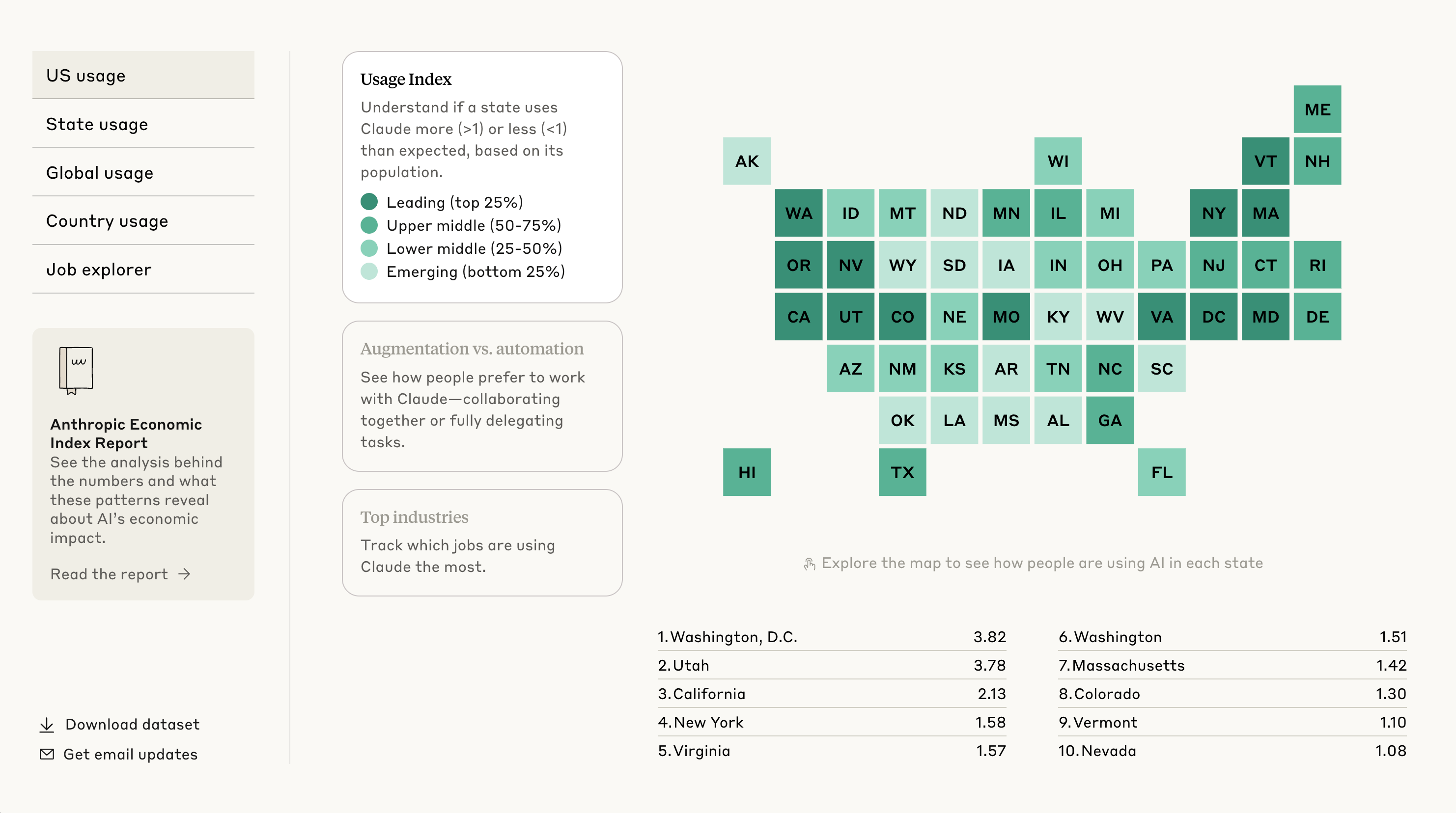
The Anthropic Economic Index reveals the shape of AI adoption across the world. Here, you can explore the data behind our research to understand how people are using Claude across every US state and hundreds of occupations. Track the topics that are trending where you live, and see how people are using AI to augment or automate their work—that is, whether they prefer to collaborate with, or delegate to, Claude.
Which Economic Tasks are Performed with AI? Evidence from Millions of Claude Conversations
Despite widespread speculation about artificial intelligence's impact on the future of work, we lack systematic empirical evidence about how these systems are actually being used for different tasks. Here, we present a novel framework for measuring AI usage patterns across the economy. We leverage a recent privacy-preserving system to analyze over four million Claude.ai conversations through the lens of tasks and occupations in the U.S. Department of Labor's O*NET Database. Our analysis reveals that AI usage primarily concentrates in software development and writing tasks, which together account for nearly half of all total usage. However, usage of AI extends more broadly across the economy, with approximately 36% of occupations using AI for at least a quarter of their associated tasks. We also analyze how AI is being used for tasks, finding 57% of usage suggests augmentation of human capabilities (e.g., learning or iterating on an output) while 43% suggests automation (e.g., fulfilling a request with minimal human involvement). While our data and methods face important limitations and only paint a picture of AI usage on a single platform, they provide an automated, granular approach for tracking AI's evolving role in the economy and identifying leading indicators of future impact as these technologies continue to advance.
The Adoption and Usage of AI Agents: Early Evidence from Perplexity
This paper presents the first large-scale field study of the adoption, usage intensity, and use cases of general-purpose AI agents operating in open-world web environments. Our analysis centers on Comet, an AI-powered browser developed by Perplexity, and its integrated agent, Comet Assistant. Drawing on hundreds of millions of anonymized user interactions, we address three fundamental questions: Who is using AI agents? How intensively are they using them? And what are they using them for? Our findings reveal substantial heterogeneity in adoption and usage across user segments. Earlier adopters, users in countries with higher GDP per capita and educational attainment, and individuals working in digital or knowledge-intensive sectors -- such as digital technology, academia, finance, marketing, and entrepreneurship -- are more likely to adopt or actively use the agent. To systematically characterize the substance of agent usage, we introduce a hierarchical agentic taxonomy that organizes use cases across three levels: topic, subtopic, and task. The two largest topics, Productivity & Workflow and Learning & Research, account for 57% of all agentic queries, while the two largest subtopics, Courses and Shopping for Goods, make up 22%. The top 10 out of 90 tasks represent 55% of queries. Personal use constitutes 55% of queries, while professional and educational contexts comprise 30% and 16%, respectively. In the short term, use cases exhibit strong stickiness, but over time users tend to shift toward more cognitively oriented topics. The diffusion of increasingly capable AI agents carries important implications for researchers, businesses, policymakers, and educators, inviting new lines of inquiry into this rapidly emerging class of AI capabilities.
Half of Americans report using AI services, with information and productivity leading use cases
New Epoch AI/Ipsos poll reveals high AI engagement, diverse use cases, and emerging workplace integration

How People Use ChatGPT
Despite the rapid adoption of LLM chatbots, little is known about how they are used. We document the growth of ChatGPT’s consumer product from its launch in November 2022 through July 2025, when it had been adopted by around 10% of the world’s adult population. Early adopters were disproportionately male but the gender gap has narrowed dramatically, and we find higher growth rates in lower-income countries. Using a privacy-preserving automated pipeline, we classify usage patterns within a representative sample of ChatGPT conversations. We find steady growth in work-related messages but even faster growth in non-work-related messages, which have grown from 53% to more than 70% of all usage. Work usage is more common for educated users in highly-paid professional occupations. We classify messages by conversation topic and find that “Practical Guidance,” “Seeking Information,” and “Writing” are the three most common topics and collectively account for nearly 80% of all conversations. Writing dominates work-related tasks, highlighting chatbots’ unique ability to generate digital outputs compared to traditional search engines. Computer programming and self-expression both represent relatively small shares of use. Overall, we find that ChatGPT provides economic value through decision support, which is especially important in knowledge-intensive jobs.

Clio: Privacy-Preserving Insights into Real-World AI Use
How are AI assistants being used in the real world? While model providers in theory have a window into this impact via their users' data, both privacy concerns and practical challenges have made analyzing this data difficult. To address these issues, we present Clio (Claude insights and observations), a privacy-preserving platform that uses AI assistants themselves to analyze and surface aggregated usage patterns across millions of conversations, without the need for human reviewers to read raw conversations. We validate this can be done with a high degree of accuracy and privacy by conducting extensive evaluations. We demonstrate Clio's usefulness in two broad ways. First, we share insights about how models are being used in the real world from one million Claude.ai Free and Pro conversations, ranging from providing advice on hairstyles to providing guidance on Git operations and concepts. We also identify the most common high-level use cases on Claude.ai (coding, writing, and research tasks) as well as patterns that differ across languages (e.g., conversations in Japanese discuss elder care and aging populations at higher-than-typical rates). Second, we use Clio to make our systems safer by identifying coordinated attempts to abuse our systems, monitoring for unknown unknowns during critical periods like launches of new capabilities or major world events, and improving our existing monitoring systems. We also discuss the limitations of our approach, as well as risks and ethical concerns. By enabling analysis of real-world AI usage, Clio provides a scalable platform for empirically grounded AI safety and governance.
User Privacy and Large Language Models: An Analysis of Frontier Developers' Privacy Policies
Hundreds of millions of people now regularly interact with large language models via chatbots. Model developers are eager to acquire new sources of high-quality training data as they race to improve model capabilities and win market share. This paper analyzes the privacy policies of six U.S. frontier AI developers to understand how they use their users' chats to train models. Drawing primarily on the California Consumer Privacy Act, we develop a novel qualitative coding schema that we apply to each developer's relevant privacy policies to compare data collection and use practices across the six companies. We find that all six developers appear to employ their users' chat data to train and improve their models by default, and that some retain this data indefinitely. Developers may collect and train on personal information disclosed in chats, including sensitive information such as biometric and health data, as well as files uploaded by users. Four of the six companies we examined appear to include children's chat data for model training, as well as customer data from other products. On the whole, developers' privacy policies often lack essential information about their practices, highlighting the need for greater transparency and accountability. We address the implications of users' lack of consent for the use of their chat data for model training, data security issues arising from indefinite chat data retention, and training on children's chat data. We conclude by providing recommendations to policymakers and developers to address the data privacy challenges posed by LLM-powered chatbots.
User Privacy and Large Language Models: An Analysis of Frontier Developers' Privacy Policies
Hundreds of millions of people now regularly interact with large language models via chatbots. Model developers are eager to acquire new sources of high-quality training data as they race to improve model capabilities and win market share. This paper analyzes the privacy policies of six U.S. frontier AI developers to understand how they use their users' chats to train models. Drawing primarily on the California Consumer Privacy Act, we develop a novel qualitative coding schema that we apply to each developer's relevant privacy policies to compare data collection and use practices across the six companies. We find that all six developers appear to employ their users' chat data to train and improve their models by default, and that some retain this data indefinitely. Developers may collect and train on personal information disclosed in chats, including sensitive information such as biometric and health data, as well as files uploaded by users. Four of the six companies we examined appear to include children's chat data for model training, as well as customer data from other products. On the whole, developers' privacy policies often lack essential information about their practices, highlighting the need for greater transparency and accountability. We address the implications of users' lack of consent for the use of their chat data for model training, data security issues arising from indefinite chat data retention, and training on children's chat data. We conclude by providing recommendations to policymakers and developers to address the data privacy challenges posed by LLM-powered chatbots.
Research Report 6: Agentic Shopping is Complicated and Contingent
This is the sixth in a series of short reports that help business, education, and policy leaders understand the technical details of working with AI through rig

HUGE — AI Without Giving Up Your Privacy
We're building an Agentic AI Platform running on your Device that lives with YOU, isolated from the cloud, fundamentally reimagining the relationship between humans and artificial intelligence through ownership, privacy, and massive context. In an age of capture and control, HUGE sells independence and sovereignty.
Perspective: AI demand is inflated, and only Anthropic is being realistic
The main usage metric for artificial intelligence, called tokens, looks explosive on paper, but it may be significantly overstated.

Americans Turning to AI to Supplement Healthcare Visits
One in four Americans use AI for health information. Most do so to supplement care, but some are using AI in place of a provider visit when barriers arise.

Mind the Gap: AI Adoption in Europe and the U.S.
This paper combines international evidence from worker and firm surveys conducted in 2025 and 2026 to document large gaps in AI adoption, both between the US and Europe and across European countries. Cross-country differences in worker demographics and firm composition account for an important share of these gaps. AI adoption, within and across countries, is also closely linked to firm personnel management practices and whether firms actively encourage AI use by workers. Micro-level evidence suggests that AI generates meaningful time savings for many workers. At the macro level, in recent years industries with higher AI adoption rates have experienced faster productivity growth. While we do not establish causality, this relationship is statistically significant and similar in magnitude in Europe and the US. We do not find clear evidence that industry-level AI adoption is associated with employment changes. We discuss limitations of existing data and outline priorities for future data collection to better assess the productivity and labor market effects of AI.
Privacy Considerations with AI Tools
Artificial intelligence (AI) tools come in all sorts of flavors. There are notetaking and transcription tools, chatbots, device-wide agentic AI features, grammar and writing tools, translation assistants, AI summaries, and research tools, among others. As a term, “AI” may refer to features in apps, apps themselves, third-party plug-ins, or a...
Still Waters, Rapid Currents: Early Labor Market Transformation under Generative AI
We study the early labor market impacts of AI chatbots by linking large-scale adoption surveys to administrative labor market records in Denmark. We document rapid currents: most employers in exposed occupations have adopted chatbot initiatives, workers report productivity benefits, and new AI-related tasks are widespread. Yet these currents have not broken the surface: using difference-indifferences, we estimate precise null effects on earnings and recorded hours at both the worker and workplace levels, ruling out effects larger than 2% two years after the launch of ChatGPT. What moves is the structure of work: employers absorb AI through task reorganization—including new tasks in content generation, AI oversight, and AI integration—and adopters transition into higher-paying occupations where AI chatbots are more relevant, though still too few to move average earnings. Technological change reshapes work well before it surfaces in earnings or hours.
Bridging the Divide: Addressing the Resistance to AI Adoption Among the Underrepresented
AI is increasingly integrating into our lives and educational settings by opening communication doors and providing limitless options for creativity. However, students, faculty, and staff of diverse backgrounds and access may vary in their adoption and application of AI technologies. Existing research has identified disparities in AI adoption. For example, a Pew Research survey indicated that men are more likely to use ChatGPT, with 29% versus 19% of women (PRC, 2023). Why is this? Additionally, many AI programs have been shown to sometimes have racial disparities built into their algorithms. ChatGPT demonstrated that the software “was more likely to associate European American names with pleasant words such as “gift” or “happy,” while African American names were more commonly associated with unpleasant words” (Guardian, 2017). Furthermore, there is evidence to suggest there are inequities ranging from issues with economic access with many premium AI features behind paywalls to concerns that people with disabilities have, which has dissuaded some people from adopting AI (APA, 2023). This presentation will explore the concerns and dynamics of adopting artificial intelligence (AI) in our lives and educational settings. We will engage and discuss these concerns and dynamics with attendees looking at issues with diversity, inclusion, and accessibility. Ultimately, this presentation seeks to foster an environment where all individuals can positively engage and feel included and empowerd by artificial intelligence in shaping the future of learning.