


Post-publication peer review (PPPR) has emerged as an important supplement to traditional peer review, with social media playing a growing role in publicising potential problems in published research. However, it remains unclear whether social media discussions of retracted articles primarily reflect good practices, such as exposing flaws and acknowledging retraction status, or bad practices, such as overlooking retractions and continuing to disseminate scientific misinformation. In this study, we collected Bluesky posts referencing scholarly articles from Altmetric and retrieved metadata for the referenced articles using OpenAlex. The final dataset included 284 retracted articles with 79 pre-retraction posts and 857 post-retraction posts, 59 retraction notices with 186 posts, and 609,461 non-retracted articles with 1,344,756 posts. We manually coded Bluesky posts discussing retracted articles to identify instances of good and bad practice. The results show that posts demonstrating good practice (89.9%) substantially outnumbered those demonstrating bad practice (10.1%). Posts reflecting good practice also had more user engagement. In the pre-retraction phase, good practice posts constituted a slight minority (43.0%), whereas in the post-retraction phase they were dominant (94.2%). Most negative posts in the pre-retraction phase (90.0%) had good practice while only 17.3% positive posts in the post-retraction phase showed bad practice. Thus, sentiment analysis can be helpful to filter posts that could flag potential flaws before retraction, but it may struggle to accurately identify the spread of misinformation after retraction. More broadly, this study highlights the potential of Bluesky to support responsible scientific communication, public scrutiny, and research integrity.
Science discussions of retracted articles on Bluesky: public scrutiny or misinformation spreading?
Post-publication peer review (PPPR) has emerged as an important supplement to traditional peer review, with social media playing a growing role in publicising potential problems in published research. However, it remains unclear whether social media discussions of retracted articles primarily reflect good practices, such as exposing flaws and acknowledging retraction status, or bad practices, such as overlooking retractions and continuing to disseminate scientific misinformation. In this study, we collected Bluesky posts referencing scholarly articles from Altmetric and retrieved metadata for the referenced articles using OpenAlex. The final dataset included 284 retracted articles with 79 pre-retraction posts and 857 post-retraction posts, 59 retraction notices with 186 posts, and 609,461 non-retracted articles with 1,344,756 posts. We manually coded Bluesky posts discussing retracted articles to identify instances of good and bad practice. The results show that posts demonstrating good practice (89.9%) substantially outnumbered those demonstrating bad practice (10.1%). Posts reflecting good practice also had more user engagement. In the pre-retraction phase, good practice posts constituted a slight minority (43.0%), whereas in the post-retraction phase they were dominant (94.2%). Most negative posts in the pre-retraction phase (90.0%) had good practice while only 17.3% positive posts in the post-retraction phase showed bad practice. Thus, sentiment analysis can be helpful to filter posts that could flag potential flaws before retraction, but it may struggle to accurately identify the spread of misinformation after retraction. More broadly, this study highlights the potential of Bluesky to support responsible scientific communication, public scrutiny, and research integrity.
The associations of social media attention, visibility, disinformation and retraction initiators with time to retraction: a Cox regression analysis
Purpose This study examines how retraction reasons, retraction initiators, journal visibility, access models and Twitter activity associate with the speed of retracting flawed scientific publications. Design/methodology/approach Using a Cox proportional hazards model, we analyzed 1,179 articles retracted in 2019–2021, including a subset of 98 papers tweeted before retraction. Findings The results reveal that higher journal impact factor and open-access status were associated with faster retractions. However, a significant negative interaction indicated that the effect of high-impact journals diminished for open-access publications. Journal-initiated retractions were slower overall, except in cases of misconduct such as co-authorship deception and plagiarism, where journals acted more quickly. Among retraction reasons, only deception in co-authoring was associated with significantly slower retractions, but this trend reversed when journals led the process. The association of social media attention with retraction speed was statistically robust, albeit modest in magnitude: each additional pre-retraction tweet was associated with a slight reduction in time to retraction. Bootstrap validation confirmed the stability of this finding. Originality/value Public scrutiny, institutional responsibility and publication visibility jointly shape the time to retraction. This study advances altmetrics discourse by positioning social media as a conditional, yet meaningful, participant in the retraction lifecycle. Beyond altmetrics, our findings highlight retractions as part of a broader network of relationships between public accountability, digital ethics and science communication, positioning them as moments of accountability shaped jointly by journals, ethical responsibilities and digital publics.

More than 10,000 research papers were retracted in 2023 — a new record
The number of articles being retracted rose sharply this year. Integrity experts say that this is only the tip of the iceberg.
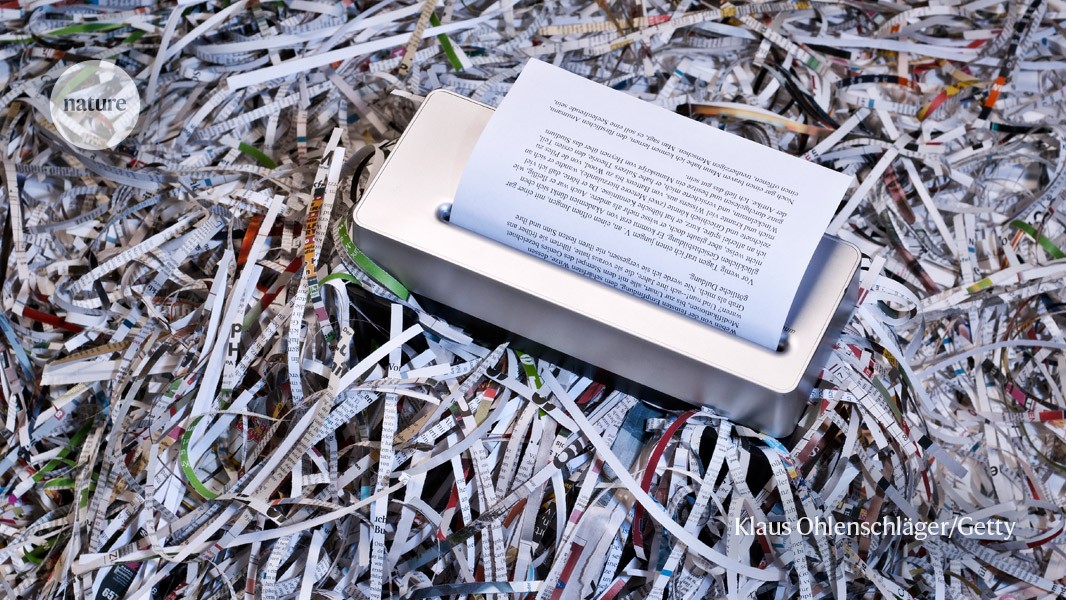
More than 10,000 research papers were retracted in 2023 — a new record
The number of articles being retracted rose sharply this year. Integrity experts say that this is only the tip of the iceberg.
How Ten Publishers Retract Research
Retractions are the primary mechanism for correcting the scholarly record, yet publishers differ markedly in how they use them. We present a bibliometric analysis of 46,087 retractions across 10 major publishers using data from the Retraction Watch database (1997-2026), examining retraction rates, reasons, temporal trends, and geographic distributions, among other dimensions. Normalized retraction rates vary by two orders of magnitude, from Elsevier's 3.97 per 10,000 publications to Hindawi's 320.02. China-affiliated authors account for the largest share of retractions at every publisher. Retraction lags and reason profiles also vary widely across publishers. Among the ten publishers, ACM is an outlier in its retraction profile. ACM's normalized rate is mid-range (5.65), yet 98.3% of its 354 retractions are related to one incident. Seven of the ten most common global retraction reasons (including misconduct, plagiarism, and data concerns) are entirely absent from ACM's record. ACM's first retraction dates to 2020, despite a catalog dating to 1997. ACM self-describes its retraction threshold as "extremely high." We discuss this threshold in relation to the COPE retraction guidelines and the implications of ACM's non-public dark archive of removed works.
The State of Papers, Retractions, and Preprints: Evidence from the CrossRef Database (2004-2024)
A 20-year analysis of CrossRef metadata demonstrates that global scholarly output -- encompassing publications, retractions, and preprints -- exhibits strikingly inertial growth, well-described by exponential, quadratic, and logistic models with nearly indistinguishable goodness-of-fit. Retraction dynamics, in particular, remain stable and minimally affected by the COVID-19 shock, which contributed less than 1% to total notices. Since 2004, publications doubled every 9.8 years, retractions every 11.4 years, and preprints at the fastest rate, every 5.6 years. The findings underscore a system primed for ongoing stress at unchanged structural bottlenecks. Although model forecasts diverge beyond 2024, the evidence suggests that the future trajectory of scholarly communication will be determined by persistent systemic inertia rather than episodic disruptions -- unless intentionally redirected by policy or AI-driven reform.
Does <span style="font-variant:small-caps;">ChatGPT</span> Ignore Article Retractions and Other Reliability Concerns?
ABSTRACT Large language models (LLMs) like ChatGPT seem to be increasingly used for information seeking and analysis, including to support academic literature reviews. To test whether the results might sometimes include retracted research, we identified 217 retracted or otherwise concerning academic studies with high altmetric scores and asked ChatGPT 4o‐mini to evaluate their quality 30 times each. Surprisingly, none of its 6510 reports mentioned that the articles were retracted or had relevant errors, and it gave 190 relatively high scores (world leading, internationally excellent, or close). The 27 articles with the lowest scores were mostly accused of being weak, although the topic (but not the article) was described as controversial in five cases (e.g., about hydroxychloroquine for COVID‐19). In a follow‐up investigation, 61 claims were extracted from retracted articles from the set, and ChatGPT 4o‐mini was asked 10 times whether each was true. It gave a definitive yes or a positive response two‐thirds of the time, including for at least one statement that had been shown to be false over a decade ago. The results therefore emphasise, from an academic knowledge perspective, the importance of verifying information from LLMs when using them for information seeking or analysis.

Does <span style="font-variant:small-caps;">ChatGPT</span> Ignore Article Retractions and Other Reliability Concerns?
ABSTRACT Large language models (LLMs) like ChatGPT seem to be increasingly used for information seeking and analysis, including to support academic literature reviews. To test whether the results might sometimes include retracted research, we identified 217 retracted or otherwise concerning academic studies with high altmetric scores and asked ChatGPT 4o‐mini to evaluate their quality 30 times each. Surprisingly, none of its 6510 reports mentioned that the articles were retracted or had relevant errors, and it gave 190 relatively high scores (world leading, internationally excellent, or close). The 27 articles with the lowest scores were mostly accused of being weak, although the topic (but not the article) was described as controversial in five cases (e.g., about hydroxychloroquine for COVID‐19). In a follow‐up investigation, 61 claims were extracted from retracted articles from the set, and ChatGPT 4o‐mini was asked 10 times whether each was true. It gave a definitive yes or a positive response two‐thirds of the time, including for at least one statement that had been shown to be false over a decade ago. The results therefore emphasise, from an academic knowledge perspective, the importance of verifying information from LLMs when using them for information seeking or analysis.

A New Paradigm for Scientific Publishing, Peer Review, and Impact Assessment
Scientific publishing and peer review have evolved little in three centuries, while the demands placed on them have grown profoundly. The growing role of artificial intelligence has underscored deep, systemic shortcomings of an aging system that has largely evaded innovation, a system whose origins are appallingly closer to the invention of the printing press than to the internet. We can do better – much better. This article is intended as the beginning of a communal experiment: a living document that critically reviews the modern academic publishing and peer-review system and presents a concrete framework to address what bibliometrics experts¹ have characterized as "the pervasive misapplication of indicators to the evaluation of scientific performance". Building on the Leiden Manifesto, DORA, and a body of scholarship spanning many disciplines and decades, we present a community-governed, non-profit platform organized around three trust-weighted impact factors, for articles, authors, and reviewers, with full algorithmic transparency, an open development log, and structural decoupling of credibility scoring from content moderation and from monetization. We invite the community to discuss, critique, and help shape it.
Scientists no Longer Find Twitter Professionally Useful, and have Switched to Bluesky
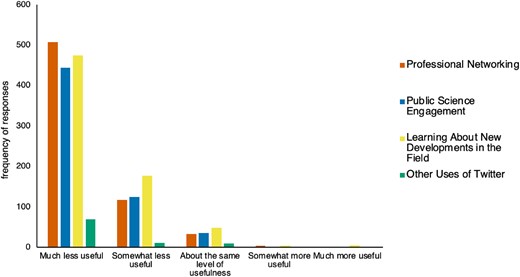
Synopsis Social media has become widely used by the scientific community for a variety of professional uses, including networking and public outreach. For the past decade, Twitter has been a primary home of scientists on social media. In recent years, new leadership at Twitter has made substantive changes that have resulted in increases in the prevalence of pseudoscience, conspiracy theory, and harassment on the platform, causing many scientists to seek alternatives. Bluesky has been suggested as a good alternative to Twitter, but the phenomenon of academics switching social media platforms has not previously been studied. Here we report on the results of a survey distributed to scientists on Twitter and Bluesky (n = 813). Results overwhelmingly confirm that changes to Twitter have made the social media platform no longer professionally useful or pleasant, and that many scientists have abandoned it in favor of Bluesky. Results show that for every reported professional benefit that scientists once gained from Twitter, scientists can now gain that benefit more effectively on Bluesky than on Twitter.
Citing Less Critically: LLMs Reshape the Rhetoric and Reach of Scientific Citation
Scientific citations carry rhetorical intent. Scholars may cite prior work positively (supporting), negatively (contrasting), or neutrally (mentioning). As large language models (LLMs) increasingly assist scientific writing, whether they reproduce citations with the same rhetorical intent as humans remains unclear. We introduce a masked-citation task to compare human and LLM-generated citation behavior. For each citation context, an LLM generates a replacement citation sentence, producing a counterfactual corpus directly comparable to human citation. We analyze what, whom, and how models cite, using an LLM-as-a-judge to classify citation intent and a 20-million-edge coauthorship network to measure social distance between cited authors. Across six popular LLMs and 1,746 top NLP conference papers (63k+ contexts, 132k+ citations), three patterns emerge: (1) Compared with human citation, LLMs cite significantly less critically; (2) LLMs over-cite popular and older papers, a tendency amplified for contrasting citations where human writing more often draws on recent, niche work; (3) Whereas humans often cite within their close social network, especially for supporting citations, LLMs tend to draw on more socially distant authors. Together, these differences are double-edged: LLM citation reaches beyond a scholar's close collaborators while being less critical and amplifying visibility bias, reshaping the rhetoric and reach of scientific citation.
Incorrect Citation Association for Articles in Online-Only Springer Nature Journals
We show that citation metrics of journal articles in many of the online-only Springer Nature journals and associated ones are distorted, going back to articles from 2001. We find that most likely due to an API response error, there are many incorrect references which typically lead to Article Number 1 of a given Volume. Among others, the issue affects journals such as Scientific Reports, Nature Communications, Communications journals, Cell Death & Disease, Light: Science & Applications, as well as many BMC, Discovery and npj journals. Beyond the negative effect of introducing incorrect reference information, this distorts the citation statistics of articles in these journals, with a few articles being massively over-cited compared to their peers, while many lose citations; e.g. both in Scientific Reports and in Nature Communications, 5 of the 10 top cited articles have article numbers of 1. We validate the distorted statistics by assessing data from multiple scientific literature databases: Crossref, OpenCitations, Semantic Scholar, and the journals' websites. The issue primarily arises from the inconsistent transition from page-based referencing of articles to article number-based referencing, as well as the improper handling of the change in the publisher's article metadata API. It seems that the most pressing problem has been present since approximately 2011, which we estimate affects the citation count of millions of authors.
You can just review things: A digital ethnography of informal peer review
Across scholarly communities, manuscripts face similar evaluative rituals: editors invite experts to privately assess submissions through formal peer reviews. This closed, loosely structured, and publisher-mediated process is now being supplemented by critiques on open, distributed platforms. We call this practice, a blend of three open peer review variants, informal peer review as it is accessible to outsiders, unmediated by publishers, and conducted across public platforms. Informal peer reviewers range from occasional error detectors to experienced sleuths who identify plagiarism, fraud, errors, conflicts of interest, and conceptual flaws. They may interpret methods, clarify jargon, assess value, and connect to related work. Here, we asked four questions: (1) Who are informal peer reviewers? (2) Where do they work? (3) How do they evaluate research? and (4) What are their impacts? To answer these questions, we conducted a cross-platform digital ethnography with participant observation. We traced discourse across communities over four months and revisited cases after nine and twelve months. From 15 communities, we selected 12 case mentions (10 unique cases) and 8 meta-commentaries from 26 reviewers. Using open and axial coding, we generated 1,080 codes and four themes: reviewers are a motley crew, they self-organize across subpar digital spaces, use deep, uncommon strategies, and they face resistance from authors, publishers, and editors. Informal peer review, we concluded, is a fragile, minimally governed patchwork of people, platforms, and practices, as well as an emerging evidence infrastructure that can be scaled up. We advise advocates and tool-builders to evolve informal review tools, communities, training, and governance by connecting to scholars' values, reducing participation friction, and rewarding attempts to extend the scholarly dialogue.
Article now retracted. Retraction notice focuses on data sharing, but doesn't mention - the ethics review body is the author's own company - the tech used to to collect the data by intercepting users' LLM prompts does not exist ht @grinschglsandra.bsky.social psycnet.apa.org/fulltext/2027-53135-001.html
APA PsycNet
psycnet.apa.org
Ian Hussey
Retractionwatch coverage of this article retractionwatch.com/2026/06/16/technology-mind-be… @grinschglsandra.bsky.social @malte.the100.ci @jamiecummins.bsky.social
In our new paper of how Bluesky users discuss retracted papers, we found: ✅ 90% of Bluesky posts show "good practices" (flagging issues/retraction status) ❌ Only 10% show "bad practices" This highlights Bluesky's vital role in responsible science communication! arxiv.org/abs/2605.04334
An article about data visualization was retracted 1.5 years after I pointed out errors. The notice says that "concerns were raised". I spend dozens of hours contacting authors and editors, reproducing analyses, and following up on ignored emails. But I'm not mentioned in the retraction notice.

RETRACTED: A Perception Study for Unit Charts in the Context of Large-Magnitude Data Representation
www.mdpi.com
