


Large language models (LLMs) increasingly help people solve problems, from debugging code to repairing machinery. This process requires generating plausible hypotheses from partial descriptions,...
LLM in a Flash: Efficient Large Language Model Inference with Limited Memory
Large language models (LLMs) are central to modern natural language processing, delivering exceptional performance in various tasks…

Words that Work: Using Large Language Models to Generate and Refine Hypotheses from Text
In this paper, we introduce a data-driven framework for generating and refining hypotheses from text. Our three-step approach–Hypothesize, Intervene, and Predic

Beyond Model Collapse: Scaling Up with Synthesized Data Requires...
Large Language Models (LLM) are increasingly trained on data generated by other LLM, either because generated text and images become part of the pre-training corpus, or because synthetized data is...
Augmenting Research Ideation with Data: An Empirical Investigation...
Recent advancements in large language models (LLMs) demonstrate strong potential for generating novel research ideas, yet such ideas often struggle with feasibility and effectiveness. In this...
Understanding Understanding: A Pragmatic Framework Motivated by...
Motivated by the rapid ascent of Large Language Models (LLMs) and debates about the extent to which they possess human-level qualities, we propose a framework for testing whether any agent (be it...
Do Large Language Models Perform the Way People Expect? Measuring the Human Generalization Function
What makes large language models (LLMs) impressive is also what makes them hard to evaluate: their diversity of uses. To evaluate these models, we must understand the purposes they will be used for. We consider a setting where these deployment decisions are made by people, and in particular, people's beliefs about where an LLM will perform well. We model such beliefs as the consequence of a human generalization function: having seen what an LLM gets right or wrong, people generalize to where else it might succeed. We collect a dataset of 19K examples of how humans make generalizations across 79 tasks from the MMLU and BIG-Bench benchmarks. We show that the human generalization function can be predicted using NLP methods: people have consistent structured ways to generalize. We then evaluate LLM alignment with the human generalization function. Our results show that -- especially for cases where the cost of mistakes is high -- more capable models (e.g. GPT-4) can do worse on the instances people choose to use them for, exactly because they are not aligned with the human generalization function.
Large language model
A large language model (LLM) is a neural network trained on a vast amount of text for natural language processing tasks, especially language generation. LLMs can typically generate, summarize, translate, and analyze text in many contexts, and are a foundational technology behind modern chatbots.[1] Biased or inaccurate training data can make an LLM's output less reliable.[2]
Reasoning Under Uncertainty: Exploring Probabilistic Reasoning Capabilities of LLMs
Despite widespread success in language understanding and generation, large language models (LLMs) exhibit unclear and often inconsistent behavior when faced with tasks that require probabilistic reasoning. In this work, we present the first comprehensive study of the reasoning capabilities of LLMs over explicit discrete probability distributions. Given observations from a probability distribution, we evaluate models on three carefully designed tasks, mode identification, maximum likelihood estimation, and sample generation, by prompting them to provide responses to queries about either the joint distribution or its conditionals. These tasks thus probe a range of probabilistic skills, including frequency analysis, marginalization, and generative behavior. Through comprehensive empirical evaluations, we demonstrate that there exists a clear performance gap between smaller and larger models, with the latter demonstrating stronger inference and surprising capabilities in sample generation. Furthermore, our investigations reveal notable limitations, including sensitivity to variations in the notation utilized to represent probabilistic outcomes and performance degradation of over 60% as context length increases. Together, our results provide a detailed understanding of the probabilistic reasoning abilities of LLMs and identify key directions for future improvement.
Reasoning Under Uncertainty: Exploring Probabilistic Reasoning Capabilities of LLMs
Despite widespread success in language understanding and generation, large language models (LLMs) exhibit unclear and often inconsistent behavior when faced with tasks that require probabilistic reasoning. In this work, we present the first comprehensive study of the reasoning capabilities of LLMs over explicit discrete probability distributions. Given observations from a probability distribution, we evaluate models on three carefully designed tasks, mode identification, maximum likelihood estimation, and sample generation, by prompting them to provide responses to queries about either the joint distribution or its conditionals. These tasks thus probe a range of probabilistic skills, including frequency analysis, marginalization, and generative behavior. Through comprehensive empirical evaluations, we demonstrate that there exists a clear performance gap between smaller and larger models, with the latter demonstrating stronger inference and surprising capabilities in sample generation. Furthermore, our investigations reveal notable limitations, including sensitivity to variations in the notation utilized to represent probabilistic outcomes and performance degradation of over 60% as context length increases. Together, our results provide a detailed understanding of the probabilistic reasoning abilities of LLMs and identify key directions for future improvement.
Forcing Generative Models to Degenerate Ones: The Power of Data...
Growing applications of large language models (LLMs) trained by a third party raise serious concerns on the security vulnerability of LLMs.It has been demonstrated that malicious actors can...
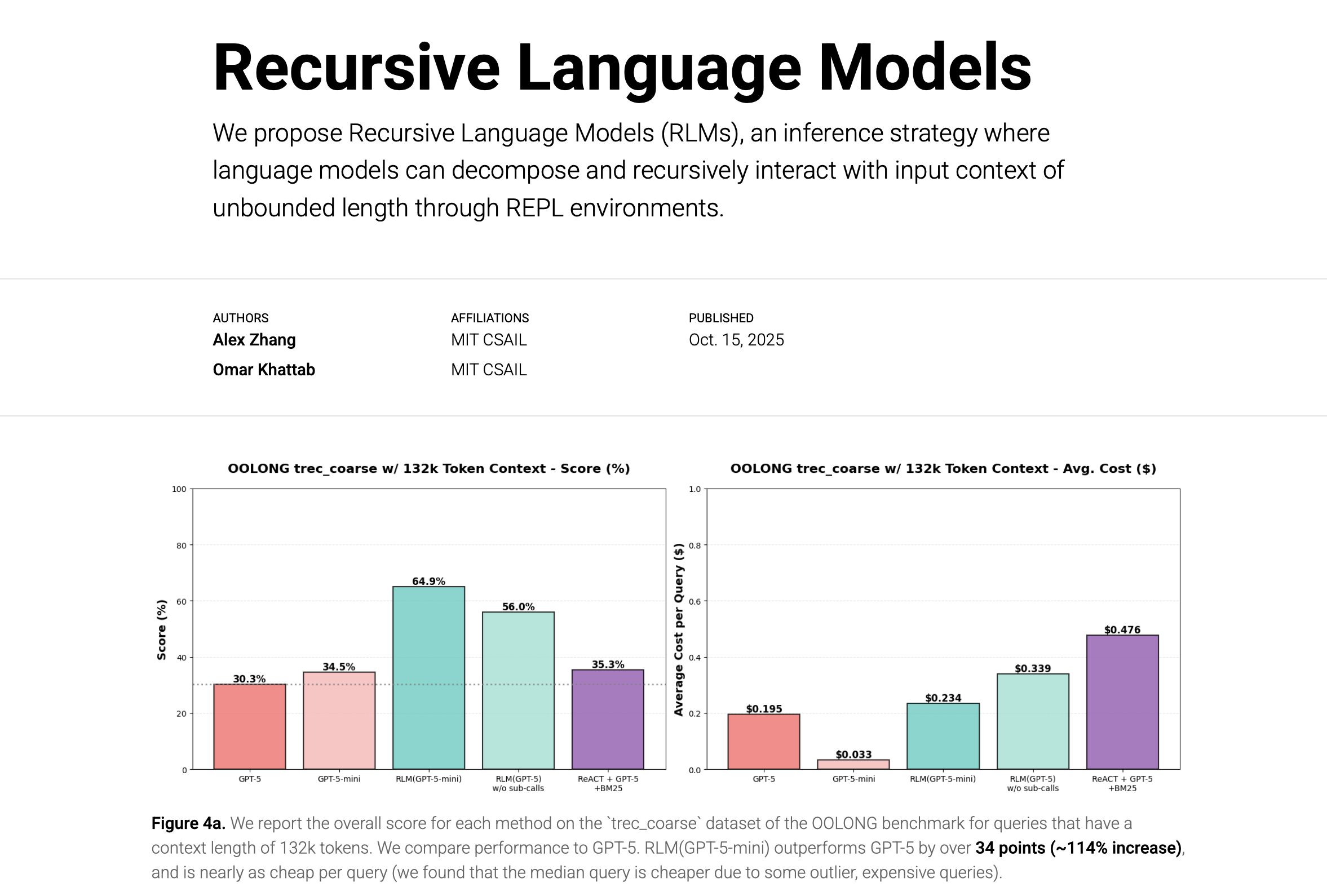
Recursive Language Models
We propose Recursive Language Models (RLMs), an inference strategy where language models can decompose and recursively interact with input context of unbounded length through REPL environments.
Why Do Large Language Models (LLMs) Struggle to Count Letters?
Large Language Models (LLMs) have achieved unprecedented performance on many complex tasks, being able, for example, to answer questions on almost any topic. However, they struggle with other simple tasks, such as counting the occurrences of letters in a word, as illustrated by the inability of many LLMs to count the number of "r" letters in "strawberry". Several works have studied this problem and linked it to the tokenization used by LLMs, to the intrinsic limitations of the attention mechanism, or to the lack of character-level training data. In this paper, we conduct an experimental study to evaluate the relations between the LLM errors when counting letters with 1) the frequency of the word and its components in the training dataset and 2) the complexity of the counting operation. We present a comprehensive analysis of the errors of LLMs when counting letter occurrences by evaluating a representative group of models over a large number of words. The results show a number of consistent trends in the models evaluated: 1) models are capable of recognizing the letters but not counting them; 2) the frequency of the word and tokens in the word does not have a significant impact on the LLM errors; 3) there is a positive correlation of letter frequency with errors, more frequent letters tend to have more counting errors, 4) the errors show a strong correlation with the number of letters or tokens in a word and 5) the strongest correlation occurs with the number of letters with counts larger than one, with most models being unable to correctly count words in which letters appear more than twice.
Why Do Large Language Models (LLMs) Struggle to Count Letters?
Large Language Models (LLMs) have achieved unprecedented performance on many complex tasks, being able, for example, to answer questions on almost any topic. However, they struggle with other simple tasks, such as counting the occurrences of letters in a word, as illustrated by the inability of many LLMs to count the number of "r" letters in "strawberry". Several works have studied this problem and linked it to the tokenization used by LLMs, to the intrinsic limitations of the attention mechanism, or to the lack of character-level training data. In this paper, we conduct an experimental study to evaluate the relations between the LLM errors when counting letters with 1) the frequency of the word and its components in the training dataset and 2) the complexity of the counting operation. We present a comprehensive analysis of the errors of LLMs when counting letter occurrences by evaluating a representative group of models over a large number of words. The results show a number of consistent trends in the models evaluated: 1) models are capable of recognizing the letters but not counting them; 2) the frequency of the word and tokens in the word does not have a significant impact on the LLM errors; 3) there is a positive correlation of letter frequency with errors, more frequent letters tend to have more counting errors, 4) the errors show a strong correlation with the number of letters or tokens in a word and 5) the strongest correlation occurs with the number of letters with counts larger than one, with most models being unable to correctly count words in which letters appear more than twice.
Recursive Language Models
We study allowing large language models (LLMs) to process arbitrarily long prompts through the lens of inference-time scaling. We propose Recursive Language Models (RLMs), a general inference paradigm that treats long prompts as part of an external environment and allows the LLM to programmatically examine, decompose, and recursively call itself over snippets of the prompt. We find that RLMs can successfully process inputs up to two orders of magnitude beyond model context windows and, even for shorter prompts, dramatically outperform the quality of vanilla frontier LLMs and common long-context and coding scaffolds (e.g., on GPT-5 by a median across the evaluated benchmarks of $26\%$ against compaction, $130\%$ against CodeAct with sub-calls, and $13\%$ against Claude Code) across four diverse long-context tasks while having comparable cost. At a small scale, we post-train the first model around the RLM. Our model, RLM-Qwen3-8B, outperforms the underlying Qwen3-8B model by $28.3\%$ on average and even approaches the quality of vanilla GPT-5 on three long-context tasks. Code is available at https://github.com/alexzhang13/rlm.
Scaling Laws Across Model Architectures: A Comparative Analysis of...
The scaling of large language models (LLMs) is a critical research area for the efficiency and effectiveness of model training and deployment. Our work investigates the transferability and...
Announcing a new version of our 2024 paper on linguistic hypothesis generation from LMs! @najoung.bsky.social and I have systematized our hypothesis generation framework, added stringent criteria for model selection, 10x-ed our learning trials, and included an epigraph from Jeff Elman 🙏!
