


We present SemRepo, an RDF knowledge graph comprising over 81 million triples describing nearly 200,000 GitHub repositories associated with scientific research. SemRepo captures repository-level metadata, such as contributors, issues, and programming languages, and interlinks this information with external scholarly knowledge graphs. In particular, repository authors are linked to their profiles in SemOpenAlex, repositories are connected to scholarly publications in LPWC, and research artifacts, such as datasets and experiments, are linked via MLSea-KG. This integration enables queries that span publications and their scholarly artifacts, which are typically fragmented across separate platforms. SemRepo supports analyses that are difficult to perform with existing resources in isolation, including provenance reconstruction across repositories and publications, as well as the systematic identification of risks to research reproducibility and software sustainability. By unifying research software with its scholarly context in a single graph, SemRepo provides an important infrastructure for large-scale analysis of software within the broader scientific research ecosystem.
SemRepo.org
SemRepo is a large-scale RDF knowledge graph of GitHub repositories linked to scientific research. SemRepo captures fine-grained repository-level metadata (e.g., contributors, issues, programming languages) and interlinks this with external scholarly knowledge graphs: repositories to publications in LPWC, repository authors to their profiles in SemOpenAlex, and research artifacts (e.g., datasets, experiments) are linked via MLSea.
Crossref: The sustainable source of community-owned scholarly metadata
This paper describes the scholarly metadata collected and made available by Crossref, as well as its importance in the scholarly research ecosystem. Containing over 106 million records and expanding at an average rate of 11% a year, Crossref’s metadata has become one of the major sources of scholarly data for publishers, authors, librarians, funders, and researchers. The metadata set consists of 13 content types, including not only traditional types, such as journals and conference papers, but also data sets, reports, preprints, peer reviews, and grants. The metadata is not limited to basic publication metadata, but can also include abstracts and links to full text, funding and license information, citation links, and the information about corrections, updates, retractions, etc. This scale and breadth make Crossref a valuable source for research in scientometrics, including measuring the growth and impact of science and understanding new trends in scholarly communications. The metadata is available through a number of APIs, including REST API and OAI-PMH. In this paper, we describe the kind of metadata that Crossref provides and how it is collected and curated. We also look at Crossref’s role in the research ecosystem and trends in metadata curation over the years, including the evolution of its citation data provision. We summarize the research used in Crossref’s metadata and describe plans that will improve metadata quality and retrieval in the future.

The Research Nexus vision for a more connected scholarly community
Crossref envisions “a rich and reusable open network of relationships connecting research organizations, people, things, and actions; a scholarly record that the global community can build on forever, for the benefit of society”. This Research Nexus expands on the importance of research objects being persistently and uniquely identified. The scholarly community has an established practice of connecting things such as citations to others’ work and it is increasingly critical to identify relationships beyond citations, bringing together published work, unpublished work, institutions, individuals, and identifying the actions that they take e.g., funding, publishing, creating, modifying, citing, and sharing. The Research Nexus brings together metadata and relationships to build a joined-up picture of the scholarly ecosystem and helps everyone identify these relationships and how they change through time. This vision is possible if all parts of the scholarly ecosystem (and beyond) work together, including various scholarly infrastructure organizations.

Two billion citation links in Crossref help research travel further - Crossref
We’ve recently reached an important milestone for the research nexus: the works in our metadata corpus are now connected with over 2 billion citation links! This is a great opportunity to share a dedicated dataset and discuss why these are important for science.

Large Knowledge Model: From Papers to a Scientific Reasoning Landscape
Accumulated scientific knowledge advances inquiry when prior findings help researchers choose new questions, design investigations, and interpret results. Realizing this value at scale requires access to the reasoning that connects research problems, scientific procedures, conclusions, and evidence. We introduce the Large Knowledge Model (LKM), a scientific knowledge infrastructure that transforms the literature into a shared, computationally accessible reasoning resource. LKM represents papers as source-grounded reasoning graphs, couples structural traversal with semantic retrieval over the same objects, and aligns related questions, claims, and reasoning chains across papers. This representation forms a Scientific Reasoning Landscape with three connected views: a Question Landscape that organizes research problems and open directions, a Workflow Landscape that exposes reusable scientific procedures, and an Evidence Landscape that connects conclusions to their support, disagreement, and conditions. The unified substrate supports reasoning-aware scientific search, evidence-grounded question answering, comparative evidence analysis, and research planning. Researchers and agents can retrieve relevant work through its scientific intent, synthesize answers with inspectable supporting arguments, and develop research plans informed by established workflows and unresolved evidence. We describe a corpus-scale system and evaluate scientific retrieval and knowledge-intensive question answering. With the answering model fixed, LKM retrieval improves accuracy by 9.30%, 4.20%, and 14.69% on ChemBench, PubMedQA, and SciBench, respectively. By connecting knowledge access to scientific reasoning and action, LKM provides a common foundation for discovering relevant research, reusing scientific knowledge, and coordinating cumulative inquiry across researchers, agents, and research cycles.
Manuscript submission systems and metadata completeness in Crossref: Patterns and associations
The importance of open research information, particularly publication metadata, is widely recognised. Crossref is one of the most important infrastructures for registering open metadata as part of DOI record registration. It is widely known, however, that the metadata of many publications is far from complete, with many publishers making certain metadata openly available, but failing to do so for other metadata elements. Publishers’ ability to register this metadata with Crossref depends on their capacity to capture and retain this data in their production workflows. Manuscript submission systems are an important, yet largely overlooked, factor in the extent to which publishers make metadata available through Crossref. In this paper, we present the results of an analysis investigating the relation between the level of metadata that publishers deposit with Crossref and the submission systems that they deploy for their journals. We have looked at the 153 publishers with the largest amounts of publications in Crossref and concentrate on the four most commonly used systems: Editorial Manager, ScholarOne, Open Journal Systems (OJS) and eJournalPress. We show that some submission systems appear better suited to capturing certain metadata elements. However, there are always cases where publishers using the same system differ widely in the level of metadata they register, suggesting that technology is not the only prohibiting factor and other considerations are at play.
Steps Towards an Infrastructure for Scholarly Synthesis
Sharing, reusing, and synthesizing knowledge is central to the research process, both individually, and with others. These core functions are not supported by our formal scholarly publishing infrastructure: instead of the smooth functioning of functional infrastructure, researchers resort to laborious "hacks" and workarounds to "mine" publications for what they need, and struggle to efficiently share the resulting information with others. Information scientists have proposed an alternative infrastructure based on the more appropriately granular model of a discourse graph of claims, and evidence, along with key rhetorical relationships between them. However, despite significant technical progress on standards and platforms, the predominant infrastructure remains steadfastly document-based. Drawing from infrastructure studies, we locate the current infrastructural bottlenecks in the lack of local systems that integrate discourse-centric models to augment synthesis work, from which an infrastructure for synthesis can be grown. Through 3 years of research through design and field deployment in a distributed community of hypertext notebook users, we elaborate a design vision of what can and should be built in order to grow a discourse-centric synthesis infrastructure: a thriving "installed base" of researchers authoring local, shareable discourse graphs to improve synthesis work, enhance primary research and research training, and augment collaborative research. We discuss how this design vision -- and our empirical work -- contributes steps towards a new infrastructure for synthesis, and increases HCI's capacity to advance collective intelligence and solve infrastructure-level problems.
Steps Towards an Infrastructure for Scholarly Synthesis
Sharing, reusing, and synthesizing knowledge is central to the research process, both individually, and with others. These core functions are not supported by our formal scholarly publishing infrastructure: instead of the smooth functioning of functional infrastructure, researchers resort to laborious ”hacks” and workarounds to ”mine” publications for what they need, and struggle to efficiently share the resulting information with others. Information scientists have proposed an alternative infrastructure based on the more appropriately granular model of a discourse graph of claims, and evidence, along with key rhetorical relationships between them. However, despite significant technical progress on standards and platforms, the predominant infrastructure remains steadfastly document-based. Drawing from infrastructure studies, we locate the current infrastructural bottlenecks in the lack of local systems that integrate discourse-centric models to augment synthesis work, from which an infrastructure for synthesis can be grown. Through 3 years of research through design and field deployment in a distributed community of hypertext notebook users, we elaborate a design vision of what can and should be built in order to grow a discourse-centric synthesis infrastructure: a thriving “installed base” of researchers authoring local, shareable discourse graphs to improve synthesis work, enhance primary research and research training, and augment collaborative research. We discuss how this design vision — and our empirical work — contributes steps towards a new infrastructure for synthesis, and increases HCI’s capacity to advance collective intelligence and solve infrastructure-level problems.
From Social Network to Sense Making
Metagov x Future of Science Seminar - Discourse Graphs with Matt Akamatsu
GitHub Star History
View and compare GitHub star history graph of open source projects.

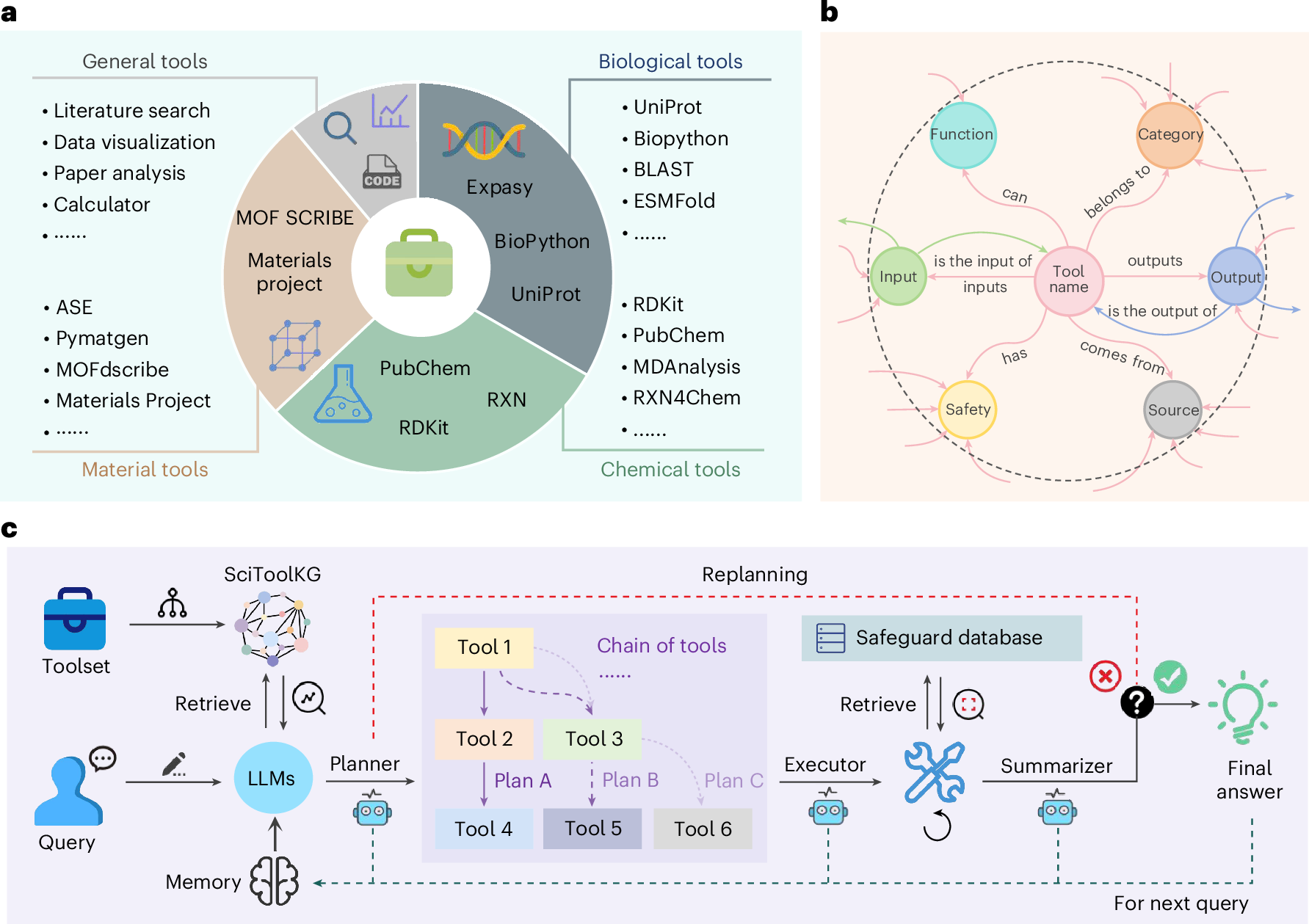
SciToolAgent: a knowledge-graph-driven scientific agent for multitool integration
Scientific research increasingly relies on specialized computational tools, yet effectively utilizing these tools requires substantial domain expertise. While large language models show promise in tool automation, they struggle to seamlessly integrate and orchestrate multiple tools for complex scientific workflows. Here we present SciToolAgent, a large language model-powered agent that automates hundreds of scientific tools across biology, chemistry and materials science. At its core, SciToolAgent leverages a scientific tool knowledge graph that enables intelligent tool selection and execution through graph-based retrieval-augmented generation. The agent also incorporates a comprehensive safety-checking module to ensure responsible and ethical tool usage. Extensive evaluations on a curated benchmark demonstrate that SciToolAgent outperforms existing approaches. Case studies in protein engineering, chemical reactivity prediction, chemical synthesis and metal–organic framework screening further demonstrate SciToolAgent’s capability to automate complex scientific workflows, making advanced research tools accessible to both experts and nonexperts.
Semantic Scholar Academic Graph API | Semantic Scholar
Build projects that accelerate scientific progress with the Semantic Scholar Academic Graph API

You are Crossref - Crossref
Crossref runs open infrastructure to link research objects, entities, and actions—creating a lasting and reusable scholarly record that underpins open science. Together with our >25,000 members in 167 countries, we drive metadata exchange and support 2.1 billion monthly API queries, facilitating global research communication, for the benefit of society.

Cody - Sourcegraph docs
Documentation for Sourcegraph, the code intelligence platform.
Scholarly APIs ⚗️

Commonly used scholarly resources API
Elsevier Developer Portal
Elsevier Developer Portal
Elsevier Developer Portal
About the Indicators API Documentation – World Bank Data Help Desk
API
developer.nytimes.com